Trust EVM held its first GameFi hackathon to promote the continuous prosperity of GameFi

 The hackathon will be held on the DoraHacks website from August 15 to September 23.
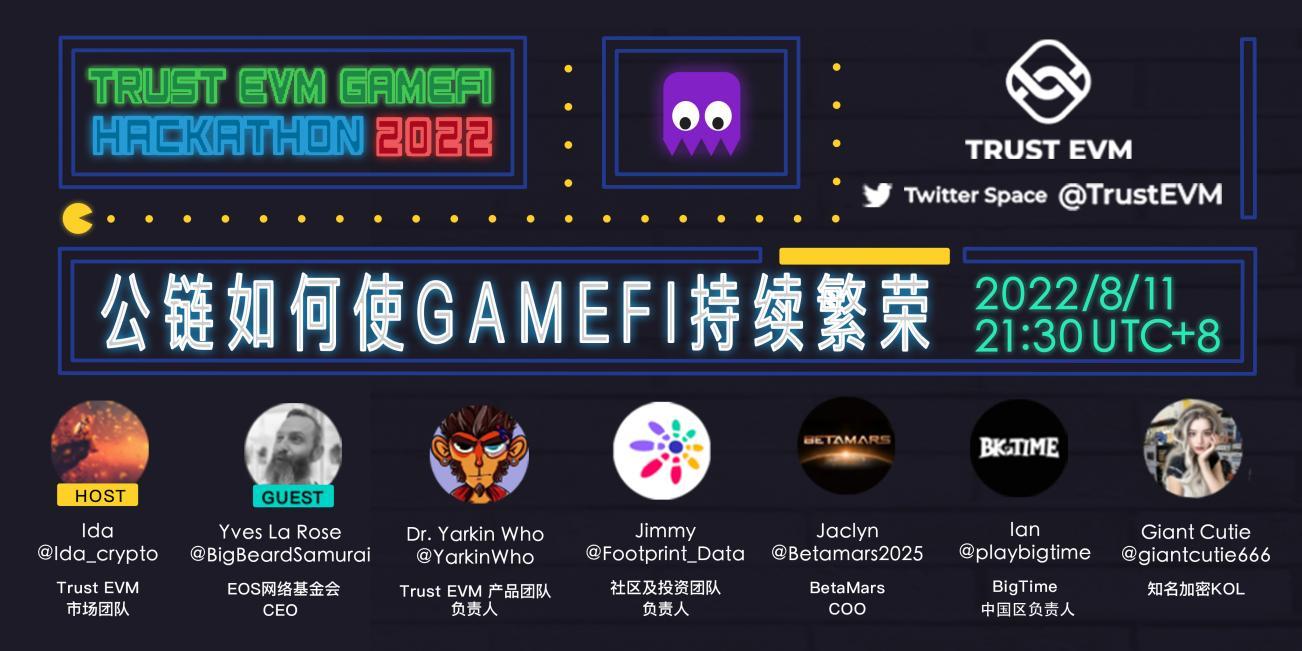
On August 11, 2022, the official Trust EVM held a live event on Twitter Space themed "Trust EVM GameFi Hackathon: How Public Chains Can Sustainably Prosper GameFi." Yves La Rose, founder and CEO of the EOS Network Foundation, delivered a speech explaining why the market needs Trust EVM to thrive in the EOS ecosystem.
In addition, the event featured guests such as Yarkin Who, head of the Trust EVM product team; Jimmy, head of community and investment at Footprint Data; Jaclyn, COO of Beta Mars; Ian, head of BigTime in China; and crypto KOL Crypto Big Beauty. They collectively discussed the significance of public chains for GameFi based on the current development status and the future trends of the GameFi sector.
During the event, it was also announced that Trust EVM will host its first GameFi hackathon on the DoraHacks website, aimed at attracting many excellent developers to deploy projects on Trust EVM. The project submission for this GameFi hackathon will be from August 15 to September 12, followed by an online roadshow and review phase, with winning projects announced on September 23. Currently, the prize pool has reached $150,000, and winning teams can share the prize based on first, second, and third place. Additionally, Trust EVM will provide technical and community support throughout the competition.
Trust EVM stated that on-chain data shows that many GameFi projects remain very active even during the bear market, with on-chain activity levels even surpassing those of DeFi. A good GameFi project will bring unprecedented activity to the public chain. This is also the main reason why Trust EVM is hosting the GameFi hackathon.
The following is the complete content of this event organized by the editor.
Highlights of the event:
- With the arrival of Trust EVM, EOS will serve as an Ethereum enabler, becoming the best choice similar to Ethereum's Layer 2 expansion.
- The Trust EVM testnet has officially launched, with the mainnet expected to be released in September or October of this year.
- Through EOS's high performance, we can make the interaction experience of Web 3.0 approach that of Web 2.0 in terms of latency. Trust EVM is expected to become a key bridge for users to enter Web 3.0.
- Against the backdrop of a series of upgrades to Trust EVM, EOS has achieved a target of over 800 swaps per second.
Yves La Rose, founder and CEO of the EOS Network Foundation, shared:
Why do we need Trust EVM to prosper the EOS ecosystem?
First, I want to emphasize that EOS is the most stable public chain in the history of cryptocurrency. It has been battle-tested and has operated smoothly for four years without any serious security incidents. It is also the only public chain that processes over 100 million transactions daily.
The returning EOS is the fastest, most affordable, most stable, and highest-performing Layer 1. As an Ethereum Virtual Machine based on the EOS network, Trust EVM provides developers with a turnkey solution. Thanks to its high compatibility, Ethereum-native applications can be seamlessly migrated to Trust EVM while providing users with low transaction costs. With the arrival of Trust EVM, EOS will also serve as an Ethereum enabler, becoming the best choice similar to Ethereum's Layer 2 expansion.
Why is Trust EVM needed? I think it can be understood from two aspects:
1. Funding and Ecosystem. It is well known that Layer 1 is very important. Previously, EOS lacked a core organization to coordinate resources across the ecosystem and did not allocate and layout funds, resources, and code reasonably to achieve EVM compatibility. The EOS Network Foundation is a non-profit organization built on decentralized protocols, aimed at using the knowledge and experience we have accumulated over the past four years to fill this gap.
It can be said that the new EOS brought by the EOS Network Foundation presents a new opportunity for EOS's development: to provide landing support for projects in need and attract the vast majority of developers through a series of incentive mechanisms to achieve EVM compatibility.
2. Technology. The achievements of Ethereum are impressive. Over the past five years, Ethereum has become a breeding ground for developers because they have all the tools and platforms, as well as access to funding. Therefore, as a decentralized organization driving the value growth of the entire ecosystem, we are also focusing on how to open the doors to welcome developers, allowing them to easily and efficiently transition to EOS. This is also one of the reasons for the birth of Trust EVM.
Trust EVM will achieve full RPC compatibility, which will create an extremely low entry barrier for EOS. Literally, this means that developers only need to double-click to deploy smart contracts on EOS, making deployment on EOS no different from other public chains. This will make the EOS chain an attractive public chain.
Currently, the Trust EVM testnet has officially launched. According to the roadmap, the mainnet is expected to be released in September or October of this year. Previously, we announced the developer preview version of the testnet, opening the doors to all developers, aiming to allow them to smoothly conduct business on the EOS chain. For many projects, Trust EVM has become the shortest path to realization.
In the future, Trust EVM will focus on improving user experience in the ecosystem to showcase its superiority and is expected to become a key bridge for users to enter Web 3.0. Through EOS's high performance, we can make the interaction experience of Web 3.0 approach that of Web 2.0 in terms of latency. Ordinary Web 2.0 users may accept a one-second delay when using an application, but they will absolutely not accept a ten-second delay. This latency is also one of the key obstacles preventing Web 2.0 users from migrating to Web 3.0.
An EVM that can enjoy the low latency brought by EOS can bring more popular applications to Web 2.0 users. This will not only lead to significant user growth but also create more possibilities.

Current Status and Future Trends of GameFi Development Roundtable Discussion:
Question 1: After experiencing the bull and bear markets of GameFi, what is your view on the current state of GameFi projects in the recovery phase?
Jimmy, head of community and investment at Footprint Data: We just released a joint report on the GameFi industry for the first half of 2022 in collaboration with CoinMarketCap. First, I want to share some data, and I think three areas of data are particularly interesting:
1. Investment and Financing
------ In the first seven months, game projects raised $1.1 billion, a 59% increase, while metaverse projects raised $1.3 billion, a 683% increase.
------ The total number of financing deals in the first seven months was 346, a 47% increase from last year, with 46% being seed rounds. The financing ratio for the Web 3.0 industry increased from 12% last year to 18%.
2. Projects
------ Currently, there are 1,582 GameFi projects, a 31% increase since January, with 68% of the growth coming from the BNB chain.
------ In terms of market share, BNB and Ethereum account for 37% and 34%, respectively, while Polygon accounts for 10%, Wax 7%, and EOS 4%.
------ Thanks to the advantages of BNB's exchange launchpad, both the total and incremental amounts of BNB remain the highest.
3. Users/Gamers
------ Currently, there are millions of players in the industry, with an average of 800,000 daily active users in the first half of the year. Compared to the global gaming market of 3 billion users, the penetration rate is still very low, only in the single-digit percentage.
------ On-chain, Wax and Hive account for 29% and 24% of the market share, respectively, while Solana, BNB, and Polygon each account for 10%, followed by EOS, Ronin, ThunderCore, and Harmony, which are relatively dispersed.
------ From the project perspective, Splinterlands on the Hive chain accounts for 20%, Alien Worlds on Wax accounts for 12%, and the rest are below 10%, indicating a very dispersed market.
From this data, we can see that the leading projects in market share are all older projects, indicating that the GameFi industry has not made substantial progress in the past seven months. However, on the other hand, it can also be seen that the industry is both in a recovery phase and in its early stages, with user penetration still very low, indicating significant market potential in the future.
Crypto KOL Crypto Big Beauty: I believe GameFi is still in its early development stage. Many projects like Illuvium and Axie Infinity performed quite well in the last bull market. Once the next bull market arrives, we may see more surprises. The demand for crypto gaming products and crypto games always exists; GameFi is not a speculative thing but something that must happen. For example, when World of Warcraft was popular, many people exchanged their dollars for digital gold to purchase digital assets in the game.
But all these assets became Blizzard's data and could not be monetized. Now, all these problems can be solved through crypto games. This is why many people are very interested in how to build an online life in the future and earn money by playing games. Therefore, the GameFi market will definitely explode, and we will certainly see more projects emerge in the next bull market, making GameFi a trillion-dollar market.
Question 2: As a GameFi project party, what do you think are the main challenges you face in promoting GameFi projects?
Ian, head of BigTime in China: The problem with GameFi 1.0 is that the games are not fun, making the economy unsustainable and unable to attract non-crypto players. To address these challenges, BigTime's goal is to become the next generation of games, first providing good games and then providing economic rewards. We never say we are P2E; rather, we allow players to play freely and earn money. BigTime's developers come from top game studios like EA, Blizzard, Epic Games, etc. Currently, there are about 30,000 early access players who are all amazed by the quality of the game. The challenge we face now is actually making people understand what the next generation of games looks like and how excellent BigTime is. Because when new ideas emerge, people often reject them. The public still needs time to learn and accept.
Jaclyn, COO of Beta Mars: User growth and early customer acquisition.
Question 3: Recently, the assets of Solana user wallets were stolen, causing losses for many GameFi projects on Solana. Do such security issues affect the choice of public chains for GameFi?
Ian, head of BigTime in China: We will consider security factors. However, BigTime is not purely a decentralized project. We will launch a feature called Vault, allowing users to choose which chain to move their assets to. BigTime's vision is to invite more Web 2.0 players to participate. Our target market is not the GameFi market of 1 million players but the traditional gaming market of 2 billion players.
Jaclyn, COO of Beta Mars: As a project party, we can only do our best to write contracts to improve them continuously; beyond that, we can only trust the public chain.
Question 4: The development of GameFi projects and the development of public chains promote each other. From a technical perspective, the performance of the chain itself and multi-chain compatibility are very critical points that determine the gaming experience. What performance requirements does GameFi have for public chains?
Ian, head of BigTime in China: First, it must be cheap; gas fees cannot be too high. Secondly, it must be fast because all equipment should be usable immediately after purchase in the game.
Jaclyn, COO of Beta Mars: Chains with low gas fees, no congestion, and strong interoperability can provide our users with a better gaming experience and improve our projects.
Yarkin, head of the Trust EVM product team: Trust EVM has the following advantages in the GameFi field:
1. Low Gas Fees. EOS has extremely low transaction costs. Compared to other low-cost EVM chains, their transaction costs mostly range from 25 to 50 cents, while EOS only costs a few cents.
2. Latency and Throughput. Trust EVM can support you to do things that are impossible on other EVM chains, such as oracles that can update every 0.5 seconds or achieving high-frequency arbitrage trading for the first time on EVM. This is thanks to the inherent high throughput and performance of EOS/EVM One.
It is worth mentioning that the complete EVM support with precompiled features and full Web3 API will also make it easier for key service providers (such as various oracles and on-demand digital generators) to deploy on Trust EVM. We have also done a lot of work to improve performance, including but not limited to cryptographic instructions for contract efficiency, Silkworm plugins to enhance efficiency, and fine-tuning or even improving the underlying EOSIO to maximize its potential. Against this backdrop, we have achieved a target of over 800 swaps per second.
Question 5: The gameplay of GameFi has previously mainly focused on X to Earn. What innovations do you think GameFi projects will have in gameplay mechanisms during the current crypto bear market? Will this lead to new demands for public chains and other infrastructure?
Ian, head of BigTime in China: As I mentioned earlier, BigTime will never be X to Earn. Without blockchain, BigTime is very similar to major titles like Diablo, Genshin Impact, and Final Fantasy, which are very interesting in terms of gaming experience. The real innovation in the GameFi economy is how to earn money through games after playing them.
Jaclyn, COO of Beta Mars: Blockchain games, rather than GameFi, X to Earn is an unsustainable model that will inevitably come to an end. Real blockchain games require shared goals and values, encompassing more emotions or a sense of belonging, similar to a metaverse built by users together.
Question 6: Will GameFi be the explosion point of the next bull market? What preparations should be made first?
Jimmy, head of community and investment at Footprint Data: I think so. Web 3.0 is still in its early stages, with infrastructure gradually improving and the number of users still low. GameFi is the sub-industry that can best attract Web 3.0 users because there are 300 million gamers worldwide, which is a huge base.
I believe that when the barriers to entry for GameFi are lowered and playability and social interaction are enhanced, it can bring a large number of users to Web 3.0 and become the explosion point of the next bull market. STEPN is a great example of what a GameFi project can achieve.
As for preparations, it depends on different roles, including players, investors, and projects. If you are playing for fun, you have nothing to prepare. If you are playing to make money, you need to study the GameFi economic model well. This includes investment scale, return on investment, payback period, and risks. For investors, it is essential to focus on three aspects of GameFi projects: entry barriers, social interaction, and playability. For the projects themselves, in addition to having low development barriers, being fun, and having a healthy and sustainable economic model, they also need to consider the choice of chain. Each chain has its advantages, including ecosystem support, development costs and difficulties, and flexibility.
Crypto KOL Crypto Big Beauty: I believe GameFi is one of the best tools to increase total market value and guide new users into the crypto world. Compared to other crypto products, GameFi has a very low barrier to entry for users; now everyone has a mobile phone, and GameFi is as simple as playing mobile games. Therefore, in the next bull market, I believe GameFi will respond the fastest.
So now is a good time to learn and research different GameFi projects. In the last bull market, some people were able to enter Illuvium early because they took the time to discover and study it. They invested in Illuvium because the 3D game, Pokemon Dynamics, and trading NFT Pokemon games have huge development prospects. Therefore, we cannot predict which projects will explode and which will unfortunately perish, so do not invest blindly; ensure you have a deeper understanding of the team, the project's economic model, and future development.
About the Trust EVM GameFi Hackathon 2022
This hackathon will be held on the DoraHacks website from August 15 to September 23, with the registration channel opening at 8 PM Beijing time on August 15. At that time, Trust EVM will also open a hackathon channel on Discord to create a platform for developers to communicate.
The Trust EVM GameFi Hackathon aims to attract excellent GameFi developer teams to deploy projects on Trust EVM, with winning teams sharing a prize pool of $150,000. For developer teams, this is a great opportunity to promote their projects and will receive full support from the organizer, Trust EVM, including technical sharing and community outreach.
Schedule (Beijing Time):
- Registration Phase: Starts at 8:00 PM on August 15
- Project Submission: August 15 to September 12, 12:00 PM
- Online Roadshow: September 14
- Review Phase: September 15 to 22
- Award Announcement: September 23
Prize Settings:
- First Prize: $5,000
- Second Prize: $3,000
- Third Prize: $1,000
Evaluation Criteria:
- Only GameFi projects will be evaluated.
- Projects must be deployed on the Trust EVM testnet and deploy on the mainnet in early October.
- Preference will be given to projects with innovative ideas in certain areas or aspects of GameFi.
- Preference will be given to GameFi projects with good prospects and a large potential user base.
- Preference will be given to projects with high completeness, strong design, and clear logic.
Event Entry: https://dorahacks.io/hackathon/36/detail
About Trust EVM
As the EVM layer of EOS, Trust EVM will directly connect the "Ren and Du Meridians" of EOS, integrating high-performance, high-availability, and high-efficiency EOS with the vast development and user base of EVM ecosystem resources, including Ethereum and all EVM-compatible chains (such as Polygon, BSC, etc.). Through Trust EVM, all EVM-based digital assets and decentralized innovative applications will connect and prosper the EOS ecosystem.
Developers are welcome to join the Trust EVM Discord channel for discussions.
Website: https://trust.one/
About the EOS Network Foundation
The EOS Network Foundation is a non-profit organization aimed at listening to community voices, conveying community will, and supporting the development of quality community projects. It serves as an information-sharing bridge for the EOS community and provides key infrastructure support for the EOS ecosystem, including funding, technology, operations, future planning, and ecosystem building, further unleashing EOS's full potential as the world's fastest governance blockchain.
Website: https://eosnetwork.com/
 Risk warning Risk warning