Explore the Flow ecosystem: Targeting the next generation and attracting mainstream users through IP

 Chain Catcher also interviewed Amber, the head of the Flow Chinese region, and Bohao, the head of Chinese technology, to provide a detailed interpretation of the development path of the Flow ecosystem.
Author: Nianqing, Chain Catcher
Recently, Flow has been continuously benefiting from good news. At the beginning of August, after Meta announced that its photo-sharing platform Instagram would support the creation of NFTs on the Flow blockchain, the price of Flow tokens surged, with an intraday increase of over 40%.
Last week, Nick Grudin, Vice President of Content and Community Partnerships at Meta with 12 years of experience, announced that he would join Dapper Labs, the operator of Flow, as Chief Business Officer in September. During his tenure at Meta, Grudin led global collaborations and content for Facebook and Instagram in video, creators, entertainment, sports, media, and community.
Flow is a blockchain network created by Dapper Labs aimed at the mainstream market. Dapper Labs previously developed the popular application CryptoKitties but decided to create a public chain that could truly support a billion users due to issues like network congestion on Ethereum.
Compared to other public chains, Flow has a distinctly different character, focusing on products like NFTs and the metaverse. It has successfully attracted a large number of mainstream users through collaborations with well-known IPs such as the NFL, UFC, Warner Music, NBA, Ubisoft, and Attack on Titan. The digital blind box of Bing Dwen Dwen launched during the Beijing Winter Olympics was sold on the Flow chain trading market nWayPlay.
Additionally, Flow's development language, Cadence, collaborated with the Libra team early on and shares many similarities with the Move language, such as a "resource-oriented" architecture. This is considered a small advantage as the narrative around Move language public chains strengthens.
While many public chains aspire to attract "a billion users," Flow has indeed drawn a significant number of mainstream users by collaborating with strong IPs and well-known brands in the traditional market, thus providing a user experience closer to traditional market trading. In terms of its ecosystem, it targets a younger "next-generation" demographic, creating applications related to culture, entertainment, sports, and fashion around this group.
What is the current state of the Flow ecosystem? What are some notable applications? Chain Catcher has provided a detailed overview in this article. Additionally, we interviewed Amber, the head of the Flow Chinese region, and Bohao, the technical lead, for further insights into the Flow ecosystem.
1. Flow Ecosystem: Everything Related to Youth, Fashion, and Brands
Due to its "mainstream-oriented" positioning, Flow's ecosystem primarily focuses on the entertainment and sports sectors. Currently, there are 375 projects built on the Flow chain, covering various fields such as NFT collectibles, art, gaming, DeFi, the metaverse, sports, fashion, virtual avatars, music, wallets, and DAOs. NBA Top Shot, NFL ALL DAY, and UFC Strike rank as the top three in total trading volume, with NBA Top Shot's sales exceeding $1 billion, and a total trading volume of $1.17 billion as of the time of writing. Other projects are relatively less prominent, with NFL ALL DAY's total trading volume at $72.3 million and UFC Strike at $20.4 million.
1. Wallets
Since Flow is not yet compatible with EVM, it does not support mainstream crypto wallets like IMtoken and Metamask. Currently, the three wallets most used in the ecosystem are the custodial wallet Dapper, the semi-custodial wallet Blocto, and the non-custodial wallet Lilico.
Dapper is a crypto wallet developed by Dapper Labs, primarily aimed at traditional users, providing a frictionless trading experience. Users can register with a Google account and make purchases directly with a credit card. The applications supported are mainly aimed at the mainstream market, such as NBA Top Shot, Genies, The Player's Lounge, NFL All Day, and UFC Strike.
Blocto is a cross-chain wallet that connects to most Flow ecosystem applications, supporting Flow NFTs and tokens while also being compatible with Ethereum, Binance Smart Chain, Avalanche, Solana, Polygon, and Tron.
Lilico was launched in April this year and has similar functions to the Metamask decentralized wallet, featuring public keys, private keys, and mnemonic phrases, but allows users to set their own domain names for easier use. Currently, it supports fewer applications and does not support cross-chain functionality.
2. NFT Trading Markets
There are many NFT trading markets in the Flow ecosystem, with a wide variety of categories. Flow currently supports NFT markets like Rarible and plans to support Opensea this year. The largest NFT market on this platform is Gaia, along with relatively more "crypto-friendly" markets like BloctoBay and Matrix Market.
- Gaia Marketplace
Gaia Marketplace is the largest NFT market in the Flow ecosystem, with a total trading volume of $1.56 million. Users can seamlessly purchase NFTs using credit cards or cryptocurrencies through Dapper Wallet, making it the next stop for many new users attracted by NBA Top Shot.
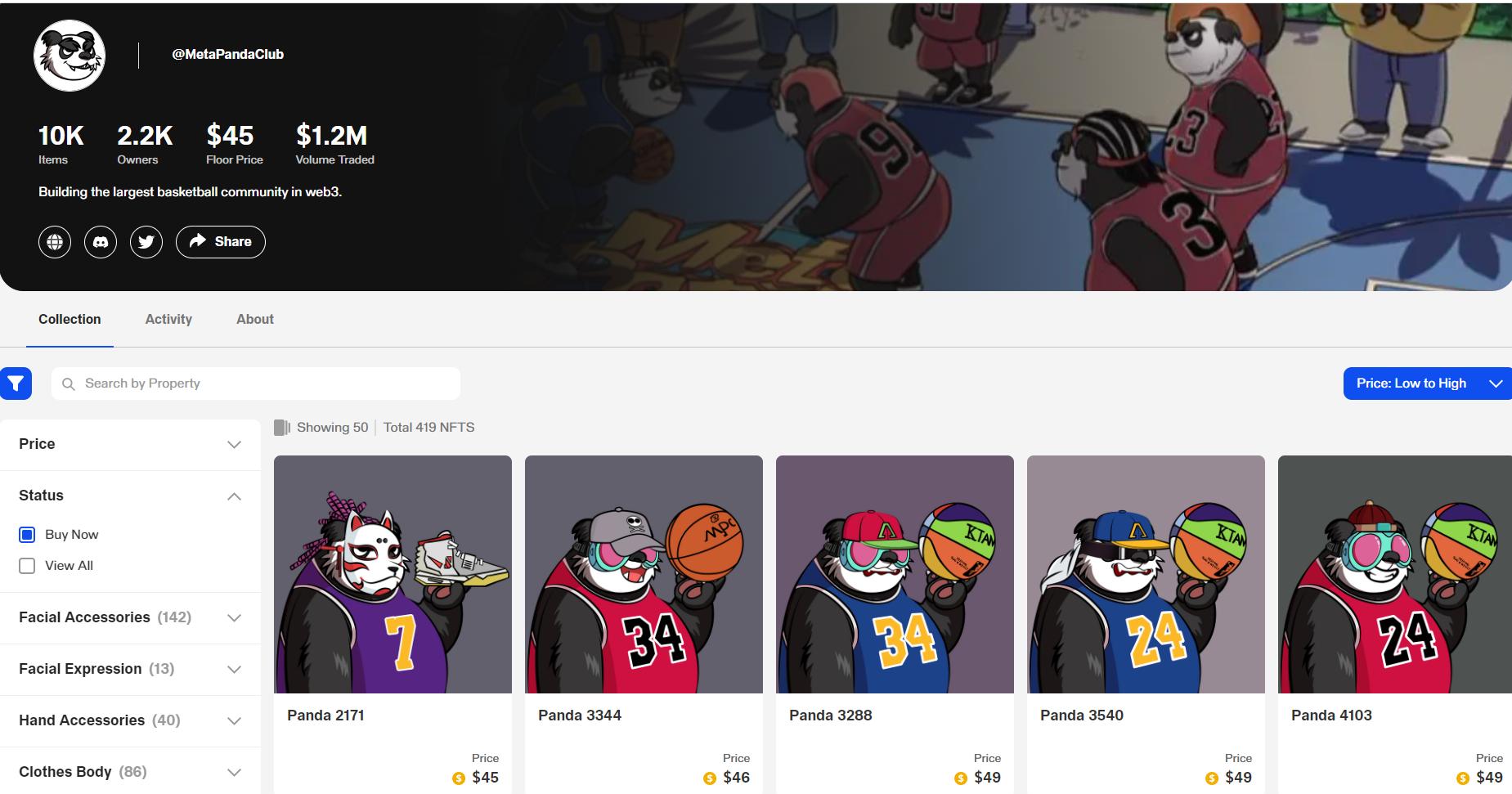
Currently, the NFT project with the highest trading volume on the Gaia market is Meta Panda Club, with a total trading volume of $1.2 million, accounting for a significant portion of the market's trading volume.
- BloctoBay
BloctoBay is an NFT market created by the development team of the Blocto wallet, portto. BloctoBay has the widest range of Flow NFT collections, including Matrix World, Chainmonsters, Jambb, and NBA Top Shot. Unlike most Flow markets, BloctoBay is purely for buying and selling already launched NFTs, and currently does not support users minting or creating NFTs.
- Matrix Market
Matrix is more open compared to the previous two NFT markets. It currently supports Blocto Wallet and Lilico wallet, and will soon support Dapper Wallet. This is the first integrated market on the Flow ecosystem aimed at creators, collectors, and traders, where anyone can create collectible NFTs with ranking.
3. Sports
Due to the tremendous success of NBA Top Shot, sports applications are also a significant feature of the Flow ecosystem, with over 40 sports-related applications currently available. The trading volumes of sports NFTs like NBA Top Shot, NFL ALL DAY, UFC Strike, and BALLERZ contribute the most liquidity to the Flow ecosystem.
Notably, the digital cricket NFT platform FanCraze, which completed a $100 million Series A financing in March this year, allows fans to buy, trade, and create NFTs on these platforms. Additionally, FanCraze has obtained official authorization, similar to previous collaborations with the NBA, NFL, and UFC, and is also the official NFT ecosystem of the International Cricket Council (ICC).
During the Beijing Winter Olympics, the International Olympic Committee officially authorized the sale of Bing Dwen Dwen digital blind boxes on the Flow chain trading market nWayPlay. Meanwhile, the IOC also collaborated with nWayPlay to develop a winter Olympic-themed game called "Olympic Games Jam: Beijing 2022."
4. DeFi
Recently, with the increasing exposure of Flow, DeFi projects on Flow have also seen rapid growth, but overall, DeFi projects started relatively late and are fewer in number. Currently, DefiLama only lists Increment Finance in the Flow ecosystem, which has seen rapid growth in TVL, reaching $4.358 million in August.
The DeFi infrastructure IncrementFi just completed a $1 million seed round of financing in July this year, primarily providing liquidity and yield solutions, with two main products: the permissionless decentralized exchange Increment Swap and the decentralized lending protocol Increment Earn.
Additionally, launched DeFi projects include the decentralized exchange BloctoSwap, the NFT P2P lending platform Flowty, the cross-chain communication platform Celer Network, and the decentralized lending platform Mantle Finance.
5. Metaverse
- Matrix World
Matrix World is the first land project in the Flow metaverse, a Turing-complete 3D virtual space that completed a $5.5 million angel round of financing in February this year. Matrix World is the first multi-chain metaverse, currently supporting both Ethereum and Flow. The project is in the pre-alpha stage and plans to officially open in early 2024, but all available plots have already been sold out. The Flow team also plans to establish the Flow headquarters in Matrix World, with projects like CryptoKitties and NBA Top Shots gradually collaborating with Matrix World.
- Genies
The digital avatar platform Genies is a star project on the Flow chain, having completed a $150 million Series C financing led by Silver Lake in April this year, with a valuation of $1 billion.
Genies has established partnerships with numerous celebrities, influencers, and brands, such as Warner, Universal, Gucci, Cardi B, Rihanna, and Justin Bieber. Genies allows users to customize and create virtual avatars that can be used in metaverse environments, with accessories available for purchase as NFTs.
- Cryptoys
Cryptoys is a digital toy NFT platform that will develop into a play-to-earn game in the future. It has not officially launched yet but is expected to be released in the coming months. In June this year, Cryptoys manufacturer OnChain Studios completed a $23 million Series A financing led by a16z, which had also previously led the platform's $7.5 million seed round financing.
6. Digital Fashion
Digital fashion is considered the next explosive point in the metaverse track. Flow has also begun to lay out in the digital fashion space, with the well-known project The Fabricant being built on Flow.
The Fabricant was established in 2018 and is building a decentralized wardrobe. It completed a $14 million Series A financing led by Greenfield One in April this year and has collaborated with brands like Adidas, Marques Almeida, and Buffalo London to create NFT fashion. Additionally, the platform has established a partnership with Epic Games and announced new collaborations with the NFT community World of Women and The Sandbox.
II. Q&A Session
1. Chain Catcher: Most people's impression of Flow is that it is an "NFT public chain," and many see CryptoKitties and NBA Top Shot as their first steps into Web3. Will this be the long-term positioning for the development of the Flow ecosystem?
Flow: In fact, Flow has never positioned itself as an NFT public chain. To be precise, we are a mainstream-oriented Web3 underlying platform. But why do people think of it as an NFT public chain? Actually, before we made CryptoKitties, our goal was to use NFTs as an entry point to bring mainstream users into the blockchain world. If tokens are primarily used in financial scenarios, NFTs represent things that people care about and believe in, allowing for connections with a broader society and a closer emotional link to individuals. This was proven with CryptoKitties.
Finance is also one of the extended scenarios of the Flow ecosystem, not the only one, which is different from most public chains that emphasize financial attributes. We hope to attract as many users to the blockchain as possible first, and then naturally let them experience the benefits of on-chain finance. Currently, there are also DeFi projects on the Flow chain, such as Increment Finance. In fact, the range covered by the Flow ecosystem is very broad, including applications in gaming, sports, art, metaverse social, and DAOs.
2. Chain Catcher: Can you summarize the characteristics of the Flow ecosystem in three words?
Flow: The first is next-generation. Whether from a technical or user attribute perspective, Flow targets the next generation of users. First, from a technical architecture standpoint, there are two points I believe are quite advanced: one is the use of a resource-oriented programming paradigm, meaning user assets are resource-based rather than recorded in a central ledger like Ethereum, ensuring user autonomy over data at the foundational level. The second is from the perspective of composability; the compatibility of the underlying SDK projects is quite strong. Additionally, Flow can natively support very complex NFT technology architectures. For example, there is an avatar application in the Flow ecosystem called Flovatar that allows users to combine different NFT components to create a complete avatar NFT, with components that can be combined or split, much like assembling Lego.
The second keyword is long-termism. For example, we have a somewhat different strategy, focusing on young users. This demographic may not have the highest consumption levels, but as they grow, they can bring strong compound network effects. For instance, the virtual avatar platform Genies has already scaled to a unicorn project valued at nearly $1 billion.
Genies allows users to customize and create their virtual avatars, which can be used in social applications like iMessage and WhatsApp. Genies has already partnered with Warner Music and Universal Music to develop virtual avatars and digital wearable NFTs for their artists. Most users on the Genies platform are girls aged 14-16, so NFT pricing is set within a range that is acceptable for their pocket money, indicating that Flow places more emphasis on the next-generation demographic entering Web3. By opening up a relatively blank market, it also helps Flow differentiate itself from other public chains.
The user base brought in by large brands like the NBA, NFL, and UFC is indeed substantial. For example, NBA Top Shot has about 2 million users, 80% of whom have never used blockchain in the mainstream market, but these users are also flowing into other applications within the ecosystem.
The third keyword is inclusivity. We hope that both crypto natives and mainstream users can meet their needs within the Flow ecosystem. For example, in terms of account systems, NBA Top Shot provides a frictionless experience for mainstream users through a custodial approach. Flow also has a highly autonomous system for managing assets, with the Flow ecosystem featuring the Dapper custodial wallet, Blocto as a switchable semi-custodial wallet, and the non-custodial wallet Lilico launched in April this year.
3. Chain Catcher: Unlike other public chains, Flow's market is more oriented towards mainstream consumers. What trade-offs has this differentiation led to for Flow, such as the often-discussed issue of "centralization"?
Flow: Regarding the issue of centralization, the founder of Not Boring has written an article that explains it quite clearly. Flow introduces a fourth dimension, which is the time dimension, in solving the "impossible triangle" problem. Initially, the complexity of Flow was very high, and the team was focused on how to develop a blockchain from scratch that could handle complex dApps to support a billion-level user base. Therefore, Flow adopts a "gradual decentralization" approach. Although it is challenging to balance decentralization in the short term, it can create a more widely applicable product with a clearer technical architecture and a healthier ecosystem.
*Related Reading: * "Not Boring Founder Explains Flow in Detail: Gradual Decentralization of a Mainstream Blockchain"
Additionally, in July, Flow reached a significant milestone by launching permissionless smart contracts, allowing any developer to deploy contracts on the mainnet without mandatory review. Since then, criticisms of centralization have gradually decreased.
4. Chain Catcher: In what aspects does Flow's "developer-friendly" nature manifest?
Flow: Although we are a non-EVM compatible chain, our developer tools are quite comprehensive, including demo environments, command-line tools, and SDKs. Besides the toolchain, we also have a local simulator, allowing developers to test programs directly on the simulator without needing to deploy a chain locally. Of course, many chains are configured this way.
I think Flow's uniqueness lies in its smart contract language being "strongly typed." "Strongly typed" means that there are many code hints and language-level checks during development. Additionally, the "resource-oriented" model is something other smart contracts currently do not possess, and the control over resources during code execution is relatively strong. If developers make omissions or deviations, there will be relevant reminders. Developers can easily identify code issues from the language level, similar to Rust, where debugging does not take long, but compiling successfully may take a while. This ensures that the syntax is correct.
5. Chain Catcher: Why did you initially consider a completely new smart contract language, Cadence, instead of the Solidity language used by most public chains?
Flow: At that time, Flow's CTO researched many public chain languages, including Solidity, Rust, and WASM, but felt that none of them met Flow's needs and positioning. Coincidentally, he saw that Facebook's Libra project proposed a "resource-oriented" paradigm for the first time, which was quite enlightening, leading us to consider adopting the concept of resources. Dapper Labs also attempted to collaborate with Libra on the technical development of a "resource-oriented" smart contract system. Unfortunately, Libra quickly fell through.
However, the team believed that the concepts and syntax checks of the Move language would greatly enhance future NFT assets and interactivity, providing more possibilities for development. Cadence is essentially an inheritance and development of the Move language. The core idea of "resource-oriented" is to truly store users' NFTs or FT and other personal assets as data resources in their own profiles. Therefore, asset interaction means transferring an asset from User A's data profile to User B's profile. The data storage form of Ethereum and EVM-compatible chains does not follow this model; it merely transfers a record in the smart contract or performs a numerical operation.
In such a model, we can ask: Do you really own your data? In fact, your data belongs to the owner of the smart contract. In the EVM model, users only have control over this data, not ownership. Therefore, from the very beginning of Flow's design, we aimed to truly be "resource-oriented," allowing users to genuinely own and interact with their assets.
6. Chain Catcher: Currently, most public chains are striving for EVM compatibility to accommodate the overflow value from Ethereum, but Flow has not yet achieved EVM compatibility, making it relatively more distinctive compared to other chains. How do you view this situation?
Flow: In terms of the public chain landscape, after Ethereum, the problems that public chains can abstract into three categories are: one is scalability, how to handle more business volume; the second is security, how to make the network more secure; and the third is usability, how to be more user-friendly.
Flow has innovations and breakthroughs in all three areas, but I believe we place more emphasis on usability. From the beginning, Flow aimed to be a platform that could support more complex functions and accommodate a billion-level user base. Since we are focused on "mainstream," we must design from the foundational architecture to ensure we can accomplish such a grand mission. Although many chains claim to be "mainstream-oriented," very few actually do it.
Flow's Dapper Wallet supports direct payments with fiat currency and credit cards, just like shopping on e-commerce platforms. Moreover, users do not have to worry about gas fees during interactions, as Flow covers and pays for gas fees through third parties.
On the other hand, usability is also reflected in economic terms. For example, the floor price of NFT projects directly determines the audience and scope. The transaction fees and NFT pricing on Flow are relatively more economically universal compared to Ethereum. On Flow, the median transaction amount is around $8, with an average active user making about five transactions daily. For instance, NBA Top Shot sees around 20 million daily transactions. This transaction frequency ranks first among all categories of projects, which is not possible in ecosystems with high economic thresholds.
Therefore, being mainstream is not a simple task, which is why Flow's "gradual" decentralization will take longer. In the blockchain world, long-termism is quite rare.
Conclusion:
Due to Flow's "mainstream-oriented" positioning, its ecosystem currently leans more towards traditional brands and markets, with NBA Top Shot accounting for a significant portion of the total trading volume in the Flow ecosystem. However, the development of projects like Gaia, Genies, FanCraze, and NFL All Day is gradually reducing this proportion.
Flow is also one of the few public chains that do not support EVM compatibility, with limited cross-chain applications and significant room for growth in DeFi. Some applications may be less friendly to crypto-native users.
Furthermore, Flow has previously faced criticism for its positioning being insufficiently "decentralized," but it is gradually moving towards decentralization. For example, starting in July, Flow officially supports any developer to deploy smart contracts without review, and is gradually transferring more network consensus nodes to the community.
Overall, from the very beginning of its architecture, Flow has established a distinct character. As Amber mentioned in the interview, being mainstream is not a simple task, which is why Flow's "gradual" decentralization will take longer.
 Risk warning
 Risk warning