Bitcoin mining companies' Nth exodus
 Core Viewpoint

 When mining no longer generates sufficient economic returns, the rational business decision is to shift resources; however, if this trend continues to spread, the question of who will bear the long-term costs of maintaining the security of the Bitcoin network will become an issue that must be faced.
Author: Zhou, ChainCatcher
Since the end of last year, publicly listed mining companies have initiated a wave of collective sell-offs.
Cango sold approximately 60% of its holdings, totaling 4,451 bitcoins, in February; Bitdeer liquidated its entire bitcoin inventory in January; Riot Platforms sold 3,778 BTC in the first quarter; and Core Scientific previously planned to sell about 2,500 bitcoins in the first quarter.
Recently, leading mining company MARA announced that from March 4 to March 25, the company sold 15,133 bitcoins, cashing out over $1 billion. At the same time, the company announced a layoff of about 15% of its staff as part of a strategic shift towards energy and digital infrastructure.
In fact, miners selling bitcoins is not a new phenomenon. During the bear markets of 2018 and 2022, mining companies also experienced large-scale liquidations and capitulations, leaving behind more efficient players. However, this time, the trigger for the sell-off is not just the decline in bitcoin prices; they also have a new destination—AI data centers.
I. Threefold Motivation Behind the Sell-off
On the surface, it appears to be a collective sell-off by mining companies, but when broken down, their motivations are not uniform and can be roughly categorized into three different selling logics.
Mining Itself Has Fallen into Loss
The first and most direct reason is cost pressure.
CoinShares' latest mining report shows that the weighted average cash cost for publicly listed mining companies to mine one BTC is approximately $79,995, while the market price of BTC hovers between $68,000 and $70,000, resulting in an average loss of nearly $19,000 per coin, with an overall loss rate of about 21%.
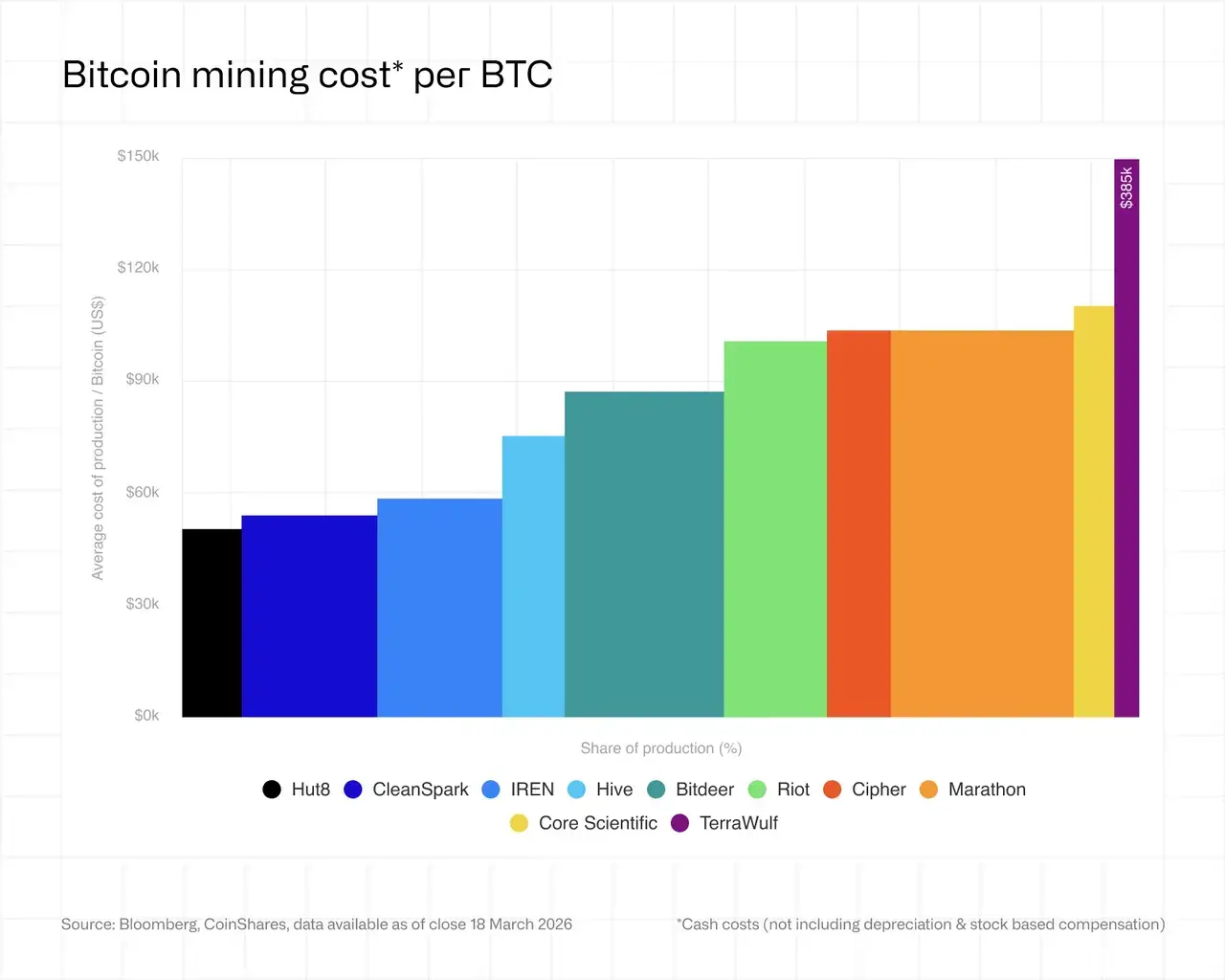
This is no longer just a matter of narrowing profit margins; it is a question of whether cash flow can sustain continued mining.
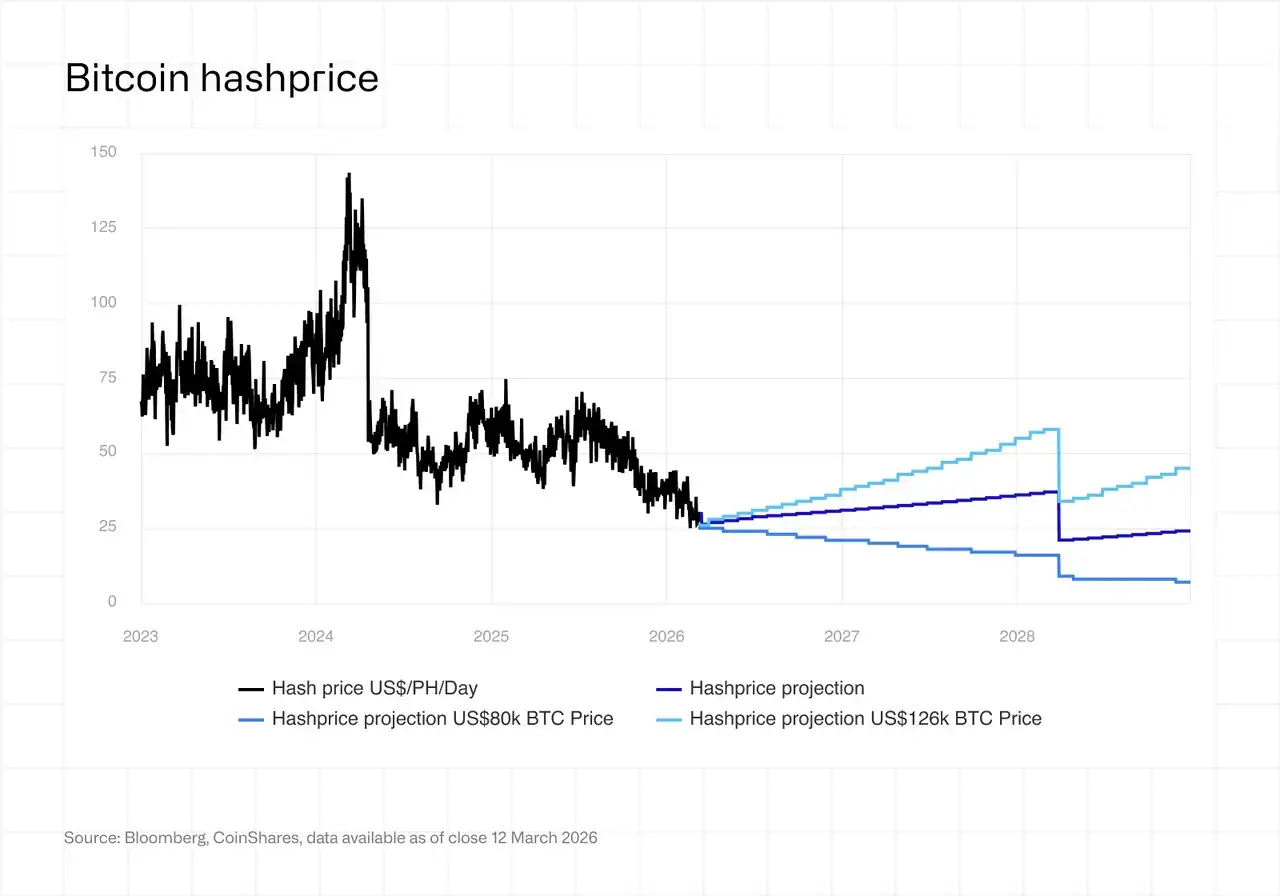
The report also indicates that the price of computing power fell to between $28 and $30 per PH per day in early March, setting a historical low since the halving. At this level, most active mining machines would need electricity prices to be below $0.05 per kilowatt-hour to maintain cash profitability. Currently, about 15% to 20% of mining machines across the network are at the breakeven point.
At the same time, the tense geopolitical situation in the Middle East is driving up energy prices, putting continuous pressure on electricity costs, which is an external variable that mining companies cannot control.
QCP Group pointed out in its report that when bitcoin prices are significantly below the average mining cost, mining companies face obvious pressure, and liquidity priorities have surpassed coin-holding strategies.
In this context, for some mining companies, selling bitcoins is a practical necessity to maintain operations.
AI Provides a More Stable Income Logic
The second motivation is more strategic and is the most worthy of exploration in this round of sell-offs.
Bloomberg analysis indicates that unlike previous sell-offs aimed at covering costs, the funds from this round of sell-offs are being reallocated to the AI sector.
The business logic behind this is clear: mining income is highly dependent on bitcoin prices, mining difficulty, and electricity prices, which are extremely volatile. In contrast, AI infrastructure is closer to long-term leases, with CoinShares reporting profit margins of 80% to 90% and income that is predictably long-term.
More critically, mining companies already hold ready resources—cheap electricity contracts, established data centers, efficient cooling systems, and mature operational teams.
Some analysts point out that the construction cost of bitcoin mining infrastructure is about $700,000 to $1 million per megawatt, while AI infrastructure can reach $8 million to $15 million per megawatt. This significant cost gap is being monetized on a large scale by mining companies.
It is worth noting that behind this transformation stands an unexpected group of promoters—technology giants and traditional financial institutions.
Previously, Google provided credit backing for the AI cloud platform Fluidstack's lease obligations, with disclosed credit support exceeding $5 billion, guaranteeing AI transformations for mining companies like TeraWulf, Cipher Mining, and Hut 8 in exchange for corresponding equity; Microsoft signed a five-year, $9.7 billion AI cloud service contract with mining company IREN; and Morgan Stanley provided Core Scientific with a $500 million loan, with a potential total limit of $1 billion.
Their entry has provided a much more solid capital backing for mining companies' transformations than expected.
At the same time, Core Scientific, TeraWulf, Hut 8, Cipher, and other mining companies have signed large AI/HPC contracts, with a cumulative amount exceeding $70 billion. The CoinShares report mentions that mining companies with AI/HPC contracts have valuation multiples about twice that of pure mining companies, and the market is rewarding those who complete the transformation first with valuation premiums.
Even the most financially stable and least leveraged mining companies like HIVE have actively scaled back their mining operations to expand into AI data centers. This indicates that the pressure to transform is no longer exclusive to high-debt mining companies but is a directional choice faced by the entire industry.
Actively Using BTC as a Financial Tool
The third logic is relatively shrewd and proactive.
Some mining companies choose to sell BTC not out of operational pressure but as a tool to optimize their balance sheets, such as MARA. The specific operation is to use the proceeds to repurchase previously issued convertible bonds at a discount to face value, which reduces both the scale of liabilities and the potential risk of equity dilution.
For these mining companies, the role of BTC on the balance sheet has quietly shifted from a long-term holding symbolizing faith to a strategically flexible asset.
Additionally, this round of sell-offs has seen a rare type of seller: sovereign nations.
On-chain data shows that the BTC holdings of the Bhutanese royal government have decreased by about 66% from their peak at the end of 2024, with single transaction sizes in March rising to between $35 million and $45 million, and the pace of selling continuing to accelerate.
Unlike most countries that accumulate BTC through market purchases, Bhutan's holdings come from its own hydropower mining operations, and this large-scale reduction may be related to funding needs for its national development projects. This is also one of the largest recorded government bitcoin sell-offs.
The three logics—mining losses, AI transformation, and debt optimization—combined with selling pressure at the sovereign level, mean that the market is facing structural supply pressures from multiple directions and of varying natures. The faith of mining companies in bitcoin is being reshaped by more realistic business logic.
II. After Exiting, Each Goes Their Own Way
Of course, selling does not equate to liquidating all holdings; the remaining positions and subsequent strategies of various mining companies are showing stark differentiation.
Three Paths, Three Choices
The first path is to stick to mining.
Represented by CleanSpark and HIVE. They do not pursue the AI transformation narrative, do not accumulate debt, and rely on a combination of low electricity prices, new generation mining machines, and low leverage to seek victory in the industry clearing process. Their logic is that as high-cost capacity gradually exits, the unit profitability of the remaining mining companies will subsequently increase.
CleanSpark has publicly stated that continuing to invest heavily in bitcoin mining "is no longer economically reasonable" at the current computing power price level, but the company still chooses to stick to its main business, betting that the cycle will eventually reverse.
Notable crypto KOL Lan Hu pointed out that historically, almost every time after a halving, miners capitulate, and those that remain are often more efficient players, gaining a larger share in the next rebound.
For these mining companies, sticking to mining is not stubbornness but a trust in cyclical patterns.
The second path is to walk on two legs.
Represented by MARA, IREN, and Riot. They retain a significant amount of BTC holdings while simultaneously laying out AI/HPC, using the relatively stable income from AI business to hedge against the cyclical volatility of mining income.
These companies are essentially solving an asset allocation problem, with answers varying by company, but the core logic is that the two business lines support each other, diversifying single risks.
The third path is a complete shift to AI.
Represented by Core Scientific, TeraWulf, and Cipher. BTC holdings have exited the core asset position, and mining has gradually become a subsidiary part of the data center business.
CoinShares expects that by the end of 2026, the proportion of AI revenue for some mining companies may reach as high as 70%, while the proportion of mining revenue may decline from about 85% in early 2025 to less than 20%. These companies nominally remain mining companies but are essentially becoming AI infrastructure operators that started from mining.
The potential risk of this path is that heavy asset transformation means a huge debt burden; if AI demand cools down, both business lines will come under pressure.
There are also viewpoints that point out that the credit guarantee structure Google is using through Fluidstack actually creates a highly concentrated counterparty risk— the entire cash flow chain relies on Fluidstack as an intermediary, and if there are significant changes in the AI lease market, this structure will become a single point of failure.
BTC Price Determines Their Fate
Regardless of which path is chosen, they ultimately point to the same variable: the price trend of BTC.
CoinShares provides three scenarios:
● If BTC rebounds to $100,000 by the end of 2026, the price of computing power will rise to about $37 per PH per day, mining profits will recover, and overall industry pressure will ease;
● If it remains below $80,000, high-cost miners will accelerate their exit, and the traditional model of mining and holding coins while waiting for a bull market will become increasingly unsustainable;
● If it breaks through historical highs, the price of computing power may soar to $59 per PH per day, and the industry will enter a new expansion cycle.
Conclusion
In summary, mining companies face two possible outcomes: either the price of bitcoin rebounds, returning to their main business, with everything currently happening merely a cyclical historical footnote; or prices remain low, with more and more mining companies completing their transformation into AI data centers, making the model of mining and holding coins while waiting for a bull market increasingly rare in this industry.
However, this transformation raises another question beyond business logic. Mining companies are not ordinary publicly listed companies; the continuous investment in computing power is itself a security budget for the bitcoin network.
Sazmining CEO Kent Halliburton has bluntly stated that these companies "hold power contracts, land, and infrastructure, yet hand these resources over to Microsoft and Google in exchange for rent checks, transforming from protecting the bitcoin network to storing rack space for massive cloud service providers."
When mining no longer generates sufficient economic returns, the rational business decision is naturally to shift resources; but if this trend continues to spread, who will bear the long-term costs of maintaining the security of the bitcoin network will become a pressing issue.
This question may have historical answers.
The bitcoin network has experienced several large-scale miner clearances, and after each one, it has operated with greater efficiency.
But this time, the departing miners are not just shutting down their machines.
The times have changed.

 Risk warning



Popular articles