A Brief Discussion on the New NFT Regulations of the App Store: A Battle Between Web3 Newcomers and Web2 Giants

 Should decentralization pay taxes to centralized channels?
Written by: PAnews
Should decentralization pay taxes to centralized channels?
A few months ago, some trading platforms introduced custom royalties, which sparked controversy in the industry due to the potential for artists to earn zero royalties. However, after the iOS 16 rollout, they remained silent.
On October 24, Apple updated its App Store policies, allowing applications to let users view their owned NFTs, but prohibiting users from using NFTs to unlock additional "features or functionalities." Applications cannot include buttons, external links, or other features that guide users to make purchases outside of the Apple App Store. This means that Apple allows Web3 startups to sell NFTs directly and can use Apple Pay for direct payments. However, Apple will charge up to a 30% commission on NFT transactions made through iOS apps.
Ultimately, this is an inevitable friction between Web3 newcomers and Web2 giants. It is a contest of who has more voice and power. NFT projects may not have the willingness or ability to resist in the face of Apple's massive traffic.
On the other hand, Apple's revenue model for both hardware and software is undergoing revolutionary changes. Under pressure from the EU, supporting Type-C interfaces is becoming a trend, and exploring more subscription services in the face of sluggish revenue growth is also a set route.
For Apple, using more NFTs, crypto, metaverse, and AR technology has become unavoidable. From the significant demonstration and driving effects of Facebook, Instagram, and Reddit, Apple has the potential to become the next main battleground for NFTs.
Apple Tax: A Very Flexible Bottom Line
The Apple tax is actually a relatively flexible bottom line. In 2020, Apple removed the popular game "Fortnite," developed by Epic Games, from its App Store, leading to a lawsuit where Apple primarily accused Epic's in-app purchase model of violating its policies.
However, Epic remained unyielding, even withdrawing from the iOS ecosystem while sticking to its principles. This incident is a classic case that forced Apple to open up to third-party payments.
Even earlier, WeChat used a covert approach to circumvent policies by using a "donation code." It can be observed that within the same system, Apple often applies different standards.
But the question is, in the decentralized model of NFTs, who will step up to challenge Apple? OpenSea currently has no significant actions.
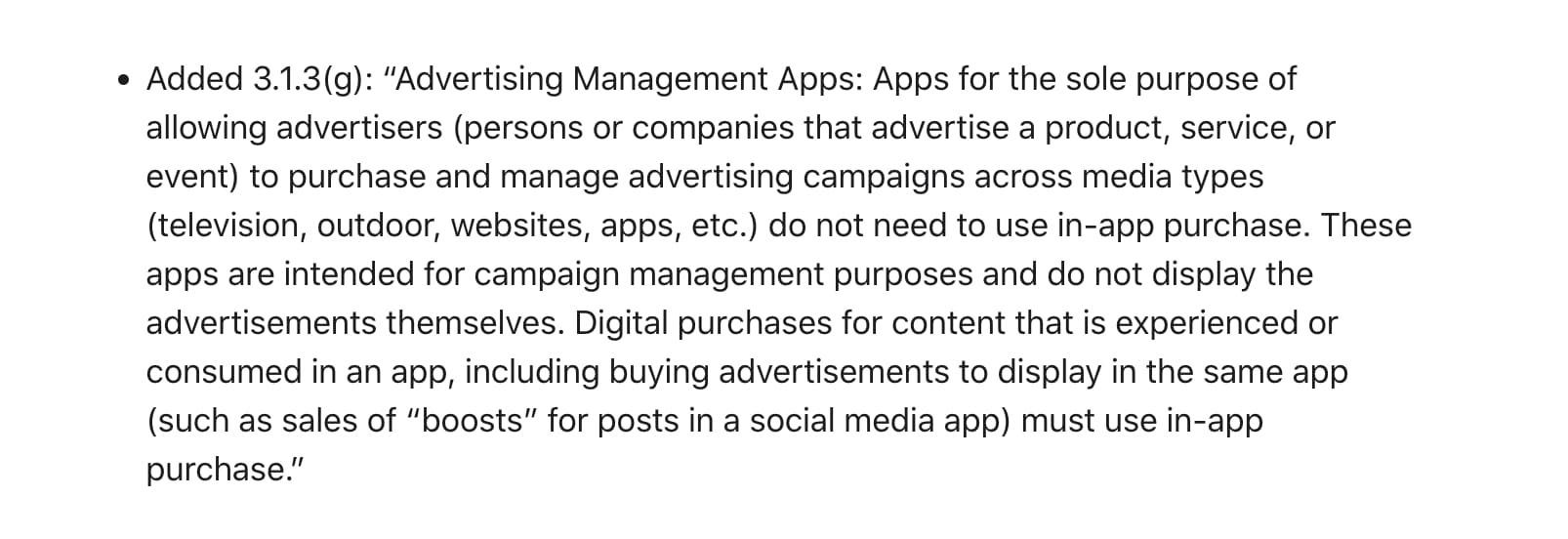
Image source: https://developer.apple.com/news/?id=xk8d7p8c
Apple's strong stance on NFTs, planning to impose a 30% fee, seems to grant NFTs a "legitimate existence" within the iOS ecosystem, but it is actually closer to a reluctant acknowledgment after the fact.
Before the relevant policies were introduced, NFT trading platforms like OpenSea had already existed in multiple countries' App Stores. Even earlier, many trading platforms, such as Binance and FTX, directly engaged in financial activities on the iOS platform.
After this policy update, NFTs can be minted, sold, and displayed within the iOS ecosystem, but only through in-app purchases. To be precise, Apple still views NFTs as a type of in-game item rather than a unique on-chain certificate owned by users.
It is currently unclear how this in-app purchase will be implemented, but it is speculated that there may be two methods:
- Use fiat currency to purchase cryptocurrency, then use the cryptocurrency to pay the Gas Fee;
- Directly use fiat currency to purchase NFTs, with Apple and the app sharing the user profits;
If it is the first method, it somewhat maintains the dignity of blockchain; if it is the second, it is not closely related to blockchain and is more akin to the operation of domestic digital collectibles (if restrictions on transfer and secondary sales are added, it would be identical).
Apple's hardware is sluggish, and increasing software sales is a long-term strategy, including more advertising (which makes fans weep) and more software subscription services to support stock prices. This support for NFTs can also be approached from this perspective.
Currently, Apple still views NFTs as a source of profit rather than wholeheartedly embracing blockchain technology and decentralized concepts, and it does not intend to share profits with applications, let alone give back to users.
In exploring NFTs, Meta has already come a long way. Although its stock price is not looking good at the moment, the integration of the metaverse with the real world is an inevitable trend.
Apple, on the other hand, is quite different. In hardware, Apple is betting on AR devices rather than VR headsets, and its software ecosystem still treats NFTs as traditional in-game items, hoping to keep users and traffic within its ecosystem.
The Future of NFTs: Opportunities Amidst Crisis
Whether Apple's measures will be effective remains uncertain.
The current policies mainly target NFT trading platforms, developers, and applications that embed NFTs, such as games.
In the broader context of customizable royalties in the industry, NFT trading platforms face challenges in paying taxes to Apple. They can be seen as having both wins and losses: winning in that Apple acknowledges the legality of NFT minting and trading, but losing in that Apple does not allow application platforms to bypass it and take profits independently, and platforms cannot adopt other payment and traffic diversion methods, including buttons, external links, or other "inducing" actions.
However, NFTs that cannot be freely bought and sold in the secondary market are hard to claim as decentralized. Additionally, there are concerns about user privacy data being leaked.
If Apple intervenes in transaction details, user transaction behavior data will also be controlled by Apple. Even if anonymous login measures are taken, user identifiers will still exist, making it difficult to claim privacy protection.
However, iOS's clear support for NFTs will significantly encourage developers and ordinary users to experiment, thereby pushing NFTs toward more mainstream audiences. Previously, NFTs on the iOS platform were not clearly defined in terms of boundaries and policies, but in reality, developers need clear guidelines from multiple perspectives, including copyright, review standards, and regional restrictions.
In other words, Apple's formal acknowledgment of NFT developers' status within the iOS ecosystem is an optional feature, not limited to the "small image" circle. The strong demand for developers is already visible.
The gameplay of embedded NFT applications can be further expanded, with the most typical being the NFTization of in-game items, which also represents a new revenue direction for Apple. However, traditional game manufacturers have not widely supported the implementation of NFTs, and when they will contribute profits to Apple's financial reports remains uncertain.
As for ordinary users, under iOS's control, there will be a more compliant user experience to engage with NFTs, a product form driven by blockchain technology. Breaking the circle is timely, although this experience will inevitably carry a considerable degree of compromise. However, Apple's payment intervention also relatively reduces security issues such as project parties running away and wallet scams.
Whether NFTs can find their opportunities from this will depend on how they respond next. Although MagicEden, the largest NFT trading market on Solana, previously stated that if Apple announced this regulation, it would delist from the Apple Store, no updates have been seen yet.
NFTs should not be tamed by giants into "golden egg-laying chickens."
This event is still unfolding, and one point should become an industry consensus: without moving toward complete decentralization, such events will happen repeatedly. Ultimately, the blockchain technology that aims to disrupt Web 2 will be tamed by giants into golden egg-laying chickens.
The real inspiration for the industry should be that the innovation of Web 3 cannot be limited to public chains and NFT mechanisms; a thorough revolution should also be applied to broader decentralized consumer-grade terminals.
Epic Games CEO Tim Sweeney rebutted when news broke that Apple would tax NFTs: "Apple is killing the NFT business that it cannot tax. Moreover, what it is killing is precisely the business that competes with its overpriced built-in payment tax. Apple must be stopped."
Perhaps Apple will win now because the power dynamics are not equal. Apple's actions will trigger an earthquake in the NFT space, but in the broader context of NFTs struggling to gain incremental users, it is inevitable that some trading platforms or game manufacturers will yield.
However, as LimitBreak's founder Gabriel Leydon stated on Twitter, while everyone is focused on Apple's taxation, they may not realize that this could be an opportunity to embed an ETH wallet into the games of a billion gamers.
Indeed, in this context, Solana's move to create a phone may be prescient, and ethOS is no longer a toy-like joke. Decentralized apps must have decentralized OS and hardware to ensure a complete experience. Regardless of the final direction, at least both have made their explorations in software and hardware.
 Risk warning
 Risk warning