Finally, Polymarket is teaming up with Kalshi to take a slice of this cake
 Core Viewpoint

 The two giants of the prediction market are expected to announce the expansion of perpetual contract products in the short term. This not only expands their product and revenue boundaries and supports the continuously rising financing and valuation but also responds to the potential threats from some cross-industry competitors.
Author: Hu Tao, ChainCatcher
The derivatives market is once again welcoming disruptors.
Yesterday, prediction market giant Polymarket announced the upcoming launch of perpetual futures trading, allowing users to trade the prices of various assets with at least 10x leverage, including real-world assets like gold and silver, stocks of companies like Nvidia and Coinbase, and digital assets like Bitcoin.
A few days ago, The Information reported that another leading prediction market project, Kalshi, plans to support perpetual futures on its platform, enabling U.S. customers to trade derivative contracts without expiration dates and use so-called financing rates for round-the-clock trading.
The two giants of the prediction market have announced the expansion of perpetual contract products in the short term, which not only expands their product and revenue boundaries and supports the ongoing rise in financing and valuations but also responds to potential threats from some cross-industry competitors.
1. High Overlap in User Profiles
The user profiles of prediction markets and perpetual contracts exhibit a high degree of homogeneity: both attract speculative investors with a high risk appetite who are extremely sensitive to macro events, and both carry a significant risk of users' investments becoming worthless in a short time.
In fact, a large portion of the trading volume in prediction markets comes directly from predictions about cryptocurrency prices. When users predict on Polymarket whether "Bitcoin will break $90,000 by the end of the month," their underlying motivation is essentially no different from going long in the contract market. By integrating perpetual contracts, prediction market platforms can fully explore the commercialization potential of their existing users.
Moreover, as a genuine aggregation of user sentiment and opinions, the prediction results from prediction markets have become an important reference for many users engaged in cryptocurrency trading. The transition from viewing predictions to engaging in contract trading is becoming a regular trading path for this group of users.
For the platform, this is not just an increase in functionality but also the completion of a trading loop: while users observe macro events (such as Federal Reserve meetings, geopolitical conflicts) and participate in predictions, they can directly use leverage to hedge or amplify returns on related assets (such as gold, U.S. stocks), thereby minimizing traffic loss.
At the same time, this functional overlap can elevate the "low-frequency, major event-driven" model of prediction markets to the "high-frequency, round-the-clock driven" dimension of the derivatives market, completely capturing users' attention.
2. The Temptation of a Trillion-Dollar Market
The direct driving force attracting prediction market platforms to enter the fray is the enormous capital volume of the derivatives market.
Although prediction markets have experienced explosive growth since 2025—according to Dune data, the total trading volume of prediction markets has exceeded $20 billion each month this year, with an average daily trading volume exceeding $700 million.
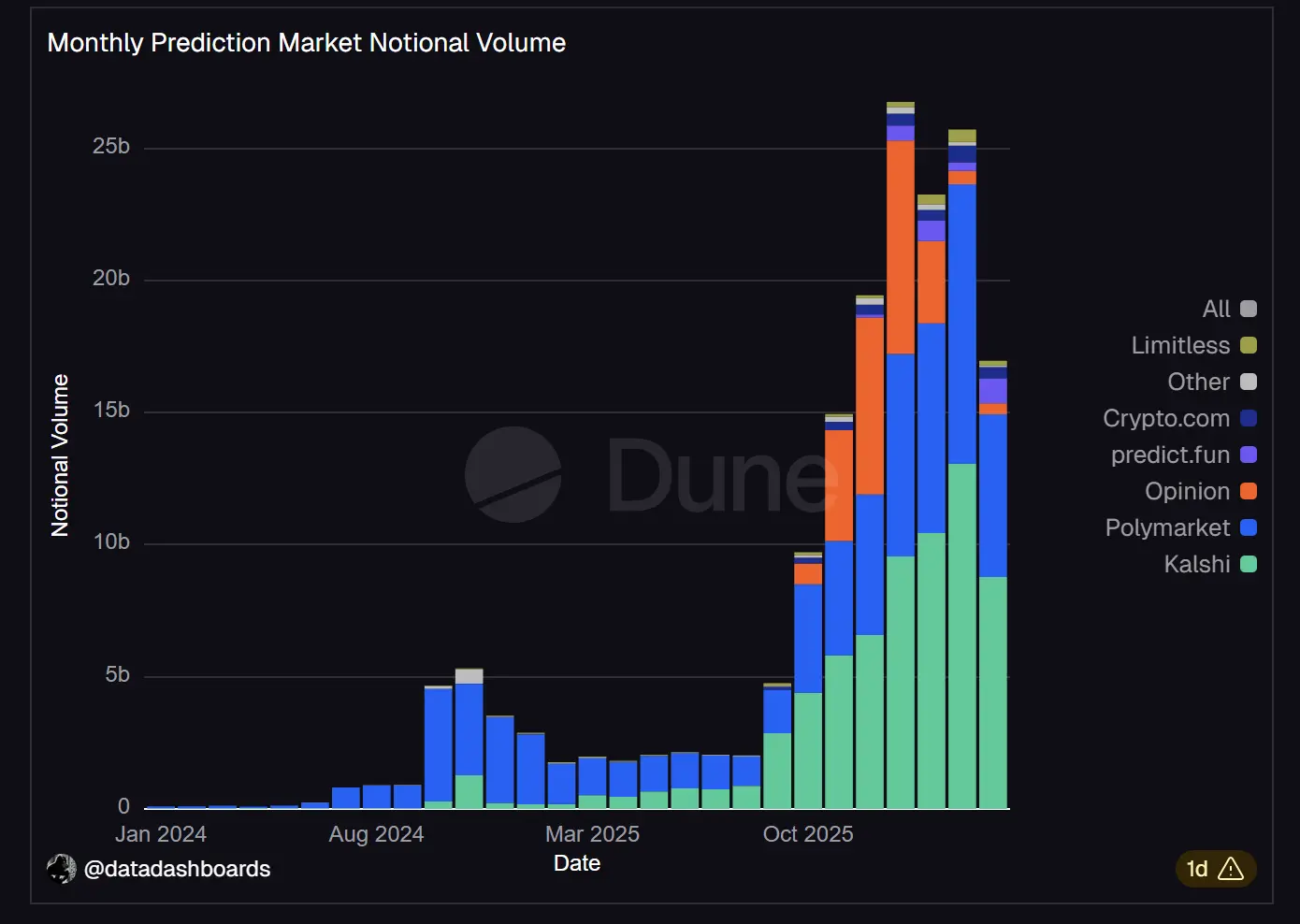
In contrast, the scale of the perpetual contract market is on an entirely different level. Top decentralized perpetual contract platforms (such as Hyperliquid and dYdX) typically maintain daily trading volumes in the billions, while centralized exchanges (CEX) see daily trading volumes in the hundreds of billions for perpetual contracts.
This potential business prospect is irresistible for Polymarket and Kalshi, which are pursuing high valuations. In the context of potential traffic declines in prediction markets due to cyclical events (such as after elections), the "high-frequency, essential, long-lasting" financial products like perpetual contracts will become the core pillar supporting their continuous valuation increases.
Moreover, the actions of Polymarket and Kalshi are not blind attempts but are backed by solid compliance.
Kalshi, as a designated contract market (DCM) regulated by the U.S. Commodity Futures Trading Commission (CFTC), has a natural advantage in providing futures and options trading within a compliant framework. This means it can offer compliant "long-lasting contracts" to U.S. retail and institutional investors within the regulated scope. Polymarket US was also designated as a DCM by the CFTC in July 2025.
3. Expansion of Trading Scenarios Becomes a Mainstream Trend
To some extent, the actions of the two prediction markets are also a response to the derivatives giant Hyperliquid.
In February of this year, Hyperliquid clearly stated on X that it plans to support outcome trading, a feature that will allow users to directly create prediction markets and options-like tools on its platform. As the current leader in on-chain perpetual contracts, Hyperliquid is attempting to cover more trading scenarios by integrating prediction functionalities.
Now, Polymarket and Kalshi's reverse entry into perpetual contracts is essentially a response to this threat: when competitors try to invade your territory, the most direct defense is to enter their core territory.
More broadly, this change points to a clearer industry trend—every platform is competing for a "trading loop."
In recent years, more and more exchanges have begun to integrate prediction market functionalities, hoping to keep users' "information trading needs" within their own systems; now, prediction markets are integrating perpetual contracts in reverse, attempting to cover users' "price trading needs."
Whether centralized exchanges, decentralized derivatives platforms, or prediction markets, they are all evolving in the same direction: from single product providers to comprehensive trading platforms covering multiple assets, tools, and scenarios.
Ultimately, the core variable behind this integration remains revenue and valuation. When growth pressure and competitive pressure combine, moving towards diversified scenarios like derivatives has almost become an inevitable choice for all trading platforms.

 Risk warning