Hyperliquid and Solana ecosystem data confirm: round-the-clock asset circulation has become a basic need for market investors

 From concept to all-weather explosion! The acceleration of tokenization "on-chain" for U.S. stocks and commodities is disrupting traditional financial boundaries with 24/7 frictionless liquidity.
Written by: WallStreetBets
Compiled by: Luffy, Foresight News
Over the past decade, the crypto industry has built a trading system for native crypto assets: spot exchanges, perpetual contracts, stablecoins, lending protocols, and meme coin ecosystems are all present. This has cultivated a whole generation of users who are already accustomed to entering the market at any time, enjoying global liquidity, and trading without being bound by the 4 PM closing time of U.S. stock markets.
In my view, the next super track in the crypto industry is the migration of traditional physical assets to the blockchain layer. Stocks, U.S. Treasuries, mutual funds, gold, crude oil, and credit products will all be on-chain.
Assets like gold and Nvidia do not require additional explanation; the real opportunity for market transformation lies in changing the channels for asset trading, trading hours, and various operational methods after purchasing assets.
The financing and secondary market trends of SpaceX, owned by Elon Musk, have already demonstrated a new model for asset circulation. The same asset can simultaneously generate liquidity in traditional brokerages, private markets, and crypto platforms. Traditional brokerages accept IPO subscription intentions, private platforms open early shares to qualified investors, and the crypto track launches SpaceX IPO perpetual contracts and tokenized related products, matching traders' expectations for the stock's opening price.
Some early derivatives could not meet market demand due to insufficient underlying circulation shares. Traders moved between brokerages, private placements, perpetual contracts, and tokenized products just to gain exposure to related assets.
This is the core trend that most people overlook: the source of assets can be the traditional financial system, but the boundaries of trading and circulation will completely break through traditional frameworks.
Stablecoins have already completed the on-chain migration of the U.S. dollar, allowing funds to flow freely around the world, even during bank holidays. Today, stocks, funds, and commodities are developing along the same path.
Why has the wave of tokenization erupted now?
For many years, asset tokenization has remained at the conceptual level. BlackRock CEO Larry Fink once compared the traditional financial system to postal mail, while tokenization is like email. Subsequently, BlackRock launched the BUIDL fund, with underlying assets consisting of cash, U.S. short-term Treasury bills, and repurchase agreements. Investors hold tokens valued at a stable $1, with returns distributed in the form of additional tokens, and compliant investors can transfer holdings between on-chain wallets.
Franklin Templeton has already deployed the infrastructure for government money market funds on-chain, with the product named BENJI. Now, BENJI is further expanding its business, collaborating with multiple banks and digital asset platforms to conduct trading and collateral financing.
These underlying asset categories already exist; tokenization changes the way asset ownership is recorded, the speed of holding transfers, and the reusable financial scenarios after issuance.
Robinhood has launched over 200 U.S. stock and ETF tokens for EU users, covering assets like Nvidia, Apple, and Microsoft, with tokens supporting uninterrupted trading five days a week.
Plume Network focuses on the asset issuance side, providing asset management institutions with a one-stop on-chain asset building infrastructure, eliminating the need for institutions to build an entire system from scratch.
TheoriqAI is positioned above the issuance layer, building various investment strategies and putting tokenized assets into on-chain lending and vault appreciation scenarios.
A few years ago, the industry was still debating whether large traditional financial institutions would adopt public chains; today, the answer is clear: major institutions have already implemented practices.
Robinhood CEO Vlad Tenev recently stated that the biggest opportunity in the crypto industry is not to create more native cryptocurrencies but to become the underlying infrastructure for physical assets. Tokenized stocks, futures, and private market assets are the intersection of traditional finance and crypto.
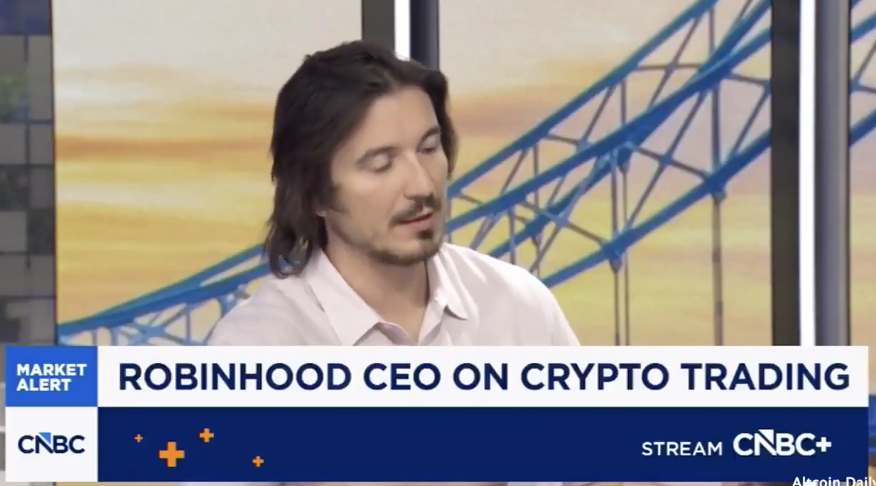
Robinhood's aggressive layout in the tokenization business has also brought this topic out of the crypto circle and into the public eye.
Airbnb CEO Brian Chesky stated that he has been closely following the tokenization track for many years: "The core highlight is not the tokens themselves, but the significant reduction in trading friction."
This is also the core reason for the rapid rise in the topic of tokenization. The market is not chasing the concept of "tokenization" but rather a new financial product with zero friction. The focus of industry discussions has shifted from "Can assets be tokenized?" to "Which tokenized products can retain long-term users?"
Asset tokenization is technically feasible; the real challenge is to continuously retain users.
Hyperliquid proves that 24/7 trading has become a market necessity.
HyperliquidX confirms that traders will actively flock to efficient, highly liquid, and year-round trading platforms.
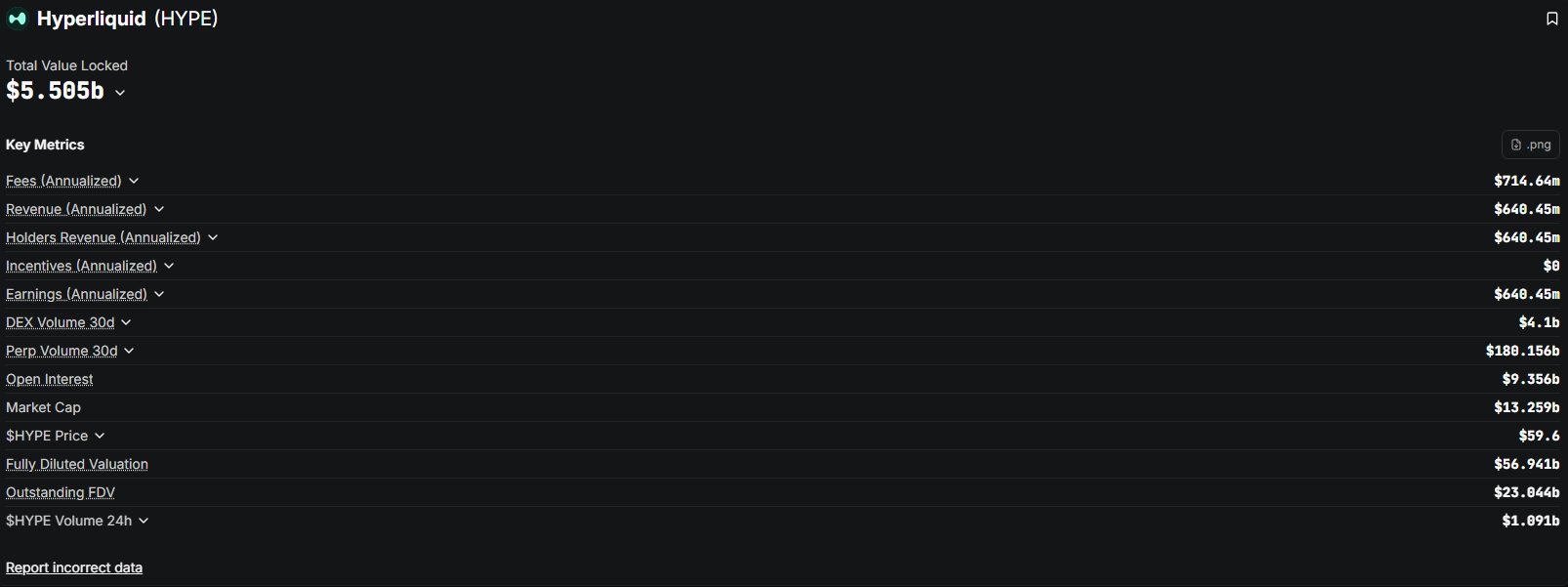
Perpetual contracts are the first category to be implemented, as they belong to synthetic assets and can be quickly launched without having to resolve custody, clearing, and various compliance legal issues all at once.
The process of bringing physical assets on-chain is more complicated, requiring custody, clearing, and matching the regulatory rules of various countries.
The perpetual contract market has already validated traders' strong demand for 24/7 uninterrupted trading, prompting the industry to explore more market structures that can be migrated on-chain.
Synapse Protocol is building the underlying layer for options trading. Its portfolio margin system allows market makers to use Hyperliquid perpetual contract holdings as margin for options sellers, hedging against underlying asset price volatility. This mechanism is particularly friendly to emerging assets. Hypercall has launched SPCX options, supporting intraday and same-day expiration contracts, providing trading exposure that cannot be achieved on Nasdaq.
Ondo Finance has expanded this model to the public market. Ondo Global Markets connects tokenized U.S. stocks and ETFs to crypto wallets, using stablecoins as the trading medium; Ondo Perps provides traders with 24/7 leveraged exposure, relying on the Ondo ONE system.
Crypto users are already familiar with this operational logic: deposit stablecoins, select assets, and complete trades. The existing challenge in the industry is that once tokenized assets are deposited into wallets, sufficient liquidity and diverse appreciation scenarios need to be built to retain users.
Stocks, the most easily popularized consumer-grade tokenized assets
SpaceX, Nvidia, Tesla, Apple, Microsoft, Coinbase, Robinhood, and the S&P 500 index are all well-known assets. This is also the core reason why major exchanges prioritize the layout of stock tokens.
Robinhood first launched U.S. stock and ETF tokens for EU users, and later developed its own public chain, upgrading its business from trading stock tokens within the app to a foundational network that supports the circulation of various on-chain assets. Robinhood has also successfully pushed stock tokens to a vast number of retail investors outside the crypto circle.
Before stock tokens became the core narrative of the crypto industry, projects like Streamex had already been deeply engaged in this track.
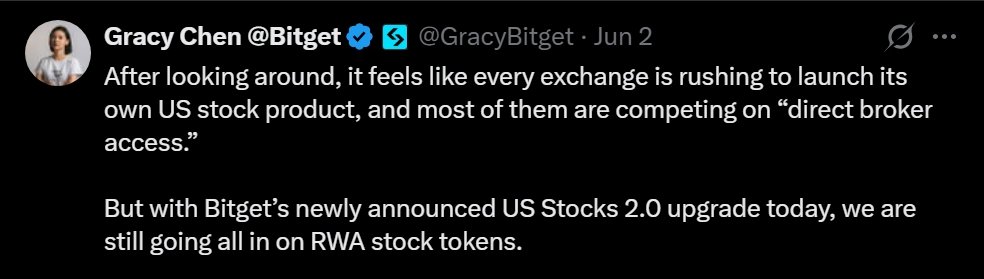
Bitget is a representative case, intuitively demonstrating the complete ecosystem of embedding tokenized stocks into crypto exchange accounts. Bitget launched "Stocks 2.0," issuing rToken tokens through the compliant RWA protocol Reality. The platform states that rToken addresses multiple pain points in the industry: direct connection to Nasdaq and NYSE liquidity, 1:1 pegging to underlying assets, synchronizing corporate dividends, and completing the entire clearing process within the Bitget ecosystem.
rNVDA and rTSLA are the most intuitive examples: the well-known Nvidia and Tesla stocks are no longer held in traditional brokerage accounts but are included in crypto trading accounts.
Ordinary investors can also buy Nvidia and Tesla through traditional apps; the main change lies in the storage scenario after asset purchase. In traditional brokerage accounts, stock assets are isolated within the brokerage's own system; in crypto exchange accounts, compliant stock tokens can share a single pool of funds with spot, margin, grid trading, copy trading, and wealth management appreciation products, with dividends automatically converted to USDT credited to account balances.
Positions are directly counted as available trading funds, rather than being isolated in brokerage accounts.
Bitget believes that when stock tokens coexist with crypto spot, collateral, and various derivatives in one account, the utility value of the assets will be greatly enhanced.
Bitget executive Gracy stated that the direct connection channels of traditional brokerages can solve liquidity and dividend issues, while Bitget achieves the same advantages through tokenization, while retaining the full range of usage scenarios for assets within crypto accounts.
The crypto trading app Fomo is closer to ordinary users, integrating crypto asset and physical asset exposure into the same mobile trading interface, primarily responsible for product distribution and asset exposure, without participating in asset issuance and underlying trading construction.
The RWA ecosystem on Solana
In six months, the on-chain physical assets launched on Solana via the Sunrise protocol have accumulated a transaction volume exceeding $3.5 billion, with 14 million transactions covering approximately 221,000 wallet addresses.
Sunrise utilizes the Wormhole native token transfer framework to deploy designated assets from issuers to Solana. Wallets, aggregators, and liquidity platforms can uniformly connect to the same asset address without needing to split multiple wrapped versions to divert liquidity.
The SPCX tokenized product perfectly validates this operational logic. Backpack Securities is responsible for securities compliance issuance; on the day of SpaceX's Nasdaq listing, Sunrise simultaneously deployed its tokens to the Solana chain. Within the first 24 hours of launch, this asset traded over $50 million across 51 trading markets on Solana, with trading volume exceeding $100 million within four days.
Backpack handles securities compliance and user asset access, while Sunrise connects to Solana ecosystem traders, liquidity, and cross-chain routing. The cycle from issuance to trading has been significantly shortened, but whether the asset can maintain trading volume will ultimately be determined by market demand.
Commodities, the bridge connecting institutions and retail investors
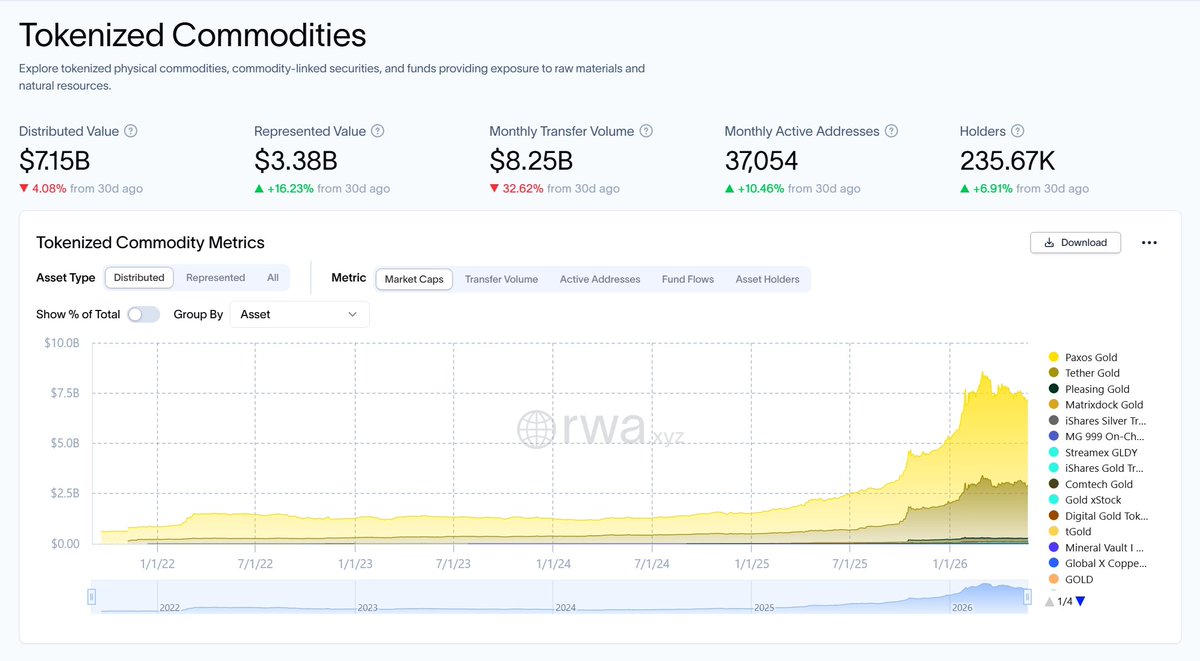
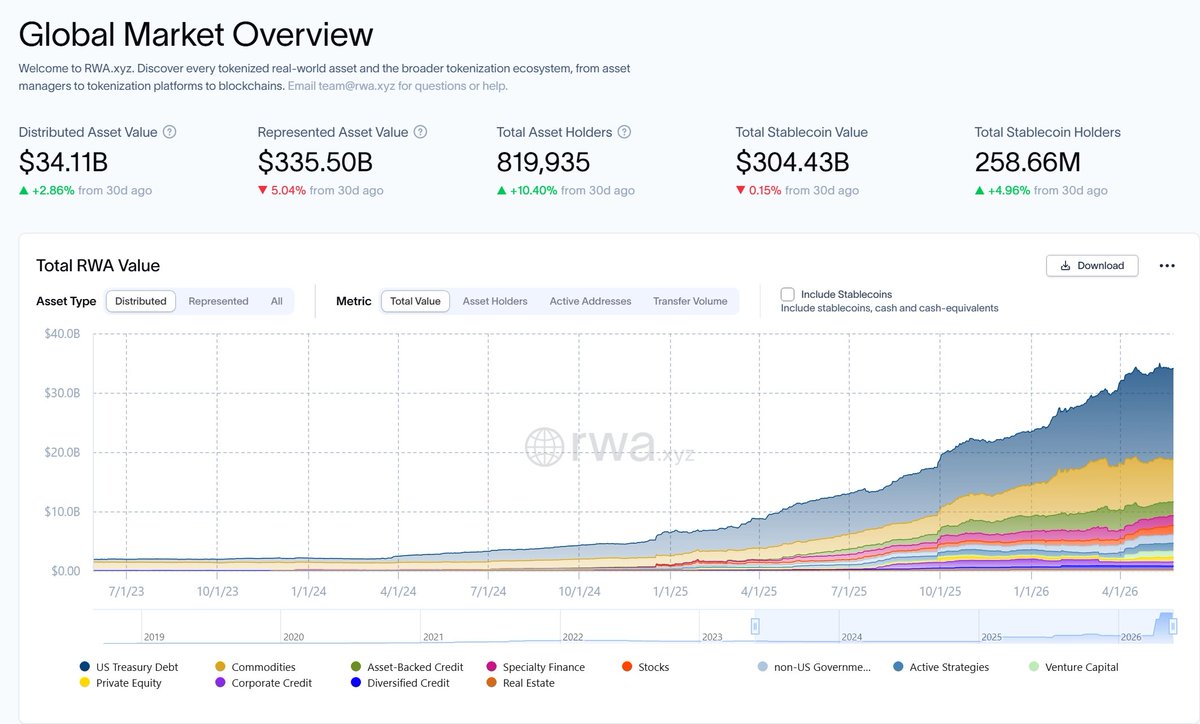
U.S. Treasuries are the most successful category for RWA implementation on the institutional side, with the core advantage being the ability to generate stable returns on-chain; stocks are the optimal target for the retail side, with broad audiences for Apple, Tesla, Nvidia, and the S&P 500; commodities lie in between. Institutions use them for hedging risks, pledging reserves, laying out physical industries, and macro asset allocation.
Gold, crude oil, silver, copper, natural gas, and mineral rights all fall under the category of commodities. The traditional trading market for commodities has long been mature, but the challenge has always been the convenient access channels for ordinary investors.
Physical commodities have a very high holding threshold; ETFs simplify the purchasing process through brokerages, while futures are open to professional traders. Tokenization adds a third path, allowing assets to circulate outside traditional trading hours, with faster clearing speeds, and can be directly used in various on-chain financial markets.
Not all commodities are suitable for on-chaining. Crude oil has different benchmarks, storage locations, delivery contracts, and quality standards; copper and natural gas also face physical delivery matching challenges. Gold has the lowest threshold, with global circulation, ample liquidity, and a unified pricing system, having already been widely traded through ETFs and futures; PAXG and XAUT also prove that users are willing to hold on-chain gold.
Currently, the main force in the on-chain RWA market remains U.S. Treasuries, with a simple and clear product logic: holding short-term U.S. Treasuries, with returns distributed to token holders.
The on-chain scale of commodities is still relatively small, but their offline spot market is extremely large.
Gold is an excellent test case, capable of verifying whether tokenization can optimize the trading, circulation, and yield distribution models of commodities, rather than merely adding a digital certificate for underlying assets.
GLDY, a tokenized gold product with yield functionality
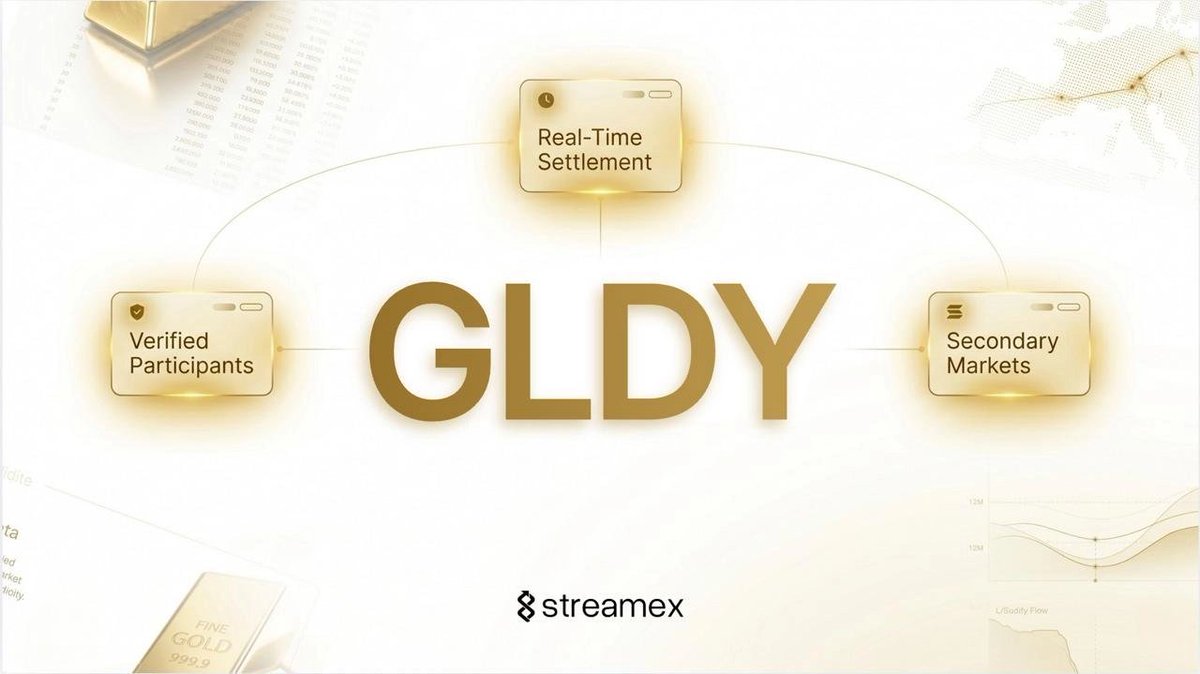
Gold, as a millennia-old store of value, is mostly held in forms that do not generate cash flow returns. The design concept of GLDY directly addresses this pain point: holding gold tokens can also earn additional gold returns.
Each token corresponds to 1 ounce of standard physical gold reserves. Streamex states that the expected dividends from the product will be distributed in incremental gold, with returns sourced from gold leasing business; data from the Streamex website shows that the current total gold reserves amount to 3096.6072 ounces.
Custodied gold can be leased to compliant enterprises in the gold industry chain, including refineries, mints, and jewelry manufacturers, with lessees paying leasing fees in the form of gold, and the returns redistributed to token holders.
Most tokenized gold products only offer digital custody; GLDY adds a layer of gold leasing appreciation, forming a completely different revenue model, distinct from merely hoarding coins in a wallet.
Like all tokenized assets, the survival of the product depends on a complete trading ecosystem: holders need reserve verification, regular dividends, compliant trading channels, and clear knowledge of the sources of returns.
The platform's Q1 2026 financial report shows that GLDY's quarter-end assets under management are approximately $14 million, with gold reserves of 3096 ounces; the first two monthly dividends have cumulatively distributed 10.48 ounces of gold to users. Orca and Wintermute are its foundational infrastructure partners.
The platform has partnered with Siebert Financial and tZERO to connect traditional brokerage channels. Siebert's wealth management and institutional clients can participate in GLDY through existing brokerage accounts, while tZERO provides custody services relying on a compliant digital securities platform. Siebert manages assets exceeding $20 billion, establishing a broad distribution channel outside the crypto circle.
The parent company Streamex is listed on Nasdaq under the stock code STEX, allowing secondary market investors to directly hold equity in the platform. In July of this year, the company's board approved a stock buyback plan of up to 10 million shares, with a maximum repurchase price of $2, as management believes the current stock price severely undervalues the business.
This ecosystem is fully equipped: Orca provides a secondary trading market, Wintermute provides liquidity as a market maker, Chainlink reserves data oracles to verify gold inventory, Aurum is responsible for the underlying data, and Siebert connects traditional wealth management client channels.
I continuously track three core indicators: the scale of gold reserves, the total amount of monthly dividends, and whether secondary market trading volume can grow steadily in sync. This is also the ultimate test standard for all tokenized assets.
Tokens themselves are not the product; the complete trading and appreciation market built around the tokens is the core value.
Long-term observation focus
I do not believe that the tokenization of physical assets is a one-sided bull market. I am more interested in innovative products that can fundamentally change the way underlying assets are used.
For stocks, I want to see if traders will continue to use tokenized versions when traditional markets are closed, and whether these positions will play a role in their other investment portfolios.
For funds, I am observing whether they will move beyond the issuance phase and begin to be used as collateral or incorporated into other financial products.
Commodities are the experimental field I am most focused on. Holding gold tokens in a wallet is easy to understand; the real challenge is providing sufficient reasons for users to abandon ETFs and traditional futures in favor of on-chain gold tokens.
Will users still be trading a month later? Can assets freely transfer across platforms? Will dividend returns grow in sync with underlying reserves? If the answers to these questions are all affirmative, then a new mature market can be considered truly formed.
Five years ago, the industry debated whether traditional financial institutions would embrace public chains; today, financial markets are gradually implementing crypto technology as foundational infrastructure.
If this trend continues to advance, one day, all assets will be tokenized.
Traditional markets have fixed closing times, while crypto markets operate year-round.
 Risk warning
Popular articles