








What is the real reason behind the intense confrontation between Binance and FTX?

 Just when everyone thought the storm would come to an end, unexpectedly, Binance founder Zhao Changpeng suddenly stepped in and dropped a bombshell.
Written by: Wu Says Blockchain
With CoinDesk exposing Alameda's financial data, although this matter is unrelated to Binance, the attacks on Binance have never ceased.
Binance co-founder He Yi commented on the incident: "Binance does not provide unsecured loans, does not engage in trading, does not buy companies recklessly, does not spend money on sponsorships, and has already sold 20% of FTX's equity. We keep our heads up to be human and our heads down to work." Especially the first sentence implies that FTX provided a large amount of unsecured loans to Alameda.
On November 6, it was reported that Binance address 0xd9…d7d7 transferred 23 million FTT (worth about $580 million) to FTX address 0x04…8379 for sale. According to further on-chain verification by Wu Says, address 0xd9…d7d7 may be the receiving address for Binance's investment in FTT that has obtained linear unlock, while address 0x04…8379 also belongs to Binance, serving as a transit to transfer FTT to Binance's official wallet. Perhaps because all FTT shares have been unlocked, Binance transferred all FTT to the official wallet in one go.
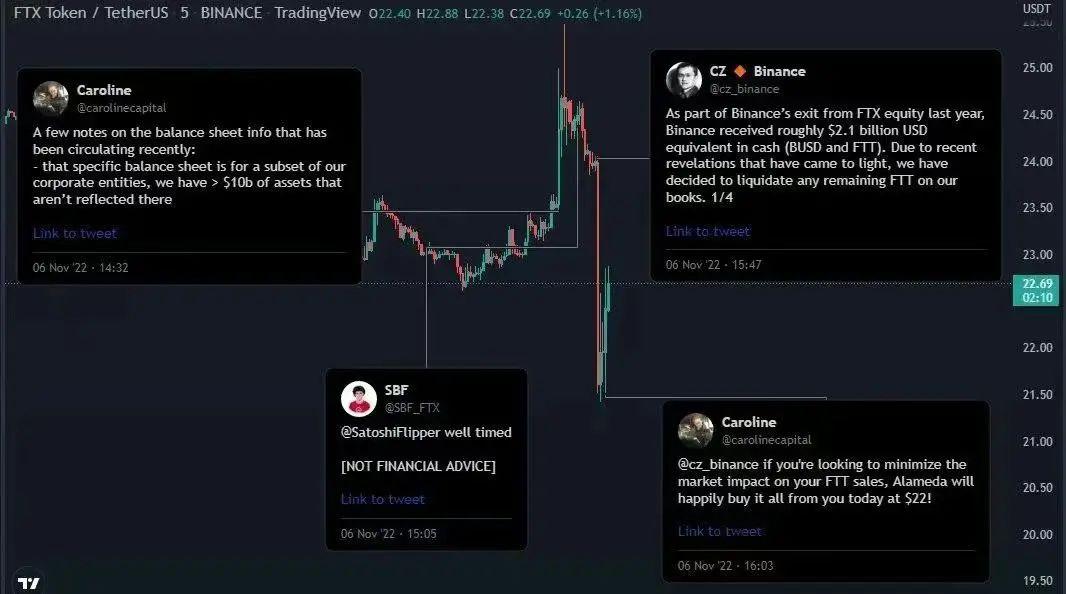
On the evening of November 6, Alameda CEO Caroline responded that the specific (CoinDesk disclosed) balance sheet is a subset of our company entity, and we have over $10 billion in assets not reflected there; given the tightening of the crypto credit space this year, we have now repaid most of the loans; we clearly have unlisted hedges. However, Caroline's brief response did not address the related transactions and fund flows with FTX, making it difficult to completely dispel external doubts.
Just when everyone thought this storm would come to an end, unexpectedly, Binance founder Zhao Changpeng suddenly stepped in and dropped a bombshell.
(Image from the community)
CZ suddenly stated that Binance received approximately $2.1 billion worth of BUSD and FTT last year due to exiting part of its equity in FTX. Due to the recent revelations, Binance decided to liquidate any remaining FTT on its books. Binance will attempt to liquidate in a way that minimizes market impact, and due to market conditions and limited liquidity, it is expected to take several months to complete. FTT subsequently plummeted. Caroline then responded that if you wish to minimize the market impact of selling FTT, Alameda would be happy to buy from you at $22 today.
SBF, who had remained silent on the Alameda incident, also had to speak out, stating that he greatly respects everything you have done to build the industry we see today, regardless of whether they reciprocate or whether we use the same methods. Including CZ. In any case— as always— it is time to build. Make love (and blockchain), not war.
CZ's response was very direct: liquidating our FTT is just risk management after exiting, learning from LUNA. We used to support it, but after the divorce, we won't pretend to make love. We do not oppose anyone. But we will not support those who lobby against other industry participants behind the scenes (referring to SBF's previous suggestion to strengthen blacklist management in the crypto industry and KYC for DeFi front ends, which sparked controversy).
SBF then responded again: a bunch of unfounded rumors have been circulating. FTX's finances have been audited, and while it sometimes slows down our speed on products, we are highly regulated, and we have processed billions of dollars in deposits/withdrawals today. (Implying that there were large withdrawals after the rumors appeared, but deposits and withdrawals are normal) There are also large conversions of dollars <> stablecoins ongoing. In the end, you should do what you want to do and trade where you want to trade. We appreciate those who stayed; when this is all over, we will welcome others back.
On the morning of November 6, research from The Data Nerd showed that Alameda Research received 56 million USDC from Circle and then transferred it to FTX. In the past 24 hours, they have sent $257 million to FTX. Meanwhile, FTX's stablecoin outflow was the largest among all exchanges in the past 7 days, with a net outflow of $292 million. According to Nansen, in the past 7 days, Binance saw an inflow of $337 million, the largest entity for stablecoin inflows, with a current balance of $26.6 billion.
SBF's restraint seems to have made it impossible to continue the "fight," and the matter seems to have temporarily come to a close. What are the reasons behind the intense confrontation? We believe there are three angles: the longstanding feud between Binance and FTX; FTX's recent challenge to Binance; and Binance's heightened vigilance towards competitors.
Binance was once an investor in FTX, and this investment became one of Binance's most profitable investments. But it is clear that Binance's investment was not focused on profit; it was essentially a strategic investment. The investment target turned into the biggest competitor, which must have infuriated CZ. Previously, Binance announced its exit from this investment, and although we do not know what happened behind the scenes, the relationship between the two parties indeed began to deteriorate rapidly.
In the rescue and acquisition of bad assets like Celsius, Blockfi, and Voyager, both FTX and Binance have been in a tug-of-war. They have a massive number of U.S. users and licenses, which are undoubtedly assets both parties are vying for. FTX achieved a comprehensive victory. This seems related to their good relationships in the U.S. In contrast, Binance's former U.S. CEO left and publicly criticized Binance, calling it a Chinese company. CZ also had to write a long article to explain that he is Canadian. In this ebb and flow, in some recent major projects like Atpos, FTX led the investment, while Binance Labs could only follow, further demonstrating FTX's advantageous position in the U.S. crypto space.
Binance's DNA has always been highly vigilant towards competitors. Not long after the crypto influencer Liangxi sang praises of Sun Yuchen, Binance dropped $150,000, showing no airs of being the world's largest exchange. Faced with FTX's global ecological advantage, suppressing it from all possible angles is indeed a routine operation.
Finally, for ordinary users, what may be of greater concern is the future trend of FTX and FTT. That is, is there a risk with FTX? We provide a few observations of our own, which do not constitute investment advice, and due to the severe lack of transparency in data, such judgments are also likely to be incorrect.
FTX's funds do not seem to have any particularly large problems at the moment. (Although CEX is a black box, we can only judge from some surface actions, such as quickly compensating previous victims; a large number of lead investments, acquisitions, political donations, etc., FTX is still spending heavily.)
The complex related transactions between Alameda and FTX certainly exist, which is also the area where Binance attacks and SBF dares not respond. The process is one aspect, and the results are another. As some professionals have analyzed, unlike 3AC and others who blindly believed in Bitcoin supercircle and gambled on direction leading to collapse, SBF and Alameda's cold style (known for dumping their investment project tokens) and tendency to short and bearish do not seem to resemble another 3AC so far.
Where are FTX's problems? If multiple negative factors intertwine and occur simultaneously in the future (for example, a hacker attack as a trigger), its risk resistance capability will indeed be relatively weak. In addition, the lack of transparency in the relationship between FTX and Alameda may also raise user concerns. The stark contrast before and after Three Arrows Capital has led to a high level of distrust in centralized institutions, also resulting in a large number of withdrawals (Binance's future attacks will certainly not be absent).
We hope SBF can take this incident as an opportunity to demonstrate more transparency, such as regularly disclosing FTX and Alameda's audit reports or parts of the audit content (for example, who the auditing firm is? Learning from Tether), to give the public more confidence, and even turn the tables on Binance.
 Risk warning
 Risk warning

Popular articles





