FTX Comes to an End: A Deep Dive into SBF's "Political Business Strategies" and the Private Relationships of Regulatory Officials

 To understand the overall story, we must start from their growth environment, family background, and the social and political resources they possess. They were "forced to grow" under the shelter of their parents and the Federal Reserve's monetary easing, and their risk control and management capabilities did not keep pace with the rapid growth of the enterprise and capital scale.
Author: Nancy, PANews
On the evening of November 11, FTX announced that FTX.com, FTX US, Alameda Research, and 130 other affiliated companies initiated bankruptcy proceedings, with Alameda's listed assets and liabilities estimated between $10 billion and $50 billion. Who would have thought that the unicorn FTX, backed by Wall Street capital, would collapse in just a few days, and the domino effect it triggered is still ongoing. In addition to several institutions "taking a big hit," many top venture capital firms are among them (see the detailed report in "Continuously Updated | Which Institutions Will Be Dragged Down by FTX?"). Moreover, on November 11, U.S. Congressman Tom Emmer tweeted that SEC Chairman Gary Gensler helped SBF and FTX exploit legal loopholes, revealing the "political business" behind FTX.
To understand the full story, we must start from their growth environment, family background, and the social and political resources they possessed. According to public information, PANews discovered the intricate connections between Alameda and FTX's "core team" and their parents with U.S. regulatory agencies, Wall Street executives, and Democratic Party leaders. The so-called effective altruism that SBF has always claimed is merely a "fig leaf" for nepotism and political pragmatism. Under the shadow of their parents and the Federal Reserve's monetary easing, their risk control and management capabilities did not keep pace with the rapid growth of the business and capital scale, which blinded them along the way, leading them to forget about risk control and operational bottom lines.
For detailed accounts and the latest news regarding the FTX incident, please follow the PANews related topic.
Alameda as FTX's "Parasite": Unveiling the Background of the Core Team
Alameda, the largest quantitative company in the crypto circle, is essentially a crypto war room formed by a few childhood friends, with core members including founder SBF, co-founder Sam Trabucco, and current CEO Caroline.
SBF, who has a knack for trading, has been idolized for having a net worth of $22.5 billion at just 29 years old. Some call him a "genius trader without faith," and even liken him to Mark Zuckerberg of the crypto world. In the end, everyone realizes that SBF is actually a "gambler" who bets with user funds.
Born in California, SBF grew up in an environment where his parents and West Coast scholars discussed politics, deeply influenced by their utilitarian philosophy. His father, Joseph Bankman, is an American lawyer and currently a professor of law and business at Stanford Law School. He has also been seen in a video from November 13, 2008, lobbying for hedge fund regulation before the U.S. House Committee on Government Reform and Oversight. He appeared in this year's August "FTX Podcast," discussing the charitable and regulatory projects he was involved in. Notably, in recent years, he has focused on tax issues and has written papers on the compliance of taxes in decentralized economies, as well as developing a new IRS tax filing system.
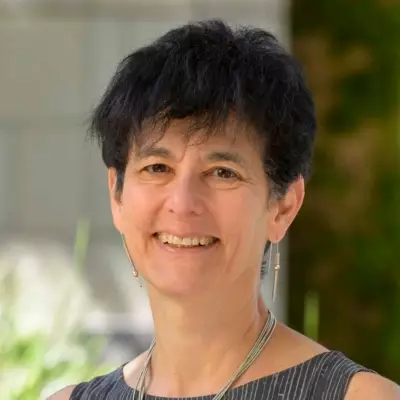
In contrast, his mother, Barbara H. Fried, also a Stanford law professor, has a more extensive background. She is a co-founder of the political fundraising organization Mind the Gap (MTG) and the voting organization (GOTV), which includes the Voter Information Center. MTG was launched after Biden announced his participation in the Democratic election, aiming to help Democratic political candidates win elections and raise funds. Many entrepreneurs and political figures have donated to this organization, including executives from companies like Google and Accenture, with SV Angel founder Ron Conway being one of the many Silicon Valley giants supporting Mind the Gap.
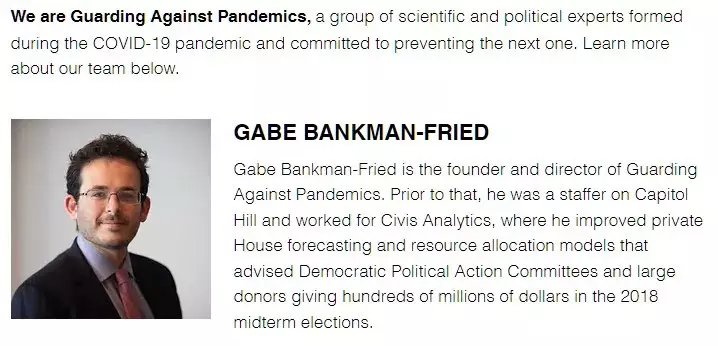
SBF's brother, Gabe Bankman-Fried (also a former Jane Street trader), is the founder of "Guarding Against Pandemics." He is a legislative correspondent for the U.S. House of Representatives and an advisor to major Democratic political donors.
Given such a family atmosphere and resources, it is not difficult to understand why SBF made substantial political donations to the Democratic Party after founding FTX. His career turning point came after graduating from university and joining the well-known Wall Street securities trading firm Jane Street, where he discovered significant arbitrage opportunities while researching the crypto market. In October 2017, SBF chose to leave Wall Street and co-founded Alameda with several friends.
Besides SBF, other core members of Alameda have traditional financial trading experience, including former Google engineer Gary Wang, former SIG bond trader and fixed income trader Trabucco and Troy Tsui, Ryan Salame who previously worked at Ernst & Young, Nate Parke who served as an engineer at UC Berkeley's RISE Lab, and Caroline, also a former Jane Street trader.
Like SBF, the two co-CEOs of Alameda, Trabucco and Caroline, also come from affluent backgrounds. Sam Trabucco is an alumnus of Stanford, where he studied with SBF. His father, Timothy Trabucco, is a senior finance officer at MIT, responsible for payroll. On August 25 of this year, Sam Trabucco suddenly announced his resignation from leadership but will continue to serve as an advisor. He explained that the enormous workload consumed most of his time and was too exhausting, stating that he currently has no plans for any other crypto projects and is traveling the world, having even bought a boat.
Caroline, also an alumna, became the sole CEO of the company. Her father, Glenn Ellison, is a professor and chair of economics at MIT. Before joining Alameda, she worked as a junior trader at Jane Street for only 19 months, marking her first job. This means that this CEO, without extensive experience in traditional finance or the crypto field, is in charge of Alameda's billions of dollars in funds. According to insiders, Caroline and SBF are childhood friends and also in a romantic relationship. They have faced scrutiny for living together in the same apartment, raising concerns about the close relationship between Alameda and FTX as an exchange and market maker, which is not beneficial for market fairness. Interestingly, Caroline once mentioned in a blog that after being invited to join Alameda, she found herself "having more trading experience than many Alameda traders" and that she needed to make a lot of decisions, many of which involved "uncertainty." Furthermore, Caroline claimed in an interview that "adapting to risk is very important; we tend not to set stop losses, and I don't think these are necessarily good risk management tools." This statement sparked heated discussions in the community.
The shift from being the center of attention to becoming the target of criticism often requires just one step. On November 11, it was revealed that Alameda had all employees resign, owing billions of dollars (court documents state the scale is between $10 billion and $50 billion) and declaring bankruptcy. In fact, Alameda, which had been racing ahead, had long since laid the groundwork for its collapse due to insufficient risk awareness.
Deep Connections with SEC Chairman Gensler
Perhaps influenced by his parents' discussions about politics and business from a young age, SBF aspired to become a "politician" and took shortcuts through his good relations with U.S. regulators.
On November 11, U.S. Congressman Tom Emmer tweeted, "My office has received reports that SEC Chairman Gary Gensler is helping SBF and FTX exploit legal loopholes to gain regulatory monopoly status. We are investigating this matter." After investigation, PANews found that SBF has deep ties with U.S. regulators.
Like SBF, Gensler is also Jewish, born into a Jewish family in Baltimore, Maryland. Gary Gensler began his career at Goldman Sachs, eventually becoming co-head of finance. Goldman Sachs CEO Robert Rubin joined the Clinton administration in 1993 and became U.S. Secretary of the Treasury in 1995, after which Gensler followed his former boss to the Treasury Department in 1997 as Assistant Secretary for Financial Markets, marking the start of his political career. He served as a senior advisor during Hillary Clinton's presidential campaign in 2008 and provided advice for Obama's campaign. During Obama's presidency, Gensler served as Chairman of the Commodity Futures Trading Commission (CFTC) from 2009 to 2014.
Upon taking office as CFTC Chairman, Gensler faced a situation similar to the current crypto market, characterized by the wild west of the over-the-counter derivatives market, pushing for the implementation of rules regulating the $400 trillion swap derivatives market in the U.S. He later served as Chief Financial Officer for Hillary Clinton's 2016 presidential campaign. However, during the Democrats' defeat in Trump's term, Gensler fell into obscurity and went to teach at MIT's economics department, also serving as chair of the Maryland Financial Consumer Protection Commission. However, with Biden's ascension, Gensler was recalled and appointed as SEC Chairman.
After Gensler returned to the political stage, many of his former subordinates from the CFTC went to work at FTX.US. For example, former CFTC acting head Mark Wetjen was hired as FTX US's head of policy and regulation in 2021; FTX US's general counsel Ryne Miller was also Gensler's personal legal advisor during his time at the CFTC. This has led to public speculation about the deep relationship between FTX and Gensler.
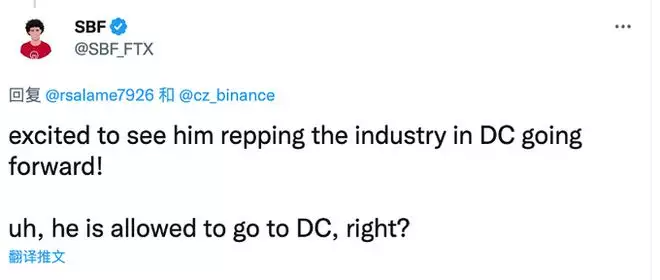
From this perspective, SBF's relationship with U.S. regulators is quite significant, which may also serve as his confidence in mocking CZ. Previously, SBF arrogantly tweeted that he could freely enter and exit Washington, but could others (referring to CZ) do the same?
However, SBF's numerous large-scale political donations and various relationships with regulators did not provide him with protection. Regarding the FTX explosion incident, White House Press Secretary Karine Jean-Pierre stated at a press conference that the White House is aware of the FTX explosion incident and will "continue to monitor the situation." The U.S. government has consistently maintained that without proper regulation, cryptocurrencies could harm ordinary Americans. This incident further emphasizes the need for prudent regulation of cryptocurrencies.
Donating to the Democratic Party: Paving the Way for Crypto Policy or Personal Power?
To expand his political influence in the crypto space, SBF has been relentless in his efforts. On one hand, SBF's trading platform FTX has been pouring money into sponsoring various top sports events, which has indeed increased user numbers while raising its profile. However, will the explosion event lead the public to further label the crypto industry as fraudulent? Additionally, can FTX continue to fulfill its previous sponsorship commitments? For instance, Miami-Dade County and the Miami Heat have already announced immediate actions to terminate their 19-year naming rights partnership with FTX, which was secured for $135 million.
On the other hand, the public's goodwill towards SBF partly stems from his advocacy for effective altruism. For example, SBF signed the "Giving Pledge," committing to donate most of his wealth to charitable organizations; furthermore, FTX launched the FTX Foundation, pledging to donate 1% of platform fees, and for every dollar a user donates, the foundation will match it, up to $10,000 per day. However, this charitable fund team also announced collective resignation on November 11 following FTX's collapse, stating that "the FTX Future Fund may not be able to fulfill many of the promised grants. We strongly condemn any deceptive or dishonest behavior that may have been engaged in by FTX's leadership."
However, regarding this effective altruism, Dovey Wan, founding partner of Primitive Ventures, believes there is no effective altruism, only the largest nepotism and political pragmatism. Everything is merely an output of a thoroughly rotten system that Bitcoin was invented to hedge against, rather than just the fraudulent behavior of specific criminals. Meanwhile, Vitalik Buterin has also criticized effective altruism, pointing out that the biggest problem with effective altruism is the lack of a specific theory for resource allocation. "Making crazy big bets and continuously accumulating wealth because you tell yourself you'll donate it later; if you issue a token, there's no need to keep a portion for yourself, you can donate it directly to charity."
Additionally, SBF has been attempting to "hug the thigh" through political donations. As early as the 2020 U.S. presidential election, SBF personally donated $5.2 million to Democratic presidential candidate Joe Biden, second only to New York City Mayor Michael Bloomberg. He has also been revealed to be a member of the U.S. Super Political Action Committee (PAC), with other members including Facebook co-founder Dustin Moskovitz and former Google CEO Eric Schmidt. This year, SBF has donated $39.2 million in the U.S. midterm elections, primarily to Democratic groups, with $27 million going to PACs, $6 million supporting Democratic House candidates, and $2 million supporting candidates friendly to cryptocurrencies. Moreover, according to previous reports by CNBC, SBF has expressed intentions to contribute between $100 million to $1 billion in political donations to candidates competing against former President Trump in the next U.S. presidential election. Although SBF later retracted this statement, it is evident that he harbors political ambitions.
In addition to SBF personally, members of his company are also actively participating in political actions. For example, FTX's engineering director Nishad Singh recently donated $1.1 million to U.S. Congresswoman Becca Balint's political activities in Vermont and $500,000 to the Oregon Democratic Party, spending about $8 million on pro-Democratic campaign donations.
Beyond political power, SBF has been paving the way for FTX's compliance through various measures. For instance, in March of this year, SBF met with Goldman Sachs CEO David Solomon, with both parties intending to reach a deep cooperation agreement, claiming they would help FTX obtain regulatory approval. However, SBF's recent regulatory actions have backfired on his reputation. He proposed the "Digital Commodity Consumer Protection Act," which aims to grant the CFTC greater regulatory authority over the cryptocurrency market and exchanges. However, the public seems unconvinced, believing that SBF's proposed sanctions, whitelist and blacklist, KYC DeFi, and stablecoin regulation contradict the decentralized philosophy of the crypto industry and could hinder crypto innovation in the U.S. Moreover, SBF's proposed crypto regulatory bill may be unable to pass due to the impact of the FTX incident. Messari CEO Ryan Selkis stated that the collapse of FTX could damage policymakers' views of the industry or prompt legislators to pass laws that hinder the industry's development.
Perhaps SBF's legendary life is temporarily concluding with FTX's bankruptcy filing, and the issues exposed by the company, such as risk control, misappropriation of user funds, and related transactions, are worth reflecting on for the industry. In a recent interview with Forbes, when asked if he would leave the industry if he found a better way to make money, such as trading orange juice futures, SBF answered without hesitation, "Yes, I would."
As SBF said, he has never been a true believer in blockchain and crypto; cryptocurrencies are merely a means to easily amass vast wealth.
 Risk warning
 Risk warning