Interpretation of Uniswap borrowing MoonPay to achieve fiat trading, how are the security and usage thresholds?

 Overall, the approach of the MoonPay platform has lowered the entry barrier for non-crypto users into the crypto space, expanding the incremental market.
Author: PANews
On December 21, Uniswap officially announced a partnership with crypto payment company MoonPay. The collaboration allows users to purchase cryptocurrencies on the Uniswap web interface using credit cards, debit cards, and bank transfers, supported by MoonPay. The first batch of tokens available for purchase includes DAI, ETH, MATIC, USDC, USDT, WBTC, and WETH. Currently, it supports the ETH, Polygon, Optimism, and Arbitrum chains.
Prior to this, MoonPay had already partnered with several well-known protocols and platforms by expanding its product service range. At the end of November 2021, MoonPay began testing its NFT high-net-worth individual fast-track service, aimed at providing a seamless transaction experience for high-net-worth individuals wishing to purchase NFTs. This service made it easier for customers to buy NFTs, with American pop singer Madonna using MoonPay's service to purchase BAYC.
Subsequently, in April 2022, the NFT marketplace OpenSea partnered with MoonPay to launch credit card payments on its platform, simplifying the process for users without cryptocurrency to purchase NFTs. In the same month, MetaMask announced a partnership with MoonPay, allowing MetaMask users to purchase ETH and other assets using mainstream credit cards, debit cards, as well as Google Pay and Apple Pay, with support for bank transfers in over 160 countries/regions.
In addition, MoonPay has also collaborated with Aptos Labs and Ethereum Layer 2 scaling solution Immutable X. According to information on MoonPay's official website, it has reached $2 billion in transactions, over 250 partners, and has more than 5 million customers, supporting over 80 types of crypto assets.
MoonPay's ability to partner with so many well-known crypto companies and protocols reflects its underlying resources and operational capabilities. In November 2021, MoonPay announced the completion of a $555 million Series A funding round, led by Coatue and Tiger Global, with a post-money valuation of $3.4 billion.
On April 13, 2022, according to Reuters, MoonPay disclosed that it raised $87 million from over 60 well-known investors, including singer Justin Bieber, rapper Snoop Dogg, and actor Bruce Willis (Note: This funding is reportedly part of MoonPay's Series A financing).
So, how secure is it to use MoonPay to purchase crypto assets? Has MoonPay lowered the barrier for users to enter the crypto space? PANews conducted a trial experience.
Is it safe to use MoonPay to purchase crypto assets?
To purchase cryptocurrencies with fiat, compliance with KYC/AML policies is required, which means users need to provide personal credit card, debit card, and other private data when using MoonPay. According to MoonPay's official documentation, all data sent to or from MoonPay is encrypted during transmission using Transport Layer Security (TLS) 1.2 or higher, and HTTP Strict Transport Security (HSTS) policies are employed to prevent downgrade attacks.
All MoonPay data is statically encrypted using AES-256 block-level storage encryption and is stored in data centers that comply with ISO 27001 and PCI DSS standards. Additionally, MoonPay complies with the General Data Protection Regulation (GDPR), ensuring that all customer and employee personal information is handled with the highest level of security and legality. All payment information is also processed and stored according to Payment Card Industry Data Security Standards (PCI DSS).
However, the possibility of data leakage by third-party partner companies during this process cannot be verified. According to the documentation regarding its partnership with Uniswap, MoonPay does not share customer data with Uniswap Labs, and Uniswap Labs does not collect or store financial data such as credit card, debit card, and bank information, or personal data such as names, surnames, email addresses, and IP addresses.
Moreover, according to Cryptoslate, in mid-March 2022, MoonPay suspended its operations in Ukraine, Russia, and Belarus, and ceased collaboration with customers who have physical addresses in these regions. Not only MoonPay, but many crypto companies chose sides during the Russia-Ukraine conflict, which is understandable. However, what concerns users is whether a company that collects a vast amount of core privacy information from users would voluntarily or be forced to compromise its data during the next political stance.
Regarding the legal regulations for users purchasing crypto assets with fiat, MoonPay has acquiring channels in Europe and compliance licenses globally. Additionally, it has completed anti-fraud processes in collaboration with the crypto compliance platform Sardine. According to official information, it also bears the risk for users encountering fraud and chargeback issues during their use.
Purchasing crypto assets with fiat has always been the most intuitive and highest demand in the market, but the anonymity of crypto assets enables criminals to conduct illegal activities such as money laundering. This process has led to many crypto users, who are not involved in illegal activities, suffering losses due to receiving funds of unknown origin without their knowledge, which is also the biggest pain point for users withdrawing and depositing fiat through centralized exchanges.
Currently, MoonPay collaborates with multiple fiat banks on the deposit side, focusing on serving incoming users and ensuring that the source of incoming funds is clean. However, for incoming users, the fiat market makers that MoonPay collaborates with include multiple companies, some of which are centralized exchanges. Given the complex asset sources and user situations at exchanges, without exceptionally strict anti-money laundering measures, incoming users still face the risk of judicial freezing if they receive illegally obtained crypto assets.
Has MoonPay lowered the barrier for users to enter the crypto space?
In this partnership with Uniswap, the collaboration documentation mentions that its fees are among the lowest in the entire market. Uniswap has negotiated low slippage and low fees for all supported token purchases with merchants. First, there is no minimum fee. Regardless of the purchase amount, merchants usually charge a minimum fee, but the minimum fee for purchasing through the Uniswap interface into MoonPay is zero. Second, USDC has no price difference. Generally, the token prices quoted by merchants are slightly higher than market prices for profit, but MoonPay offers zero slippage for USDC purchases.
However, through PANews' product experience, it was found that purchasing 1 ETH via MoonPay costs 8,918 yuan, while the ETH price on Binance's fiat channel at the same time was 8,419 yuan. This means that MoonPay's ETH fiat price is 500 yuan higher than Binance's, with a price difference of up to 5.6%.
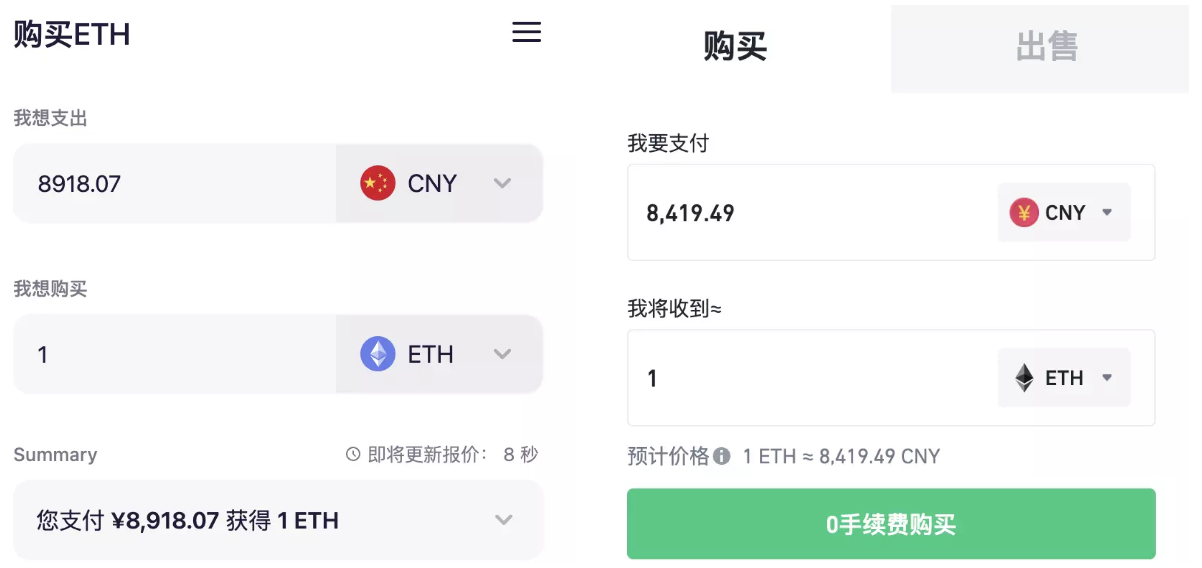
(Left is MoonPay fiat purchase on Uniswap, right is fiat purchase on Binance)
This is in serious contradiction to the information disclosed in Uniswap's official collaboration documentation. According to MoonPay's official information, when users purchase crypto assets, the service fee charged is 4.5% of each purchase or a minimum fee of $4.99. Users selling cryptocurrencies must pay a 1% fee. Currently, the fee data for MoonPay on the Uniswap interface aligns roughly with its original figures.
During a bull market, due to FOMO sentiment, users can accept such high fees. As mentioned earlier, MoonPay capitalized on the NFT summer, providing many users with a convenient channel to purchase NFTs. Especially by associating with celebrities and blue-chip NFTs, it further built its brand effect. At the same time, it continuously expands payment scenarios to accommodate a larger group. However, in a bearish market environment, this somewhat reduces new users' willingness to enter the crypto space through it.
Overall, MoonPay's platform approach has lowered the barrier for outside users to enter the crypto space, expanding the incremental market. However, its high fees limit its ability to bring a broader audience to the crypto field.
Conclusion
MoonPay's fees are high, especially when users purchase NFT assets, where the existing royalties and platform fees in the NFT market can reach around 15%. The optimistic sentiment during bull market cycles allows users to overlook such high price differences and friction, generating significant demand. In bear market cycles, users will begin to reconsider.
However, users in the crypto space rely on bull market cycles to achieve significant growth, while user growth during bear market cycles is lackluster. Therefore, MoonPay overall has expanded the channel for more users to enter the crypto space and lowered the barrier. From MoonPay's perspective, apart from profit, fees also cover costs associated with partnerships with banks and various compliance process reviews.
The issue of whether asset sources are legitimate still cannot be avoided and relies on the platform's strict review capabilities. Centralized exchanges frequently encounter issues with frozen cards and assets, one reason being lax reviews, where essentially anyone can become a market maker by simply depositing collateral. The integration of centralized exchanges' liquidity into the MoonPay platform poses one of the hidden risks for asset compliance.
However, this is a common issue that exists in the current industry and even in the internet itself, and it cannot be expected that the MoonPay platform will resolve it. From the perspective of the crypto space, the existence of the MoonPay platform provides more scenarios, allowing users to purchase crypto assets directly with fewer unnecessary procedures, and even to buy them through credit card loans, enabling a larger group to conveniently enter the crypto space, thereby providing greater imaginative space for the total valuation of crypto assets.
 Risk warning
 Risk warning