






Bankless: Leading the way at the start of the year, is Optimism overvalued?
 Optimism is facing increasingly fierce competition, but maintaining decentralization is key to its continued growth.
Written by: Ben Giove, Bankless
Compiled by: aididiaojp.eth, Foresight News
The Layer 2 war is becoming increasingly intense, and Bankless is trying to determine who the winner is through in-depth research on on-chain metrics. Last week we analyzed Arbitrum, and now let's take a look at its formidable competitor: Optimism.
Both Optimism and Arbitrum are optimistic rollup solutions, and it has become one of Ethereum's leading scaling solutions.
The concept of Layer 2 has been around for a long time, but it has gained renewed attention in recent months with the emergence of the first rollup token, OP.
OP has been one of the best-performing tokens in early 2023, with an increase of up to 227%, rising 135% relative to Ethereum. Optimism now has a fully diluted market cap of $13 billion, comparable to Solana.
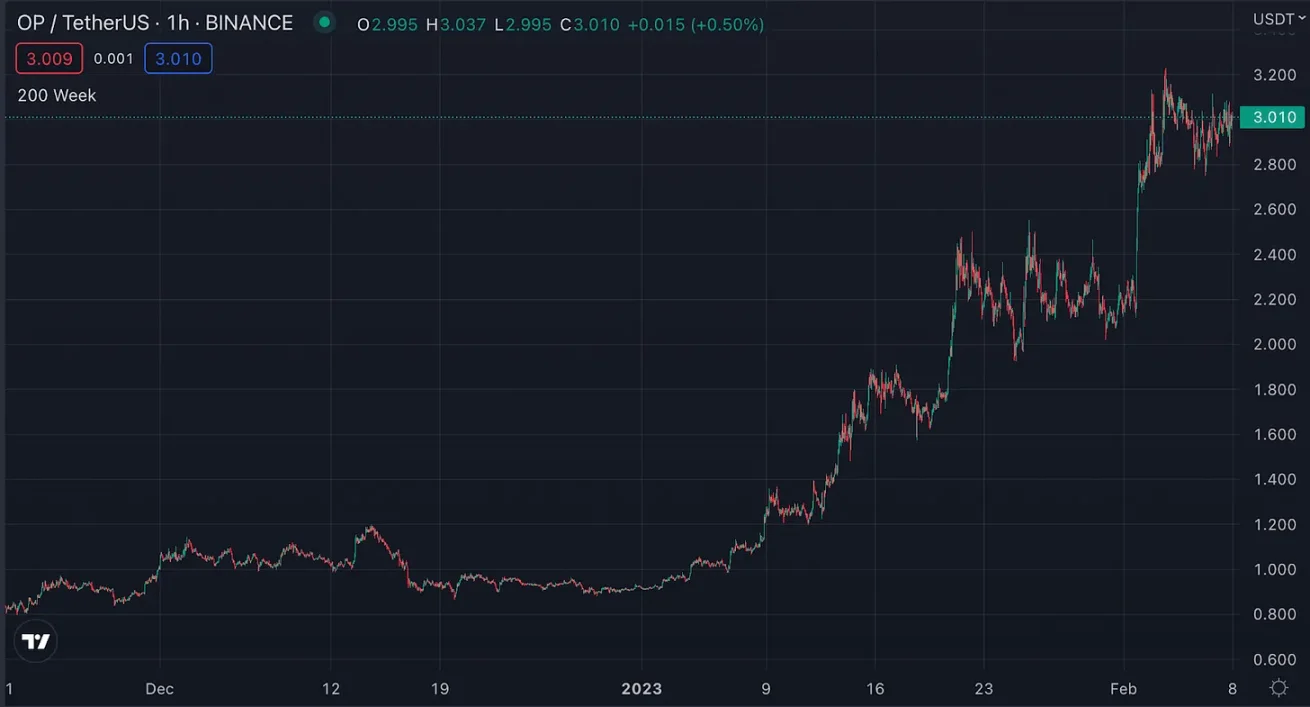
Source: TradingView
This raises some questions: Is Optimism's high valuation justified? Do the fundamentals support OP's outstanding performance? Where does Optimism stand in the fiercely competitive L2 space?
This article will attempt to answer these questions through three aspects:
Key Performance Indicators
Major DApps in the Optimism Ecosystem
Upcoming Growth Catalysts and Risk Factors
Key Performance Indicators
TVL
Optimism's DeFi TVL currently stands at $787 million, making it the second-ranked Layer 2 by TVL, only behind Arbitrum ($1.39 billion), and it is also the seventh largest blockchain network tracked by DeFi Llama.
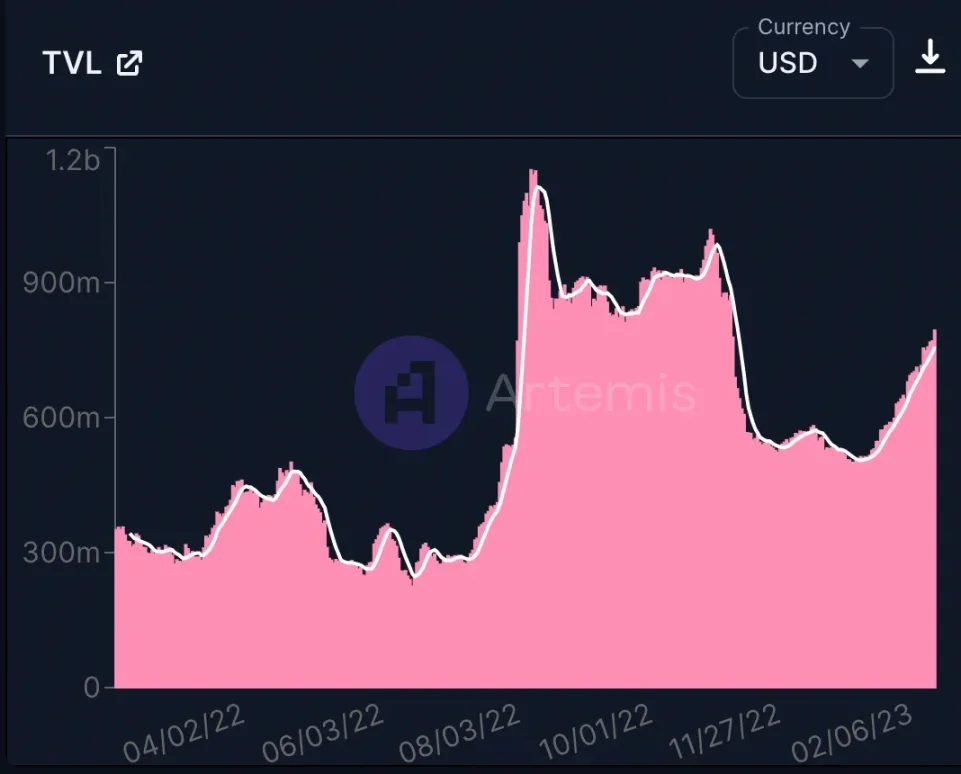
Optimism DAA - Source: Artemis
Optimism's share of the total locked value across all public chains has steadily increased over the past year, rising from 0.2% to 1.2%. Its share within Layer 2 has also significantly grown, increasing from 13.5% to 35.2% during this period.
This growth may have been driven by the governance token OP launched in April 2022. Optimism airdropped OP to platform users, becoming the first among the "Big Four L2s" (Optimism, Arbitrum, StarkWare, and ZkSync) to launch a token, which helped guide liquidity and TVL growth last summer.
Users
Optimism saw a significant increase in active addresses in 2022, with the total daily active addresses (DAA) in the fourth quarter growing by 4% compared to the first quarter.
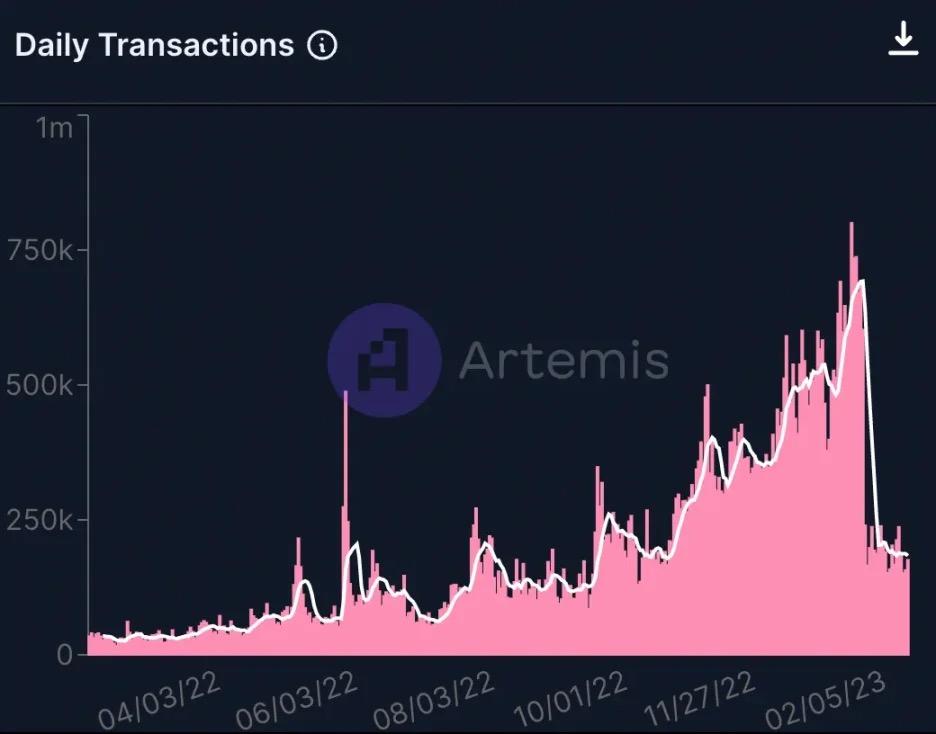
Optimism DAA - Source: Artemis
This growth can be attributed to the use of DApps on the network, such as projects within the Synthetix ecosystem, as well as the aforementioned incentive programs.
Digging deeper, we can see that DAA skyrocketed at the end of the year, with a quarter-over-quarter increase of 152.7% from Q3 to Q4. The surge in users was largely due to the launch of the Optimism Quests event, a program similar to Arbitrum Odyssey, where users could earn NFTs by interacting with dApps on the network.
Now that Optimism Quests has concluded, the number of users seems to be returning to previous levels, with a 7.2% quarter-over-quarter decline in transaction volume in Q1 2023 compared to Q4 of last year.
Transaction Volume
Like the number of users, Optimism's transaction count surged during 2022, with total transaction volume in the fourth quarter increasing by 851% compared to the first quarter. This growth peaked in the fourth quarter, with a quarter-over-quarter increase of 144.8% compared to Q3.
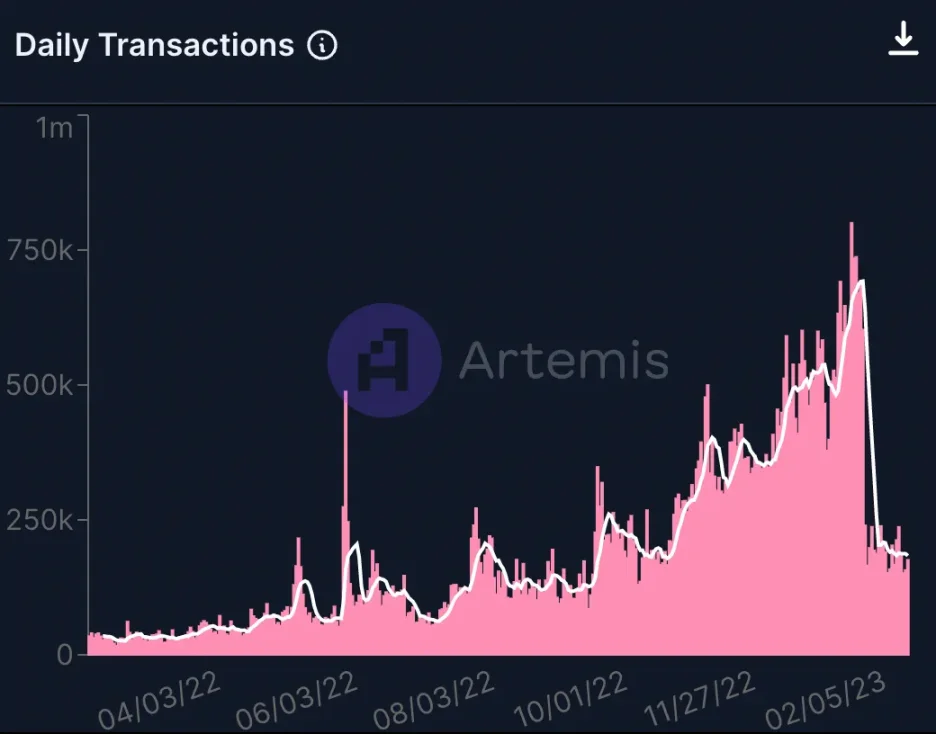
Optimism Daily Transactions - Source: Artemis
While some of these transaction metrics can be attributed to dApp usage, such as active addresses, this figure seems to have been inflated by Optimism Quests. After the Quests ended on January 18, transaction volume immediately declined in the first quarter.
Popular DApps
While not as widely used as other L2 ecosystems like Arbitrum, Optimism has an increasing number of dApps in various fields built on the OP Stack, including both general and application-specific rollups. Let's discuss some of the popular representatives below:
Velodrome
Velodrome is the largest dApp by TVL in the Optimism ecosystem, valued at $178 million. Velodrome began to emerge after Optimism airdropped OP to users who staked veVELO in July 2022. VELO holders can stake veVELO to receive NFTs as proof of eligibility for airdrop benefits on the platform.
Velodrome has discovered PMF from protocols like stablecoins and LSDs, aiming to control token releases and incentivize liquidity by rewarding veVELO stakers. Currently, veVELO can offer over 52% annualized returns for holders locking in for four years.
Although the Solidly AMM architecture is not competitive compared to Uniswap V3, Velodrome seems to have captured the core of the community and carved out a liquidity-centric niche market.
Synthetix
Synthetix is not only one of the OG DeFi protocols on Ethereum but also one of the first major protocols to migrate to L2, deploying on Optimism in July 2021.
Currently, over $193 million worth of SNX is staked on Optimism, including a supply of $48 million in sUSD. Many protocols have chosen to build projects on top of Synthetix to leverage sUSD liquidity, including perpetual contract exchange Kwenta, options AMM protocol Lyra, and parimutuel market protocol Thales.
In recent months, Synthetix has faced several challenges, the most notable being a sharp decline in fee revenue, but there are several noteworthy catalysts on the horizon, such as continued adoption of its V2 perps and the upcoming Synthetix V3.
Lattice
Lattice is a developer of on-chain games built on the OP Stack. The OP Stack is a framework for creating custom modular rollups that can interoperate if they use the same sequencer.
Lattice has developed two games: OP Craft, a Minecraft-like game where users can build in an open world, and the combat game Sky Strife.
OP Craft has only had a two-week demo so far, but both it and Sky Strife, which will launch later in 2023, will run on a custom rollup fully built using the OP Stack. Given the appeal of games in the crypto-native world, Lattice's release could serve as a significant entry point for bringing users into the Optimism ecosystem.
Future Outlook
Growth Catalysts
Optimism will have several important catalysts emerging that will help sustain its growth in the coming months.
The first is the upcoming airdrop of 10 million OP tokens in February (valued at $26.4 million at current prices). This airdrop will be distributed to various stakeholders within the ecosystem through retroactive public goods funding (RPGF), with specifics to be decided by a vote from members of the Optimism Citizen House. The Citizen House is one of two governance bodies within Optimism, with membership determined by soulbound NFTs.
The OP allocated to projects through RPGF is an important user incentive mechanism, and if the market continues to rise, it will help guide users and liquidity onto the network. In the long run, Optimism's use of RPGF and experimental governance models can help attract idealistic and long-term oriented developers.
Another upcoming catalyst for Optimism is Bedrock. Bedrock is a significant network upgrade aimed at reducing transaction costs and increasing transaction speeds. Bedrock will also help enhance Optimism's modularity by allowing rollups to transition more easily from optimistic rollups to zk-rollups. The vote to approve the operation of Bedrock is currently going through the Layer 2 governance process.
The third catalyst stimulating further growth of OP is the increasing popularity of the OP Stack. Not only are some games being developed based on the OP Craft framework, but other projects are also beginning to leverage this technology, one example being the decentralized options exchange Aevo developed by Ribbon. Aevo is an order book-based options exchange and will launch its own custom Layer 2 in the coming months.
Risks
Optimism has undoubtedly carved out a niche market and spawned many growth catalysts. Its ecosystem is growing, but it also faces increasingly fierce competition.
Optimism's incentives have proven successful in attracting users, liquidity, and application protocols to the network, but we have reason to question whether they are allocating these incentives in a way that maximizes their long-term return on investment.
So far, Optimism has distributed $69.9 million in rewards. Since November 2022, Optimism's share of TVL in L2 has decreased from 46.6% to 35.5%.
This loss has ultimately turned into gains for Arbitrum, as despite not having a token, their market share increased from 49.8% to 62.1% during this period.
Optimism still has a significant amount of dry powder in its treasury. However, Optimism airdropped a large number of tokens without new users or capital entering the cryptocurrency space and while DeFi does not dominate L2.
As networks like StarkNet, Fuel, Polygon's zkEVM, Scroll, and of course Arbitrum launch or release their own tokens, competition in the L2 space will intensify. The advantages of other use cases remain to be determined, but there are reasons to doubt that Optimism will not face challenges.
However, competition is not the biggest risk Optimism faces today.
Like Arbitrum and other Layer 2s, the greatest threat to Optimism's long-term success is the trend toward centralization of the network. According to Layer 2 Beat, Optimism has several key centralization trends, such as not yet supporting fraud proofs, having a centralized sequencer, upgradeable contracts, and lacking a mechanism to propose blocks in the event of validator failures.
Most Layer 2s have appropriate safeguards in place to minimize the risk of user fund losses. While many projects have been in development for years, rollups remain an emerging technology in the grand scheme.
However, it is absolutely critical for Optimism to achieve decentralization as quickly as possible in a secure manner, as the fund losses caused by these centralization trends could have catastrophic effects on the network's growth prospects.
Conclusion
The Optimism ecosystem is rapidly evolving, and many upcoming catalysts can help it stay on a growth trajectory. Although only about 5% of the OP supply has been released into circulation, its FDV may inflate in the short term, but Optimism's usage seems to guarantee a valuation comparable to other non-Ethereum L1 and L2 networks.
The surge in usage can largely be attributed to incentives, and Optimism has managed to leverage these incentives to ensure its position as a leading L2 alongside Arbitrum. However, with increasing competition, there are reasons to doubt whether Rollup deployed some ammunition at an inopportune time to attract the maximum number of users and liquidity.
Aside from the existing centralization issues, Optimism's silver bullet may be the OP Stack. If the OP Stack becomes the standard for developing custom L3s, Optimism should benefit immensely from the composability between rollups using that framework.
As of today, Optimism does not seem to be the leading Layer 2, but there are still many reasons to be optimistic about its future growth prospects.
 Risk warning
 Risk warning