Bitcoin's "New Cultural Movement": NFTs are Increasing Use Cases on the Network and Generating Revenue for Miners

 Fundamentalists are fiercely resisting Bitcoin NFTs.
Written by: Qin Xiaofeng, Odaily Planet Daily
Image source: Generated by Maze AI
In the past two weeks, an NFT protocol called Ordinals has gained significant attention on the Bitcoin network.
Supporters believe it offers more gameplay and use cases, enhancing Bitcoin's application scenarios beyond just value storage; opponents criticize it for deviating from Satoshi Nakamoto's vision of Bitcoin as a peer-to-peer (P2P) cash system, while also causing network congestion and driving up gas fees.
Despite the ongoing controversy, more and more projects are joining the Ordinals ecosystem. Data from Dune Analytics shows that as of the time of writing, the total number of NFTs minted through the Ordinals protocol has surpassed 100,000 (currently 118,002). In the past week, the fees spent on inscribing "Inscriptions" via the Ordinals protocol have surged, totaling $880,000; 50% of Bitcoin's block space is occupied by "Inscriptions."
"This is 100% meme-driven development," said Casey Rodarmor, the founder of the Ordinals protocol, in an interview, stating that the project's original intention was to make memes on Bitcoin more vibrant. Today, this meme culture movement is profoundly changing the ecosystem of the most classical public chain, Bitcoin.
1. NFT Protocol on the Bitcoin Mainnet
In mid-December last year, software engineer Casey Rodarmor released the NFT protocol "Ordinals," but it garnered little attention. It wasn't until the end of January this year that the situation changed—Ordinals protocol released V4 and introduced "Inscriptions" on the Bitcoin mainnet.
What are "Inscriptions"? Inscriptions are blockchain-native digital artifacts. They are created by using the Ordinals protocol to write content into satoshis (the smallest unit of Bitcoin) and can be viewed using an ordinals explorer. Inscriptions do not require separate tokens, sidechains, or changes to Bitcoin.
The content of Inscriptions includes images, text, SVG, or HTML; the content is contained within the transaction witness, usually including signatures and other data proving the transaction's authorization. During mining, Inscriptions are etched onto the first satoshi of the first output of the transaction, distinguishing them from other satoshis through marking.
According to the documentation of the Ordinals protocol, all "satoshis" written with NFT content can be saved or transferred to other Bitcoin addresses, and the transaction will display the inscription content on the Bitcoin blockchain. This content is intricately linked to "satoshis," and the Ordinals protocol turns this content into an immutable "digital artwork," allowing users to track, transfer, store, buy, and sell.
In simple terms, the emergence of the Ordinals protocol allows project developers to store information in the smallest unit of Bitcoin, satoshi, without the need for other sidechains, simplifying the processes of issuing, transferring, and trading NFTs on the Bitcoin chain.
The NFT narrative on the Bitcoin network has also attracted many "clone" versions of well-known projects. The first to emerge was Bitcoin Punks—claiming to be the first project to successfully upload the original Ethereum CryptoPunks to the Bitcoin blockchain using Ordinals. Although the minting process was somewhat cumbersome, Bitcoin Punks was still fully minted within a day, with reports of off-market prices increasing by 100 times, greatly stimulating the rise of subsequent imitation projects. (Odaily Planet Daily note: Currently, the highest sale price listed for the Bitcoin Punks series on Ordinals Market is 1.39 ETH, with the number 2273.)
Following closely, projects like OrdinalPenguins and ordrocks have emerged in droves, with the daily minting volume of the Ordinals protocol experiencing explosive growth. Data from Dune Analytics shows that on February 9, the daily minting volume of the Ordinals protocol exceeded 20,000 (20,848); as of the time of writing, the total number of NFTs minted through the Ordinals protocol has surpassed 100,000 (118,002).
In addition to leveraging well-known projects as a gimmick, some hardcore NFT players have chosen to directly destroy Ethereum chain NFTs and reissue new NFTs on the Bitcoin chain. "Bored Ape" player Jason A. Williams posted on social media that the NFT community is shifting to the Bitcoin blockchain, and the Ordinals protocol brings true scarcity to digital collectibles. Therefore, he decided to use TeleBurn to permanently destroy BAYC#1626 on Ethereum while minting it on the world's most scarce and secure blockchain, with no intention of returning to Ethereum. It is understood that BAYC#1626 was minted as "Inscription 5413" on the Bitcoin blockchain.
This approach has also been mimicked by the NFT infrastructure protocol CapsuleNFT, which launched a Bitcoin NFT series called Ordinary Oranges that can be viewed and traded on the Ethereum mainnet; holders of Ordinary Orange can destroy their NFTs on the Ethereum mainnet at any time and receive a corresponding unique inscription on the Bitcoin network, but the market has not responded positively to this approach, with no transactions currently taking place.
Compared to these unofficial and traffic-grabbing clone projects, OnChainMonkey's entry (possibly to secure a position and prevent imitation) has truly propelled the rise of the Bitcoin NFT wave. This project previously issued 10,000 NFTs on Ethereum, with a total trading volume exceeding 14,000 ETH, and now all have been synchronized onto the Bitcoin network, making it one of the well-known projects to enter the Bitcoin NFT market early.
Just this afternoon, Gabriel Leydon, CEO of Limit Break, the parent company of DigiDaigaku, tweeted that he is setting up a Limit Break Bitcoin node, and Digi Genesis collectors will be able to receive a Free Bitcoin NFT. DeGods also announced that it will mint 535 NFTs based on Ordinals on the Bitcoin chain.
2. Bitcoin Fundamentalism vs. Pragmatism
The wave of Bitcoin NFTs driven by the Ordinals protocol has also sparked controversy within the Bitcoin community, with supporters and opponents engaging in heated debates on social media.
Bitcoin fundamentalists believe that the emergence of NFTs deviates from Satoshi Nakamoto's vision of Bitcoin as a peer-to-peer cash system. Moreover, NFTs may occupy block space on the Bitcoin network, subsequently driving up transaction fees.
This is indeed the case, as data from OKLink's multi-chain explorer shows that Ordinals' "Inscriptions" are consuming 50% of Bitcoin's block space, with a block space utilization rate of 100%. Glassnode data indicates that the average block size of Bitcoin has surged from an average of 1.5 to 2 MB in early February to currently 3 to 3.5 MB; at the same time, the number of pending SegWit and non-SegWit blocks in Bitcoin's mempool has also significantly increased—this is the highest level since the FTX collapse, as shown below:
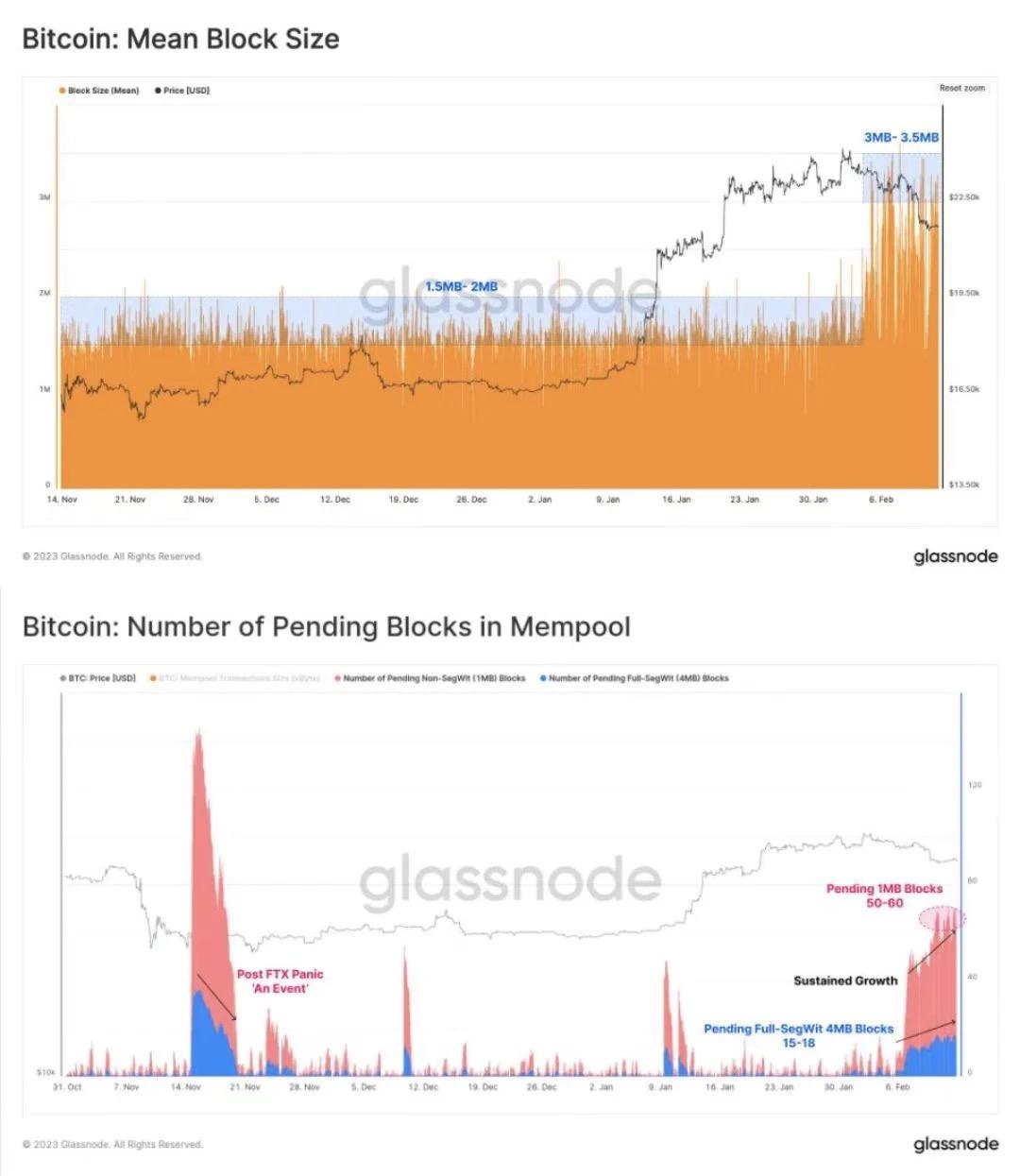
Bitcoin block size and mempool situation. Source: Glassnode
Of course, many opposing views still focus on how NFTs harm Bitcoin's original use case, with some community members stating that "allowing Bitcoin to be used for NFTs is somewhat like allowing hospitals to be used for wild parties."
Adam Back, CEO of Blockstream and a core Bitcoin developer, believes that Bitcoin's original intention is to be censorship-resistant, so at least its utilization should involve something meaningful, rather than simply wasting network space resources; issuing Bitcoin NFTs is very foolish.
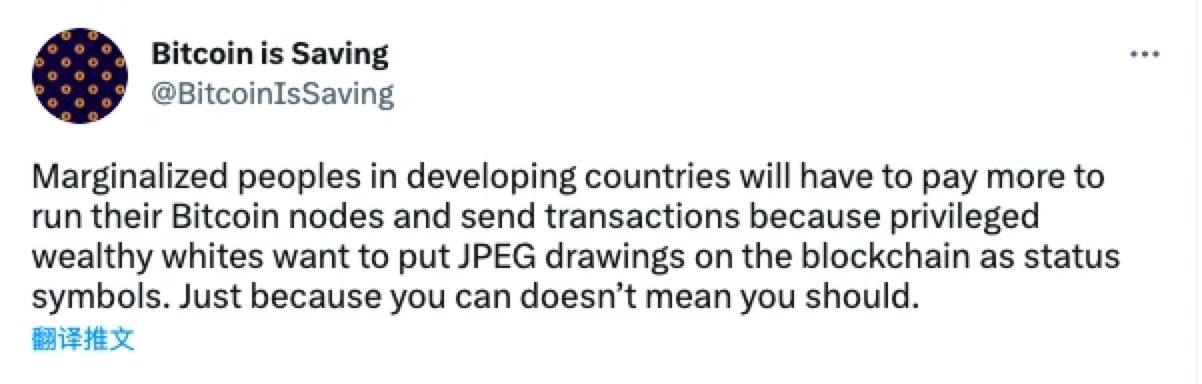
Bitcoin community KOL "Bitcoin is Saving," with nearly 300,000 followers, argues that NFT avatars are a symbol of privileged identity, accessible only to wealthy investors, and if network fees rise significantly, it will inevitably exclude more marginalized groups from the Bitcoin network, hindering the promotion of crypto adoption.
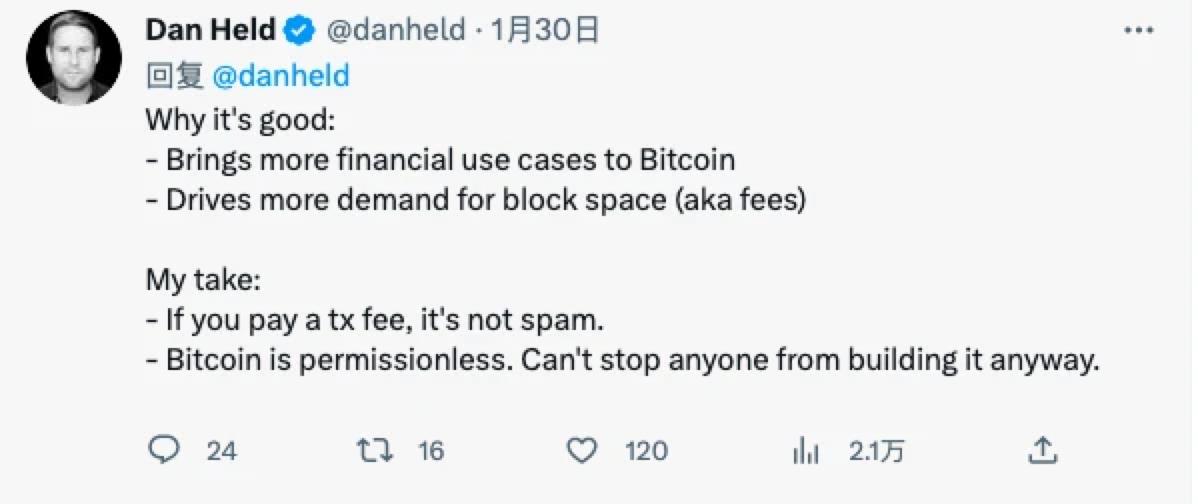
In contrast, supporters argue that the rise of Bitcoin NFTs has found new application scenarios beyond traditional value storage, providing Bitcoin with more gameplay and financial use cases. Former Kraken executive and Bitcoin bull Dan Held stated that the rise of NFTs will drive demand for block space, thereby increasing fees—"as long as you pay the transaction fee, it is not spam."
From the miners' perspective, the emergence of Bitcoin NFTs has also brought new revenue growth avenues. On-chain data shows that in the past week, the fees spent on inscribing "Inscriptions" via the Ordinals protocol have surged, currently totaling $880,000; particularly on February 15, the daily fees of the Ordinals protocol reached a new high of $170,000, accounting for 24% of the total transaction fees on the Bitcoin network that day.
For Bitcoin miners, in the current context of increasing hash power and declining mining revenue, the fees from the Ordinals protocol can alleviate financial pressure to some extent, better maintaining the security of the Bitcoin network. Especially after the halving next year, when block rewards will further decrease, increasing transaction fees on the Bitcoin network becomes particularly important.
Conclusion
In the 14 years of Bitcoin's development history, it has undergone one round of innovative narratives after another. Now, with the emergence of Ordinals and Inscriptions, this ancient public chain is linked to trendy digital artworks, which may lead to significant events beyond its current scope. Although Bitcoin network activity has surged, whether this trend can be sustained remains to be seen.
Currently, it seems that apart from Bitcoin fundamentalists who are not very satisfied, miners and project developers are generally welcoming towards Bitcoin NFTs.
 Risk warning
 Risk warning