Dialogue Tether CTO: Stablecoin operations require more guidance from regulatory agencies, hoping to see better development of DeFi

 Tether is still working to complete a comprehensive audit, covering not only recent years but also previous years. Once the audit results are finalized, they will be made public as soon as possible.
Guest: Paolo Ardoino, CTO of Tether
Interview: ChainCatcher
According to Coingecko data, the issuance of the stablecoin USDt has exceeded $83.3 billion, with a market share of over 60%, and it continues to grow. As the world's largest stablecoin issuer, Tether has always been a focal point for regulators, and its financial status and transparency have been questioned by the market multiple times. Nevertheless, after the collapse of Terra's UST and the failures of several crypto banks, Circle's USDC also briefly lost its peg, yet Tether remained stable and maintained strong growth after several crises. In May of this year, Tether announced the completion of an audit conducted by independent accounting firm BDO Italia, reporting a net profit of $1.48 billion in the first quarter, more than doubling quarter-over-quarter.
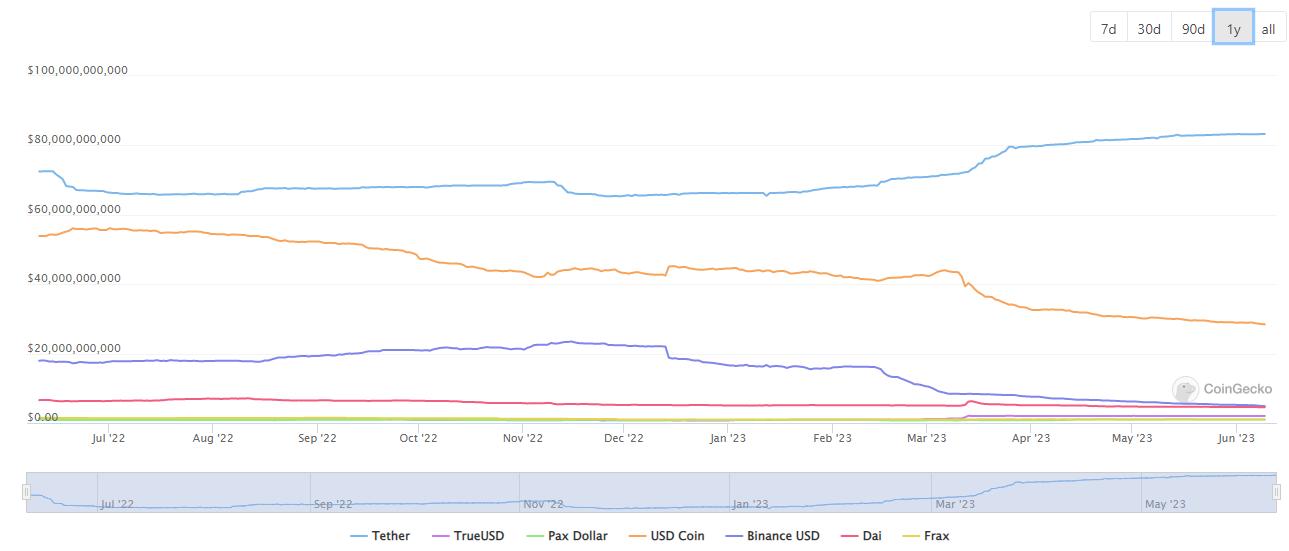
Data source: Coingecko
In light of a series of events, Tether is also taking various measures to improve transparency. Since 2017, Tether has committed to comprehensive audits, which has led to ongoing skepticism. Recently, Tether's CTO Paolo Ardoino accepted an interview with ChainCatcher, where he responded that Tether has been the first in the industry to disclose reserve composition and provide public proof, and there has been no misleading terminology such as "official audit" to confuse the public.
Currently, Tether is still working to complete a comprehensive audit that covers not only recent years but also previous years. Once the audit results are finalized, they will be made public as soon as possible.
Additionally, in the interview, Paolo Ardoino mentioned the issue of unclear regulation, stating that regulators should provide more guidance on how stablecoins operate and what reserves they should have.
Paolo Ardoino also shared insights on algorithmic stablecoins, more use cases for USDT, and Bitcoin cross-border payments. Below is the full dialogue:
1. ChainCatcher: Tether has considerable "experience" in dealing with regulators. How do you view the recent actions taken by U.S. regulators regarding stablecoins and the crypto market?
Paolo Ardoino: It is important to note that the regulatory landscape for cryptocurrencies and stablecoins is still evolving and changing. Overall, the approach to regulating the cryptocurrency market and the stablecoin industry is to strike a balance between protecting consumers and reducing risks while promoting innovation and development in the industry.
Although it remains uncertain how regulators will continue to adapt to this rapidly changing industry, we do believe that regulators should provide more guidance on how stablecoins operate and what reserves they should have. Tether is committed to operating in a safe and transparent manner while complying with all government regulations and laws.
Therefore, regulatory bodies such as the SEC and CFTC have taken steps to enhance oversight of the industry, such as requiring cryptocurrency exchanges to register with the SEC as securities dealers.
2. ChainCatcher: Is there currently an objective standard for stablecoin regulation, such as whether regulators will explicitly require stablecoin providers to disclose certain information or if there are similar disclosure requirements for custodial asset banks?
Paolo Ardoino: Currently, there is no universal standard applicable to every stablecoin company globally. Whether stablecoin companies must disclose their financial institution partners depends on the laws and regulations of the relevant countries. For Tether, we have proactively become an industry leader in transparency by providing evidence of our reserves through quarterly attestation reports. In fact, you can view Tether's transparency policy here: https://tether.to/en/transparency/.
3. ChainCatcher: Centralized stablecoins indeed cannot escape reliance on centralized issuers, and compliance with regulations may be a necessary path. Meanwhile, decentralized algorithmic stablecoins may have attempted some "de-regulation," although the collapse of UST last year led to a loss of confidence in algorithmic stablecoins. How do you evaluate algorithmic stablecoins?
Paolo Ardoino: Algorithmic stablecoins play a crucial role in the cryptocurrency ecosystem, especially on-chain. However, unlike collateralized stablecoins backed by highly liquid collateral, algorithmic stablecoins rely on market operations to maintain value. Unfortunately, these market operations often fail, leading to significant value declines. The Terra algorithmic stablecoin is one such example, ultimately proving to be under-collateralized. It employed several mechanisms to achieve stability, but ultimately none of these mechanisms worked.
In contrast, Tether (USDT) is fully backed by liquid reserves, making it less susceptible to market fluctuations compared to algorithmic stablecoins. After the collapse of Terra/Luna, investors scrutinized stablecoins more carefully and became more cautious, but it is essential to distinguish Terra and its unique algorithmic approach from other asset-backed stablecoins similar to Tether. Terra and USDt employ different designs, mechanisms, and collateral methods.
4. ChainCatcher: A recent report by Forbes raised the following question:
Tether has essentially concealed its financial status. Tether has never submitted a comprehensive audit of its reserves and has only provided incremental snapshots of its accounts in the form of periodic "attestations" prepared by third-party accounting firms (the most recent being BDO Italia)… In contrast, its competitor Circle, which manages the stablecoin USD Coin, has disclosed specific government bonds, CUSIPs, and maturity dates that support its $41 billion digital dollars.
How does Tether respond to these concerns?
Paolo Ardoino: According to our recent attestation for the first quarter of 2023, Tether continues to prioritize transparency and has made significant progress in emerging markets, becoming a reliable choice for users amid market turbulence. Tether showed a strong performance in the first quarter, with a net profit of $1.48 billion and robust reserves. Additionally, the circulating token supply increased by 20%, demonstrating high customer trust in Tether and confirming a very optimistic outlook for the company's future.
Unfortunately, some traditional media continue to spread outdated and inaccurate claims regarding our financial status. The fact is, Tether maintains a strong, prudent, and liquid portfolio, prioritizing reserve protection. We provide assurance opinions every quarter, which include comprehensive explanations proving that all Tether tokens are backed by reserves.
It is important to emphasize that Tether has been the first in the industry to disclose reserve composition and provide public proof, without misleading the public into thinking it is an official audit. Although Tether and its main competitors have not yet conducted financial audits of stablecoins, Tether is working hard to complete a comprehensive audit, covering not only recent years but also previous years. Once the audit results are finalized, we will make them public.
In addition to reserves, Tether's resilience during market volatility also demonstrates why Tether is the most trusted stablecoin globally. When Terra/Luna collapsed, Tether successfully redeemed over 10% of circulating USDt, equivalent to $7 billion, within 48 hours. From market peaks to troughs, Tether handled nearly $20 billion in redemptions. While other players favored by traditional media faltered under market scrutiny, Tether has developed into the largest, most liquid, and widely adopted stablecoin in the industry.
5. ChainCatcher: How can we further enhance user understanding of Tether's transparency?
Paolo Ardoino: Users can visit our website to view quarterly attestation opinions regarding reserves. Tether is educating and engaging users through various channels to keep our community informed. We are committed not only to providing quarterly transparency reports but also to collaborating with auditors to complete the audit work as soon as possible. Additionally, we have listened to user feedback, such as converting all commercial paper reserves into short-term U.S. Treasury bills, and we will continue to ensure that every action we take aligns with the best interests of the industry and the community.
6. ChainCatcher: Besides digital payments and cross-border payments, what other use cases and potential do stablecoins have in developing economies?
Paolo Ardoino: Stablecoins have the potential to disrupt the entire financial sector, starting with transforming digital payments and enabling seamless transactions in decentralized finance. Tether's USDt itself offers numerous benefits, enhancing business operations, simplifying processes, minimizing transaction errors, and significantly reducing credit card fraud.
The transferability of USDt between exchanges and individuals eliminates the need for intermediaries like banks, which traditionally participate in the money transfer process. Tether can provide a user-friendly buying and selling experience and is currently available on cryptocurrency exchanges. Therefore, during periods of market volatility, Tether is often used as the preferred option for holding funds on exchanges.
Stablecoins, including Tether, are also facilitating cross-border trade and remittances, particularly in emerging markets. USDt provides a stable and efficient means of dollar transmission, with tens of thousands of users from Asia, Latin America, and Europe using it daily. The adoption of Tether and other stablecoins in these regions enhances transaction efficiency, provides more arbitrage opportunities, and various other trades.
Moreover, stablecoins like Tether are empowering businesses by providing convenience, stability, and efficiency, enabling secure and rapid transactions, and reshaping the financial landscape.
7. ChainCatcher: Currently, USDt is not only used for crypto trading but has also become a retail currency tool in many developing countries, such as Latin America and Africa. For example, Lugano in Switzerland has announced USDt as legal tender, which is very significant for the entire crypto industry. What plans does Tether have to promote the widespread adoption of USDt? What challenges exist in promoting it across different countries and regions?
Paolo Ardoino: Through "Plan ₿" (a collaborative initiative between Tether and Lugano), we have broadly showcased the transformative potential of blockchain technology. By partnering with local businesses and well-known retailers (such as the famous fashion brand Guess), we demonstrate the feasibility and advantages of integrating Bitcoin and cryptocurrencies into daily life.
We can proudly say that USDt is essentially a tool for achieving financial freedom, promoting financial inclusivity and democratization. We are not just serving white-collar clients on Wall Street; instead, we are entering emerging markets where Tether tokens provide a safe haven product for the unbanked and offer them access to the global financial market.
It is also gratifying to witness organic growth of the product within communities. For instance, in countries like El Salvador and Turkey, which are plagued by severe inflation, people use USDt as a means of preserving value. Similarly, migrant workers who previously relied on expensive services like Western Union for cross-border remittances have turned to Tether. Our tokens enable them to save more of their hard-earned money, free from uncontrollable external factors.
8. ChainCatcher: How is the previously launched "Plan ₿" progressing?
Paolo Ardoino: Through "Plan ₿," Lugano has made significant strides in adopting cryptocurrencies, which are not only a breakthrough model for financial and technological innovation in Europe but globally as well. Since the launch of "Plan ₿" in March 2022, more and more merchants in Lugano (including well-known brands like Guess and McDonald's) have begun accepting Bitcoin, USDt, and Lugano's local token LVGA as payment for their products and services. The widespread acceptance of Bitcoin and blockchain technology in Lugano illustrates the potential of a free, open, and borderless monetary system.
Mainstream adoption of Bitcoin is an inevitable progression; however, like any financial system's adoption, it undoubtedly takes time. Nevertheless, as more residents and visitors in Lugano experience the convenience of using cryptocurrencies for payments, the number of stores and businesses accepting cryptocurrencies (currently at 150) continues to grow, naturally increasing the demand for Bitcoin and other cryptocurrencies. This is where our annual "Plan ₿" forum can play a role, as it can be crucial in promoting education about Bitcoin and blockchain. Through the adoption of Tether tokens, we realize that when people can easily adopt tools for financial freedom, they are willing to use them. We firmly believe that the essence of Bitcoin lies in providing individuals with the opportunity to gain financial autonomy.
9. ChainCatcher: Some viewpoints suggest that Bitcoin is more like a store of value, and due to its high volatility, it is challenging to accept it as a payment method. How do you view this?
Paolo Ardoino: We do not focus on volatility; rather, we emphasize that Bitcoin is a permissionless payment solution. Furthermore, with advancements in Bitcoin scaling technologies like the Lightning Network, its payment efficiency and adoption rate will significantly increase. Bitcoin was designed as a decentralized, peer-to-peer cash ledger system that can operate independently of fiat currencies. This is why we strongly advocate for using Bitcoin as a peer-to-peer network to promote global financial inclusivity.
To further achieve this goal, Tether remains committed to supporting the development and adoption of the Lightning Network and similar technologies to enable seamless integration of Bitcoin. Additionally, we will continue to invest in and support the Bitcoin community, including developers and white-hat hackers, to strengthen the Bitcoin network's robustness, resilience, and immutability. Promoting the widespread use of Bitcoin as a means of peer-to-peer financial transactions enables us to achieve global financial inclusivity.
10. ChainCatcher: Do you have any recent updates about Tether that you would like to share with us?
Paolo Ardoino: For Tether, freedom of communication and financial freedom are complementary. In addition to stablecoins, we are also focusing on building peer-to-peer application platforms like Holepunch. Last year, we launched a peer-to-peer text and video chat application called Keet in collaboration with Bitfinex and software company Hypercore, utilizing the framework provided by Holepunch to establish a more efficient and decentralized connection for users while maintaining a high level of security and privacy through encryption.
Furthermore, to continue the achievements of the "Plan ₿" initiative, we will once again hold a two-week summer school in Lugano, primarily aimed at training people to understand Bitcoin and peer-to-peer technology and how they can bring about financial freedom and promote freedom of speech. The course topics will focus on Bitcoin, the Lightning Network, stablecoins, peer-to-peer technology, mining, blockchain analysis, regulation, and self-regulation. The "Plan ₿" summer school will allow participants to collaborate with industry leaders to develop peer-to-peer prototypes, deepen their understanding of technology, and help shape the next generation of founders, developers, and creators.
We will hold the second "Plan ₿" forum in Lugano on October 20-21, 2023, where we will gather world leaders, technology experts, and entrepreneurs to discuss national-level Bitcoin adoption, economics, financial freedom, and freedom of speech.
11. ChainCatcher: Which specific areas of cryptocurrency do you personally find promising?
Paolo Ardoino: I believe the stablecoin sector will continue to grow. Although the entire stablecoin space will have to face more challenging obstacles related to the regulation and systemic risks of traditional banking systems. Tether has shown the most resilience in the face of market volatility, and given that USDt is supported by highly liquid conservative reserves, I believe Tether's competitors will also improve. We welcome innovation and fair competition; after all, if this field is dominated by only Tether, it cannot be called an "industry." Users should not have only one choice.
Additionally, I hope to see more development in the decentralized finance (DeFi) sector in 2023. In recent months, we have seen numerous issues with centralized traditional institutions and exchanges. Decentralization should be the pursuit of builders in the crypto spirit. Keeping money in one's own wallet or on one's phone or laptop is what people need, and it is what DeFi should focus on. DeFi is a way to solve real-life problems for people, which aligns closely with Tether's vision.
If we forget the original vision of Bitcoin's creation and only focus on speculation and competing over the latest meme coins, we will return to square one—where the current banking system remains the sole representative of the financial industry.
 Risk warning
 Risk warning