The new roadmap for Starknet has been released. Which DeFi protocols are worth focusing on for interaction?

 The V3 trading structure to be released in the first quarter of next year will support paying transaction fees with STRK.
Original Author: Karen, Foresight News
Recently, Starknet released a new roadmap, which outlines plans to support the use of STRK to pay transaction fees in the V3 transaction structure, hinting at the imminent launch of the STRK token.
What are the five major points identified in Starknet's new roadmap? How far has the Starknet token process progressed? Which DeFi protocols are worth focusing on for interaction?
Starknet Roadmap Major Update Identifies Five Key Points
According to Starknet's latest roadmap, five major points have been identified: improvements in network stability, V3 transactions, transaction fee markets, reducing L1 costs using EIP-4844, and lowering transaction costs through the Volition model.
In terms of network stability improvements, Starknet released the v0.12.0 version in July this year, regarded as a "quantum leap," focusing on increasing network throughput and making significant improvements to the sequencer. Subsequently, Starknet v0.12.1 (optimizing transaction efficiency) and v0.12.2 (enabling P2P authentication and enhancing maximum throughput and TPS) were released on the mainnet. This month, Starknet v0.12.3 (removing support for Starknet feeder gateways) was released on the testnet.
The V3 transaction structure being built by Starknet will support paying transaction fees with STRK. The V3 transaction structure will also support the following features (not all available in Starknet V0.13.0):
Fee Market: A fee market starting from Starknet v0.14.0 that allows users to optimize their transaction processes during congestion.
Paymaster Mechanism: Similar to EIP-4337, allowing entities other than the transaction sender to pay transaction fees through fee abstraction.
Volition Model: Used to reduce data availability costs, introducing hybrid state design, allowing users to choose their preferred data availability model.
Nonce Generalization: Enabling users to send multiple transactions simultaneously by specifying different channels for different transactions.
Account deployment will occur during the account's initial call or declaration transaction.
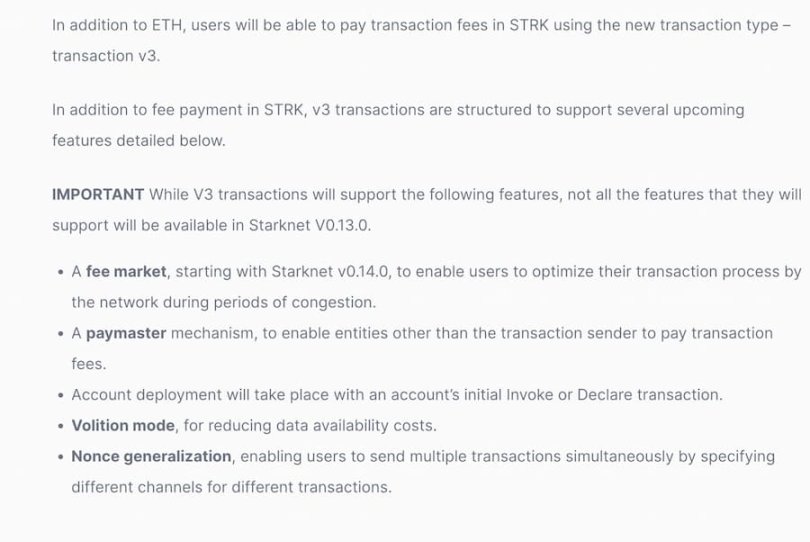
According to the SNIP 10 proposal regarding the STRK fee token, one of the main purposes of STRK is to serve as a fee payment token on Starknet. However, the original transaction version will continue to use ETH as the fee token. The Starknet sequencer will use off-chain STRK < > ETH price feeds provided by Pragma Oracle. Starknet explains that this is only a temporary solution for centralized situations, and long-term decentralized protocol proposals will be released later.
Additionally, Starknet plans to use EIP-4844 to reduce L1 costs. EIP-4844 reduces transaction fees by introducing blob-carrying transactions.
Some planned dates for Starknet network upgrades are as follows:
December 11, 2023: Launch of V0.12.3 mainnet.
December 5, 2023: Launch of V0.13.0 Goerli testnet. This date may be postponed by a week to December 13 if necessary.
January 22, 2024: V0.13.0 mainnet, pending governance vote.
Starknet Token Distribution Model and Progress
In November 2022, Starknet deployed the STRK token on the Ethereum mainnet, with the contract address: 0xCa14007Eff0dB1f8135f4C25B34De49AB0d42766. STRK will be used as a staking token for participating in the Starknet consensus mechanism, a governance token, and for paying transaction fees.
Regarding transaction fees, Starknet previously stated that fees are expected to be paid solely using the native STRK token. The plan to use both STRK and ETH as transaction fees may only be a transitional measure.
There has been intense discussion in the Starknet forum about the potential risks to the sequencer from the decision to use both STRK and ETH as transaction fees.
STRK staking may also be used to ensure the network's activity and security, with services potentially including sequencing, achieving temporary L2 consensus before reaching L1 finality, STARK proof services, and data availability provision.
Starknet disclosed its tokenomics in mid-2022, with a maximum total supply of 10 billion STRK tokens, of which:
17% is allocated to StarkWare investors;
32.9% is allocated to core contributors, including StarkWare and its employees and advisors, as well as Starknet software development partners;
50.1% is granted by StarkWare to be distributed by the foundation, including:
9% as community provisions for individuals working on Starknet and supporting or developing its underlying technology;
9% as community rebates (for partial payment of fees for joining Starknet from Ethereum); 12% for funding research and work for the development, testing, deployment, and maintenance of the Starknet protocol;
10% as a strategic reserve for funding ecosystem activities aligned with the foundation's mission;
2% is decided by Starknet token holders and the foundation to be donated to reputable institutions and organizations, such as universities and NGOs;
8.1% is unallocated and will further support the Starknet community as decided by the community.
All tokens allocated to core contributors and investors will be subject to a four-year lock-up period (with a one-year complete lock-up followed by linear release).
Since the beginning of this year, Starknet's pace of decentralization and token distribution has also been accelerating. In March 2023, the Starknet Foundation announced the appointment of five committees, including:
Provisions Committee responsible for planning, supervising, and executing the supply of the Starknet ecosystem token STRK;
Early Adopters Grant Committee dedicated to promoting the development of the Starknet ecosystem by providing funding to innovative teams building on-chain applications on Starknet;
Developer Collaboration Committee will introduce the Starknet ecosystem by nurturing and supervising new strategic developer partnerships;
Governance Committee's task is to play a key role in the ongoing decentralization of the Starknet ecosystem;
Ecosystem Access Committee is responsible for authorizing new developers and community members and integrating them into the Starknet ecosystem.
In May, the Starknet Foundation announced the first round of 67 awarded projects for the Starknet Early Adopters Grant (EAG) program. The total budget is 10 million STRK tokens, accounting for 0.1% of the initial token issuance of STARK (10 billion), which will be distributed to projects through multiple rounds.
Among the awarded projects, those launched on the mainnet before April 5 of this year can unlock 100% of the grant tokens, while projects on the testnet can immediately unlock 25%, with the remaining 75% distributed within two months after launching on the mainnet. Currently, there are 429 addresses holding STARK, most of which may be token donations.
In October, the Starknet Foundation also launched the Starknet Early Community Members Program (ECMP), aimed at recognizing community contributors who have contributed to Starknet so far, planning to allocate 50 million STRK tokens to individuals who contributed in the early days of the network, including those rewarding technical discussions, organizing Starknet-related events, and regularly publishing Starknet brand content. The application window has now closed, and the committee will make a decision on December 29, 2023.
Which DeFi Protocols Are Worth Focusing On?
According to L2B EAT data, Starknet currently has a locked value of $169 million, which includes all assets cross-chain to Starknet but not yet used. However, according to DefiLlama data, the locked value of DeFi on Starknet is only $35 million.
Source: DefiLlama
Although Starknet's locked value in Layer 2 is not impressive and has stagnated since August this year, its ecosystem is steadily expanding. The following is the ecosystem map released by Starknet in late this month.
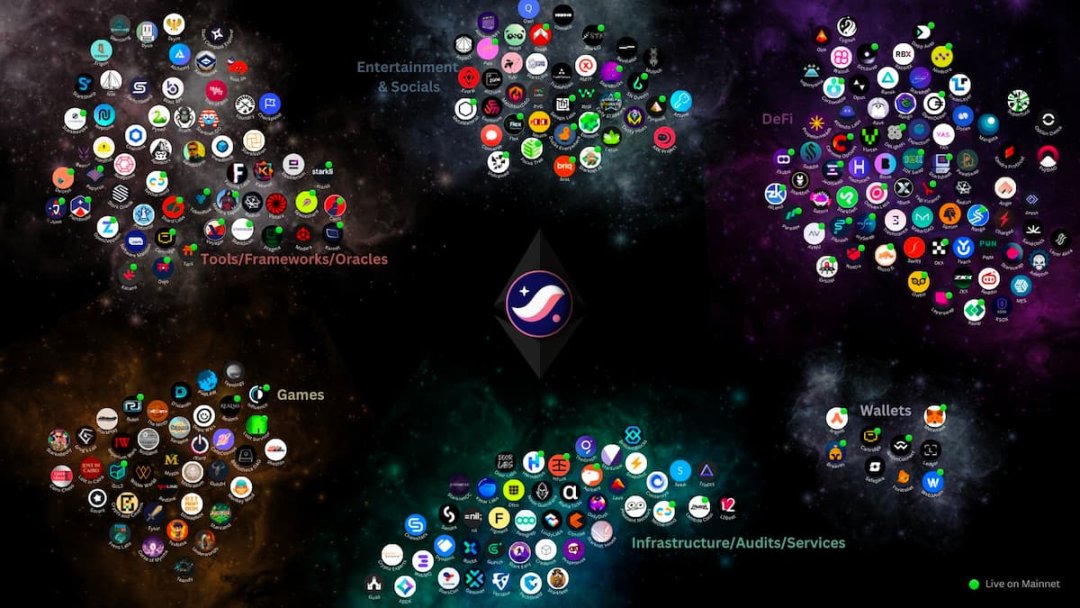
To guide and promote the development of the DeFi ecosystem on Starknet, the Starknet Foundation announced the establishment of a DeFi Committee in November, tasked with researching, designing, and executing on-chain liquidity, with a budget of 5 million STRK.
The DeFi Committee is chaired by six members: Starknet Foundation administrator Damian, Argent co-founder and CEO Itamar Lesuisse, zkLend co-founder Jane Ma, AVNU co-founder and CEO Mentor, Nostra product lead Richard Thomas-Pryce, and ZKX CTO Vitaly Yakovlev.
The author has selected eight DeFi protocols worth focusing on for interaction and provides a brief introduction.
JediSwap
JediSwap is a permissionless and composable AMM protocol on Starknet, built by the Mesh Finance community. JediSwap launched on the Starknet mainnet in December 2022, currently with a TVL of approximately $10 million, ranking first on the Starknet network.
JediSwap received a grant of 150,000 STARK tokens in May this year, and prior to that, in January 2022, JediSwap also received a grant awarded by StarkWare.
In JediSwap, liquidity providers can earn a fee of 0.3%, proportional to their share in the liquidity pool. Fees are added to the pool, accumulating in real-time, and can be claimed by withdrawing liquidity. In recent months, JediSwap has also launched a ZAP feature, allowing users to swap any single token to any JediSwap LP position with just one Starknet transaction. According to the roadmap released by JediSwap in Q2, index products will be launched in Q1 of next year.
Ekubo
Ekubo is an AMM protocol in the Starknet ecosystem led and advised by former Uniswap team engineer Moody Salem. Ekubo adopts concentrated liquidity and a "till" model, where all pools are managed in a single contract, and token transfers are delayed until the transaction is completed when users swap with the pool or update positions on Ekubo. Aggregators can keep them in Ekubo for later use, completely avoiding costly token transfers.
Additionally, Ekubo supports customizing pool behavior by writing extension contracts, allowing third-party developers to utilize the Ekubo AMM protocol to build oracles, new order types, trading strategies, and even privacy solutions.
According to Moody Salem, he joined Uniswap Labs as the fifth employee in April 2020, wrote most of the early Uniswap interface, created the token list, wrote the first swap routing algorithm for V2 and V3, submitted about half of the V3 code, and ultimately led the design of V4.
In October this year, Ekubo published a proposal discussion on the Uniswap governance forum, proposing to establish a partnership with Uniswap DAO in exchange for a 20% share of future Ekubo protocol governance tokens, funded with 3 million UNI (approximately $12 million).
Subsequently, the Uniswap community voted to approve the "Invest in Ekubo Protocol" temperature check proposal, but Ekubo decided not to proceed with the proposal regarding Uniswap DAO's investment in Ekubo and will not put the proposal to on-chain voting, citing that implementing the proposal through the requested changes would impose a heavy burden on Ekubo and distract from the focus on Ekubo protocol development.
mySwap
mySwap is an AMM protocol on Starknet that launched a new version last month, featuring a concentrated liquidity (CL) configuration that allows liquidity to be provided for specific price ranges to enhance capital efficiency or for the entire price range. As of the time of writing, mySwap's locked value is close to $7 million.
SithSwap
SithSwap is a dual liquidity engine AMM that supports variable pools (similar to UNI V2) and stable pools (similar to Curve) trading. SithSwap is based on a dual-token incentive system, consisting of the native SITH token and xSITH (a transferable utility and governance token), both provided as rewards.
SithSwap completed a $2.65 million seed round financing at a valuation of $25 million in June 2022, led by Lemniscap, with participation from Big Brain Holdings, GSR Markets, D Web3 Capital, Ghaf Capital Partners, and others.
SithSwap disclosed its tokenomics early on, with a total supply of 100 million SITH tokens, of which:
50.1% is used for releasing rewards, distributed over the next three years;
10% is allocated to core contributors, released linearly over 1.5 years;
6.8% is allocated to the treasury, of which 2% is allocated to partnerships and 4.8% to the development fund;
10.6% is allocated to seed round investors;
22.5% of the genesis portion, with 15% for public sale, 5% for initial liquidity, and 2.5% entering the genesis pool as xSITH, distributed linearly over 6 months.
The following is the modified token release schedule for SithSwap from three months ago, indicating that governance tokens will be released this quarter.
AVNU
AVNU has developed a request for quote (RFQ) system and DEX aggregator on Starknet, aggregating liquidity from 10 kSwap, JediSwap, mySwap, Ekubo, SithSwap, and others. In the RFQ system, the AVNU API integrates off-chain liquidity from professional market makers using the RFQ system, which is more suitable for large transactions. For direct routing, AVNU charges a fee of 0.02%; for complex routing, AVNU charges a fee of 0.15%.
The leading smart contract wallet on Starknet, Argent, will integrate AVNU on its mobile wallet, allowing users to exchange tokens across multiple trading platforms.
AVNU has also introduced a points system that allows users to earn points through trading, with the number of points related to transaction frequency, transaction amount, and other factors.
zkLend
zkLend is a native L2 money market protocol built on Starknet, completing a $5 million seed round financing in March 2022, led by Delphi Digital, with other investors including StarkWare, Three Arrows Capital, Alameda Research, MetaCartel DAO, Amber Group, Genesis Block Ventures, and others.
zkLend officially launched on the Starknet mainnet in October this year, with features including multi-call input, support for more assets (including wstETH), and more. According to the zkLend roadmap, cross-chain lending and zkLend institutional MVP will also be enabled in Q4.
zkLend has also disclosed its tokenomics on its official website, with a total supply of 100 million tokens, 17% allocated to private and public investors, 15% allocated to the team and advisors, 17% allocated to the ecosystem, and 35% allocated to staking and distribution rewards.
The zkLend white paper states that the ZEND token can be staked and exchanged for stZEND, allowing stZEND holders to share protocol revenue, enhance release rewards, and gain governance rights.
Nostra
Nostra is developed by the team behind the yield tokenization and fixed-rate protocol Tempus, serving as a liquidity layer on Starknet, supporting lending and trading services. Nostra will also launch a Starknet native stablecoin UNO pegged to the US dollar. Users can deposit ETH into Lending and convert it to iETH-c, which serves as collateral for minting UNO.
Tempus Labs allocated 5 million DAI to Nostra in August last year to support the development of the Nostra ecosystem.
Note: Most Starknet native projects are in the early stages of development, and users should interact with caution. Investors should conduct thorough research and due diligence to understand the risks and potential returns before interacting with any protocol.
 Risk warning Risk warning


Popular articles