




In 3 months, planned financing exceeds 1.5 billion USD, Bitcoin mining companies prepare ammunition for the new halving

 Halving meets BitcoinFi, is it an opportunity or a reshuffle for mining companies?
Author: flowie, ChainCatcher
Editor: Marco, ChainCatcher
Every Bitcoin halving is a stress test for mining companies.
Around April 2024, Bitcoin will experience its fourth halving. At that time, the block reward for Bitcoin will decrease from 6.25 to 3.125 Bitcoins. The halving will increase mining difficulty, affecting the income of mining companies, while the anticipated price increase associated with the halving will also make mining more profitable.
Large mining companies are preparing in advance for the halving by actively raising funds through various means such as equity financing, credit borrowing, and selling Bitcoins to prepare ammunition for the upcoming Bitcoin halving.
According to incomplete statistics from ChainCatcher, from the end of October 2023 to the end of January 2024, at least more than 11 Bitcoin mining companies announced financing, raising over $700 million. In addition, some mining companies are still actively seeking financing. On October 31 last year, Bitcoin mining company Marathon Digital submitted an S-3 form to the SEC, planning to raise up to $750 million through a mixed equity offering.
Active Financing by Mining Companies on the Eve of Halving, Amounts May Exceed $1.5 Billion
The threat of Bitcoin halving is very intuitive for most mining companies. In addition to the income from mining block rewards being cut in half, the production and operational costs of mining companies are increasing.
According to the latest report from Grayscale, in 2023, the 7-day average hash rate surged from 255 EH/s to 516 EH/s, an increase of 102%, significantly exceeding the 41% growth rate of 2022. With the substantial increase in computing power, the difficulty and cost of Bitcoin mining are also rising.
Many mining companies have recently spent considerable amounts to purchase new mining equipment. For example, Bitcoin mining company CleanSpark announced the acquisition of three Bitcoin mining facilities in Mississippi for $19.8 million. Crypto mining companies Phoenix Group and CleanSpark purchased Bitcoin mining machines worth $187 million and 160,000 Bitcoin mining machines from Bitmain, respectively.
Faced with the dual challenges of reduced income and increased expenses, Bitcoin mining companies have raised funds over the past four months to alleviate short-term financial pressure.
According to data from crypto data platform RootData, from the end of October 2023 to the end of January 2024, there were almost 4 to 5 financing deals each month, with most financing amounts in the tens of millions of dollars.

The largest financing deal was the IPO completed by Bitcoin mining company Phoenix Group in December last year. Phoenix Group completed a $371 million IPO on the Abu Dhabi Securities Exchange (ADX), attracting $12 billion in funds, with a 33-fold oversubscription.
In addition to Phoenix Group, Australian Bitcoin miner Arkon Energy also completed a financing round of over $100 million in the same month, led by Bluesky Capital Management, with participation from Kestrel 0x1, Nural Capital, and others. Earlier, on October 24, Bitcoin mining company Crusoe Energy announced a $200 million financing commitment from investment firm Upper90.
Additionally, two mining companies have raised amounts exceeding $50 million. Canaan Creative raised $75 million through two rounds of preferred stock issuance for research and development, expanding production capacity, and other general corporate purposes. Core Scientific, which has completed bankruptcy restructuring, announced in December 2023 that its $55 million equity issuance had been oversubscribed.
Some Bitcoin mining companies are still in the process of financing. On October 27 last year, Bitcoin mining company Marathon Digital, valued at $6 billion, submitted an S-3 form to the SEC, planning to raise up to $750 million through a mixed equity offering. According to the document, Marathon Digital plans to use most of the raised funds to purchase more Bitcoin mining machines. Subsequently, another mining company, Bitfury, also planned to sell 10 million shares of Cipher Mining common stock to potentially raise nearly $30 million.
If financing goes smoothly, it is expected that Bitcoin mining companies may cumulatively obtain over $1.5 billion in financing before and after the halving.
In addition to actively seeking financing, Bitcoin miners are also selling large amounts of Bitcoin to obtain liquidity. According to CryptoQuant data, from early January 2024 to early February, the Bitcoin reserves (unsold Bitcoins held in company-related digital wallets) decreased by 8,400 coins, down to 1.8 million coins. The last time this level was reached was in June 2021.
Halving Meets Bitcoin FOMO, Are Mining Companies Facing Opportunities or Restructuring?
While debt and equity financing can temporarily alleviate financial pressure, in the long run, they also lay greater financial risks for mining companies after the halving.
Since the Bitcoin halving primarily affects block reward income, mining companies like Bitmain, which mainly sell mining machines, are relatively less affected. In contrast, mining companies represented by Marathon Digital, Hut 8, and Riot, which rely on mining and holding coins for their main revenue, face higher debt ratios and leverage, as they can only rely on improving Bitcoin mining efficiency and the appreciation of Bitcoin for profit. Their revenue is strongly correlated with Bitcoin prices, and such mining companies may face insolvency during bear markets.
Looking back at the last halving cycle (May 2020), although Bitcoin prices rose by 72% in the six months following the halving, most mining companies that primarily relied on mining and holding coins faced greater net losses after the halving.
For example, Marathon Digital saw its total revenue reach $159 million in 2021, a 35-fold increase from $4.37 million in 2020, as the crypto market entered a bull market and Bitcoin prices peaked at nearly $70,000. However, the total operating costs in 2021 also increased 26-fold compared to 2020, resulting in a net loss that expanded from over $10 million in 2020 to over $37 million in 2021. As the crypto market entered a bear market in 2022, Marathon's net loss expanded to $686 million.
Similarly, Riot's net loss in 2022 also reached $510 million; Core Scientific applied for bankruptcy protection at the end of 2022 due to excessive losses; and mining companies like Argo sold assets due to debt.
In the new halving cycle of 2024, mining companies still face similar financial challenges. According to a mining report released by CoinShares, it is predicted that the average production cost for each Bitcoin after the fourth halving in 2024 will be $37,900. Most miners will face challenges related to sales and administrative expenses and will need to reduce costs to maintain profitability. Unless Bitcoin prices remain above $40,000, only Bitfarms, Iris, CleanSpark, TeraWulf, and Cormint are expected to remain profitable. The Hashrate Index predicts that more mergers, acquisitions, and asset sales among mining companies will occur in 2024 and 2025.
Although the 2024 halving presents challenges for mining companies, it also introduces some noteworthy new variables and opportunities compared to the previous three halvings.
Looking back at 2023, with the explosion of the Bitcoin ecosystem, the mining industry and mining companies experienced a degree of recovery. The total annual revenue of Bitcoin mining (transaction fees and mining rewards) approached $10 billion, with total revenue gradually climbing each quarter. According to Hashrate Index statistics, nearly every publicly listed mining company saw significant increases in stock prices, market capitalization, and company valuations in 2023. The financial health of publicly listed Bitcoin mining companies is better compared to 2022.
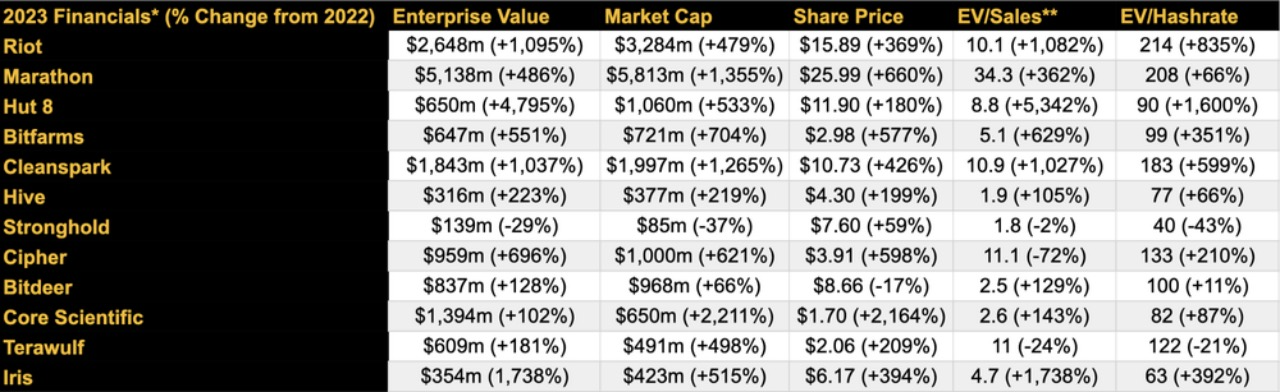
Several mining companies significantly narrowed their net losses in 2023. For instance, Marathon reduced its net loss from $686 million in 2022 to $268 million; Riot narrowed its loss from $510 million in 2022 to $288 million.
In addition to block rewards, Bitcoin mining revenue also comes from transaction fees. As block rewards halve, the importance of transaction fees will increase. The explosion of Ordinals and inscriptions in 2023 has significantly raised transaction fees, bringing new opportunities for mining companies.
According to data from Hashrate Index, in 2023, transaction fees accounted for 7.6% of block rewards, compared to only 1.5% in 2022. On November 20, 2023, transaction fees on the Bitcoin network surpassed those on the Ethereum network for the first time, setting a historical record.
As Bitcoin continues to rise this year, if the trading volume of inscription activities continues to increase, and the concentrated explosion of Bitcoin Layer 2 attracts more developers and users, it could drive innovation and activity on the Bitcoin network, making the resulting transaction fees one of the most important sources of income for miners.
Additionally, after the approval of the Bitcoin spot ETF in the U.S. at the beginning of the year, it may also help offset some of the selling pressure from mining issuance, thereby positively impacting Bitcoin prices and alleviating the asset-liability ratio of Bitcoin mining companies.
Overall, although the expansion of various dimensions of Bitcoin brings some opportunities for mining companies, the revenue challenges posed by the halving remain severe. Mining companies need to control costs and seek more revenue models.
 Risk warning Risk warning