Lawyer's reminder: Be careful when signing a promissory note for lending virtual currency, you might not get it back!

 A sued B in court with evidence such as the IOU and USDT transfer records, requesting repayment. This essentially means that the court recognizes the legality of using virtual currency as a substitute for monetary payment, and thus, judicial support will not be granted.
Source: Mankun Blockchain
01 Real Case
Recently, a lawyer from Mankun encountered a virtual currency lending case. The case is roughly as follows: Party B issued a promissory note to Party A, stating that Party B borrowed 500,000 yuan from Party A for a term of one year. After the debt matured, Party B refused to repay for various reasons, and Party A, feeling helpless, sued in court, requesting the return of the 500,000 yuan specified in the promissory note.
The lending between Party A and Party B was not that simple. The court determined that the amount lent by Party A was a transfer of 70,000 USDT to Party B. Specifically, Party A and Party B had a prior verbal agreement that since Party B was receiving virtual currency, Party A would first transfer the virtual currency to Party B, who would then provide Party A with the corresponding cash equivalent. Finally, Party A would hand over the 500,000 yuan in cash to Party B, thereby fulfilling the loan agreement (see the diagram for specific steps). During the trial, Party B did not raise any objections to the promissory note or the USDT transfer records provided by Party A, but Party B denied ever receiving the 500,000 yuan from Party A, thus arguing that Party A had not lent money to Party B as agreed, and therefore Party B did not need to repay.
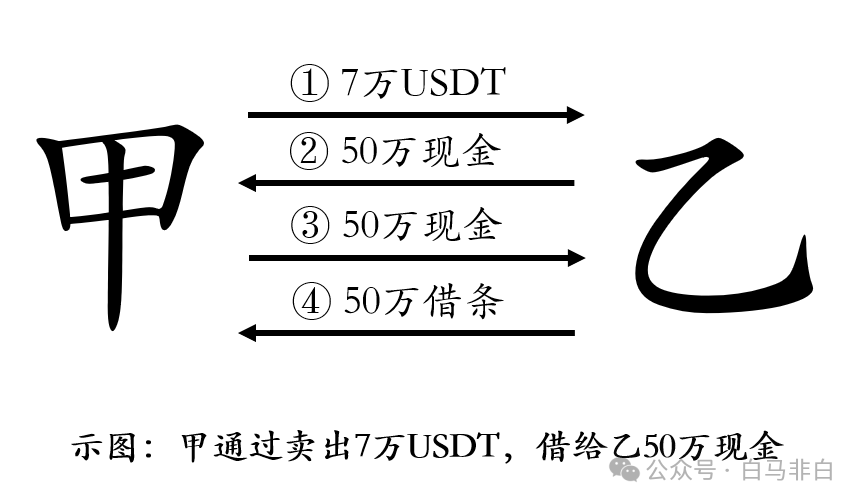
02 Court's View: Dismissal
After hearing the case, the court ultimately dismissed all of Party A's claims. The reasoning was roughly as follows: According to notices and announcements issued by the People's Bank of China and other ministries, virtual currency does not possess the attributes of legal tender and coerciveness, and is not a true legal currency issued by the central bank; therefore, it cannot and should not circulate or be used as currency in the market. Additionally, referring to the Supreme Court's guiding case No. 199, "Gao Zheyu vs. Shenzhen Yunsil Road Innovation Development Fund Company and Li Bin's Application for Revocation of Arbitration Award," it also should not support disguised exchange transactions between virtual currency and legal currency. Based on this, the court determined that Party A's act of transferring virtual currency instead of delivering cash violated public order and good morals, thus ruling to dismiss all of Party A's claims.
From the aforementioned operations of the loan between Party A and Party B, it can be seen that both parties recognized that virtual currency could not circulate as legal currency and consciously took preventive measures to avoid legal risks, namely agreeing to first convert virtual currency into legal currency before completing the loan delivery. Unfortunately, Party A did not actually convert the virtual currency into cash (regardless of whether the buyer of the virtual currency was Party B or someone else) before handing the cash to Party B. In fact, Party A, seeking convenience, directly transferred virtual currency worth 500,000 yuan to Party B as a substitute for fulfilling the loan of 500,000 yuan. In other words, Party A treated 70,000 USDT as 500,000 yuan directly and believed that it had the right to demand repayment from Party B based on the promissory note. However, from the court's perspective, if Party A's claim were supported, it would effectively acknowledge that the act of using virtual currency as money is legal.
In general, in private lending, if the parties agree on the loan amount and the lender actually delivers other easily liquidated assets, such as equivalent scarce goods, short-term bonds, or bearer stocks, it can be considered that the lender has already lent the money as agreed. However, virtual currency, as a special type of virtual asset, has the exchange value of a general equivalent. If the court recognizes the validity of replacing cash payments with virtual currency transfers, such judicial endorsement would contradict the current premise in China that denies the circulation of virtual currency as legal currency.
The practice of issuing promissory notes for lending virtual currency, or situations where the promissory note states that money is borrowed while virtual currency is actually delivered, is becoming increasingly common. Given the difficulty of filing civil cases or criminal reports involving currency in reality, lenders often believe that as long as the promissory note specifies that money is borrowed and does not mention virtual currency, having the promissory note provides protection, thinking they are foolproof. However, they are unaware that in private lending disputes, the court needs to consider multiple facts to determine whether the loan actually occurred—when the borrower requests repayment, they must not only present the promissory note but also provide evidence to prove that the "loaned funds" were actually delivered to have the right to demand repayment under legal or agreed circumstances.
03 How Can Lenders Retrieve Their Currency?
As mentioned earlier, Party A, holding the promissory note and USDT transfer records, sued Party B for repayment, which is equivalent to relying on the court's acknowledgment that using virtual currency as a substitute for cash payments is legal, and thus would not receive judicial support. Since virtual currency cannot be "used as money," Party A's transfer of USDT to Party B cannot be regarded as Party A having lent funds as agreed, hence Party B would argue that since Party A did not "lend money," Party B also does not need to "repay money."
Although Party A did not "spend money" and Party B did not "receive money," the court recognized the fact that Party A actually transferred virtual currency and Party B received the virtual currency during the trial. The reason Party A transferred virtual currency worth 500,000 yuan was to fulfill the obligation of lending 500,000 yuan to Party B. Since the court believes that Party A's act of transferring virtual currency cannot replace the act of lending money, then Party B's receipt and possession of 70,000 virtual currencies have no legal basis. Given that virtual currency can be legally held as a virtual commodity, it is also an object that the law should protect; therefore, according to the unjust enrichment clause stipulated in Article 122 of the Civil Code, Party A has the right to demand the return of the virtual currency from Party B.
In judicial practice, there is a viewpoint that citizens bear the risk of investing and trading virtual currency and are not protected by law. For instance, according to the first item (fourth) of the notice issued by the People's Bank of China and other ministries regarding "further preventing and handling the risks of virtual currency trading speculation," it states that "……investing in virtual currency and related derivatives, which violates public order and good morals, renders the relevant civil legal acts invalid, and the resulting losses shall be borne by the investors themselves……" However, this viewpoint is not valid—on one hand, the scope of loss-bearing in the aforementioned notice is already controversial, and on the other hand, the regulations of the aforementioned ministries should not contradict the principle of property return after the invalidation of acts stipulated by higher laws. For specific analysis, refer to the previous article "If there are disputes over investing in virtual currency, can the investment funds be refunded?" In cases where virtual currency is obtained without legal basis, it should be treated similarly to cases of erroneous transfers or theft, and Party B should return the virtual currency to its rightful owner, while Party A has the right to request its return. Imagine if Party A demands the return of virtual currency that Party B possesses without reasonable basis, and if the court ignores this under the so-called "risk-bearing" rationale, it would be equivalent to supporting Party B's behavior of "borrowing money and not needing to return the currency."
04 Mankun Lawyer's Advice
1. In private lending involving virtual currency, try to avoid situations where "currency is replaced by virtual currency." Such deceptive operations can backfire. When lending virtual currency, it is sufficient to directly state that it is virtual currency on the promissory note.
- Directly transferring virtual currency to the borrower can help avoid receiving dirty money, reduce transaction costs, and minimize time costs like T+1, but using virtual currency directly as money carries greater legal risks.
 Risk warning Risk warning