






Hong Kong opens virtual asset ETF channel: Is the expected scale of 500 million USD conservative or optimistic?

 When estimating the scale of inflowing funds, why do various institutions place such importance on southbound funds?
Author: Hedy Bi, OKLink Research Institute
The approval of Bitcoin spot ETFs is no longer a new topic. According to a report from Reuters yesterday, at least three offshore Chinese asset management companies will soon launch virtual asset spot ETFs in Hong Kong (Bitcoin spot and Ethereum spot ETFs). The Hong Kong government's strong support for Web3 and the frequent favorable policies have become a consensus expectation in the industry. The OKLink Research Institute observed that the approval of Bitcoin and Ethereum spot ETFs in Hong Kong did not cause as much of a stir in the market as the approval of Bitcoin spot ETFs in the United States. However, during media inquiries, we learned that people are more concerned about the amount of funds involved and the deeper significance behind it. In this article, I will explore the following questions from the perspective of a "Hong Kong stock trader":
1. Why do institutions place such importance on southbound funds when estimating the scale of fund inflows?
Since July 2022, ETFs have been included in the "Stock Connect" program. This plan allows investors from mainland China and Hong Kong to trade and settle stocks listed in each other's markets through their domestic securities exchanges and clearing houses, thus creating two categories of funds: southbound funds (from mainland China to Hong Kong) and northbound funds (from Hong Kong to mainland China).
If southbound funds are approved, the virtual asset market represented by Bitcoin will become a new financial market for both China and the United States. According to publicly available data from the China Securities Regulatory Commission, as of December 31, 2023, although there are only 8 southbound qualified ETFs available for mainland investors, their daily trading volume reaches 108.3 billion RMB (approximately 15 billion USD). This means that 5% of the qualified ETFs available for southbound trading have attracted 16% of the fund inflows into the Hong Kong Stock Exchange (RMB channel).
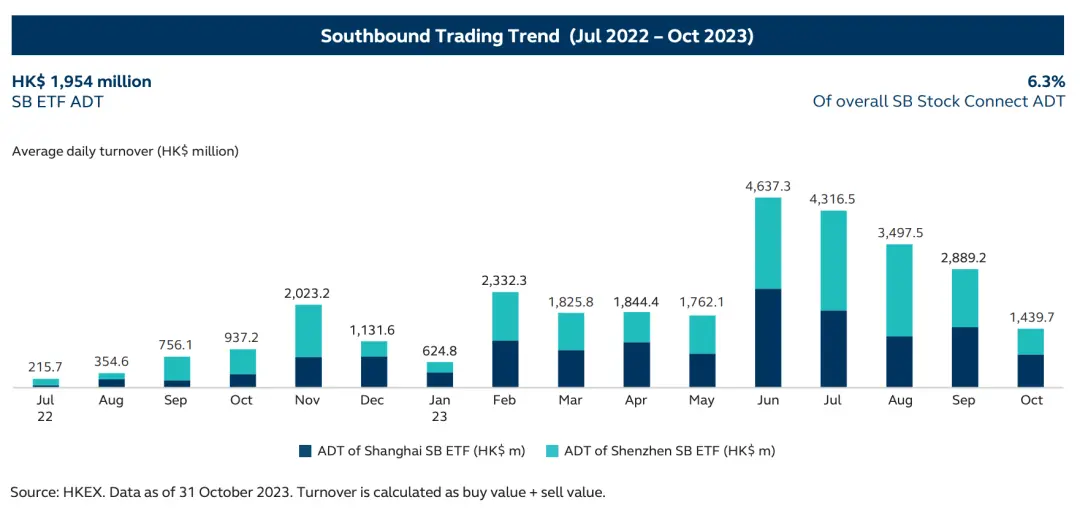
However, we also noticed that the number of qualified ETFs entering the Hong Kong ETF market through the Shanghai-Hong Kong Stock Connect / Shenzhen-Hong Kong Stock Connect channels is quite limited. In addition, the Hong Kong Securities and Futures Commission proposed in its 2024 outlook to strengthen Hong Kong's position as a global leading offshore RMB center through "Swap Connect," "HKD-RMB dual counter model," and a dual counter market maker mechanism. Considering the current attitude of mainland China towards virtual asset trading, after communicating with relevant financial markets in Shanghai and Hong Kong as well as Web3 industry insiders, the OKLink Research Institute concluded that the likelihood of Hong Kong's Bitcoin and Ethereum spot ETFs being opened to mainland investors in the short term is extremely low. Based on the comprehensive opinions of various regulatory agencies and industry insiders, we believe that under the current circumstances, mainland residents cannot invest in Bitcoin and Ethereum spot ETFs through the Shanghai-Hong Kong Stock Connect / Shenzhen-Hong Kong Stock Connect.
However, the funds cashed out through the Shanghai/Shenzhen-Hong Kong Stock Connect can only return along the original path in the local settlement system, meaning that RMB funds entering and exiting through the Stock Connect will not remain in the Hong Kong market in other asset forms, which implies that offshore RMB is not within the Stock Connect channels.
2. U.S. Bitcoin ETF vs. Hong Kong ETF, does Hong Kong still have attractiveness?
We noted that Bloomberg's senior ETF analyst Eric Balchunas believes that $500 million would be a rather optimistic figure. However, we firmly believe that the potential of the Hong Kong virtual asset ETF market far exceeds this figure. This article will analyze from three aspects: the risk preferences of Hong Kong ETF investors, the state of the Hong Kong virtual asset market before the announcement, and the setting of ETFs in both regions.
Eric Balchunas compared the ETF market sizes and indeed found that the overall size of the Hong Kong ETF market is much smaller than that of the U.S., but we also discovered an interesting phenomenon. Among the top ten ETFs in Hong Kong, the ETF ranked first by AUM accounts for 54% of the total AUM, while in the U.S., it is only 20%. This indicates that the distribution of investors in the Hong Kong ETF market is uneven, with over 50% of investments concentrated in the top tier.
Moreover, the ETF with the highest AUM in the Hong Kong market is also the gold ETF (SPDR GOLD TRUST) used for comparison by Bitcoin investors, with an AUM of approximately $69.8 billion, while the top ETF in the U.S. ETP market is based on the S&P 500, with an AUM of approximately $518.7 billion, and SPDR GOLD TRUST's AUM accounts for 13.5% of the U.S. market's top ETF. Therefore, we can conclude that **the head effect in the Hong Kong ETF market is more pronounced, and compared to U.S. ETF investors who are more inclined to invest in U.S. stocks (such as the S&P 500), *Hong Kong investors show a greater interest in investing in gold.* This indicates that investors in the two markets may have different understandings of risk preferences and economic cycles. The Hong Kong market is likely to have a greater acceptance of Bitcoin as "digital gold."

Data Source: HKEX, ETFdatabase
Regarding enthusiasm for Bitcoin, the people of Hong Kong seem to have a higher level of enthusiasm. During a field study of the Hong Kong virtual asset OTC market at the end of last year, the OKLink Research Institute found that as of January this year, there were at least 200 physical crypto OTC exchange shops in the Hong Kong virtual asset market. According to our estimates, the average annual trading volume through exchange shops exceeds $10 billion. Before the ETF channel was available, Chainalysis also estimated the Hong Kong market: despite having a much smaller population than the U.S., the active OTC cryptocurrency market in Hong Kong drove a trading volume of $64 billion during the bear market (from June 2022 to June 2023). Compared to other regions in Asia, Hong Kong dominates large institutional cryptocurrency trading. In Hong Kong's annual virtual asset trading, 46.8% of transactions are institutional trades exceeding $10 million, higher than the global average for similar transactions.
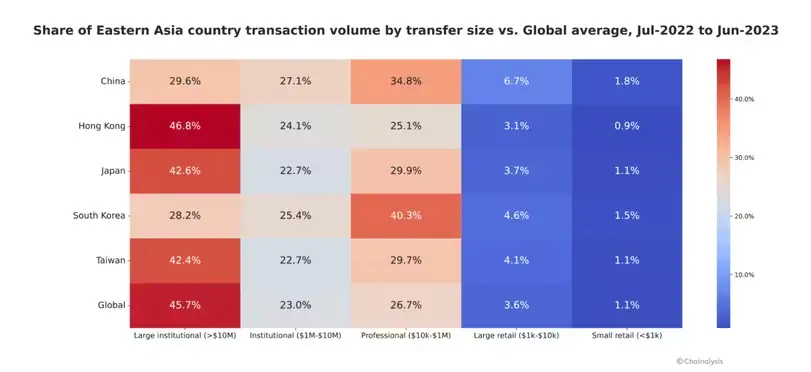
Data Source: Chainalysis
Additionally, regarding the redemption mechanism, due to Hong Kong's comprehensive regulatory framework in the virtual asset market, the physical redemption mechanism will be more favorable for "crypto-native" investors. The four methods of "coin in, cash out," "coin in, coin out," "cash in, coin out," and "cash in, cash out" are more flexible than the cash redemption mechanism in the U.S. (the last one) and also present arbitrage opportunities. Furthermore, we believe that for Hong Kong investors who already hold BTC and ETH, the probability of obtaining illegal funds when converting Bitcoin to fiat currency is significantly reduced, thus protecting investors' assets.
As for the Ethereum spot ETF, although Ethereum currently has a market capitalization of $371.7 billion compared to Bitcoin's $1.25 trillion market cap, the issuer has more motivation to promote it. This is because the Ethereum spot ETF not only benefits from price appreciation but also offers additional yields from staking. As early as February 7, 2024, local time, Ark Invest submitted an updated S-1 amendment application that included "the sponsor may from time to time stake a portion of the trust assets on one or more trusted third-party staking platforms."
For qualified investors in Hong Kong, especially large transaction investors, as far as we know, the management fees in Hong Kong are not advantageous so far. However, there are other factors to consider regarding fund inflow. The current fund rate of 0 for FBTC does not rank first in terms of fund inflows, which may be related to FBTC's choice of self-custody rather than third-party custody (Coinbase, Gemini).
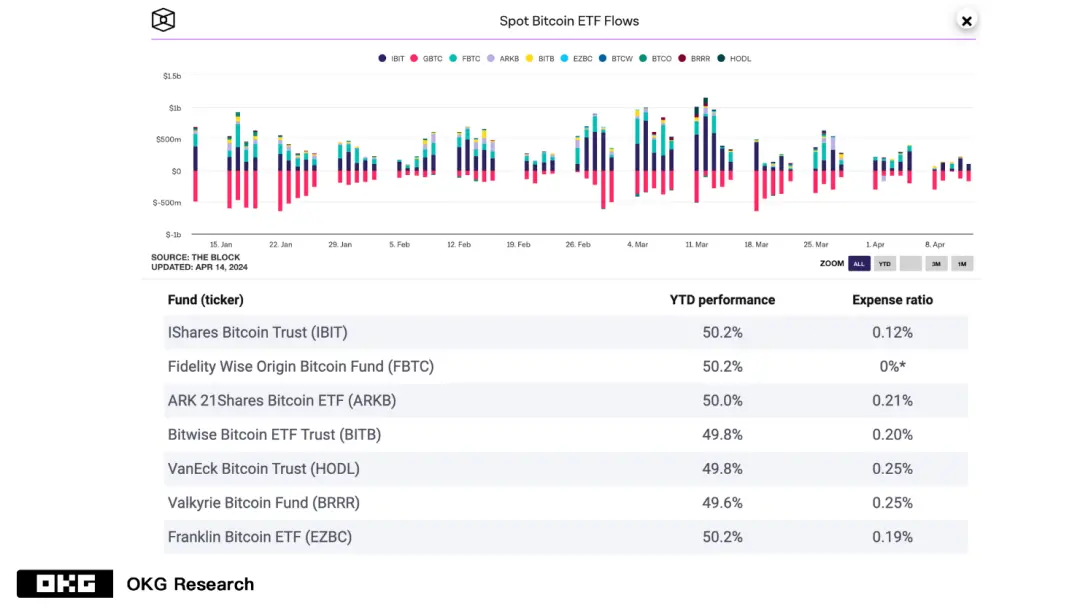
Data Source: The Block, Public Info
Hong Kong's layout of Web3 and the opening of more familiar ETF channels carry deeper significance. This is not only a favorable adjustment for financial institutions due to the overall "shrinkage" of assets on their balance sheets but also a strategic move for those who wish to remain at the "table" or even lead the new financial table. With the favorable fundamentals such as Bitcoin halving, we look forward to the future potential of Hong Kong's virtual asset spot ETFs!
 Risk warning
 Risk warning