When the first stock of stablecoins, Circle, decides to tear off the label
 Core Viewpoint

 The next focus of market observation will be the timeline for the launch of the Arc mainnet, the market acceptance of the ARC token after it becomes publicly tradable, and the impact of the subsequent implementation of the U.S. GENIUS Act and Clarity Act on the overall competitive landscape of stablecoins.
Author: Chloe, ChainCatcher
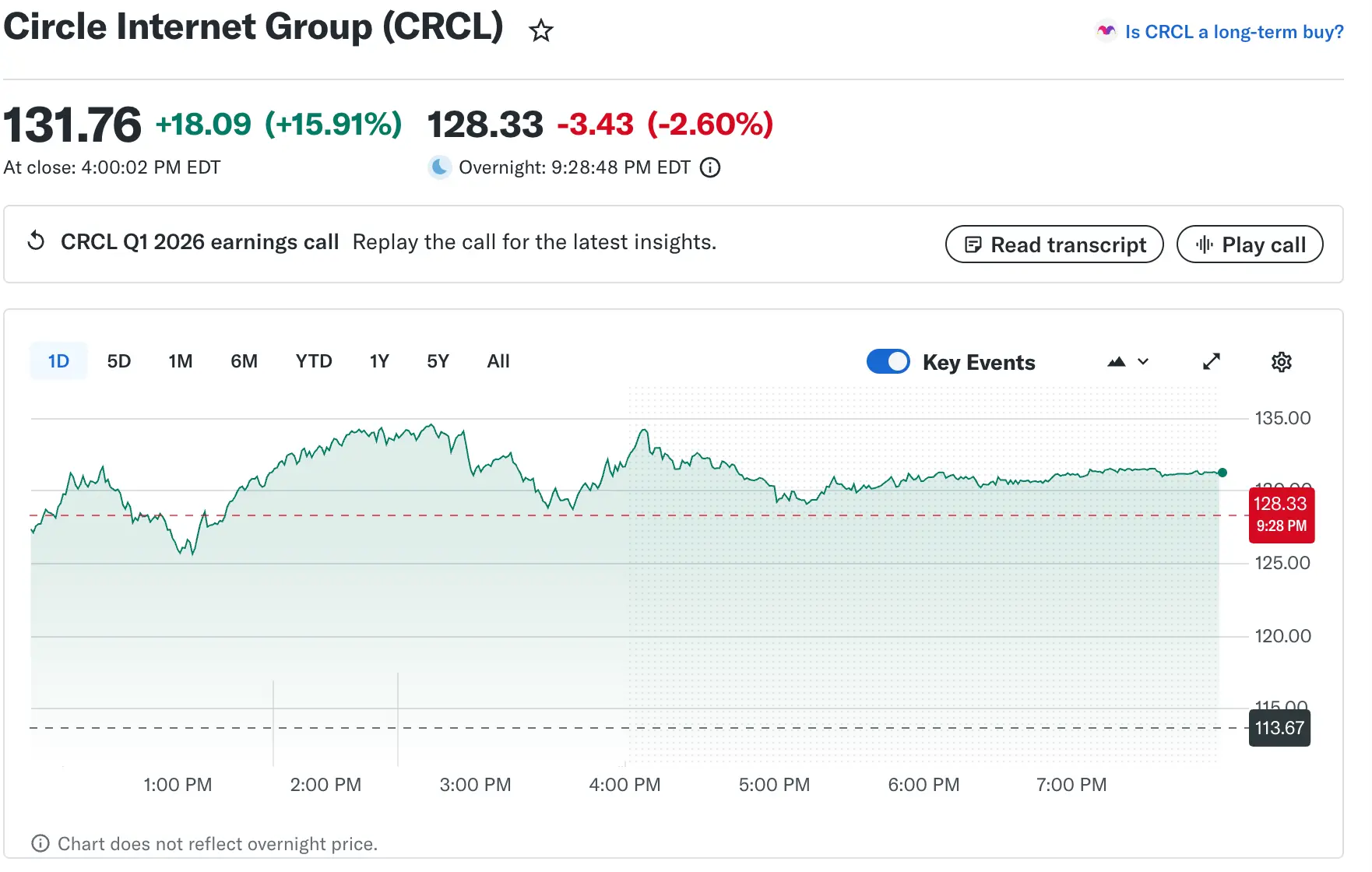
Circle announced its Q1 2026 financial report before the market opened yesterday, delivering a report card with double-digit year-on-year revenue growth and simultaneously disclosing that its new public chain Arc's native token completed a $222 million presale at a $3 billion valuation. Despite a 15% year-on-year decline in net profit due to stock compensation and operational investments, market focus remained on the long-term narrative of Arc and AI agent payments, with CRCL's stock price soaring nearly 16% on the day, closing at $131.76, a new high since mid-March.
USDC Scale Hits New Highs, On-chain Transaction Volume Up 263% Year-on-Year
Circle's total revenue and reserve income for Q1 reached $694 million, a 20% year-on-year increase. Among them:
Reserve Income: $653 million, a 17% year-on-year increase, mainly benefiting from a 39% year-on-year increase in the average circulation of USDC, but partially offset by a 66 basis point year-on-year decline in reserve yield (down to 3.5%).
Other Revenue: $42 million, nearly doubling year-on-year, reflecting strong growth in subscription, service, and transaction income.
Net Profit from Continuing Operations: $55 million, a 15% year-on-year decline, mainly due to stock compensation and related payroll taxes after the IPO, as well as increased investments in products, distribution, and operational infrastructure.
Adjusted EBITDA: $151 million, a 24% year-on-year increase; adjusted EBITDA margin of 53%.
It is noteworthy that both revenue and net profit fell short of Wall Street analysts' expectations prior to the financial report release. According to Bloomberg, sell-side analysts had initially predicted revenue of about $720.8 million and a reserve yield of 3.56%, both of which were not met; however, the adjusted EBITDA of $151 million exceeded the market expectation of $137.9 million, providing some support. This also indicates that the interest rate environment will be one of the most critical external variables for Circle moving forward.
Additionally, on the operational side, the circulation of USDC reached $77 billion, a 28% year-on-year increase; the on-chain transaction volume of USDC in Q1 reached $21.5 trillion, a 263% year-on-year increase, reflecting a significant increase in the use of stablecoins as a medium for payment and settlement.
According to Visa Onchain Analytics data, USDC accounted for 63% of stablecoin transaction volume in Q1; meanwhile, Circle's USYC has become the world's largest tokenized money market fund as of May 7. Other key operational metrics include the end-of-period "platform retention" amount for USDC at $13.7 billion, a 254% year-on-year increase; the number of "active wallets" holding over $10 in USDC reached 7.2 million, a 47% year-on-year increase, and the stablecoin market share was 28%, a year-on-year decline of 62 basis points, directly reflecting competitive pressure from Tether and other competitors.
Public Chain Arc Completes $222 Million Token Financing, Impressive Investor Lineup
Circle also announced that its Layer 1 public chain Arc, aimed at institutional finance, has completed a $222 million presale of its native token ARC, with a fully diluted network valuation of $3 billion. According to the crypto asset data platform RootData, the financing was led by a16z with a $75 million investment, with participation from over ten institutions including BlackRock, Apollo Funds, Intercontinental Exchange (ICE), Standard Chartered Ventures, ARK Invest, and Bullish.

Circle CEO Jeremy Allaire stated that the company is transforming from a stablecoin issuer to a broader internet platform company, entering the operating system and application business. In terms of token distribution, Circle holds 25% of the initial supply of 1 billion tokens, with 60% allocated to network builders and participants, and 15% for long-term reserves.
It is important to note that Circle stated that this financial report did not include the financial impact of the ARC Token presale, the Arc incentive program, and future revenues related to Arc.
Reiterates Previously Announced Full-Year Performance Guidance, No Adjustments Made
Additionally, Circle launched a series of "Agent Stack" products, including Circle CLI (command line tool), Agent Wallets (agent wallets), and Agent Marketplace (agent marketplace), allowing developers and merchants to establish, fund, and monetize AI agent-driven activities using USDC across multiple public chains and payment protocols.
The financial report revealed that Circle Payments Network (CPN) reached a transaction volume of $8.3 billion as of March 31, annualized based on activity over the past 30 days. The newly launched Managed Payments in April allows financial institutions to offer stablecoin payment services without managing digital assets themselves.
New USDC enterprise use cases include: Kyriba embedding USDC into corporate treasury systems, and Polymarket expanding the use of USDC as a core collateral and settlement asset.
Finally, regarding the outlook for the full year 2026, Circle chose to reiterate its previously announced performance guidance without any upward or downward adjustments. Specifically, USDC circulation is still expected to maintain a 40% compound annual growth rate (CAGR) over several years; other revenue for FY2026 is estimated to be between $150 million and $170 million, RLDC profit margin is expected to be between 38% and 40%, and adjusted operating expenses are projected to be between $570 million and $585 million.
Similarly, this guidance does not include the financial impact of the ARC Token presale, the Arc incentive program, and future revenues related to Arc, indicating that once the Arc ecosystem is successfully launched, there is room for upward adjustments in subsequent figures.
Majority of Wall Street Analysts Give Bullish Ratings
After the financial report was released, CRCL surged about 16% on the day, closing at $131.76, a new high since March 18, with a cumulative increase of 66% this year, bringing its market capitalization back to about $35 billion.
Wall Street analysts hold an overall optimistic view of Circle's stock performance over the next 12 months. According to TipRanks, the consensus target price is $138.5, with Citigroup's Peter Christiansen giving a 12-month target of $243, and Bernstein's Gautam Chhugani giving a target of $190; along with ten other analysts, all have given a "buy" rating.
However, analysts remain cautious about short-term execution risks. Clear Street analyst Owen Lau pointed out that while the narratives around Arc and Agent Stack are eye-catching, "they are not yet substantive businesses." Needham & Co.'s John Todaro specifically mentioned that recent hacking incidents affecting DeFi protocols could indirectly impact USDC use cases: "How would it affect Circle's business if funds leave DeFi?" William Blair's Andrew Jeffrey believes that CRCL's stock price will still experience high volatility in the short term, but Circle has significant advantages in "stablecoin commerce," with multiple catalysts advancing simultaneously.
It can be seen that Circle's financial report shows that the scale of the stablecoin business is still rapidly expanding, but the unit economics are compressed by interest rates and distribution costs. The market is willing to give a 16% single-day increase, betting more on the Arc public chain, ARC token economy, and AI agent payments being able to reposition Circle from a stablecoin issuer to a "network financial operating system" in the medium to long term, and open up second and third growth curves beyond the existing USDC interest margin model.
Perhaps the next focus of market observation will be the timeline for the Arc mainnet launch, the market acceptance of the ARC token after public circulation, and the impact of the subsequent implementation of the US GENIUS Act and Clarity Act on the overall competitive landscape of stablecoins.

 Risk warning