No issuing coins, only charging tolls: Visa's stablecoin strategy is tougher than that of issuers
 Core Viewpoint

 For VISA, it doesn't matter whether there is a winner or not; what matters is that the winner ultimately has to source from me.
Author: Chloe, ChainCatcher
Visa announced its Q3 2026 financial report, with net revenue of $11.6 billion, a year-on-year increase of 14%. The payment volume for the quarter surpassed $40 trillion for the first time in the company's history. However, what truly caught the market's attention was the statement about stablecoins during the earnings call.
Visa announced its membership in the Open Standard Alliance and support for the new stablecoin OpenUSD, while emphasizing that it will maintain a multi-currency, multi-chain strategy. Through the product structure of the Visa stablecoin platform, the controversies among OUSD alliance members, and the concentration data of the stablecoin market, what exactly is Visa planning?
Key Points Behind the Financial Report
On July 28, 2026, Visa released its Q3 2026 financial report. With net revenue of $11.6 billion and earnings per share of $3.32, CEO Ryan McInerney stated that both figures exceeded the company's expectations. At fixed exchange rates, payment volume increased by 10% year-on-year, and the number of transactions processed also grew by 10% to 72 billion, with cross-border transaction volume, payment transaction volume, and processed transactions all maintaining double-digit growth, with cross-border being the segment with the highest gross margin for Visa.
The other side of the financial report is less rosy. Visa also disclosed that it is cutting jobs, primarily focused on the technology and product teams, with a GAAP severance charge of $563 million for the quarter, and repurchased $4.9 billion in stock while distributing $1.3 billion in dividends. The company raised its full-year outlook but clearly directed the freed-up resources towards three areas: AI, stablecoins, and agency commerce.
In other words, this is a financial report that trades layoffs for investment capacity, and what truly deserves attention is where the laid-off resources will be allocated.
From Blockchain to Application Layer, Visa is Laying the Foundation for Stablecoins
During the earnings call, Visa's description of stablecoins was comprehensive. The company stated that it has invested in every layer of stablecoins, from blockchain, issuance, wallets, infrastructure, all the way to the application layer, with this quarter's progress focusing on issuance and application ends. The action on the issuance side is joining the Open Standard Alliance, which plans to issue OpenUSD—a new stablecoin designed for global capital flow.
What the Visa Stablecoin Platform is Actually Selling
On the application side is the Visa Stablecoin Platform (VSP). This product was launched in mid-July and is positioned to allow financial institutions, fintech companies, and crypto-native organizations to gain stablecoin capabilities through a Visa-managed environment, including deposits, custody, and redemption, initially supporting OUSD. The earnings call provided a more complete functional outline: this platform enables partners to settle with Visa using stablecoins, obtain on-chain wallet-as-a-service infrastructure, and transfer funds between fiat and stablecoins.
Pismo and the Subtle Underline of Tokenized Deposits
Less discussed than stablecoins is another side line. Visa stated that the platform will integrate with payment infrastructure company Pismo to provide tokenized deposit support for financial institutions, with plans to introduce third-party tokenized deposit infrastructure providers in the future.
Tokenized deposits and stablecoins are technically similar but are two different things in financial structure: one is an on-chain expression of bank liabilities, while the other is a currency substitute issued by non-bank entities. Visa is simultaneously positioned on both sides, leaving room between the banking system and the crypto system. It has already placed its bets on which side will win.
VISA's Declaration of Pricing Power
During the earnings call, an analyst directly asked the sharpest question: Will OpenUSD compete with established issuers like Circle and Tether?
McInerney's response was that Visa will maintain a multi-currency, multi-chain approach, and the company's role is not to pick winners. He also added that stablecoins have not yet reached widespread scale outside of a few use cases, one of which has already emerged: the U Card.
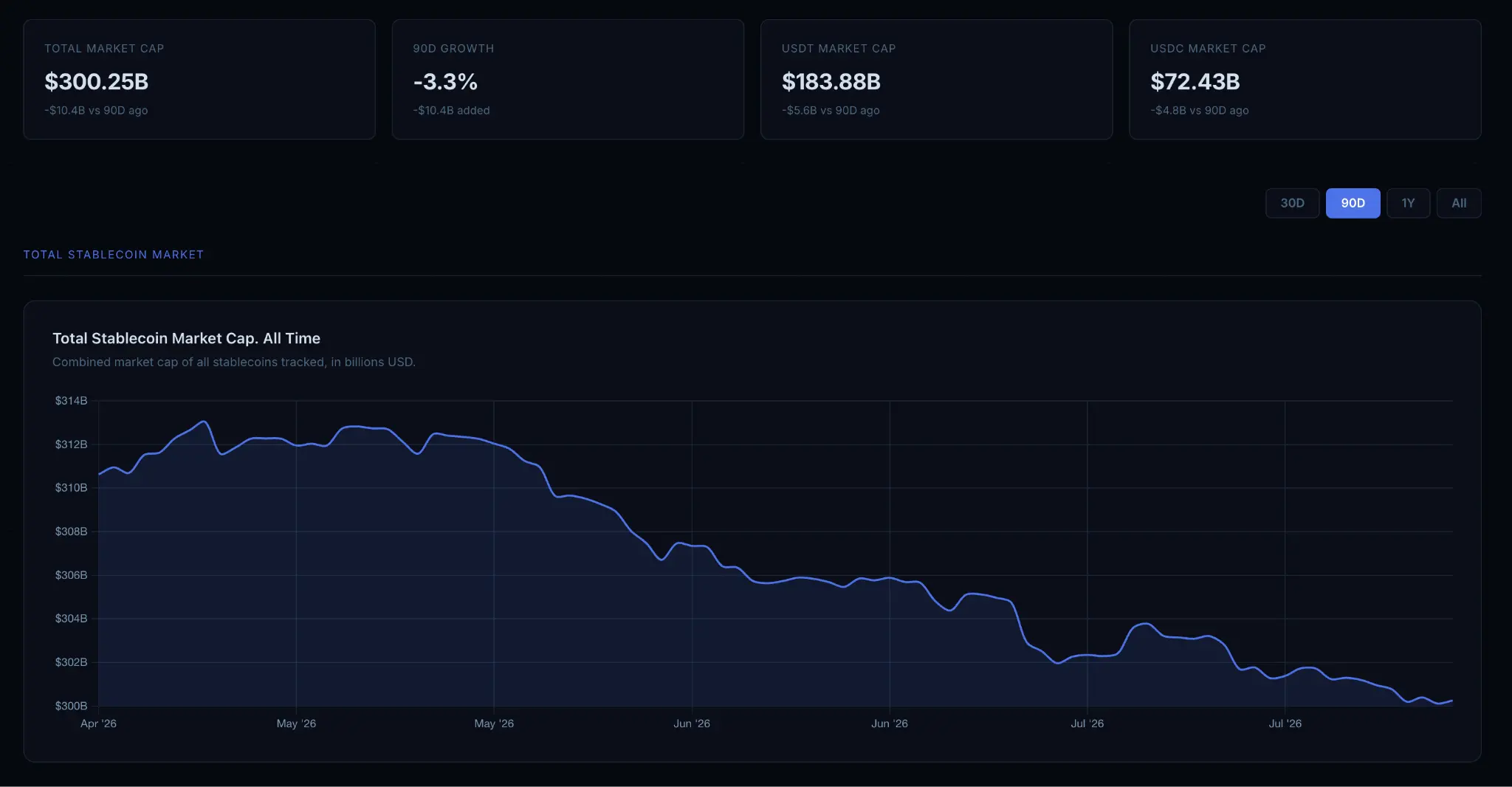
The concentration of the stablecoin market is extremely high: as of the end of July 2026, the total market capitalization of stablecoins was approximately $303.2 billion, with USDT accounting for $184.2 billion and USDC for $73.4 billion, and the overall market cap has slightly shrunk by 3.3% over the past 90 days. In a stagnant total market where two issuers control the vast majority of circulation, the cost for any new entrant to capture market share is extremely high. However, if you do not issue coins and only focus on settlement, exchange, and wallet layers, it does not matter who has a large share, because every transaction must go through Visa.
140 Founding Partners, Yet Some Companies Learned of Their Membership from the News
ARK analyst Lorenzo Valente made a judgment in a post on X on July 29: The commitments of OUSD partners increasingly resemble a soft letter of intent rather than a strategic bet. His emphasis was that supporting OUSD and genuinely investing in distribution channels, balance sheets, and resources to make it successful are two completely different things.
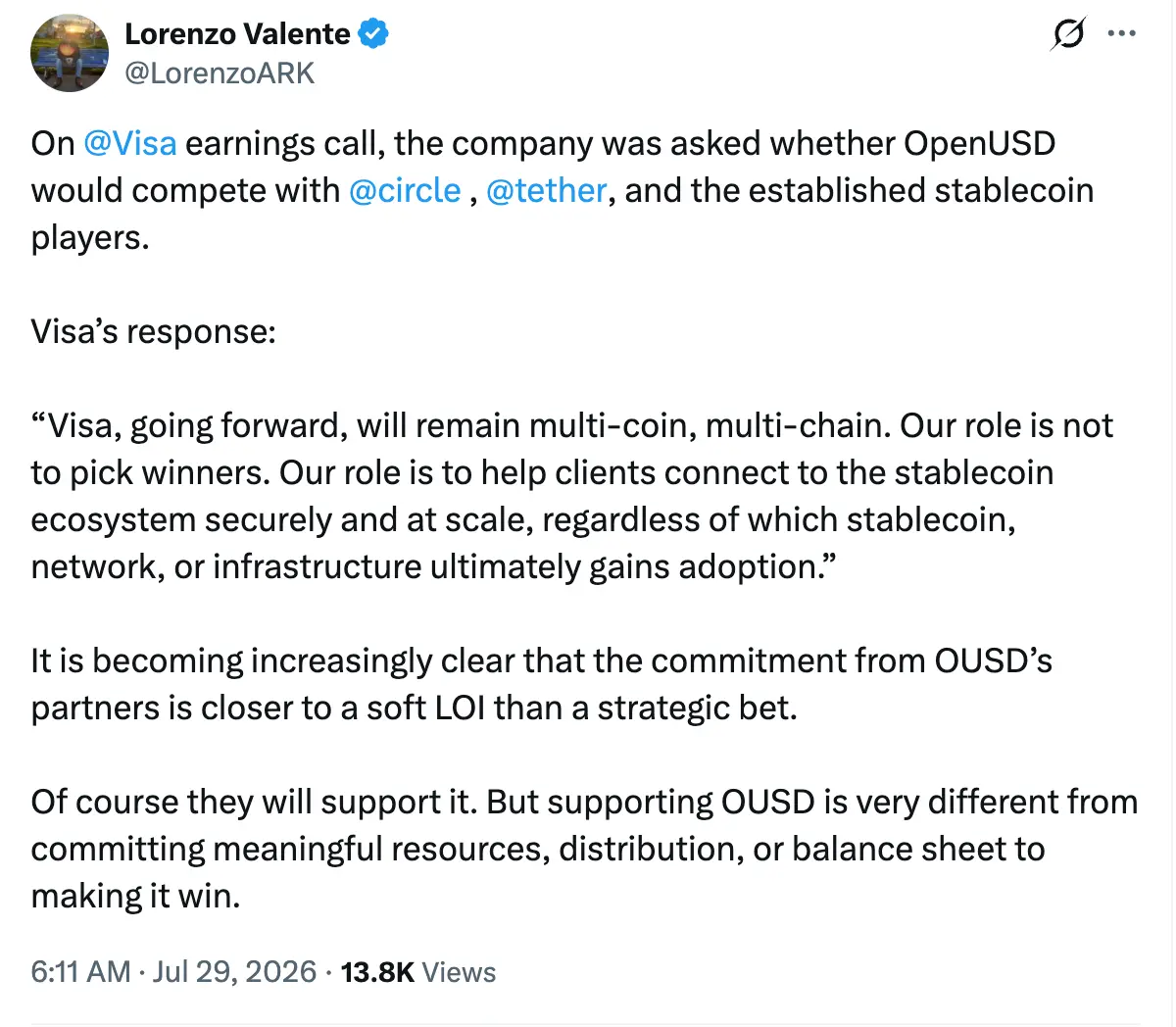
This judgment has factual basis. OUSD consists of a founding alliance of over 140 companies, spanning payments, banking, technology, and crypto industries, including Visa, Mastercard, Stripe, BlackRock, BNY, Standard Chartered, Google, Shopify, Coinbase, and Ripple, with Zach Abrams, CEO of Bridge under Stripe, serving as the founding CEO of Open Standard. Its differentiated design has three points: zero-cost minting and redemption, no limit on amounts, and nearly all reserve income flowing back to partners after deducting management fees. The token is expected to launch later in 2026, with Solana as the initial chain.
The problem lies in the list itself. Shortly after the announcement, a series of denials emerged: Samsung stated it had not engaged in formal discussions with Open Standard and was unclear about its role in the alliance; Dunamu, Shinhan Bank, and K Bank said they had received inquiries but had not approved participation, and some companies learned from media reports that they were listed. The same report also mentioned that Circle CEO Jeremy Allaire criticized the alliance-style stablecoin model as structurally prone to failure.
More notably, the absence of major players: the three largest USD stablecoin issuers—Circle, Tether, and PayPal—are not among the partners. An alliance without current leaders and with members publicly denying participation is too early to claim it represents industry consensus. It resembles a collectively signed statement of observation.
Visa's signature on this list and its statement during the earnings call of "not picking winners" are essentially two sides of the same coin.
Those Who Don't Pick Winners Are Betting on the Channels Themselves
Is Visa's joining of OpenUSD a threat to Circle and Tether?
Not in the short term. An alliance without exclusive commitments and members still denying their participation poses relatively low threat; on the other hand, from Visa's perspective, the cost of this signature is extremely low, gaining a position and voice in the stablecoin narrative without having to take responsibility for any successes or failures—it's an option, not a bet.
If we extend the timeline, the real variable is when Visa will start directing its merchant network and card issuer relationships towards a specific stablecoin. Until then, no matter how fierce the competition at the issuance level, Visa will play the role of an observer, so for VISA, whether or not to pick winners is not important; what matters is that the winners ultimately have to source from me, thus controlling the channels themselves.
 Risk warning



Popular articles