The largest foreign company IPO in history falls below the issue price, triggering a Hyperliquid on-chain liquidation storm
 Core Viewpoint

 It took only 17 days from listing to breaking the issue price.
Author: Chloe, ChainCatcher
This morning, an unusual order from pre-market trading in the Korean stock market triggered a chain reaction on the blockchain.
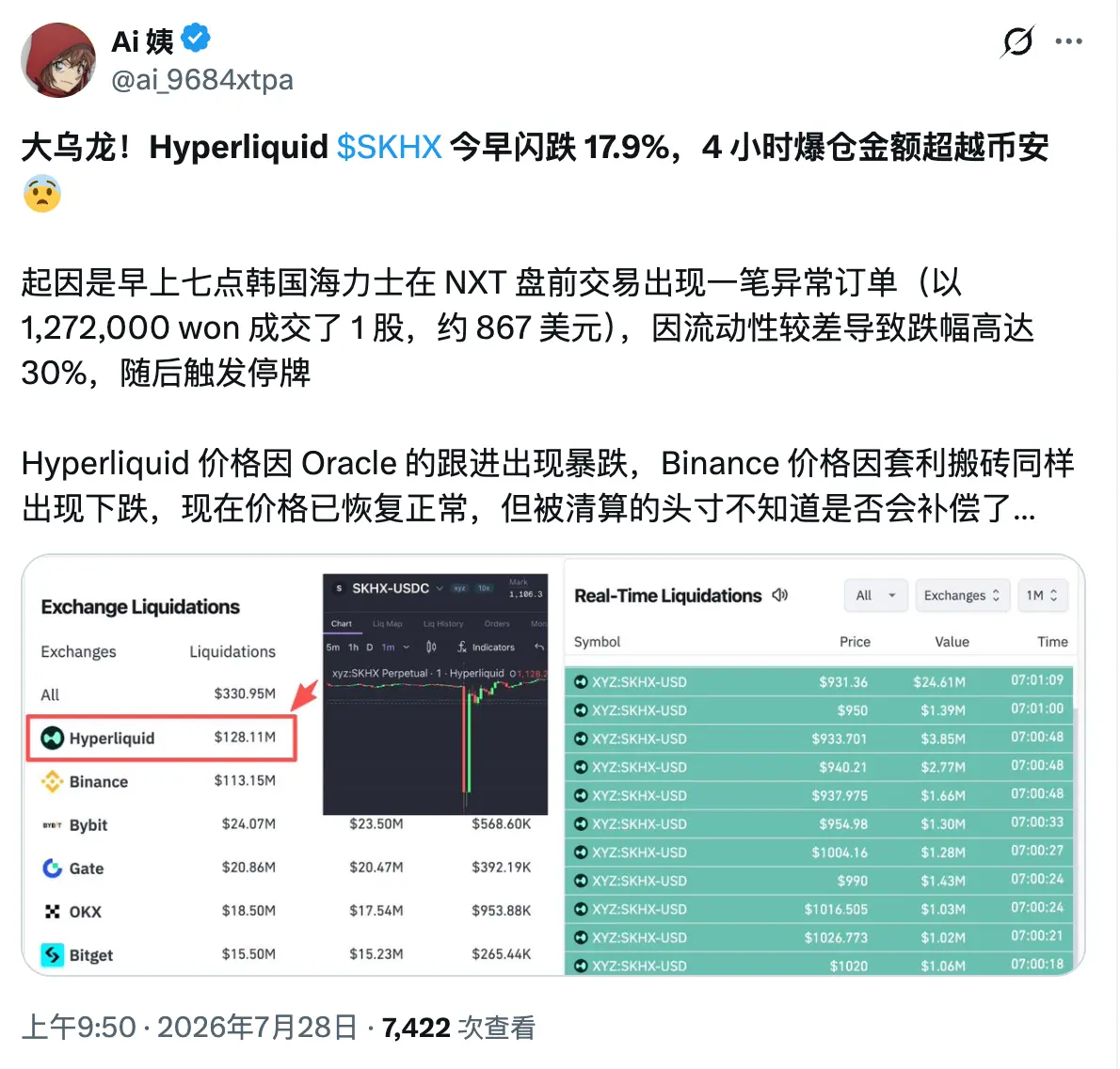
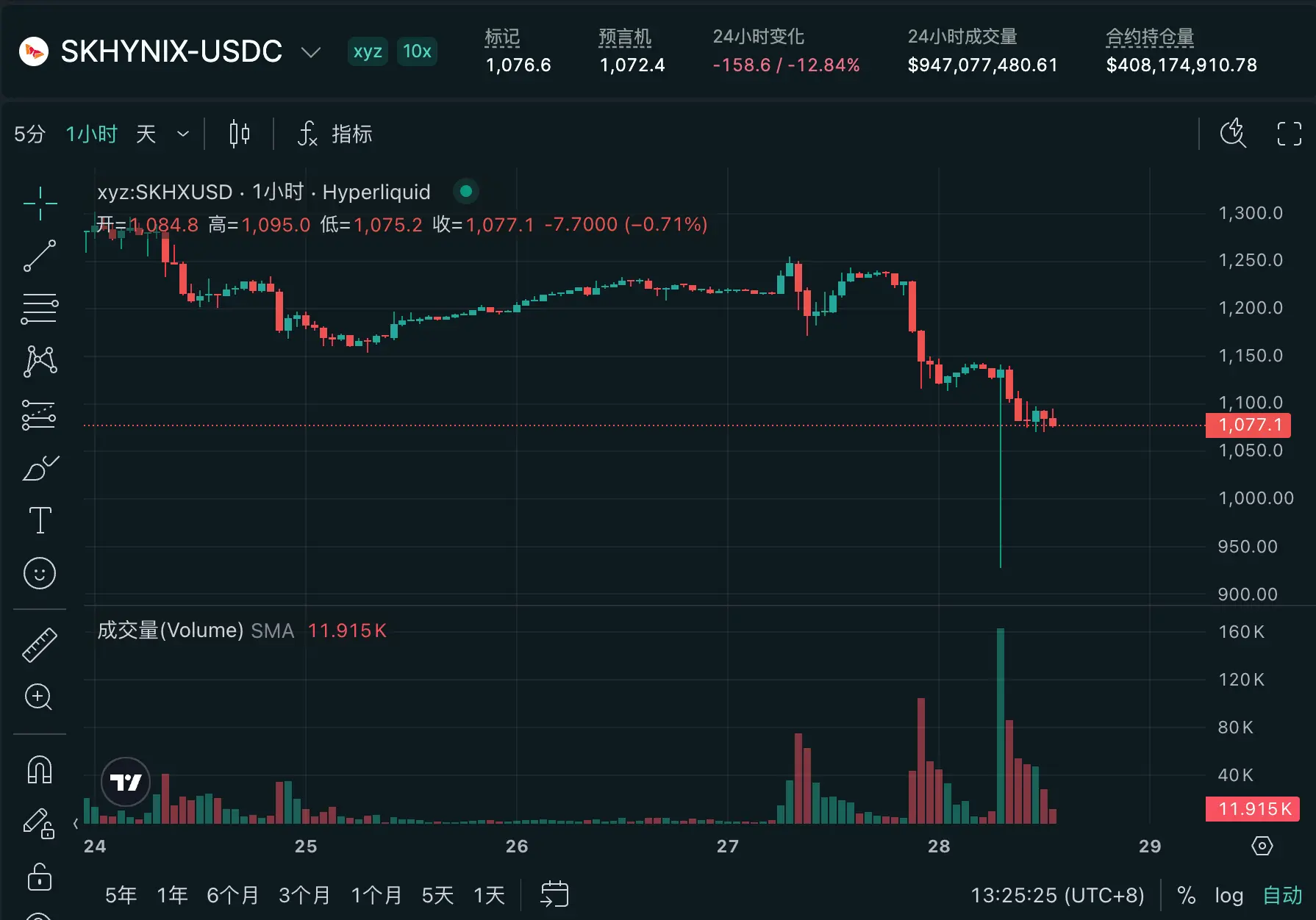
According to on-chain analyst Ai Yi's monitoring, the perpetual contract SKHX tracking SK Hynix on Hyperliquid plummeted by 17.9% this morning, causing the liquidation amount on Hyperliquid to surpass that of Binance in a short time. The root of this on-chain flash crash lies in a single order that only executed one share at 8 AM Seoul time in the pre-market of the Korean alternative trading system NXT.
Transmission Mechanism: Oracle Follow-up, On-chain Longs Forced Liquidated
According to a report by the Seoul Economic Daily, on July 28, before the market opened, the Korean alternative trading system Nextrade (NXT) recorded a transaction with extremely low liquidity: SK Hynix executed one share at 1,272,000 Korean won (approximately $867), significantly discounted from the previous trading day's closing price, with a drop of nearly 30%, which subsequently triggered a pre-market trading halt mechanism.
Industry analysts generally believe this may have been caused by an investor's order error, compounded by insufficient liquidity during the pre-market auction period. Due to the limited depth of the order book at that time, the abnormal transaction of just one share instantly drove the price down to a very low level. Although trading was subsequently halted, during this brief period of price distortion, the abnormal quote was transmitted to the on-chain contract market via an oracle.
The SKHX perpetual contract on the Hyperliquid platform is a stock-type perpetual contract deployed by Trade.xyz through the HIP-3 framework, settled in USDC, supporting up to ten times leverage, and tracking the price of SK Hynix's common stock (000660.KS) listed in Seoul, rather than the NASDAQ ADR quote.
It can be said that the pricing of the contract completely relies on the real-time stock price data returned by external oracles. Once the abnormal low-priced transaction occurred in the NXT pre-market, the oracle immediately followed up, significantly lowering the mark price, which directly triggered the forced liquidation process for on-chain long positions.
From the candlestick chart, it is clear that this morning, SKHX experienced an extremely long lower shadow, dipping to about $927 at one point, and then quickly rebounding to around $1,080 within a few minutes. Before the price rapidly recovered, some high-leverage positions had already been forcibly liquidated.
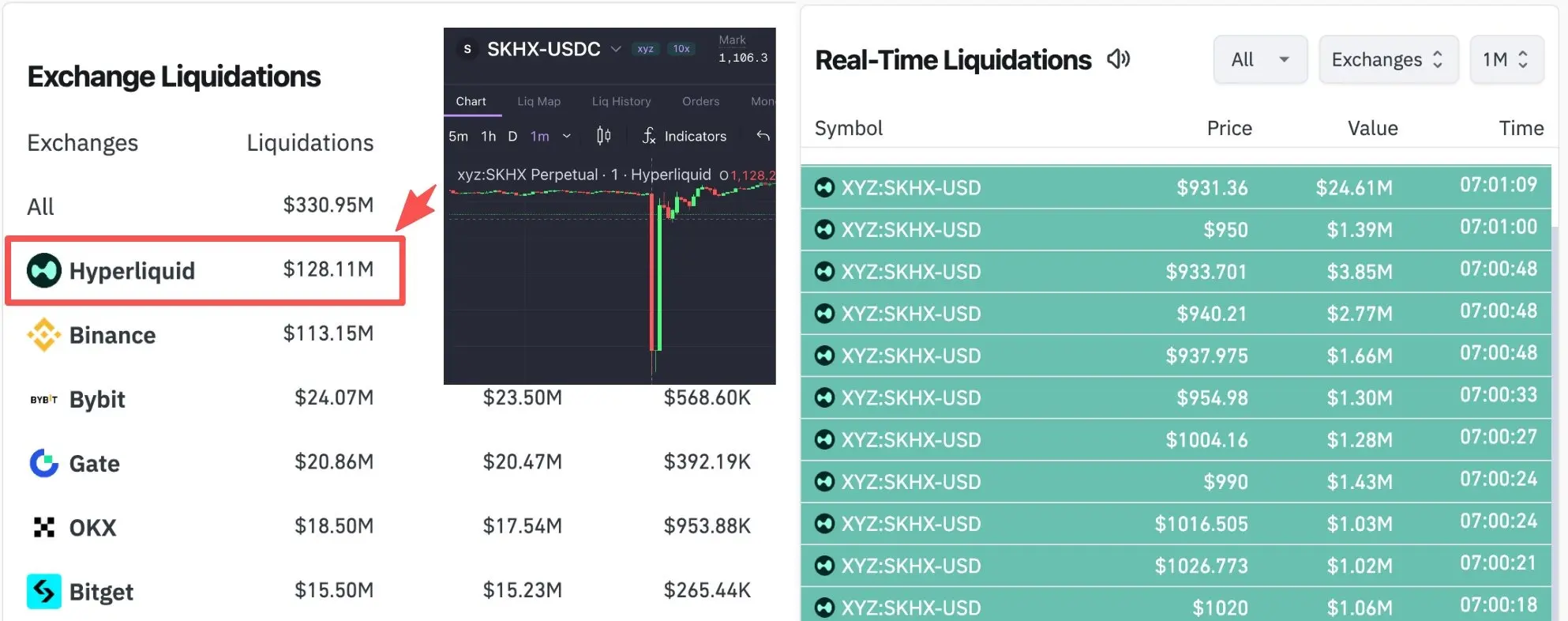
According to derivative market monitoring data, within four hours after the incident, the total liquidation amount on Hyperliquid's platform was approximately $128.11 million, higher than Binance's $113.15 million during the same period, ranking first among the exchanges included in this data platform; the total liquidation amount across all exchanges was approximately $330.95 million. However, this data represents the overall liquidation amount at the exchange level and cannot all be attributed to the liquidation caused by the SKHX single contract.
Real-time liquidation details show that between 7:00 and 7:01, multiple forced liquidations of millions of dollars occurred for XYZ:SKHX-USD within less than a minute, with individual nominal values ranging from approximately $1.02 million to $24.61 million.
In addition, the price of the SKHX contract on Binance also fell sharply. On-chain analysis suggests that the sudden widening price gap between Hyperliquid and Binance triggered cross-platform arbitrage: traders may have bought on the lower-priced Hyperliquid while selling or shorting on Binance, causing the downward trend to transmit to Binance, after which the prices on both platforms returned to normal ranges.
Sharp Drop Below IPO Price, SK Hynix ADR Plummets
The root of today's on-chain storm can be traced back to the downward trend of SK Hynix's stock price over the past few weeks and a new round of significant declines in the Korean stock market today.
SK Hynix completed its pricing on July 9, listing its ADR at $149 each on the US stock market, raising approximately $26.5 billion, setting a historical record for foreign companies going public in the US, surpassing Alibaba's fundraising scale in 2014. It opened at $170 on the first day, closing at $168, with an increase of nearly 13%, and its market value once exceeded $1.2 trillion.
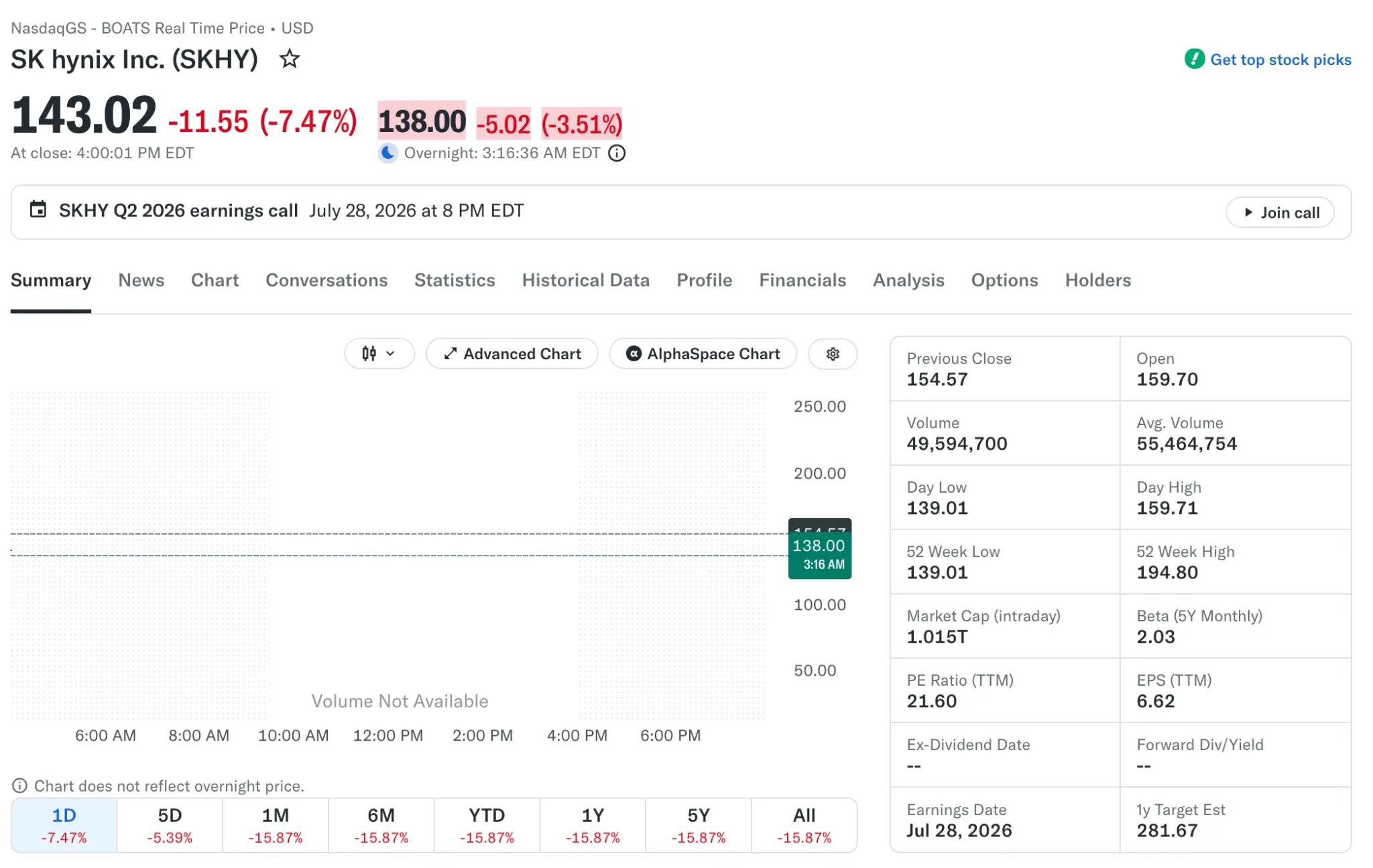
However, it took only 17 days from listing to falling below the IPO price. On July 27, SK Hynix's ADR fell to a low of $139.01 during US trading, closing at $143.02, officially dropping below the $149 issuance price, becoming one of the first large IPOs this year to break below its offering price.
Additionally, the company is expected to release its second-quarter financial report on July 29, which is projected to set a record for the strongest single-quarter profit in history. According to consensus estimates from Korean brokerages, operating profit is expected to reach 64.1 trillion Korean won, with an operating profit margin as high as 77%, and single-quarter profits may even surpass the historical record for the entire year of 2025. However, despite the impressive financial report, the market is not buying it.
Andy Wong, head of multi-asset at Pictet Asset Management, bluntly stated that the core of the market debate is: "Has the memory industry taken too large a share of profits from the AI industry?" He revealed that his fund has reduced its holdings in SK Hynix in recent weeks, and the outside world wants to know if any factors can reverse the market's existing impression of SK Hynix extracting excessively high profits from the supply chain.
Today (July 28), the situation in the Korean stock market became even more dire after the opening. The KOSPI index quickly triggered the program trading pause (Sidecar) mechanism, pausing program trading sell orders for five minutes; subsequently, the decline expanded to 8%, officially triggering a circuit breaker, fully halting trading for 20 minutes. SK Hynix fell more than 11% at one point, and Samsung Electronics also dropped over 9%. This marks the 22nd time this year that the KOSPI has triggered the seller's program trading pause (Sidecar) mechanism, and if including buyers, it is the 42nd time this year.
Two macro factors triggered this sharp decline. First, US chip stocks fell sharply overnight, with the Philadelphia Semiconductor Index dropping over 2%, Nvidia falling nearly 5%, handing over the title of the world's largest market capitalization to Apple, and market doubts about Nvidia's "circular financing model" have resurfaced. Second, the competitive threat from China has sharply increased.
On July 27, China's DRAM manufacturer Changxin Technology (CXMT) surged over 465% on its first day of listing on the STAR Market, topping the A-share market with a total transaction volume exceeding 140 billion yuan; at the same time, there were reports that Chinese companies have started mass production of DUV lithography equipment with government support, raising concerns about the global memory competition landscape and accelerating capital outflows from the Korean semiconductor sector.
Turbulent Macro Background, On-chain Stocks Bear More Risks
The multiple risks of on-chain perpetual contracts are further highlighted against this backdrop. First, there is the volatility risk of the underlying asset itself; SK Hynix is already in a period of severe fluctuations, both in Seoul and on NASDAQ, with the demand boom for AI chips coexisting with competitive threats from China, and valuations are being re-anchored almost weekly.
Additionally, there is the cross-market price disparity risk; SKHX tracks the price of common stock in Seoul, not the NASDAQ ADR. Currently, the price disparity between the two markets exceeds twenty percentage points, with Seoul continuing to decline today while the ADR has not yet opened, further amplifying the volatility of the on-chain contract due to time zone discrepancies.
Finally, there is the risk of oracle switching for liquidation; the pricing of such contracts completely relies on external data sources. Once the data source becomes abnormal, whether due to erroneous transactions or potential subsequent oracle mechanism switches, the instantaneous shift in the mark price could trigger forced liquidation before traders have time to react.
On-chain stocks provide users without overseas brokerage accounts with a 24-hour, non-stop holding tool, but the cost is that they must simultaneously bear several overlapping risks.
 Risk warning Risk warning