EigenLayer Ecosystem Full Analysis: The Prologue of Re-staking and the Rise of AVS

 As more blockchain and crypto projects seek to reduce startup costs through shared security models, EigenLayer's re-staking model may become an important direction for the security architecture of future blockchain networks. Additionally, it could drive the emergence of new economic models and investment opportunities, particularly in the fields of DeFi and cross-chain operations. This not only brings innovation and value to the Ethereum network but also provides momentum and direction for the entire blockchain ecosystem.
Author: HotcoinGlobal
The re-staking protocol EigenLayer, based on the Ethereum network, proposes to utilize ETH staked for validating the Ethereum network to share security and capital efficiency with other protocols, while providing additional interest to protocol participants. Driven by concepts such as AVS, re-staking, and point systems, a vast ecosystem has gradually formed. From the beginning of 2024 to now, EigenLayer's TVL has increased 12 times, attracting approximately $160 million in investments from crypto VCs, including a16z, quickly rising to the second position in the total TVL ranking of DeFi protocols, second only to Lido. Recently, with the launch of the EigenLayer mainnet, it has sparked industry discussions and widespread attention.
I. Overview of EigenLayer
EigenLayer is a re-staking protocol based on Ethereum that allows ETH already staked on the Ethereum network to be re-staked to enhance network security. In other words, users who stake ETH can choose to join EigenLayer smart contracts to re-stake their ETH and extend the cryptoeconomic security to other applications on the network. At the same time, it provides additional returns for network participants. This process not only improves capital utilization efficiency but also enhances the overall security of the network.
EigenLayer supports the secure operation of other blockchain protocols and applications by utilizing ETH already staked on Ethereum, a process known as re-staking. Re-staking allows Ethereum validators to use part or all of their staked ETH to support other Active Validation Services (AVS), such as bridging protocols, sequencers, and oracles. These services typically require their own staking and validation mechanisms to ensure network security, but through EigenLayer's re-staking feature, they can obtain Ethereum-level security without having to attract large amounts of capital themselves.
Through re-staking, originally single-use staked capital can simultaneously support multiple networks, thereby enhancing the capital efficiency and security of the entire ecosystem. This mechanism does not require additional native tokens; it only requires the use of ETH or liquid staking tokens (LST), such as stETH, rETH, etc., to participate in the staking validation process of AVS.
The features and advantages of EigenLayer are as follows:
Establishing a new security-sharing model: The innovation of EigenLayer lies in bringing a new model of security sharing to Ethereum, allowing different blockchain protocols to share Ethereum's security infrastructure without having to establish a large network of validation nodes themselves, significantly reducing the startup costs for new blockchain protocols. Additionally, re-staking increases the overall network's resistance to attacks, as attacking any protected protocol requires overcoming the security protections added by re-staking.
Enhancing ETH capital efficiency: The re-staking mechanism introduced by EigenLayer improves the liquidity and utilization efficiency of capital. Now, the same ETH can serve multiple networks simultaneously, allowing users to enjoy the original staking rewards while also earning additional rewards for participating in other AVS protocols. This brings greater flexibility and scalability to the Ethereum network and the entire blockchain ecosystem.
Lowering participation thresholds: Through the re-staking mechanism, small stakers can also participate in the security of the Ethereum network. Stakers do not need to have the full staking threshold of 32 ETH; individual stakers can participate through liquid staking tokens (Liquidity Staking Tokens, LST). EigenLayer supports LSTs, such as stETH, which represent staking rights to the original ETH and can circulate and be used freely in DeFi projects.
Increasing decentralization: By allowing small stakes, EigenLayer further decentralizes the contributor base for network security, reducing reliance on large stakers, which helps prevent potential centralization risks and validator monopolies. Additionally, the design of EigenLayer encourages broader community participation and governance, making blockchain networks more democratic and decentralized.
II. Design Principles of EigenLayer
Re-staking: In the EigenLayer ecosystem, re-staking provides security guarantees shared with Ethereum, which is the foundation of the entire EigenLayer. Participants re-stake their ETH from Ethereum into the EigenLayer network, and this ETH serves as collateral to support the security and operation of the network. Stakers will receive dual rewards from the native Ethereum network validation as well as from AVS.
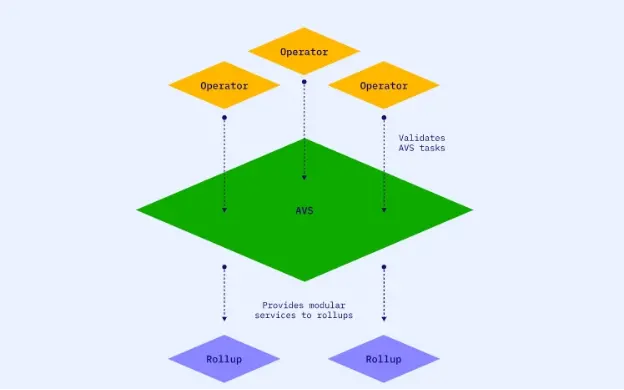
Active Validation Services (AVS): Active Validation Services (AVS) utilize these re-staked ETH to enhance their service capabilities. AVS is a special service or application that runs on EigenLayer and directly uses these re-staked funds to provide enhanced network services. These services can include various functions such as computation, storage, and data processing. AVS can be likened to middleware or modules, such as new blockchains, DA layers, virtual machines, oracle networks, cross-chain bridges, etc. AVS can provide data services for DeFi, gaming, and wallets.
Rollups: In the EigenLayer ecosystem, Rollups benefit from the modular services provided by AVS as an Ethereum Layer 2 solution. For example, through services like EigenDA (EigenLayer's super data availability service), Rollups can achieve super-scalability in data processing, greatly increasing their capacity to handle large-scale data.
Operators: Operators play a key role in the EigenLayer ecosystem, executing various validation tasks that rely on staked ETH as security, which is also the foundation for AVS. Operators' responsibilities include but are not limited to validating transactions, executing smart contracts, and maintaining network security. Their work ensures that AVS can operate reliably, providing support for upper-layer applications and services.
Safeguards: Considering the additional risks that re-staking may bring, EigenLayer has introduced multiple risk control mechanisms. For example, to address potential security issues arising from AVS, EigenLayer has designed a system called "Decentralized Validator Clusters" (DVC) to distribute risks, ensuring that even if some AVS encounter issues, the overall security of the network will not be compromised. To ensure the normal operation of the network and the safety of staked capital, EigenLayer implements a slashing mechanism for improperly acting stakers. Slashing refers to the method EigenLayer uses to ensure the honesty of AVS operators; validators who act maliciously will face the risk of having their stakes revoked.
Point system: EigenLayer has introduced an internal point system that awards EigenLayer points for each hour of ETH deposited by re-stakers. The purpose of this system is to measure users' contributions to the network, reflecting their staking activity and duration through the number of points. Although the EigenLayer team has not yet specified the exact uses of the points or announced any details about launching an EigenLayer token, many users continue to engage in re-staking activities, anticipating potential future token airdrops based on points. This indicates that users hold expectations and confidence in EigenLayer's future development.
III. Methods of EigenLayer Re-staking
Currently, EigenLayer supports two methods of re-staking: Liquid Restaking and Native Restaking.
1. Liquid Restaking
This allows the staking of liquid staking tokens (LST), which are staking certificates issued by LSP (Liquid Staking Protocol) that represent rights to the original ETH staked and can circulate and be used freely in various decentralized finance (DeFi) protocols, thus not affecting the staker's staking position and reward collection on Ethereum. LSP addresses certain limitations of staking on the Ethereum network, allowing users to participate in Ethereum network validation and earn validation rewards with less than 32 ETH of capital. It also allows the use of LST in DeFi protocols to generate additional income or to sell LST on the market without waiting for the unstaking period, effectively providing the same benefits as unstaked assets. For example, Lido Finance is currently the most well-known LSP, and the LST issued by Lido Finance is stETH. EigenLayer accepts users staking stETH, making it the infrastructure that secures AVS.
Currently, EigenLayer supports a total of 12 types of LST for liquid re-staking, including stETH, swETH, mETH, stETH, wbETH, rETH, sfrxETH, cbETH, osETH, oETH, lsETH, and ankrETH.
EigenLayer only accepts LST re-staking deposits during specific time periods or limits the incentives and governance participation rights obtained from a single LST from EigenLayer to a maximum of 33%. So far, EigenLayer's LST re-staking limits have been increased five times. On April 16, EigenLayer announced the removal of all deposit limits for LST and reopened the deposit window, allowing ETH to be re-staked through the EigenPod on the EigenLayer application.
2. Native Restaking
Native Restaking is a more direct method where stakers use their staked ETH directly in EigenLayer's smart contracts, meaning that Ethereum PoS node validators connect their staked ETH in the network to EigenLayer to participate in the validation process of AVS. Executing native re-staking requires staking at least 32 ETH, and participants need to directly manage an Ethereum node, which provides a higher entry barrier compared to liquid re-staking.
Since ETH is directly used in EigenLayer's smart contracts, native re-staking offers higher security. Staked assets are directly exposed to Ethereum and AVS's penalty standards, increasing capital protection. Compared to liquid re-staking, native re-staking does not involve any intermediate tokens, reducing risks associated with token volatility or mismanagement. However, its downside is lower liquidity of funds, and unlocking and transferring assets may take longer.
IV. Current Status and Project Review of the EigenLayer Ecosystem
Currently, the EigenLayer ecosystem has begun to support various AVS and has integrated with several well-known DeFi protocols and other blockchain services. It allows the use of different types of staking proofs (such as LST and native ETH) to support these services, making capital utilization more efficient.
On April 10, EigenLayer announced the official launch of its blockchain mainnet, accompanied by the launch of EigenDA, a data availability (DA) service developed by the EigenLayer team. At the end of February, a16z announced a $100 million investment in EigenLayer, making it a crypto unicorn valued at $10 billion. As of April 18, according to DefiLlama data, EigenLayer's TVL has exceeded $12.8 billion.
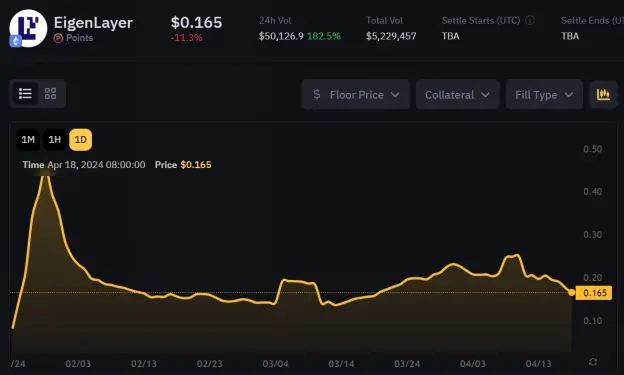
As of April 18, EigenLayer has distributed approximately 4.2 billion points to all re-stakers. In the over-the-counter trading market Whales Market, the trading price for each EigenLayer point is $0.165.
(1) Review of EigenLayer Ecosystem AVS Projects
Currently, EigenLayer has announced 13 AVS. EigenDA, as the first launched AVS, is developed by Eigen Labs and aims to help other blockchain protocols store transaction data and other information. AVS outside of EigenDA will be able to "register" using this protocol, but they are currently not fully deployable.
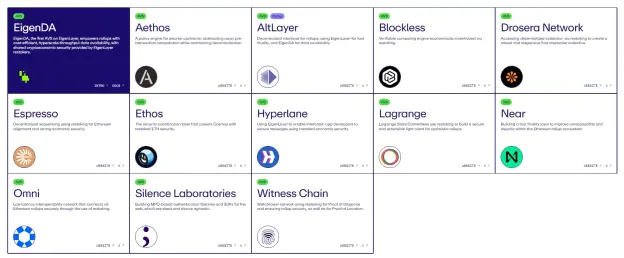
EigenDA: EigenDA is the first AVS on EigenLayer, providing efficient, super-scalable data availability services for Rollups. By leveraging the shared cryptoeconomic security provided by EigenLayer's re-stakers, EigenDA enables Rollups to process large-scale data at lower costs and higher efficiency. On April 18, EigenLayer announced that it had reduced the staking threshold for EigenDA verification nodes from 320 ETH to 96 ETH. EigenLayer stated that this change would allow more new verification nodes to participate in EigenDA's AVS verification services.
Aethos: Aethos is a policy engine for smart contracts that abstracts pre-transaction computation while maintaining decentralization. Aethos simplifies the preprocessing of smart contracts, making contract execution more efficient and secure.
AltLayer: AltLayer is a decentralized inter-layer network designed for Rollups. It utilizes EigenLayer to achieve rapid finality and ensures data availability through EigenDA, optimizing interoperability and performance between Rollups.
Blockless: Blockless is a verifiable computing engine that provides economic incentives through the re-staking mechanism. It offers a decentralized verification platform for complex computations, enhancing the transparency and credibility of computation results.
Drosera Network: Drosera Network creates a powerful and responsive first responder collective through re-staking, focusing on decentralized validation. This provides a new avenue for emergency response and secure validation for the network.
Espresso: Espresso is a decentralized serialization service that uses re-staking to achieve alignment and strong economic security for Ethereum. It ensures the sequentiality and consistency of transaction execution.
Ethos: Ethos is a secure coordination layer that utilizes the security of re-staked ETH to support Cosmos. It enhances the security and efficiency of cross-chain interactions.
Hyperlane: Hyperlane uses EigenLayer to enhance message security for inter-chain application developers, providing guarantees for communication between applications through re-staked economic security.
Lagrange: Lagrange creates a secure and scalable light client through re-staking, specifically for OP Rollups. It improves network accessibility and responsiveness through light clients.
Near: Near aims to build a fast finality layer to improve composability and liquidity within the Ethereum Rollup ecosystem. This helps enhance the efficiency of cross-Rollup operations.
Omni: Omni is a low-latency interoperability network that connects all Ethereum Rollups through re-staking, ensuring the security and efficient operation of the entire network.
Silence Laboratories: Silence Laboratories is building a verification library and SDK based on multi-party computation (MPC), which is technology stack and device agnostic, enhancing the security and flexibility of the network.
Witness Chain: Witness Chain is a monitoring network that utilizes re-staking for proof, focusing on the security and proof location of Rollups. By providing proof diligence and location functionality, it enhances the monitoring and verification capabilities of the network.
(2) Review of EigenLayer Ecosystem Rollup Projects
Rollup projects leverage EigenLayer's technology to achieve rapid finality and efficient data availability, further expanding their blockchain solutions. Currently, there are 9 integrated Layer 2 solutions, among which AltLayer is both an AVS and a Rollup project.
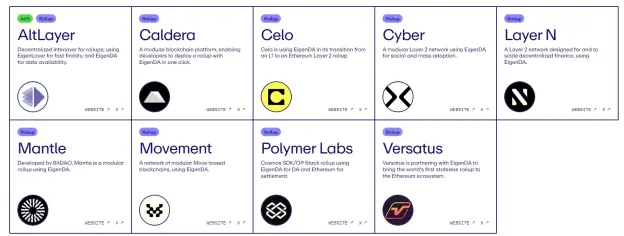
Caldera: Caldera is a modular blockchain platform that allows developers to deploy Rollups with EigenDA services with one click. This platform greatly reduces the technical barriers for developers by simplifying the deployment process, enabling more innovations and applications to go live quickly.
Celo: Celo was originally an independent layer network and is now transforming into an Ethereum Layer 2 Rollup using EigenDA. Through this transformation, Celo can better integrate into the Ethereum ecosystem while enhancing its network performance and scalability.
Cyber: Cyber is a modular Layer 2 network designed for social and large-scale adoption, using EigenDA to optimize data processing and user experience. Cyber aims to promote the application of blockchain technology in the social media space through efficient data services.
Layer N: Layer N is a Layer 2 network designed to accelerate decentralized finance (DeFi), also utilizing EigenDA to enhance data processing capabilities. Through this technical support, Layer N aims to provide higher efficiency and better scalability for DeFi applications.
Mantle: Mantle, developed by BitDAO, is a modular Rollup using EigenDA. This project combines BitDAO's resources with EigenDA's technology to provide users with an efficient and powerful blockchain platform.
Movement: The Movement network consists of a series of modular blockchains based on the Move language, also adopting EigenDA technology. This design allows Movement to ensure efficient data processing and security while providing flexibility.
Polymer Labs: Polymer Labs is a Rollup that combines Cosmos SDK and OP stack, using EigenDA for data availability services and settling on Ethereum. This multi-technology integrated solution provides diverse application scenarios and strong network support for its users.
Versatus: Versatus is a project collaborating with EigenDA, aiming to introduce the world's first stateless Rollup into the Ethereum ecosystem. This innovative Rollup design brings new development potential to the Ethereum ecosystem through efficient data processing and a unique network structure.
(3) Review of EigenLayer Ecosystem LRP Related Projects
The Liquid Restaking Protocol (LRP) is a key component of the EigenLayer ecosystem, designed to attract and increase user participation in a flexible and efficient manner. LRP allows users to deposit ETH or LST (liquid staking tokens) and represents users in re-staking on EigenLayer, providing a more flexible way for users to participate in the EigenLayer ecosystem. Users can choose to re-stake through the LRP platform without directly engaging in complex staking processes, including earning EigenLayer points and additional points provided by the platform.
To prove users' deposits and participation, LRP issues LRT, which represents users' staking shares in LRP. LRT serves not only as a certificate of the holder's assets but can also be freely traded in the DeFi market, providing additional liquidity and yield opportunities, thereby further increasing returns based on EigenLayer points. Representative LRT-related projects include Ether.fi, Kelp DAO, EigenPie, Pendle Finance, and Gearbox.
Ether.fi: Ether.fi started as part of LSP in the EigenLayer ecosystem but quickly showcased its application breadth in DeFi through its innovative eETH and weETH tokens. These two tokens, through buyback mechanisms and reward nature designs, not only ensure compatibility with mainstream DeFi protocols but also enhance user participation and liquidity of staked assets through EigenLayer point farming.
Kelp DAO: Kelp DAO provides users with an attractive staking and re-staking scenario through its unique re-staking solution and Kelp Miles point system. Its development reflects the efforts of the LRP ecosystem to improve user experience and reduce transaction costs, especially in situations where high gas fees and network congestion often hinder user experience.
EigenPie: EigenPie, as part of the MagPie ecosystem, focuses on aggregating governance tokens and influencing DeFi protocol decisions. Its strategy is to diversify risks and optimize the liquidity and usability of tokens through independent re-staking methods. This is particularly crucial for promoting the long-term sustainable development of the protocol.
Pendle Finance: Pendle Finance, in collaboration with Ether.fi, launched Ether.fi’s eETH as the first LRT available on its platform. Ether.fi designed a system to allocate EigenLayer points and Ether.fi loyalty points to users holding eETH YT tokens (YT-eETH). This allows users to purchase near-expiry YT-eETH (which becomes cheaper) and accumulate interest and points up to that date.
Gearbox: Gearbox is a leveraged yield protocol that allows borrowers to leverage their positions by depositing staked assets and assets borrowed from the protocol in credit accounts. Gearbox launched a leveraged point strategy in collaboration with the LRP protocol. Gearbox allows the accumulation of EigenLayer points and LRP local points in credit accounts and sends them to borrowers' wallets, providing users with up to 9 times leveraged points.
V. Risks and Challenges of the EigenLayer Ecosystem
As a re-staking layer built on Ethereum, EigenLayer provides innovative solutions for blockchain technology but also comes with several risks and challenges.
Technical implementation risks: The implementation of EigenLayer heavily relies on complex technical solutions, including the stability and security of smart contracts. Vulnerabilities in smart contracts or security issues at the protocol level could lead to significant financial losses. Additionally, since EigenLayer is directly integrated with Ethereum's node ecosystem, any imperfections in technical execution could affect its overall security and efficiency.
Market acceptance: Although EigenLayer offers an innovative re-staking solution, market acceptance remains an important uncertainty. The volatility of the crypto market may affect the value of staked assets, and the degree of market acceptance of this emerging technology will directly impact EigenLayer's liquidity and widespread adoption.
Centralization risks: The re-staking model may lead to capital concentration among a few high-performing validators, potentially exacerbating centralization trends and creating market monopolies, thus threatening the decentralization principles of the Ethereum ecosystem.
Possibility of consensus splits: If EigenLayer's operational model directly intervenes in Ethereum's node ecosystem, it may impact Ethereum's social consensus. If mishandled, it could lead to community splits or even chain forks.
Risks of AVS: EigenLayer provides additional functionalities and services through its AVS (Active Validation Services), but the security and efficiency of these services depend on the reliability of operators and technical implementation. Any operational failures could result in losses for staked ETH. For AVS that require very high network security, re-staking may not provide sufficient protection, potentially affecting the trust and adoption of these services.
VI. Development Outlook of the EigenLayer Ecosystem
EigenLayer has gradually evolved from the concept of sharing Ethereum network security and generating additional income into a vast ecosystem that meets the needs of infrastructure builders and investors, sparking immense interest and high expectations in the infrastructure industry and crypto market.
Expansion of AVS: Following the launch of EigenDA, EigenLayer will introduce more AVS, providing more customized services, such as enhanced data processing capabilities and more efficient transaction validation, thereby expanding its service scope and influence.
Enhanced security: By implementing advanced security measures and auditing mechanisms, such as slashing, to ensure that AVS operations are not affected by malicious attacks or vulnerabilities.
Cross-chain integration: Developing cross-chain solutions that allow EigenLayer to serve not only Ethereum but also interoperate with other major blockchains, enhancing its market applicability and user base. Collaborating with more blockchains and crypto projects to achieve technical interoperability and improve overall network efficiency.
Ecosystem expansion: Establishing partnerships with more ecosystem projects such as DeFi, DAOs, and NFT platforms, bringing value to these platforms through efficient re-staking solutions.
Integration of emerging technologies: Exploring the possibility of integrating emerging technologies such as artificial intelligence and the Internet of Things with EigenLayer technology to create new application models.
Competition and cooperation: As Lido is the largest liquid staking protocol in the Ethereum ecosystem, staking the most ETH and having many node operators, the direct conflicts of interest between EigenLayer and Lido may prompt Lido to rethink its business model and sustainability, while EigenLayer also needs time to gradually fill in the missing modules.
As more and more blockchain and crypto projects seek to reduce startup costs through shared security models, EigenLayer's re-staking model may become an important direction for the future security architecture of blockchain networks. Additionally, it may drive the emergence of new economic models and investment opportunities, particularly in the fields of DeFi and cross-chain operations. This not only brings innovation and value to the Ethereum network but also provides momentum and direction for the entire blockchain ecosystem.
Hotcoin is closely monitoring the development dynamics of the EigenLayer ecosystem and the re-staking track, having launched quality assets such as ALT, ETHFI, OMNI, NEAR, CYBER, and PENDLE. For crypto investments, come to Hotcoin, where the hottest quality assets are available first and faster!
 Risk warning
 Risk warning