








Founder of Baixing.com: I believe half of the statement that large language models devour everything
 Core Viewpoint

 The internet has been shouting for so many years about devouring everything. Has it really devoured everything now? Is it the internet that devours everything, or is it the large models that devour everything? Both are devouring, and nothing is left?
Author: Wang Jianshuo, Founder of Baixing.com
Many people say, "The large model is everything." I don't quite believe it.
Every time I hear phrases like "devouring everything," I feel that it's mostly because our understanding of the future hasn't reached that level, which is why we casually make such broad statements. Otherwise, how could one thing devour everything? Take the internet for example—after shouting "devouring everything" for so many years, has it really devoured everything? Is it the internet that devours everything, or is it the large model that devours everything? Both are devouring, and nothing is left?
So I would rather put it another way: it is a very important foundation. Without this foundation, the entire world cannot develop, just like the internet cannot exist without its underlying backbone, just like electricity cannot exist without power plants. I can accept that.
But once there is a foundation, that's where the excitement happens.
Take electricity as an example. When electricity is generated, what is the first application people see? The light bulb. Thomas Edison lit the first one, and then it kept shining, shining, shining. If the world stopped there, with only one light bulb, I could completely say: the power plant is the core of the entire world, the power plant devours everything.
But that's not the case. Later, engines were developed to drive machines; then you would find that once this underlying thing called electricity exists, countless electrical appliances will emerge to use it. Washing machines wash clothes, televisions are for watching TV, vacuum cleaners are for vacuuming—these are all applications of electricity. Without electricity, none of these things would exist. But if you say "electricity devours everything," I don't believe it.
The same goes for large models. They provide basic intelligence. But this intelligence must be placed into a specific, scenario-oriented "machine" or "device" to function and truly change the world.
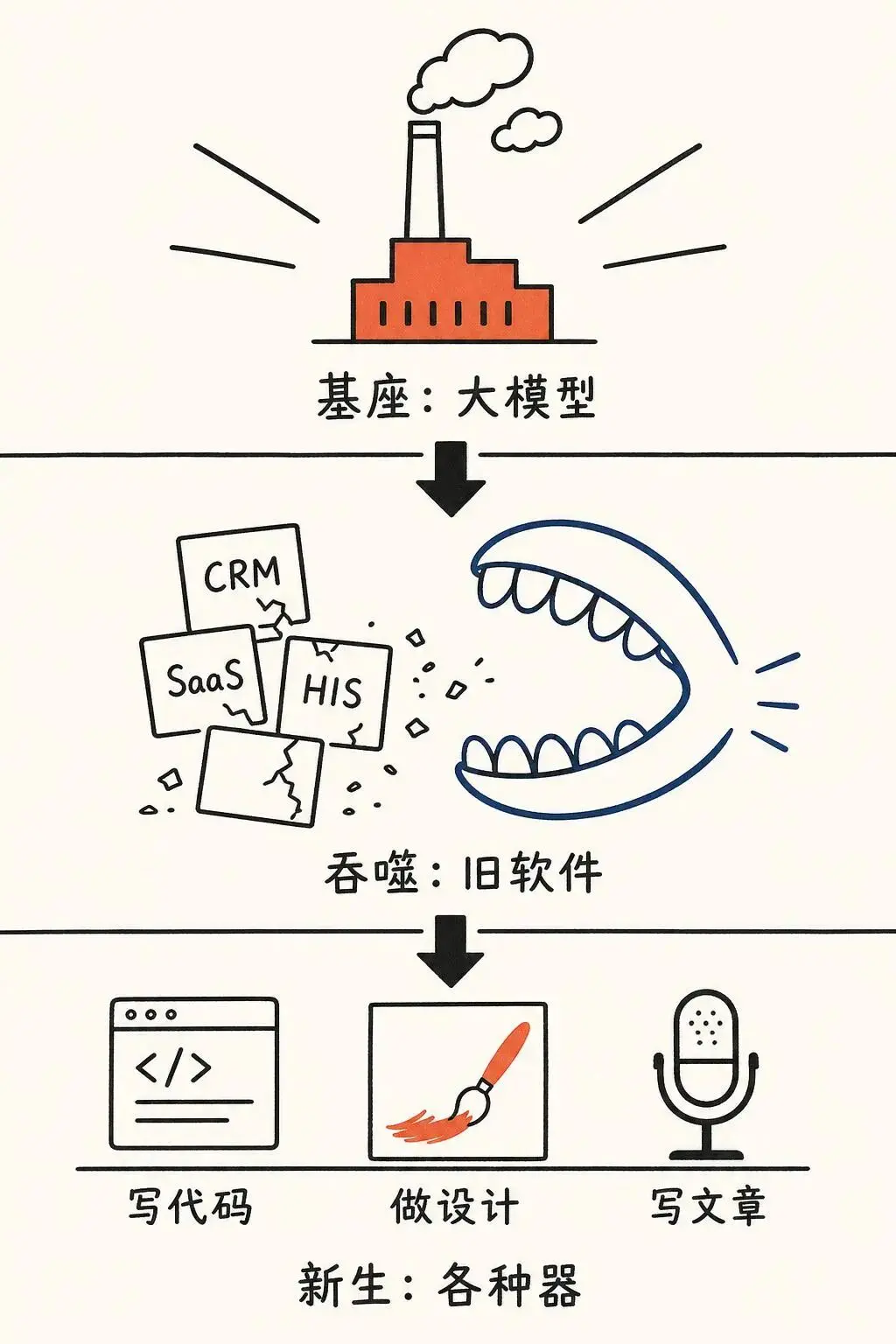
Claude Code is for writing code, Claude Design is for design, VoiceDrop is for writing articles. They are all large models, but placed in different devices, solving completely different problems.
Just having electricity and water, without a washing machine, clothes still cannot be washed. Imagine a power plant generating massive amounts of electricity, which is very powerful, and then what? Without a washing machine, can that pile of electricity wash clothes by itself?
Intelligence is great, but most things in the world require a combination of multiple elements to work, just like a washing machine needs to combine electricity, water, and even a drum to function; large models may replace many things in the software domain, but the world only needs applications that require one element, not more.
Take a current example. Now we have large models, but just having large models is not enough; there needs to be a layer called Harness on top of it—this layer has only recently emerged—to establish a relationship with code, ultimately forming something truly usable. A large model alone cannot write code. Of course, the core of Claude Code, to be honest, I could write it in just over fifty lines; if it were longer, I could add a few more lines, and it could run programs. But you must see: without this outer layer, the large model is still not very useful—meaning that the intelligence of the large model, when not combined with the code execution capabilities provided by the operating system, is not economical, and sometimes even impossible.
The core value of this interface layer is to help us place that intelligence, akin to electricity and water, into a specific application scenario, transforming it into a machine capable of solving specific problems.
At this point, of course, I don't completely disbelieve the logic behind "devouring everything."
What it mainly refers to is the existing software. Up to now, we have piled up a very large layer of software—things pieced together by many rules, forms, buttons, and workflows, quite a lot. A large number of filters, fixed templates, a bunch of backend operations, and many SaaS detection functions. Also, various things we used to know as "M," whether CRM or HIS (hospital information system), are all sorts of so-called "systems," "software," and other similar things, a whole bunch.
In this layer, I believe large language models will indeed devour quite a bit.
Why? Because these original software systems are based on clear instructions that computers can execute, solidified and repeatedly executed—this is what we call software. And this is precisely what large language models are best at tackling.
However.
In this layer, besides software, there are many other things. Customer information. Execution capabilities—like when you book a flight, the actual ability to transport a plane and people from one place to another. There is also trust. Many things in the physical world. I don't think these will be devoured.
After devouring that layer, it instead opens up a larger space—new types of software above it.
New types of software will definitely have a fluid interface; they may not need to solidify as many rules as before. Once those rules are handed over to AI, think about it: previously, achieving a CRM like Salesforce was already the pinnacle of human effort. But if this part becomes relatively easier to solve, what everyone will do next is to unleash more imagination and possibilities on top of that— and that part is precisely what we have not yet seen.
The mistake we often make is right here. When a new technology arrives, because we can't see the larger path ahead, we can only focus on this part in front of us. A leaf obstructs the view, preventing us from seeing Mount Tai.
Don't even mention such trend judgments. I still remember in 2004, a group of friends gathered and complained that no company could ever be larger than Sina, Sohu, or Netease, saying that the internet was nearing its end and they would monopolize everything. But just a few years passed? The world turned upside down. We should be crying over our own shortsightedness back then.
So my stance is this: Is the large model important? Yes, it is a foundation, the main focal point of recent times. But once it becomes stable and can continuously provide something, it will need various machines and devices on top to solve specific problems. That thick layer—how it is used and where it is used—will be the mainstream of the second wave of this trend.
The phrase "devouring everything" is too imprecise. Is there anything in the world, any social form, any technology, that has truly devoured everything?
Finding opportunities in the places it has devoured—that is the truly important thing.

 Risk warning


Popular articles





