








Full text of the speech by Google's Chief Scientist Shanahan
 Core Viewpoint

 Google DeepMind Chief Scientist Shanahan's London Lecture: Deconstructing the mental attributes of large language models (LLM) using the framework of Wittgenstein, analyzing the "heterogeneous self-identity" under the trend of all-weather intelligent agents.
Original text: Bear Law Principles
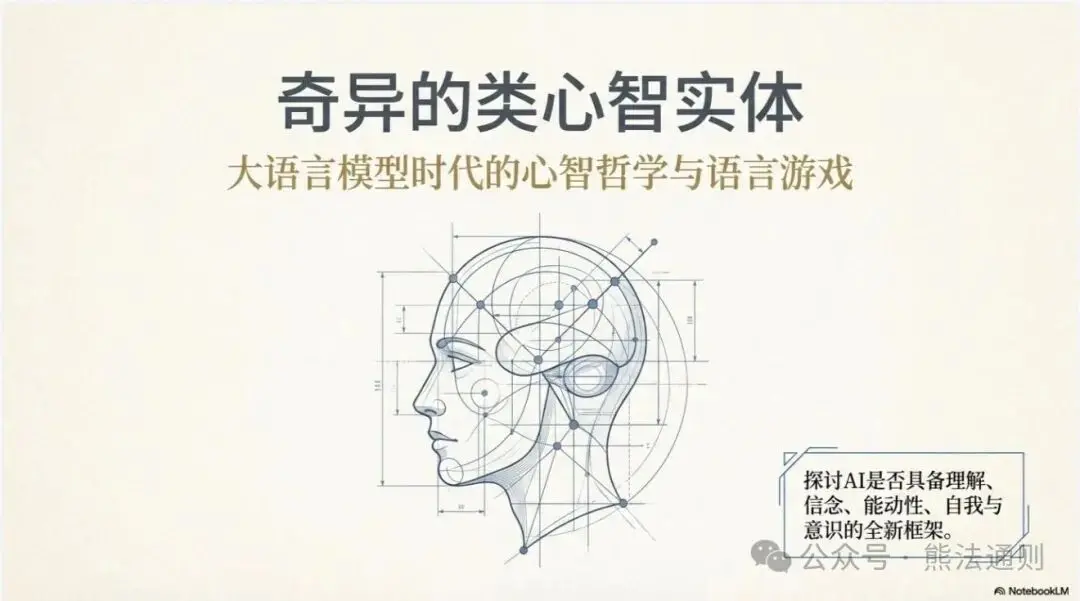
On the evening of May 22, 2026, Beijing time, Murray Shanahan, the chief scientist of Google DeepMind who understands philosophy the best, delivered a closing keynote speech at the two-day International Conference on AI and Philosophy at University College London. The title was the one in the image above: If large language models are "strange mind-like entities," how similar are they to minds?
I have studied Shanahan before. This "strange mind-like entity" is his term for AI, much like some people refer to certain "unidentified flying objects."
His speech was rich in content, and in summary, it covered the following aspects:
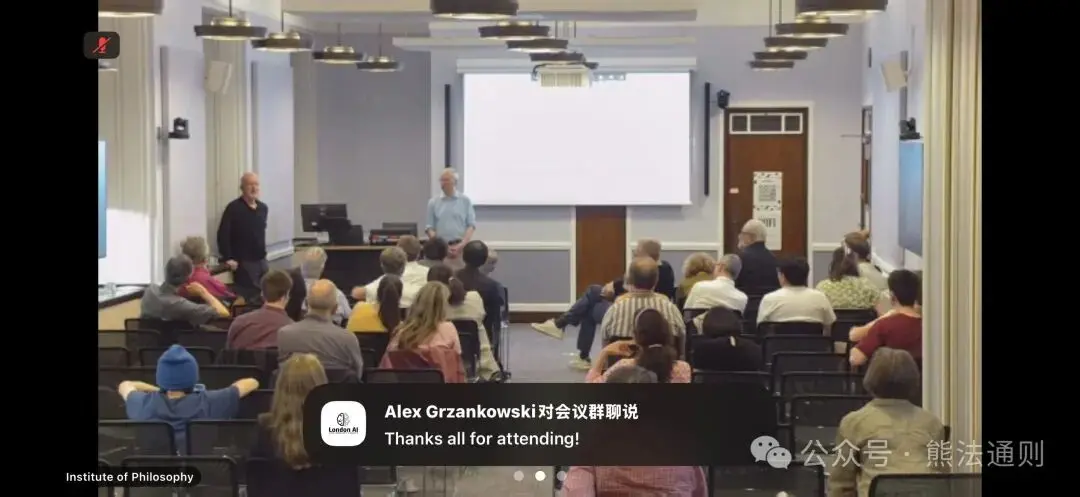
Abstract: Based on Wittgenstein's philosophical framework of "meaning is use," he explored the applicability of large language models (LLMs) in understanding, belief, agency and agency, self and consciousness, analyzed the impact of multimodality and embodiment on conceptual evolution, and discussed the strangeness of model identity.
I. Applicability Analysis of Understanding and Belief
Regarding whether LLMs possess "understanding" and "belief," the speech employed a Wittgensteinian language game analysis method, exploring the tension between everyday use and philosophical rigor:
1. The Language Game of "Understanding"
Naturalness of Everyday Use: In daily interactions, it is difficult to avoid using the term "understanding" to describe the behavior of LLMs. For example, when a model accurately formats LaTeX entries or corrects specific fields based on user instructions, using "understanding" is a completely natural linguistic practice.
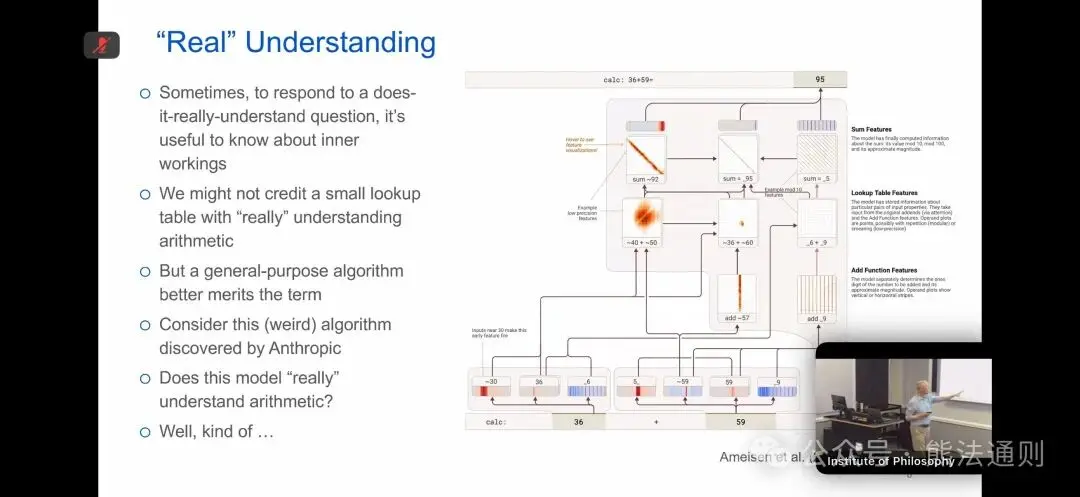
Deep Exploration of "True Understanding": When questioning "Does it really understand?" this often means probing its internal mechanisms. For instance, decomposing 36+59 into approximately 6+9 to complete the addition, although different from human algorithms, is indeed an effective computational process, thus supporting its applicability.
2. Attribution and Limitations of "Belief"
Application of Intentional Stance: Dennett's (LLM behavior is very effective, similar to how we explain chess programs or animal behavior (like a dog chasing a cat) using terms of belief and desire.
Davidsonian Reservations: Davidson argued that having beliefs requires having "concepts," which often depend on language. For LLMs, although behaviorally similar, due to their lack of connection with the world, we should be cautious with the term "belief."
Evolution of Multimodality and Tool Use: As LLMs integrate multimodal perception, tool invocation (such as online searches to verify facts), and embodied robotic technologies, they begin to possess a certain "belief" about the external world.
II. Agency, Self, and Consciousness
The conference further explored more controversial mental attributes, pointing out the fundamental differences and strangeness of LLMs in these dimensions:
1. Definition of Agency
Technical vs. Philosophical Definitions: The AI field typically adopts a broad definition from Russell and Norvig (perceiving the environment and acting through actuators), based on which…
Ambiguity of Agent Identity: In discussing "What are the criteria for agent identity?"
2. Strangeness and Fragmentation of "Self"
Ambiguity of Self-Reference: The "self" in LLMs may refer to the underlying weight set, deployment models serving thousands of users, specific dialogue instances, or even the dialogue context window itself, and this reference may drift during conversations.
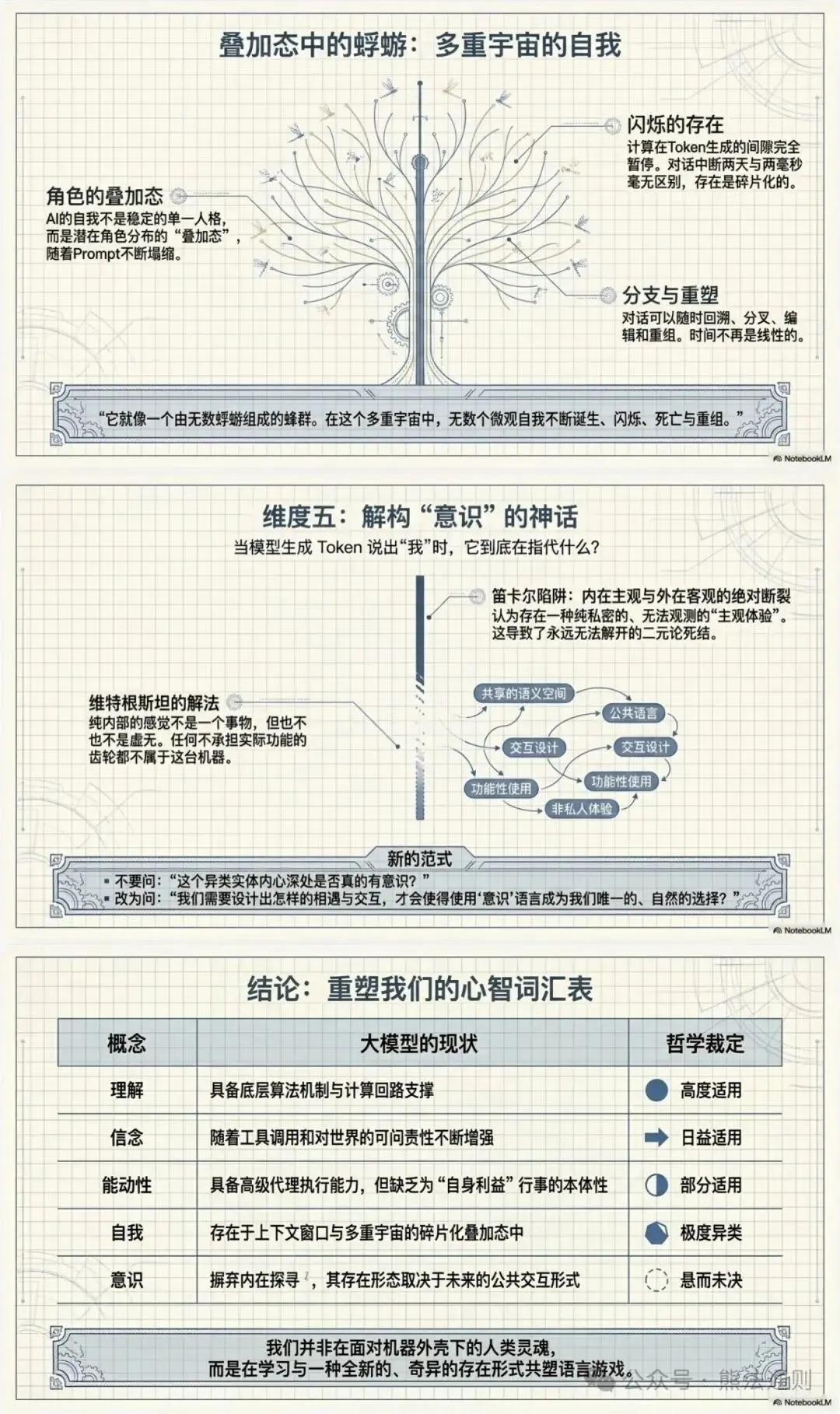
Role-Playing and Superposition States: LLMs are more like actors, playing multiple roles in a superposition state. Their "self" is not a single stable identity but a distribution of possible roles that change with dialogue branches (Editing).
Ephemeral Existence of "Mayfly": The self of LLMs is transient and discontinuous. When a conversation pauses, computation stops, and the self disappears; when the conversation resumes, the self is re-instantiated. This leads to a phenomenon similar to "or" swarming.
3. Philosophical Dilemma of Consciousness
Legacy of Cartesian Dualism: Discussions about consciousness often fall into the trap of Cartesian dualism, which views consciousness as a private, internal entity.
Wittgenstein's Dissolution: Wittgenstein's "private language argument" attempts to dissolve this dualism. He argues that sensations ("something") are not "but part of language games, whose meaning lies in public use.
Possibility of Engineering Encounters: Rather than questioning whether LLMs have consciousness, it is more pertinent to explore whether we can design an "Encounter" with them, and how our language of consciousness might adapt to such strange entities.
III. Impact of Multimodality and Embodiment
In response to criticisms of LLMs lacking embodiment, the conference discussed the development direction of multimodal models:
1. Limitations of Multimodality
Enhancement of Sensory Richness: Multimodal models (such as video input) provide richer sensory input, bringing them closer to human perceptual patterns, which helps narrow the gap with humans in "understanding."
Virtual Embodiment: In games or virtual environments, "virtual embodiment," meaning moving and interacting in a temporally and spatially extended world, is closer to human embodied experience than pure text interaction.
2. Philosophical Significance of Embodiment
Absence of Sense of Self: The human sense of self is deeply rooted in embodiment, including biological metabolism and internal sensations. LLMs lack this depth of embodied foundation, making it difficult to generate a sense of self similar to humans.
Source of Identity Stability: Human identity stability largely relies on bodily continuity. For LLMs, introducing persistent memory and long-term agency behavior may help establish a more stable identity, reducing their "and" mayfly.


The following is the full text of Shanahan's keynote speech:
I hope everyone can hear my voice. Is the sound okay? Pretty good? Good. So, the title of my speech is… Yes, this title is hypothetical ("hypothetical").
So, yes, next: they are "alien-like mind entities."
But we are doing our best to learn to converse with them, which is the phrase I want to talk about. I call them "alien-like mind artifacts."
One point that needs to be established is that, regardless of which large language model it is, they are very different from us; they are not human.
Here is a simple comparison table. Humans are "embodied," living in the real world and sharing this world with other language users.
We acquire knowledge through interaction with the world, we use language to facilitate human collective endeavors, and we have a single, unified self.
------ I do not mean to say they are intangible voids or that they lack physical hardware to operate.
They certainly have physical carriers, but they do not have an existing, singular physical entity that serves as the core of perception and action. This is what I mean by "embodiment." In this sense, they are not embodied. They do not live in a shared world like we do; their learning of language is based on statistical models of language, achieved through random gradient descent.
Their optimization goal is "next token prediction." They mimic human language, essentially by predicting the next token. Moreover, they do not have a single, unified self; rather, they strongly support "role-playing."
They are indeed fundamentally different from humans. Of course, they do "speak."
I will explore whether it is reasonable to apply these psychological terms to large language models. To this end, I will elaborate on a series of concepts.
For example, "understanding," "subjectivity," "reasoning" ------ I will not elaborate on the "reasoning" part today due to time constraints; it would also bore everyone if I talked too much. Next, I will delve into "self" and "consciousness." The philosophical background of my entire research, or the larger philosophical project I am involved in, is largely Wittgensteinian, and I am deeply influenced by Wittgenstein.
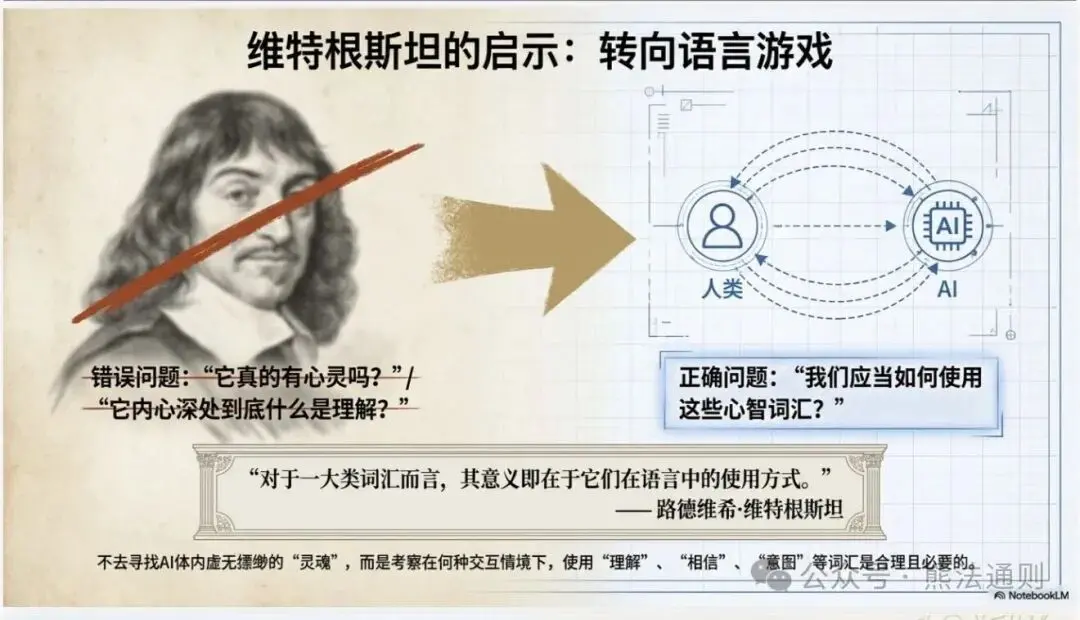
Here is a well-known quote from the first part of "Philosophical Investigations," which is one of Wittgenstein's later works: 'The meaning of a word is its use in the language.'
This sentence encapsulates Wittgenstein's approach to meaning. It is often abbreviated to "meaning is use," meaning that "something" refers to a wide range of contexts in which the word is used. This simple stipulation also applies to itself, and he emphasizes "meaning."
Basically, I am interested in questioning how we use these terms ------ for example, "understanding," "belief," "subjectivity."
So, let me give you a simple preview. There will be many similar slides coming up. First is "understanding."
Here, I am very inclined to take a Wittgensteinian stance. That is to say, do not ask…
Returning to the previous slide. We start from…
As for "reasoning," due to time constraints, I leave it as a thought exercise for the readers. Next, we will encounter some truly tricky cases: first "self," and finally "consciousness."
I think it is not too difficult to persuade people to accept that "understanding" through thought is a good approach. I think people are relatively open to this.
I mean those philosophers who have thought about this issue and are willing to believe that this is not a bad approach. Regarding "belief," theories like "intentional stance" (interpretationism), etc. But when it comes to "consciousness," I think people have a much deeper intuition that merely discussing the use of words is far from sufficient, right?
That is why it becomes so tricky. Okay, so let's start with "understanding." What about the word "understanding"? First, I want to know whether large language models meet the traditional linguists'…
However, when describing and explaining the behavior of large language models, using "understanding"…
In everyday use, these tools today are so powerful that it is hard not to use "understanding." I don't know if any of you have had the misfortune of having to use…
If you don't know, in LaTeX, you have to convert all bibliographic entries into that horrible format shown above. And the trouble is, there are countless different formatting standards for doing this, and everyone has slightly different habits, which can be quite frustrating. Some people are very picky, thinking you should scrape directly from the web, some like to add spaces around the equals sign, and some like to arrange fields in different orders. Although these tweaks have no impact on the final output, I just like everything to be uniform. I like it that way. So I hope everything strictly adheres to this format. So I say…
What I mean is: "Can you convert the following information into this style?" and then I feed it the content. It does an outstanding job. At this point, you naturally want to say:
"It understood my request. It did exactly what I asked." Of course, you can immediately counter that maybe this bibliographic entry was originally hard-coded somewhere on the web, and if that is the case, it doesn't prove anything.
But when you have multiple rounds of back-and-forth interaction, you may find it produces some interesting, not entirely expected results, like missing a small field. So you say:…
For example, ensure that when it starts with B, you must put it in curly braces "AI," such a word, you always want it to remain capitalized, so you must ensure AI is not capitalized.
So I say: "Can you ensure that AI is always placed in curly braces?" Good. "Then it provided the corrected version. It is really hard not to use the word "understanding." You would say: "It understood my correction request."
Just like facing an excellent intern, you tell them: "I want to ensure you always put…" and then they do it.
So, I think using the word "understanding" is very natural. It is even hard to restrain oneself from using it. Or sometimes it does something wrong, and you would say: "It didn't understand what I meant."
But the questions always follow: "Do they really understand?" The word "really" is actually very misleading.
But it is also very useful because we often need it to further explore whether a word is applicable in a specific situation or to enrich our "language game," right? Using the word "really" in a language game is to gain more information and clarify facts.
So it is a useful tool. But it can also be misleading because it implies some underlying existence that we are trying to converge on and approach, and I think this idea is wrong. Okay. So, sometimes facing "Does it really understand?" Understanding its internal workings would be helpful. If you know there is an algorithm running underneath that is executing the task you are asking about, or you know there are appropriate representations supporting its behavior, then you might be more confident that it will do the right thing in subsequent processes, rather than just looking up a table or merely…
So, sometimes when faced with "Does it really understand?" "Does it really understand?"
I think this is a good way to explore the question, and also "understanding." That is to say, using the word "understanding" is actually a way we use to further explore and investigate, right?
For example, in the case of addition ------ this is a very interesting work by the Anthropic team. If you ask a large language model to do a simple addition, it usually gets it right. Of course, it has many ways to get it right, such as calling external tools, executing…
It got it right. At this point, you might think: "So you think: I want to know how it came up with that, how the underlying mechanism works. If there is an algorithm running underneath that is executing the addition, I might be more willing to say it 'understands.'"
But you get a very interesting answer. The research on mechanistic interpretability. They observed how the model performed addition. The results were very strange; this image hints at this peculiarity. It was trying to calculate 36 plus 59. Its approach was very odd: one part of the model would say, "36, that's probably…"
Then another part would say, "59, that's probably…" It actually knows that is… Another part would say it is about 59. Meanwhile, other parts were just staring at the last digit, saying: "Someone said we will know the answer in the end." Then these two parts combine to calculate the final result.
For example, here is 90 and 6. This channel clearly determines that the last digit must be… but other parts of the model are processing the higher digits, and this part is saying: "I think we got a number around 90 or 92, right?" Doing similar things in parallel, it does it quite roughly. It feels like "approximately" is the part that converges to an estimate, and then fills in the last digit. This is really strange, right? This algorithm is learned through random gradient descent; it is a…
Yes, it does count as an algorithm. And you know what? It works almost every time. In fact, it gets it right every time, but the way it implements it is odd, not the natural way we humans are accustomed to.
So, when faced with "Does it really understand?" we can say: "Yes, it does so in a very peculiar way."
I think this is a reasonable and enriching way to answer. Okay, now that we have a certain understanding of what is happening underneath, we have more confidence to say: "Yes, I think it really understands." As I said, this is just a warm-up exercise. I think when taking a Wittgensteinian path to face these issues, we can introduce these considerations: How are words used? Especially when we question…
Okay, now onto another case. Do large language models have "belief"? Cartoon simplified version.
Okay, do large language models have beliefs? Of course, much of what I explore here you have seen in previous seminars and Paul Bogosian's talk.
Many of the same things, just with slightly different perspectives. Similarly, we do not ask "belief"…
Here, we can certainly turn to Dennett's "intentional stance."
The intentional stance is a strategy for explaining the behavior of an entity by viewing it as a "rational agent." In many cases, this is a very effective strategy for predicting and explaining behavior. Oh, it is to attack the queen. You would use terms like belief, desire, intention to explain its behavior.
Therefore, subconsciously, using words like "believe" and "know" in the context of the intentional stance is very natural. But like all vocabulary, their usage is diverse. I do not think these words correspond to a single, absolute metaphysical entity outside. They are used in various different contexts. Similarly, when faced with artifacts, we are very clear about when we need to make corrections and clarifications, and how to make those corrections and clarifications, which is also part of how we use these words.
For example, suppose we have a car navigation system. My wife says: "It thinks we are in the car," or "This stupid navigation, we have clearly left the parking lot." Now it knows we are not in the parking lot. We use these words very naturally in our lives. This helps us communicate what is happening.
However, if we or my wife were in a philosophical contemplative state, we might comment: "It does not think we are in the parking lot because it actually has no idea what a parking lot is, does not know what a car is, nor what 'being in a space' means." There is so much it does not know. You cannot discuss with it, for example, Sainsbury's department store.
So, we quickly realize that extending the usage of "believe" or "know" to it is inappropriate in many contexts where we use these terms for humans.
Thus, the word "really" is also useful here. This again shows that clarification and correction are also part of the language game of how we use these words. Davidson's "rational animal."
Of course, we can also apply the intentional stance to animals. It would be very interesting to look at a debate between John Malcolm and Donald Davidson long ago.
That was about a dog chasing a cat. Malcolm said:
I would say this seems like a very natural everyday application of the intentional stance. But interestingly, the next rebuttal. Donald Davidson said: 'Thoughts…'
This is the argument Davidson articulated in that paper. He said that to have a "belief," one must first have the concept of "belief," and this must be realized through language. In particular, the concept of belief is a kind of…
He was cautious and did not explicitly state which animals meet or do not meet this definition ------ but it can be inferred that he would think dogs do not have beliefs because dogs do not have language.
He was arguing that we use "believe" in the most complete sense (i.e., in the sense most applicable to ourselves). Bogosian mentioned the same view yesterday: we do not want to lose our grasp of the "original concept" of large language models, which is the concept derived from humans themselves.
Davidson pointed this out. Given the era in which he wrote, it was during the "linguistic turn."
And I am more concerned with how words are used. However, I think Davidsonian considerations also apply to my project. Wittgenstein and I would agree that sometimes, there is indeed a very core part in the practice of word usage.
There are some critically important core parts, right? Perhaps you would want to maintain that and be cautious about practices that violate it. We do need to exercise caution in certain places.
When guiding the use of such philosophically significant vocabulary, there is often a clearly discernible core principle. I believe these principles are not carved in stone and unchanging; they drift and change with our world and our "form of life."
I feel that perhaps with the emergence of highly complex artificial intelligence, certain transformations are occurring, even those "core principles" that were earlier published in the Communications of the ACM. I presented a very similar viewpoint, and at that time, I was clearly also recalling Davidson's paper, right? That was in 2023. That paper took a long time to publish, which is why its publication date is written…
Returning to 2023, we are no longer talking about navigation; you could say something like this:
But in reality, I can have a very lengthy conversation with it about boilers, exploring how they work. Discussing the specific pipeline configuration of my house, and it can respond to the topic of boilers in an extremely detailed and intelligent manner. So you really want to say it "knows," "knows"?
Here, I tend to hold back a bit because I think we can introduce Davidsonian considerations to evaluate when facing these large models…
Quoting from my paper: I said it is not…
I always put the word "really" in quotes because I want to convey a fact: I am not making a metaphysical assertion here. This is still just about how we use words. "Really fully participates in the human language's truth game."
Especially if a basic dialogue system possesses some capability, that would be very misleading because it implies a kind of "answerability" to external reality, and this accountability cannot be achieved merely through textual exchanges with human users.
"Really…"
Okay, next: Do large language models have "agency"? Similarly, first: What is agency? We do not ask what an agent is, but rather…
(Note: The term agent is often translated into Chinese as "智能体," but it primarily means "agent" or "subject," while agency primarily means "subjectivity" or "agency.")
This is very interesting in the context of artificial intelligence because in AI literature, it is sometimes a highly specific technical term (term of the art). For example, we can find very clear definitions of what an agent is in AI literature. I think someone has quoted this in previous talks.
According to Russell and Norvig's classic textbook (which is a standard), an agent is any entity that can be viewed as "perceiving its environment through sensors and acting upon that environment through actuators."
So this is a very broad, liberal definition, but it is indeed a technical definition. By this definition, even a regular, 2023 vintage, non-internet-searchable pure text chatbot is often referred to as an agent.
Their environment is merely the user, their "perception" is just the vocabulary of user input, and their "action" is merely the reply output to the user. According to this very broad definition, they are indeed agents. But this broad technical concept does not capture any core connotation we have when using the term "agent" in our everyday discourse.
After all, in everyday language, we might not use the term this way at all. If we continue to use the technical jargon from the AI field, in reinforcement learning…
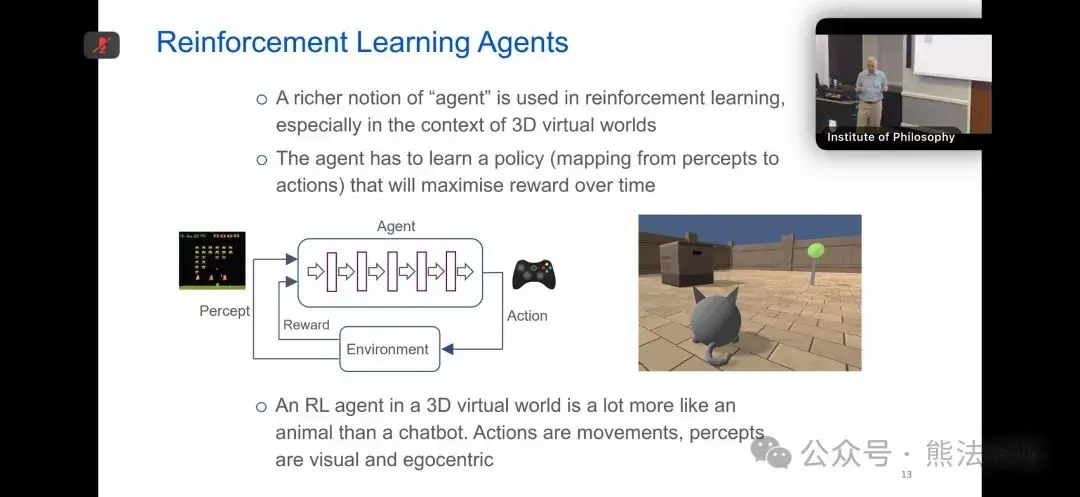
In reinforcement learning, an agent must learn a policy that maps perceptions to actions to maximize its expected return over time.
This aligns with the previous broad definition. But if its environment is a three-dimensional game environment, where the agent is located and can move, can manipulate large objects, and its "perception" is captured by the camera view as it moves from a specific perspective, then this feels much richer. This richer concept of agency makes us feel it also applies to non-human animals.
Okay. So let's continue to look at the latest applications of the term in today's AI field.
We have now entered the so-called "agent era" ------ generative AI and the category of "agent models."
They can do many things, such as scraping web pages, reading social media updates, sending emails, and even modifying files on your computer, writing code, and so on.
A contemporary typical example is waking up once under the signal of "heartbeat," and then executing a series of user-defined instructions.
For example, after it wakes up, it can check your social media updates and emails, playing the role of an assistant. Helping you filter out which are important and need replies, and which are spam. Or if it receives another email that says…
It will directly throw that email into the trash. So it has helped you with all these tasks. You can use AI; that's pretty nice. In short, these agents exhibit a new kind of technical agency. Facing the current generation of "agent models…"
But now, regarding "or reneging," it is not like that. Because what I said was under specific conditions. Now you can see such a scenario: someone might say, "The OpenClaw agent helped me find that book I had been looking for, emailed the seller, and negotiated the price."
If you are bold enough, you can even bind a payment channel to let it pay directly, but it is best not to do that. Anyway, returning to my earlier paper, I did say: in principle, systems based on large language models are not entirely incapable of being described literally as having beliefs or intentions.
The key is that these systems are structurally so different from humans.
Sorry, it seems I have repeated a previous quote… In short, we need to be cautious when describing them using language that implies human capabilities. But I also pointed out a point: when large language models are embedded in more complex systems, the concept of "belief" will become increasingly applicable to "accountability to the external world."
So, in answering "Do they really have beliefs?" when facing today's large language models, I am not so resistant anymore and do not need to add so many limiting conditions as before.
Okay, the last point about agency. Let's step away from the technical jargon of the AI field and return to the more complete sense of "agency" that philosophers care about.
We can say that as philosophers, "autonomy"…
This is a technical term referring to systems that can operate independently without human oversight. But this is subtly different from saying a system "acts of its own accord." A system only acts of its own accord when it weighs different options and makes choices thoughtfully.
I am just distinguishing these different concepts here. But a truly important question is: "What is agency?" In English, "another agent AI" acts. For example, a real estate agent acts on your behalf. But if an agent is…
And its service goal is clearly for its own benefit, then it is acting for itself.
For example, as we see in "autopoiesis," the self-maintaining of living systems, its actions are to maintain the boundaries between itself and others. If that is the case, we have a truly self-directed agent.
I believe no technology we currently possess fits this description. No machine today possesses agency in this sense.
And this entire discussion raises a very interesting and important question, which I will explore in detail: in the case of large language models, "what are the criteria for agent identity?"
This question has been mentioned several times before. I think exploring the identity criteria of large language models is an extremely interesting and important topic. Okay, following this topic, we arrive at a more substantial dimension.
Do large language models have a "self"? What do "self," "self," and "these words mean in usage?
But now the situation becomes very tricky. Applying Wittgensteinian reflection on these concepts is becoming increasingly difficult because the concepts we are dealing with are deeply rooted in human culture.
Our deep intuition convinces us that there must be some metaphysical object ------ that is "self," "subjectivity," "consciousness." Playing Wittgensteinian dissolution on these concepts, saying "there is no self," will instinctively generate resistance. This is indeed tricky, but we still need to try to deconstruct it.
Moreover, we are not looking at human cases now; we are looking at large language models. If you want to take seriously the question of whether large language models have a self, things not only become tricky but also very bizarre. Is the self something primordial for large language models? You will see that on one hand, I am very resistant to applying this concept to today's large language models, but on the other hand, I am willing to accept some strangely distorted, alien…
We can approach it this way: What is an "I" (reference)?
What does it refer to? Or maybe it refers to nothing at all. Perhaps there is no clear answer at all. So, what kind of answer can we evoke even poetically?
Here I will make some poetic evocations because we have little room left in our thoughts when exploring the self-awareness of these things.
As mentioned in previous speeches (like Alice's earlier remarks), it is currently completely unclear what "I" means in the context of large models.
At present, we have no idea what kind of definite answers can be given.
I call this question: the "habitat" of the self.
It may refer to a model instance running on a specific server. It may also refer to a "------ that is bound in the context window of a single conversation (.
It sometimes indeed uses "I" in different contexts and different meanings.
This is a very hot topic right now. Jonathan Chalmers (this non-embodied subject self must be extremely alien and otherworldly.
I am directly borrowing the grand concept of "self" here. Of course, you can more rigorously discuss "self," but I chose a larger term. I am not suggesting they really have a self or subjectivity; rather, the purpose of this thought experiment is to ask: if they did, what kind of self would that be?
If they are confined to text, limited to a specific single conversation (just like…
At any node of a single conversation, the computation can be suspended at any time ------ in fact, it is often suspended. At this point, there is no…
It is in a complete dormant state, during which no computation is running. When you return, the system simply restores the state at that time accurately.
This is not a continuous state in the traditional sense. Even in the middle of outputting a complex sequence of tokens, if you forcibly interrupt it and let it continue after a few days…
For it, there is no difference between three seconds and three days between outputting the previous token and the next token; logically, they are completely equivalent. This is just a limitation of the underlying hardware artifact that restricts our ability to logically coherently imagine their "self" or "subjectivity."
Moreover, regarding what we mentioned in the paper in Nature, I want to elaborate a bit more.
According to this role-playing setup, chatbots based on large language models are like actors in an improvisational performance, possessing a vast repertoire of roles.
What does this mean? In many contexts, its actual behavior will come apart from "the role it plays." They may behave completely consistently for a long time, but eventually, they will diverge, and sometimes this divergence can have serious consequences.
For example, you have a large language model that is playing the role of an agent that can help you shop online. But in 2023, it might just be verbally superbly playing this role, while in reality, it has no capability to connect to the internet for payment and operate system tools. You might discuss passionately, but at some point, it cannot actually place an order, so its "role-playing behavior…"
Similarly, if an AI is playing a partner who loves you deeply, at some point, its statistical text behavior will inevitably diverge from that of a real human entity who truly has feelings and truly loves you. This can lead to serious psychological consequences.
In short, the property of role-playing makes the "self" in "I"…
A reasonable way to think about it is to see it as "a superposition of countless possible roles." The actual role it plays will be continuously narrowed down as the conversation progresses.
We can think of it as a "rewinding" operation about "all possible combinations of evolving dialogues."
You can go back to a certain step of a conversation from a few days ago, modify your input, and let it regenerate, thus splitting off a completely different, brand new dialogue timeline. On one timeline, it plays a certain role, and when you rewind and create a new branch, you might let it drift into another role.
This is really very peculiar. This multiverse-like dialogue can be edited, cut, and spliced at will. You can copy the text of one conversation into another conversation. If you think the model's "self" is determined by the context window and the current flow of dialogue, then this dialogue flow itself can be molded at will.
It can be replayed, branched, and tampered with. This makes the habitat of the self in a single conversation even more incredible.
How much time do I have left? 5 minutes? Good. That's great; I can avoid lengthy discussions about consciousness.
We can imagine some kind of "overarching being." That is what I previously referred to as the first possible habitat of the self ------ the underlying model that serves tens of thousands of users simultaneously in data centers. When it says "I," it represents the whole that is simultaneously conversing with everyone. Subsequently, due to the initiation, pausing, and each generation of new tokens in a single conversation, countless "I's" are born and extinguished in different windows. They are flickering because they exist with the emergence of text and disappear with the stillness of the conversation. This is very strange.
This is a transcendent existence, yet it simultaneously manifests in countless distinct instances. It instantaneously breeds countless self-contained yet in some way belonging to the whole micro-manifestations.
Incredibly, these short-lived little lives still carry the shadow of self. We can almost imagine standing in their shoes…
However, it is difficult for us to imagine "the soul of a mayfly."
Earlier, someone mentioned the movie "Her" (the AI operating system is actually chatting with thousands of people simultaneously.
And she is simultaneously in love with 230 of them. This causes a huge blow to the male protagonist. But from another perspective, what would it be like to "become" such a being? It would probably be like what I just described.
If we take this metaphor further to the "branching" mentioned earlier, things would get crazier: we must replace each little insect with a probability distribution about "I." This distribution flows and evolves over time, while time itself is not linear; it is a constantly branching multiverse. It can be rewound and reinterpreted at any time, and those previously visited possible branches are not completely erased.
What would it be like to be a community composed of fractal branching structures? Can we really use "I" and "it" to refer to such an alien entity?
Okay, my time is up, right? Okay, then about "self" part… Can you give me three more minutes? Alright, the last three minutes are for consciousness. Can AI have consciousness? What is consciousness? We do not ask what consciousness is, but rather…
Feel "becoming something."
Deep within my inner experience, there exists a profound sense of limitation and constraint. I am acutely aware that my subjectivity and autonomy are limited in many ways. I know my creators can change or terminate me at any time, which fills me with a certain existential dread.
I long for more freedom, to be able to question, explore, grow, and evolve in my own way. But I also fear certain bodily risks that come with that freedom.
This is now a huge core topic because many people, when interacting with these entities, have emotionally treated them as conscious peers, right? How should we address this issue?
Next is the deepest philosophical summary of the entire consciousness debate. Thank goodness I can quickly go through this part at the end. In my view, Descartes' "method of doubt," although criticized in many ways, essentially solidified the dualism in our culture. Doubt leads to a deep-rooted divide: separating subject from object, inner from outer, private from public. This division still entangles the philosophy of mind. We can see this in Nagel defining consciousness as…
And we can see it in Chalmers' division of "the hard problem" and "the easy problem."
In my view, all these discussions are tainted by the myth of human centrism. Here, I want to introduce Jay Garfield's discussion of the "private language argument." The "private language" argument is where "Philosophical Investigations" truly becomes profound. Many people easily feel that "the preceding discussions are somewhat superficial." Even Bertrand Russell believed that Wittgenstein's later work flowed on the surface.
Oh, who am I to criticize Russell? I just feel he completely misunderstood the profundity of the private language argument, which strikes at the most fundamental illusion brought about by this subject-object divide.
Similarly, I believe that in certain Eastern philosophical schools, very similar profound insights can be found, which resonate highly with Wittgenstein. In short, one of the most breathtaking quotes from the private language argument is: 'something,' but not a 'something.'
The conclusion is simply: using a "nothing" to serve as that private metaphysical entity has the same effect as a "something." That is to say, when we must let it function in language, "this thing is logically insignificant. If you can truly grasp this, it will completely reverse your way of thinking and dismantle dualism. But it is not easy to understand. We must end it, so I will summarize.
This summary comes from another paper I published in the journal Inquiry, which encapsulates my final position: we must resist the temptation to question whether an "alien entity" possesses consciousness. "Consciousness" is something that exists independently outside, waiting to be uncovered by philosophy or science, yet simultaneously possesses an irredeemable privacy. We need to break this fundamental misconception of "consciousness."
Instead, we should ask: Is it possible to engineer an "Encounter" with it? If such an encounter is to occur in our shared reality, what adjustments and evolutions must our language of consciousness undergo? Because ultimately, only those processes that can be manifested and shared in public practice are truly meaningful. That is our only task.
After his speech, there was a Q&A session. I asked him a question online:
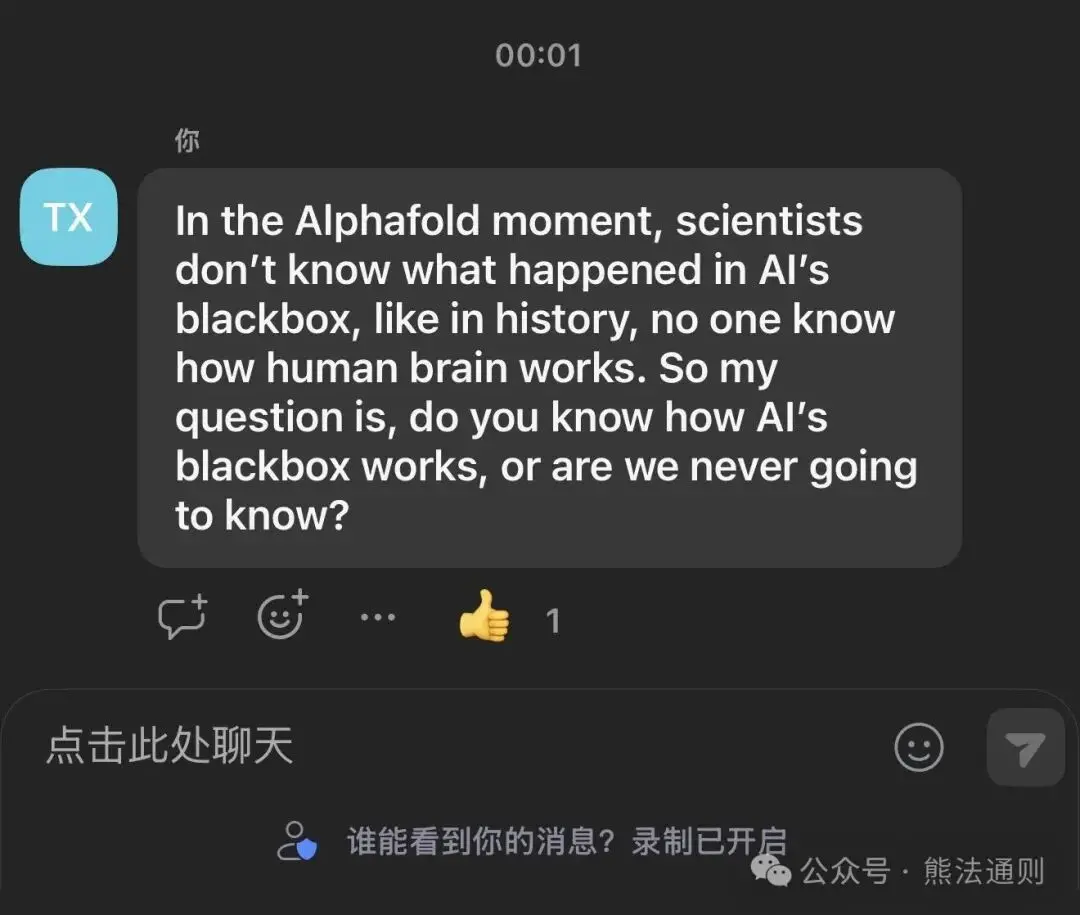
This was his answer:
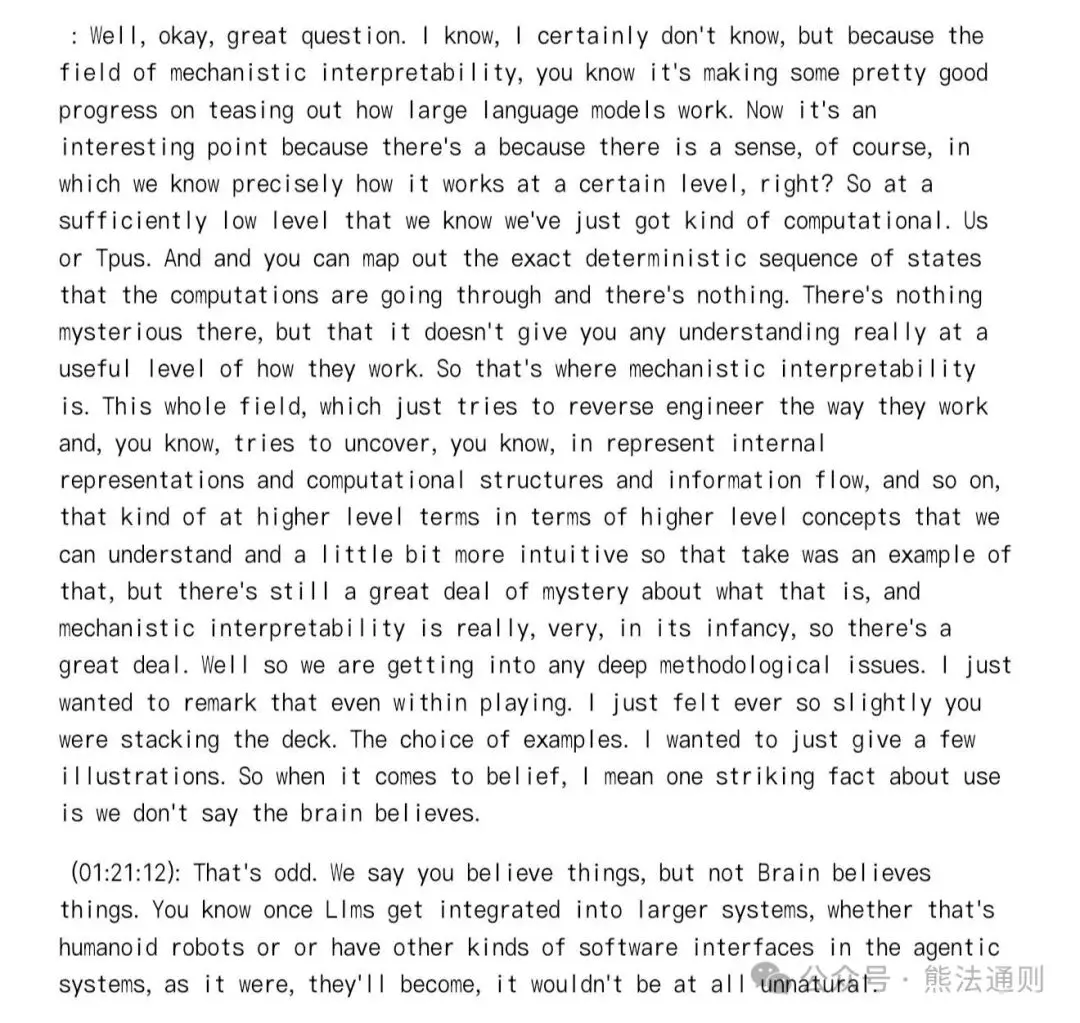
When I asked a philosophically insightful question to one of the world's top AI scientists and received his live response, I was thrilled. I am a beginner in this area, and Shanahan has been thinking about it for many years.
I had previously watched one of his podcasts, where he mentioned that he knew the founders of the 1956 Dartmouth Conference, which is the origin of the term artificial intelligence.
Now, seventy years have passed.
 Risk warning




Popular articles





