



Interest rate hikes, rate cuts, wars, elections, cryptocurrency is becoming less pure!

 Why do we need to care about so many issues in researching cryptography? It's overwhelming!
It's often said that Chinese people generally have a sentiment of being a small citizen of a big country, just like those earning a monthly salary of 3000 are keen on international affairs and macroeconomics, occasionally indulging in grandiose fantasies of pointing out the direction of the country with passion and ambition. Don't be fooled by my humble meal of radish, pickled vegetables, and tofu; it doesn't stop me from caring about the CPI of the big beautiful country. Now that the information bubbles have been burst, it's clear how many holes are in the luxurious outer garments. The CPI inflation data for April in the big beautiful country will soon be revealed.
This Wednesday evening, the Labor Statistics Bureau of the big beautiful country will release the April CPI data. This key inflation indicator will influence the direction of monetary policy and determine market expectations for future monetary policy paths.
Market predictions indicate that despite soaring gasoline prices, the year-on-year increase in April's CPI may slightly drop to 3.4%, while the month-on-month increase remains at 0.4%. The core CPI (excluding food and energy) is expected to show its first slowdown in six months, with the year-on-year growth rate easing to 3.6%, the lowest in nearly three years.
This trend brings a glimmer of hope for relief from price pressures, but the CPI remains high, and the Federal Reserve is cautious in its interest rate decisions, awaiting clear signals of sustained inflation slowdown.
First, the Federal Reserve has clearly stated that it cannot raise interest rates any further, which is undoubtedly good news for the U.S. financial market, which has been under pressure from high interest rates. However, this also means that the Federal Reserve has recognized the negative impact of rate hikes on the economy and has had to make compromises.
Second, the Federal Reserve announced that starting in June, it will reduce the scale of its bond sales from $60 billion to $25 billion. This measure aims to alleviate tensions in global markets and avoid a market crash caused by massive bond sell-offs. However, this also exposes the Federal Reserve's helplessness and dilemma in responding to the global financial crisis.
Finally, the Federal Reserve warned not to try to predict when they will cut interest rates, as they themselves do not know. This statement is particularly unsettling, as the Federal Reserve, as one of the world's major central banks, has a significant impact on global financial markets. It seems the Federal Reserve is betting that it can harvest enough global assets before the U.S. financial industry collapses under high interest rates.
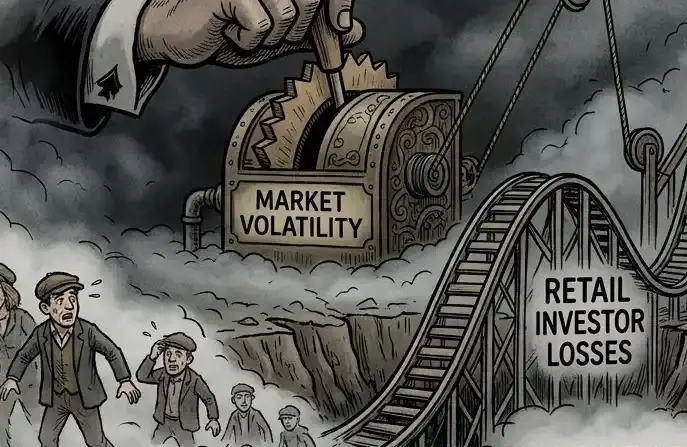
The pressure index is soaring, and with little money in pockets, the profit-making effect is getting worse, and more and more investors are unwilling to trade. On one hand, purchasing power is weakening, and on the other hand, selling pressure is also decreasing. This is the current situation. Those investors who want to buy have already acted; unless there are new changes in price or market sentiment, those who want to sell have also reduced their numbers, unless there is a new bearish trend. The market has been oscillating at this position for too long, and most investors have become numb.
Why is it so difficult to make money in the crypto space at this stage?
The Bitcoin ETF has been approved, and off-market funds have started to enter, making the market increasingly regulated and larger. Once big funds enter, it becomes difficult for ordinary institutions and whales to manipulate the market. Personally, I feel that Wall Street capital is likely to control future trends. After the decline of dollar hegemony, this capital needs to find new ways to harvest, and the crypto space might be a good choice. A regulated market is a good thing, but the previous rounds of wealth creation myths may be coming to an end, and the profits that retail investors can earn will also decrease.
The wealth creation in several bull markets was due to initial information asymmetry, where early investors could profit during the unnoticed or crowdfunding stages. However, now project parties use high market values as investment guarantees, and even before going public, insiders and big whales have already built up their positions. Positive news and FOMO constantly tease your wealth nerves, and by the time you make up your mind, you might already be wearing the hat of a retail investor left holding the bag, watching your account shrink while project parties are slacking off and big whales are splashing in the pool.
Returning to policy, if CPI continues to rise and the Federal Reserve does not cut interest rates, will a bear market come?
Generally speaking, if there is an economic recession or crisis, the Federal Reserve will adopt a loosening policy to promote a rapid market recovery. However, if the economic situation is good, the Federal Reserve may avoid loosening; in this case, even without cutting interest rates, market liquidity will gradually increase and recover, but it may take some time, at least until after 2026.
Cutting interest rates itself does not significantly increase liquidity; it is the loosening policy that truly enhances liquidity. The main advantage of cutting interest rates is that it marks the final stage of the Federal Reserve tightening its policy, preparing the market for expected loosening. Therefore, cutting interest rates does not equate to releasing liquidity.
Some worry that if interest rates are not cut, a "bear market" will arrive.
Not cutting interest rates will not lead to a bear market, but it will increase uncertainty in the risk market and raise the possibility of economic recession, which could ultimately lead to negative outcomes. However, this is merely a probabilistic possibility; it can be said that maintaining high interest rates daily increases the likelihood of black swan events occurring.
But let's not forget that policies can change, and the key lies in who signs them. The election in the big beautiful country is essentially between two old men, Biden and Trump, who often sing opposite tunes. It is well known that Biden dislikes cryptocurrency, while Trump embraces it and has issued his own NFT. Who gets elected will directly affect the development of cryptocurrency.
Interest rate hikes, cuts, wars, elections, and other seemingly unrelated matters actually have a direct impact on the trends in cryptocurrency.
Cryptocurrency is becoming increasingly impure.
 Risk warning Risk warning