Galaxy: The Evolution of Memes and Their Position on the Blockchain

 Their important role on the chain is not about how much they should be worth, but about the blockchain being used as a channel to disseminate them.
Original Title: 《The Evolution of Memes and Their Place on Blockchains》
Author: Zack Pokorny, Galaxy
Compiled by: Bai Shui, Jinse Finance
Whether you love them or hate them, memes have become a cornerstone of the crypto economy. Memes are not known for technological innovation or breakthroughs in blockchain scalability; some skeptics claim they have no value at all. Some builders in the blockchain ecosystem even believe that memes overshadow their serious work, damaging the overall brand and image of crypto. However, due to their viral nature, memes have surged and accumulated significant value in the broader crypto market.
Fundamentally, memes are ideas, symbols, or behaviors that spread within or between subcultures. History shows that memes have existed in various forms and through different media for centuries in human civilization. They are likely to continue to exist and manifest on the most widely used communication channels. During the pandemic, memes saw a significant rise as investors gathered on sites like r/wallstreetbets to express their dissatisfaction with the status quo by investing in stocks heavily shorted by Wall Street giants, most notably GameStop. Permissionless blockchains further amplified this phenomenon. Dogecoin may be the original meme, but in recent years, the popularity of memes has exploded. We estimate that the total market capitalization of memes on permissionless blockchains currently exceeds $60 billion. The growth of memes is built on the monetary connections shared by holders of non-fungible token projects and indicates that communities, cultures, groups, and trends may increasingly rely on monetary tools for cohesion and speculation.
The Evolution of Memes and Modes of Expression
While the content of memes and the messages they convey have evolved with changes in society, culture, and technology, the digital images we share and laugh at today are essentially not new. They are merely a continuation of something that has evolved over thousands of years alongside early humans. Storytelling is an integral part of humanity, whether through organic marketing or intentional promotion; viral meme images, prose, and concepts have played significant roles in the formation and transformation of human society. From cave paintings to Roman graffiti, from anonymously circulated pamphlets to newspaper cartoons, widely shared images and concepts have conveyed knowledge, helped overthrow governments, and driven social change across eras.
While this general notion of memes has always existed, two important components have undergone fundamental changes throughout history: the medium through which they are expressed and the means of dissemination. The oral traditions of ancient societies condensed complex histories into memorable, repeatable stories, which were crucial for passing knowledge to future generations. Viral images were widely used in ancient Greek and Roman societies to convey political messages, and as methods of creation and dissemination became increasingly sophisticated and convenient, the influence of viral images grew. Blockchain represents the next stage in the evolution of memes, as its technology has been widely standardized, with ledgers offering permanence and immutability, and global accessibility.
The Evolution of the Meme Canvas
Since the dawn of humanity, the intrinsic desire to express and share experiences, emotions, and thoughts has driven communication and cultural development. Early humans used charcoal and chisels to inscribe their thoughts and observations on cave walls and stones, creating the first known "meme." These primitive memes demonstrated humanity's fundamental need for connection and the sharing of cultural and expressive elements.
As civilizations flourished and technology advanced, the mediums depicting memes continued to evolve. Paint, ink, slate, and paper became new canvases, with beautiful murals appearing in ancient public buildings, grotesque graffiti on the Roman Colosseum, and satirical cartoons in newspapers.
The birth of modern internet memes in 1993 marked the last paradigm shift in how we express and share ideas. Through emails and message boards, the digital realm became a new frontier for the evolution of memes, allowing individuals to participate in and share memes on a larger and more expressive scale.
Today, the emergence of memes places us on the brink of another transformative moment in the history of expression and distribution, fundamentally altering interpersonal communication. The widespread use of blockchain as a canvas for memes and peer-to-peer (P2P) networks as dissemination channels signifies a new era in human communication and cultural evolution. Just as the printing press revolutionized the spread of ideas (and ultimately memes) in the 15th century, and television and the internet changed the dissemination of ideas in the 20th century, blockchain will redefine how we create, share, and consume memes and information in the 21st century.
The Evolution of Meme Distribution
In the early days of human civilization, memes were likely exchanged through person-to-person interactions, a process that, while not efficient for large-scale dissemination, was the most advanced means of communication at the time. As humans developed more complex communication tools and technologies, such as writing, printing, and painting, the distribution of memes became more widespread. Graffiti on building walls and paintings in public spaces allowed a broader audience to access these cultural elements, even if the memes themselves remained limited in their transmissibility.
The advent of newspapers marked a significant milestone in human communication and the dissemination of memes in the form of cartoons and caricatures. While the creation of memes in this medium faced more restrictions, the use of automobiles, bicycles, and storefronts as dissemination channels made the spread of memes much easier. These modes of transportation were among the most significant advancements of the time, enabling rapid dissemination of information, ideas, and culture to a wide audience.
The rise of television and the internet ushered in a new era of meme dissemination, democratizing access to memes and allowing people to view them from anywhere in the world. The privileges that once determined access to memes were largely eliminated, as anyone with an internet connection or television broadcast could participate in and share these cultural elements. With advancements in these technologies and their applications, the creation of memes became increasingly simple, and the emergence of tools and platforms facilitated the production and distribution of memes.
Throughout history, memes have entered the most advanced, influential, and widely adopted communication channels of their time in their own way. All of this has had a significant impact on humanity.
The adoption of blockchain as a medium for meme expression highlights the growing importance of this technology as a central platform for sharing thoughts and experiences in the purely digital age.
Memes on the Blockchain
Memecoins are tokenized representations of internet memes or other humorous events or concepts. They are native assets of the blockchain, transferable, usable in blockchain-based applications, and tradable on secondary markets like DEX. Memecoins are often represented by their code or a string of characters identifying them, along with associated characters or other visual effects, just like most memes known today. For example, Dogecoin is a Layer 1 blockchain created in 2013 to parody Bitcoin, relying on the recent popularity of Shiba Inu photos online. Dogecoin is a fork of Bitcoin and was launched before the rise of tokenization, thus requiring its own Layer 1 blockchain to exist. Today, existing Layer 1 blockchains like Ethereum, Solana, and even Bitcoin can host and issue non-native tokens, and their ecosystems are equipped with out-of-the-box token contracts, decentralized exchanges, and other tools to facilitate token issuance.
Each memecoin is backed by a contract bound to a Layer 1 blockchain or Layer 2 network, specifying the memecoin's name, supply, and other details outlining its digital identity. Memecoins can only be deployed by launching one of these token contracts. In the early days of blockchain, issuing tokens was often costly and fraught with difficulties, as it required technical expertise to write or modify contracts, issue tokens on the blockchain, and create liquidity pools on DEX for trading. Today, many of these difficulties have been abstracted away by services that automatically issue tokens and create liquidity pools after users input their memecoin details. Recently, Pump.Fun has become a popular venue for issuing memecoins, but there are many ready-made token contracts that can be easily deployed on various blockchains. The relative ease of issuing memecoins has created a flywheel effect, leading to the generation of memecoins and speculation around them reaching unprecedented scales.
Gambling as a Distribution Mechanism
By definition, with very few exceptions, memecoins have no real utility. While Dogecoin is a gas token used to purchase block space on the Dogecoin blockchain, today's memecoins are almost entirely worthless native gas tokens. Instead, memecoins are often blockchain tokens without corresponding gas or application utility, typically promoted by creators, held by communities, or speculated on by traders as a channel to bet on the relative rise or fall of the underlying meme's viral spread. Due to the lack of underlying fundamental utility, memecoins exhibit extreme volatility, and their volatility becomes a vehicle for attracting users, leading to broader usage and understanding of them and the blockchains hosting them. The desire for crazy returns and overnight wealth is a motivation for many people's interest in memecoins. The potential for increased financial wealth has been the initial (and continues to be) catalyst for the adoption of memecoins on the blockchain as a canvas for cultural and emotional expression.
Some argue that this is a flaw, indicating that memecoins are temporary or will gradually fade as people make and lose money. However, as we have pointed out, memes have always existed, and the desire for quick profits has also persisted. While memes in the internet age have become ubiquitous, it is only recently that they have become assets that can be monetized and traded. The tokenization of blockchain combines the viral spread of powerful information with humanity's desire for wealth. This combination is new and likely to remain popular.
Meme Data
In this section of the report, we will examine the on-chain activity and value driven by memecoins over the past few years.
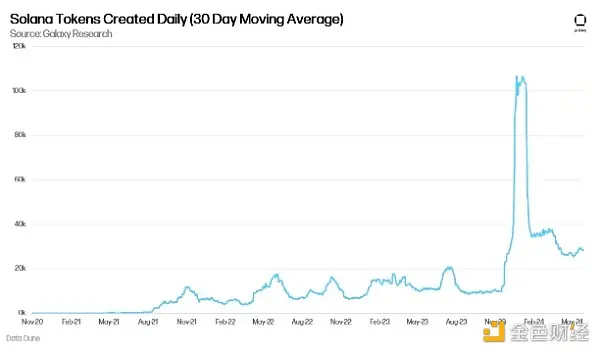
Solana is the primary blockchain for memecoins in 2024. Solana's low-fee environment lowers the barrier for users to create and trade memecoins, and its fast transaction confirmation speeds make the experience of using the blockchain comparable to loading memes in an internet browser. The end of 2023 marked a turning point for memes' on-chain presence. From August to November 2023, Solana averaged about 9,000 new tokens per day, now averaging 28,000 new tokens daily, more than three times that number. At peak times, using a 30-day moving average, it added over 100,000 new tokens daily. While not all of these tokens belong to memecoins, the large meme culture present on Solana allows it to act as a proxy for memecoin creation in the crypto space.
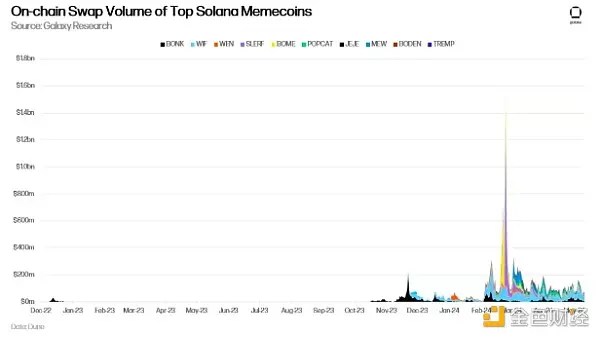
In the past 30 days, the on-chain trading volume of the top Solana memecoins, by market capitalization, has averaged between $91 million and $109 million. The average trading volume of the top two Solana memecoins, Bonk and WIF, accounted for 59% of this period.
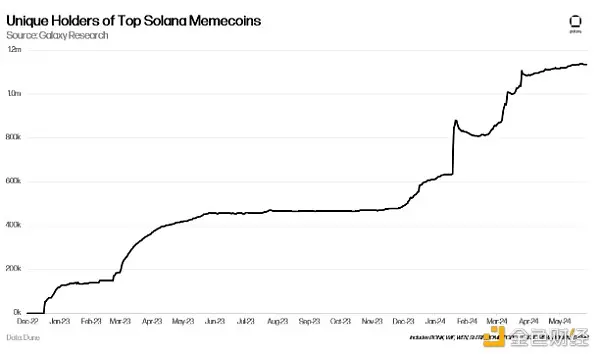
As trading volume increases, the user base continues to expand. The top ten memecoins on Solana collectively have over 1.136 million unique holders. Note that this number considers addresses holding multiple memecoins as a single holder. This trend highlights the reach of memecoins and the speed at which this trend is spreading.
However, memecoins did not start with Solana. $DOGE is one of the earliest and most valuable memecoins in cryptocurrency, launched in 2013, with a value of $24 billion as of May 29, 2024. $DOGE was launched on its own blockchain, the Dogecoin network. Besides Dogecoin, Ethereum was the original platform for memecoins during the 2020-2022 cryptocurrency bull market. Ethereum is the birthplace of iconic memes like SHIB, and more recently, PEPE and Harry Potter Obama Sonic 10 Inu, playing a significant role in establishing memes on the blockchain. Even as activity on Ethereum has migrated to other networks, it still holds the second and third largest memecoins, SHIB and PEPE.
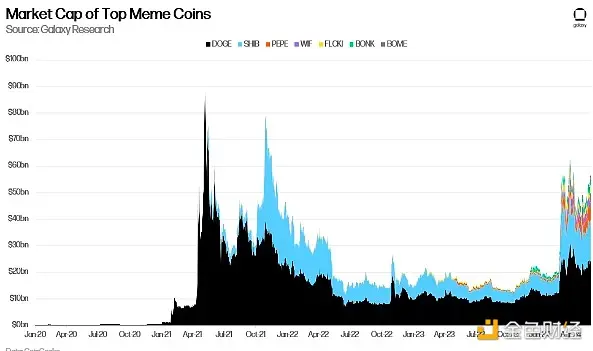
As the number of memecoins grows, their scale is also increasing. As of May 29, 2024, the total value of the top memecoins is $57 billion, a 3.5-fold increase compared to the same period last year and a 4.8-fold increase from the bear market low. An interesting feature of this chart is that four of the seven memecoins depicted were created within the last 511 days as of May 29, 2024; two of the seven memecoins were launched within 160 days. This highlights the rapidly changing nature of memecoins and the lack of durability due to the fast-paced evolution of contemporary human and internet culture.
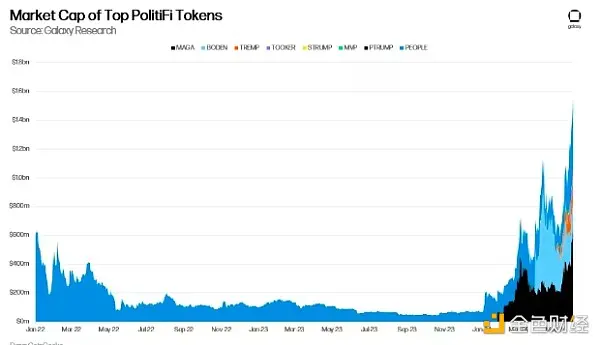
Over time, people have become increasingly accustomed to using blockchains as platforms for cultural exchange, and the types of memes emerging on-chain have become more specific, ranging from major dog and animal coins to memecoins expressing political beliefs and viewpoints. This shift indicates that blockchains are becoming a more important means of communication, with memes as the primary vehicle. The following chart tracks the total market capitalization of top "PolitiFi" tokens or memecoins depicting political figures and symbols.
It wasn't until 2024, the year of the 60th quadrennial presidential election in the United States, that these types of memes appeared on the blockchain. Memecoins representing political figures have essentially not existed in the past, despite their presence over several election cycles. However, some politicians, such as former U.S. President Donald Trump, have previously experimented with NFTs.
Non-obvious Utility of Memecoins
While memecoins as assets typically do not provide any specific utility—unlike Layer 1 native assets used to purchase block space, and they rarely have any governance or application utility—some have led to significant secondary activity. For example, the dog-themed memecoin $BONK was launched on Solana shortly after the FTX collapse at the end of 2022. Due to its close association with Sam Bankman-Fried and FTX, the usage of the Solana blockchain significantly declined. The value of $SOL itself, the native token of the Solana blockchain, had dropped 86% from its historical high in November 2021, but it fell another 78% between the FTX collapse and early 2023. $BONK was initially designed to reignite interest in Solana and catalyze on-chain activity by airdropping free memecoins to Solana developers, application users, and NFT holders. And it did work; in addition to a significant price increase, since its launch, $BONK has integrated into the Solana ecosystem with over 129 integrations across DeFi, gaming, NFTs, and other types of on-chain applications; it has become a major sponsor of Solana and non-Solana-related social/cultural activities; and it has developed its own bonk-specific applications, such as Bonk AMM, attribution contracts, and even gamified fitness applications like Moonwalk.
Memecoins can also serve as liquidity flowing through newly designed application pipelines. The decentralized exchanges and DeFi applications serving memecoins today may become the infrastructure supporting more traditional tokenized markets in the future. Just as MakerDAO is an application that allows users to convert ETH into stablecoins, but is now one of the primary ways traditional asset issuers bring U.S. Treasury bonds on-chain, the explosive growth of memecoins may also lead to the development and evolution of new application primitives, driving more enduring blockchain adoption in the future.
Conclusion
In 2024, two major segments are driving most of the traffic and interest in the cryptocurrency market: Bitcoin (especially considering the U.S. launch of a spot BTC ETP) and memecoins. Other important segments, such as NFTs, DeFi, and gaming, continue to grow and evolve, but their tokens have mostly underperformed, and the market has not positioned them as driving narratives. Newer technological concepts remain the focus of public interest, such as modularity and re-staking, but most have yet to launch. Bitcoin's continued strong performance and growing institutional adoption remain powerful macro narratives in cryptocurrency, but the most compelling native narrative in today's market is memecoins.
While many view memecoins as nihilistic and essentially useless, their existence is built on generations of viral stories, and their activity continues to drive blockchain adoption. Their significant role on-chain is not about how much they should be worth, but rather how blockchains are used as communication channels for disseminating them—because they are poised to become broader channels for societal expression. As blockchains gain more attention as means of communication and cultural exchange, the fusion of memes with technology positions this new medium alongside newspapers, automobiles, television, and the internet, all of which have had a profound impact on humanity and have become technologies adopted globally.
 Risk warning
 Risk warning





Popular articles