LayerZero airdrop causes another stir, is the current token distribution model going to be eliminated?
 This distorted model, where retail investors work hard only to be ultimately abandoned, may eventually be eliminated.
Author: Luccy, Blockchain Rhythm
The witch hunt event that has been ongoing for over a month has finally come to an end. The LayerZero Foundation announced today on X that it has launched a page for checking airdrop eligibility, but the results can still be described as "stingy."
As one of the most anticipated potential airdrop projects in the community, the LayerZero airdrop was expected to be "the big one," but with the witch hunt event in progress, many studios and even individual accounts were reported as witch accounts, resulting in a complete loss after months of hard work.
Related Reading: "Is LayerZero's Token Launch Preceded by the Largest 'Witch Hunt' in History?"
According to a report previously released by LayerZero, there are 800,000 addresses that are potential witch accounts. So far, LayerZero Labs CEO Bryan Pellegrino stated on X that not all witches have been eliminated, and on the airdrop claim day, the final list of witches (to be released tomorrow) will have their allocations redistributed to LayerZero Core airdrop eligible participants.
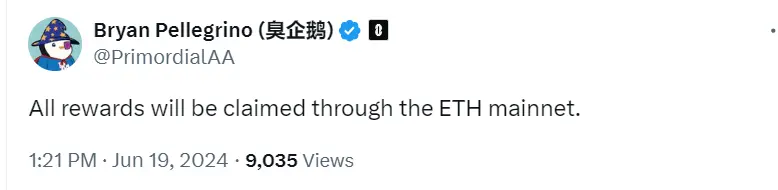
In the airdrop claim page shared by the community, some users ranked in the top 5% could only claim a little over 200 ZRO tokens, valued at about 600u based on an off-market price of 3u. Bryan Pellegrino also mentioned that the airdrop will be claimed on the mainnet, which means that the already meager airdrop earnings will also need to deduct gas costs.
Is LayerZero Also Facing "Insider Trading" Controversy?
However, while most users mockingly criticize the situation, some users claim they are eligible to receive tens of thousands of ZRO, and most of these individuals hold Kanpai Pandas NFTs.
Currently, the token economic distribution rules for ZRO are only based on the version initially announced by Bryan Pellegrino, which states that the total supply of $ZRO is 1 billion tokens, with 23.8% allocated to the community and developers. Among these, 8.5% of the tokens will be in circulation on the first day, 5% allocated to official bridge users, 3% to RFP projects (i.e., ecosystem users), and 0.5% to the community pool. The remaining majority will be distributed over the next 36 months, with additional retroactive allocations every 12 months.
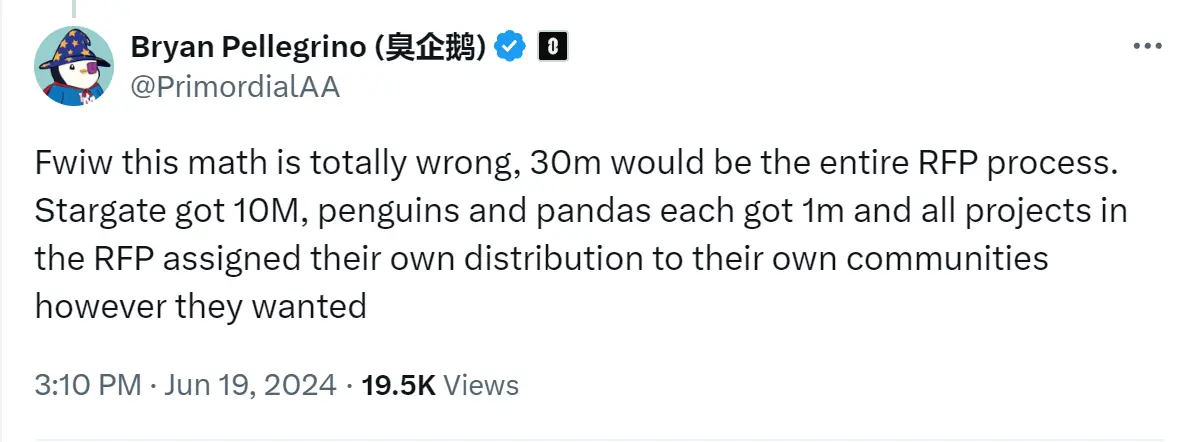
This means that out of the 238 million $ZRO allocated for the airdrop, 20.23 million will be in circulation on the first day. Bryan Pellegrino stated in the community that Stargate ecosystem users will receive a total of 10 million ZRO airdrop, while Pudgy Penguins and Kanpai Pandas will each receive 1 million airdrop, with all projects in the RFP distributing airdrops to their respective communities as they see fit.
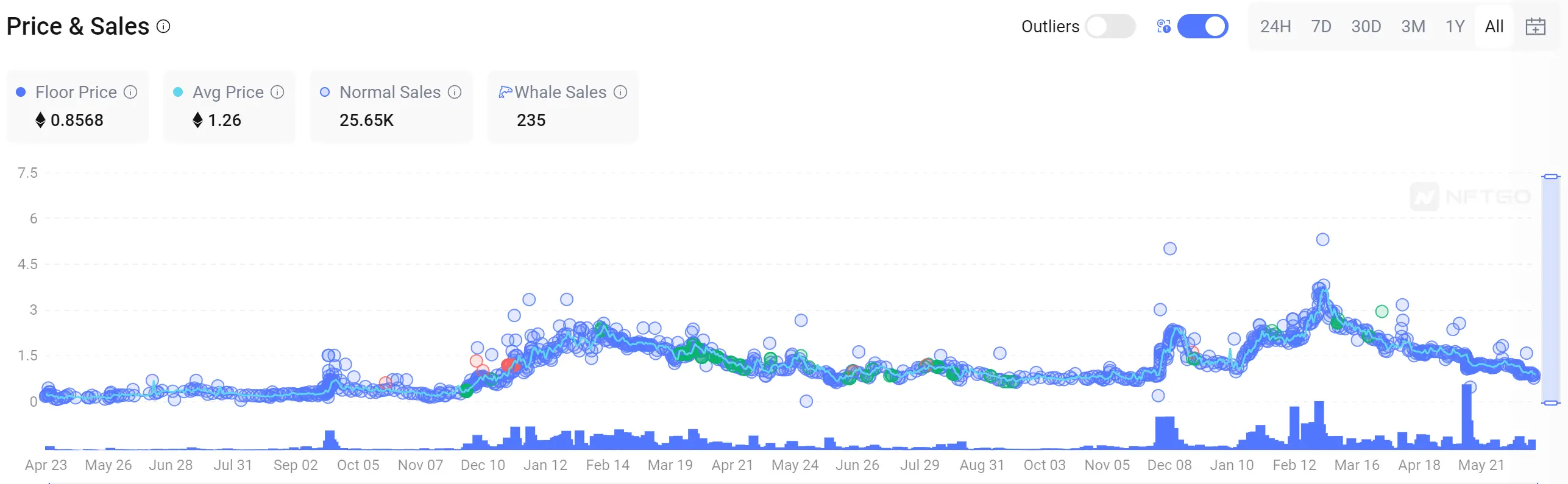
Among them, one address holding 50 Kanpai Pandas NFTs received a total of 5,335.55 ZRO airdrop, while another address starting with 0x816 received 10,000 ZRO for holding 152 NFTs. On average, one NFT received about 100 ZRO, adjusted based on the rarity of the NFT itself.
Since Kanpai Pandas is not a very well-known project, this has raised suspicions of "insider trading." However, according to nftgo data, there is no significant correlation between the peak trading volume of Kanpai Pandas and the snapshot time for the LayerZero airdrop, and its official Twitter has been operating well. Therefore, the suspicion of "insider trading" regarding Kanpai Pandas is questionable.
Related Reading: "Is the Kanpai Pandas that Received the LayerZero Airdrop Engaging in 'Insider Trading'?"
How Should Airdrop Tokens Be Distributed?
Not only ZRO, but also looking at the recent ZK airdrop, due to the number of eligible addresses being far less than expected, the lack of transparency in decision-making, Nansen distancing itself, and the frequent appearance of suspicious addresses, the official response has been lacking, leading to a series of mysterious operations that have also fallen into the "insider trading" controversy. Previously, AltLayer was also discussed by the community for "insider trading" behavior related to OG NFTs.
Related Reading: "ZKsync Airdrop Controversy: Questionable Rules Spark Doubts, Insider Trading Disputes Emerge"
The fundamental reason lies in the community's dissatisfaction with the airdrop distribution ratio. Retail investors cannot know how to make their accounts meet the official airdrop standards, and the official's "final interpretation rights" only make it seem like there is something fishy going on behind the scenes, ultimately resulting in airdrops being allocated to insiders, while the insiders sell tokens and retail investors are left holding the bag, with the remaining token supply continuously unlocked and sold off.
In contrast, the previous Uniswap airdrop stated that anyone who had used Uniswap, regardless of whether they successfully exchanged or not, could claim 400 UNI airdrop tokens. Additionally, holding UNI also provided benefits such as SOCKS tokens.
Although this no-threshold airdrop has also faced criticism, in today's era of widespread "insider trading" and retail investors being left to pick up the pieces, it seems that UNI has become a truly successful airdrop case.
Crypto researcher Kerman Kohli, after studying a series of controversial airdrop cases including Optimism, Starknet, and EigenLayer, offered insights. He believes that whales should not receive all the tokens just because they invested a large amount of capital, but at the same time, the smallest users should still receive some basic amount of tokens.
However, these two goals are in direct conflict. Currently, the best approach according to industry standards seems to be to implement a tiered system, where for "large" users, the allocation is slightly less linear (more liquidity, more tokens); for "medium" users, the allocation is linear; and for "small" users, a fixed amount is allocated. At the same time, some rough standards should be used to implement this tiered system.
Related Reading: "Understanding Airdrop Mechanisms: How to Design a Satisfactory Airdrop?"
Will the ZRO Airdrop Mark the End of 'Insider Trading'?
Looking at ZRO, its initiation of the "largest scale" witch hunt has frustrated many studios. Although the project team has good reasons, namely wanting to airdrop tokens to real users rather than studios that would collectively sell off as soon as they launch, it is indeed disheartening for studios that have invested real money to help the project improve data and test performance, only to be discarded.
Regarding the strong dissatisfaction caused by ZRO, c00 k1 e (@lon e lyhors e m e) stated that the real reason is that these airdrop project teams are breaking the balance between VCs, project teams, and "insider trading" users.
"Insider trading" users, or studios, are the most vulnerable party in this distorted game driven by irresponsible VC funding that inflates valuations and recklessly throws money around. Project teams need user interaction data to secure funding from VCs, while VCs need project teams to issue tokens to cash out. Each project team clearly uses tokens as a carrot dangled in front of "insider trading" users, making users work for free to boost their data growth with the promise of future tokens.
The greed of VCs or investment misjudgments have led to these projects having inflated valuations, and since the projects cannot form a reliable and stable business model, they can only rely on issuing tokens to make retail investors pay for their undigested waste.
This distorted model, where retail investors work hard only to be abandoned in the end, may eventually be eliminated.
 Risk warning Risk warning






Popular articles