Ripple offers $5 billion to acquire Circle: An unexpected power play

 Stablecoins are no longer just a simple crypto tool; they are rapidly becoming a digital conduit for global capital flows, a coveted power play—whoever controls the stablecoin standards, access, and integration points can shape the future of cross-border payments, institutional DeFi, and programmable finance.
Source: Forbes
Compiled by: Odaily Planet Daily Moni
Editor’s Note: A significant piece of news has emerged in the stablecoin market—Ripple has made a $4-5 billion acquisition offer to its competitor, stablecoin provider Circle Internet Group, which is pushing for an IPO! Yes, you heard it right, this is Ripple, which just got the U.S. Securities and Exchange Commission to drop its appeal and acknowledge that XRP is not a security. However, this offer was deemed too low and was rejected. It is reported that Ripple remains very interested in Circle but has yet to decide whether to make another offer.
Why would Ripple, a well-known crypto company, attempt to acquire Circle at this point? Will Circle ultimately say "Yes" or "No"? In response to these questions, Forbes has published an in-depth analysis of some "insider" information, the original text is organized and translated as follows, enjoy~
Why Does Ripple Want to Acquire a Stablecoin Company?
Stablecoins require both scale and speed.
The news of Ripple's acquisition of stablecoin company Circle may not sound like a typical acquisition deal at first, but for industry insiders familiar with Ripple's corporate strategy, acquiring Circle is actually "unexpected yet reasonable."
At the beginning of April, Ripple acquired brokerage firm Hidden Road for $1.25 billion and announced that it would use the RLUSD stablecoin as collateral for its main brokerage product, shifting its post-trade activities to the XRP Ledger blockchain. Ripple believes this acquisition has the potential to optimize the cost and liquidity of its cross-border payment service, Ripple Payments, and provide custody services for Hidden Road's clients.
It is worth mentioning that Hidden Road has successfully obtained a brokerage license, meaning this acquisition gives Ripple the legitimate right to engage with traditional financial tracks as an institution. XRP and RLUSD could evolve into liquidity bridge assets under institutional trading execution, repo financing, and even sovereign debt swaps, opening doors for tokenized government bonds, central bank digital currencies, and RWAs.
Clearly, Ripple's "ambition" has surpassed the crypto track, and its power tentacles are beginning to embed more deeply into traditional financial infrastructure, with stablecoins anchored to fiat currency undoubtedly being the best bridge to connect the crypto and traditional financial worlds.
In fact, as early as mid-2024, Ripple CEO Brad Garlinghouse identified a stablecoin strategy and announced the launch of the RLUSD stablecoin at the XRP Ledger community summit. After receiving approval from the New York Department of Financial Services (NYDFS), RLUSD officially launched at the end of last year, currently boasting a market cap of approximately $316.9 million, marking a good start.
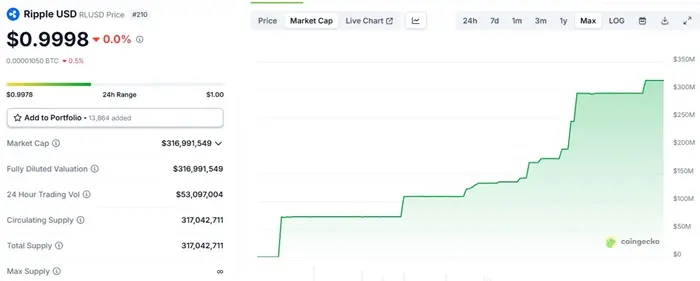
However, for the current stablecoin market, which has a market cap close to $245 billion, RLUSD's performance has been lukewarm. If a "conservative" strategy is adopted, it seems difficult to keep up with rapidly developing competitors. Not to mention the USDT, which has a market cap approaching $149 billion, and USDC, with a market cap of about $61.5 billion, even compared to USD 1, which recently surpassed a $2 billion market cap, RLUSD's advantages are not very obvious.
Therefore, Ripple's acquisition of Circle is not just about expansion; it is also an acceleration strategy that allows Ripple to quickly secure a place in the global stablecoin economy.
Will Circle Say "Yes"?
From Circle's perspective, being acquired is not necessarily a bad thing.
First, the huge capital is sufficiently attractive. Ripple's $5 billion acquisition offer is very appealing, and such an injection of capital could significantly accelerate Circle's global expansion. Additional funds could also drive deeper R&D and expand Circle's partnerships, especially in markets where infrastructure and access are still forming.
Second, the synergy between Ripple and Circle could yield "Win-Win" potential. Ripple brings extensive experience in navigating complex global regulations and a proven blockchain network, while Circle already has rich experience in stablecoin operations. Combining the two could spark the creation of entirely new financial products, such as tokenized payment systems, cross-border settlement innovations, and hybrid DeFi/TradFi solutions.
We must not forget the geographical advantage; Ripple has a well-established international footprint. Its network extends far beyond U.S. borders, with strong relationships in Asia, Latin America, and Europe. 90% of Ripple's business is conducted outside the U.S., and this influence could help USDC enter markets where stablecoin adoption is still in its infancy but growing rapidly.
Will Circle Say "No"?
While Ripple may reiterate its acquisition offer, Circle has temporarily rejected it on the grounds that the offer is too low. From the latest developments, Circle's decision may involve three reasons: valuation, vision, and regulation.
In terms of valuation, USDC's market cap is currently close to $62 billion, and with Circle's IPO plans in full swing, Ripple's acquisition offer at this time seems more like "speculation." Circle is not a company seeking an exit but is moving toward a broader future in the stablecoin market. The $5 billion acquisition may not only underestimate Circle's financial status but also the strategic importance of USDC in the evolving digital dollar landscape.
Secondly, Circle has a clear vision, and merging with a direct competitor could create friction. Although Ripple and Circle both operate in the stablecoin space, RLUSD and USDC do not fully align in governance models, market strategies, etc. An acquisition could lead to a realignment of priorities, potentially undermining Circle's mission-driven approach to an open financial system.
Thirdly, regulatory considerations cannot be overlooked. The merger of two heavyweight companies in the crypto ecosystem would trigger stricter scrutiny from global regulators. Especially in the current environment—where U.S. lawmakers are actively defining the digital asset framework—this move could lead to significant operational slowdowns, legal complexities, and even pushback from certain jurisdictions.
What Does Circle's Decision Mean for the Market and Stablecoins?
Circle's rejection of Ripple's acquisition is not just a story about price; it is a signal of belief—that Circle believes its independent strategy is stronger than a quick acquisition. As the IPO progresses, Circle aims to establish USDC as the global standard for dollar-backed stablecoins, doubling down on its reputation for transparency, compliance, and innovation.
At the same time, Ripple will not give up on the "big cake" of the stablecoin market. RLUSD is currently in the early stages of its lifecycle, but Ripple's actions indicate a long-term strategy aimed at integrating blockchain infrastructure with traditional finance. Whether through additional acquisitions, deeper ecosystem investments, or policy collaborations, Ripple will persist and fight for victory.
It can be said that stablecoins are no longer a simple crypto tool but are rapidly becoming a digital pipeline for global capital flows, a coveted power play—whoever controls the stablecoin standards, access, and integration points can shape the future of cross-border payments, institutional-level DeFi, and programmable finance.
Power Play—Bigger Than Circle and Ripple
For leaders in fintech, digital assets, and global payments: merely relying on market share will not win the future; "winning" is about ecosystem coverage, interoperability, and trust. The stablecoin race is far from over, and the true winners will be those who can innovate boldly while maintaining enough resilience to cope with regulation, market volatility, and global demand. Stablecoins are becoming a core pillar of the cryptocurrency ecosystem, and in the coming years, the integration, competition, and regulatory battles surrounding "compliant stablecoins + payment networks" will become the main theme.
Ripple's acquisition offer to Circle may seem like a simple acquisition deal, but it reflects the maturity of the stablecoin ecosystem and the blurred lines between crypto-native innovation and institutional adoption of stablecoins, further highlighting the importance of strategic consistency when traditional finance meets crypto finance.
 Risk warning Risk warning