What is wrong with stablecoins according to the founder of Airwallex?

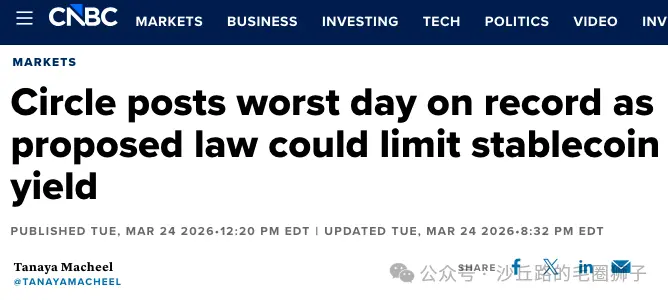
 Circle uses a beautiful margin ledger and a rapidly expanding network effect to tell the market: "cheap remittances" is just the prologue, rewriting the financial foundation is the main act.
Author: Charlie Little Sun, the Loop Lion of Dune Road
Let’s start with the conclusion: In the G10 gold corridor like USD-EUR, Airwallex's "instant + 0.01% fee" indeed scores almost full marks; however, the financial world is far more than just this expressway. Stripe's reckless acquisition of Bridge, Visa integrating stablecoin settlements into its network, and Circle's explosive IPO on the NYSE—these actions collectively outline a larger landscape: whoever can clear the "last mile" of money has the opportunity to rewrite the next round of payment infrastructure.

1. The halo of "0.01% + instant" only covers 15% of the territory
Jack Zhang posted a series of long articles on X, with a core viewpoint that is very straightforward:
- Price------Airwallex has pushed the USD→EUR rate down to 0.01%;
- Speed------Funds settle in real-time; on-chain may not be faster;
- Grounding------Stablecoin inflows and outflows are expensive and regulatory hurdles abound, with no hardcore use cases seen in 15 years.
If the stage is limited to London ↔ New York ↔ Frankfurt, he is not exaggerating. The problem is—85% of global cross-border traffic does not flow along this broad avenue. In the eyes of Argentine freelancers, banks still take 3 days to start and charge a 3% fee; Kenyan merchants supplying goods to Nigeria must navigate two correspondent banking "winding roads"; Turkish importers wanting to pay a deposit on Friday night face banks closed for the weekend and can only wait. In these corners ignored by the "mainstream," the volume of stablecoins has tripled in six months, growing wildly like weeds.
2. Three curves explaining "why stablecoins"
Latin America Curve: Dollar scarcity spurs on-chain dollars In 2021, stablecoins in Latin America had a scale of only $20 billion; by 2024, it surged to $68 billion, and this year it has risen to $75 billion in the first half. High inflation, dollar scarcity, and weekend downtime have pushed funds onto the chain—not to save 0.01%, but to ensure "it arrives right now."
Big Tech Betting Curve: Keep customers in the network, don’t let money escape Bridge was just acquired by Stripe for $1.1 billion, and Visa immediately laid down this route in Ecuador, Peru, and Colombia. What they value has never been the FX spread, but the expansion dividends of "keeping money within their ecosystem"—once money doesn’t need to land in banks, payment companies can simultaneously transform into custodians, wealth management supermarkets, and credit gateways.
Wall Street Valuation Curve: Circle can print money just from interest Circle made a net profit of $780 million last year solely from USDC position interest; its stock price more than doubled in three days post-IPO. What Wall Street is paying for is the cash machine of "on-chain dollars + treasury bond interest spread," as well as the early signs of a network effect that has already been realized: the more companies that accept USDC, the less demand for withdrawals, and the less dispute over fees.
3. Beyond "cheap" and "fast," there are more tricky costs
Many people focus on the fee schedule but overlook the T+2 liquidity, Nostro pre-funding, and KYC multi-layer reviews hidden behind the reports. These are the black holes that swallow cross-border profits.

When these frictions are compressed into "code logic," the advantage of a 0.01% fee quickly becomes insufficient.
4. Three scenarios that can outperform banks right now
USD→ARS Salaries
With bank forex controls and weekend downtimes, transfers must wait until business days. USDC wallets arrive in 5 minutes, with an actual comprehensive fee rate of ≈ 1%—employers are stable, and employees are willing to receive.
KES↔NGN Small and Medium Payments
There is no direct settlement between Kenya and Nigeria; on-chain P2P operates 24 hours, with a fee rate of 1-2%. Weekend Global Liquidity Scheduling
Banks enter sleep mode after Friday, causing funds to be stuck; finance departments can sweep to BUIDL on-chain in seconds, safely earning 4% annualized, and immediately transfer out on business days for payroll. These may not be "sexy," but they represent the thickest profit meat and the long tail where bank services are lacking.
5. How the flywheel accelerates before 2026
Bank-issued stablecoins: After MiCA takes effect, at least ten regional banks in continental Europe will replicate Société Générale's EUR stablecoin. Super App Entry: Grab, MercadoPago, etc., are already in gray testing for USDC wallets; once defaulted, tens of millions of users will immediately step into the on-chain world. On-chain closed loops take shape: merchants receive, supply chains pay, employees earn, and wealth management interest is all completed within the same network, naturally driving off-ramp fees to zero. Corporate financial migration: Deloitte predicts that by 2027, 10% of the idle cash of the Fortune 500 will be parked in interest-bearing stablecoin accounts, with bank demand deposits being drained by more than half. At that time, discussing the 0.01% of the G10 corridor will be like telecom giants in 2010 still cutting long-distance fees by a penny, unable to stop WhatsApp from adding a million new users for free calls every day.
6. The last words left by Circle's IPO
Circle tells the market with a beautiful interest margin ledger and a rapidly expanding network effect: "cheap remittances" is just the prologue; rewriting the financial foundation is the main act.
Airwallex has pushed the G10 to near perfection, which is the champion posture in a 15% world; but the remaining 85% of the market is changing tracks and scoreboards. Next stop, money will fly everywhere like emails. At that time, who will still care if the email stamp is 1 cent or 0.1 cent? Watch the landscape shuffle, and don’t tie your hands and feet at the starting line.
 Risk warning
 Risk warning