The U.S. House of Representatives passes the CLARITY Act, is a new era of cryptocurrency regulation on the horizon?

 The bill is not only the starting point for reshaping the U.S. cryptocurrency regulatory framework but may also become a critical turning point for institutions to accelerate their entry and for innovation to truly take off.
Author: Fairy, ChainCatcher
Editor: TB, ChainCatcher
On the chessboard of U.S. regulation of digital assets, another heavyweight piece is accelerating its move, in addition to the stablecoin-specific legislation known as the "GENIUS Act." The "CLARITY Act," hailed as a "turning point in crypto regulation," may completely rewrite the trajectory of the U.S. crypto industry.
In recent years, U.S. crypto projects, developers, and platforms have been navigating a murky regulatory environment. The unclear responsibilities between the SEC and CFTC have led many projects into a "trial and error" predicament, where being deemed an "unregistered securities offering" could result in fines or even existential crises.
The emergence of the "CLARITY Act" not only aims to clarify the regulatory boundaries between the SEC and CFTC but also seeks to establish a predictable and compliant development path for the digital asset industry.
Today, the bill has been unanimously approved by the House Financial Services Committee and the Agriculture Committee, and will next be submitted to the House for a vote. This marks not only the starting point for reshaping the U.S. crypto regulatory framework but may also become a critical juncture for accelerating institutional entry and genuine innovation.
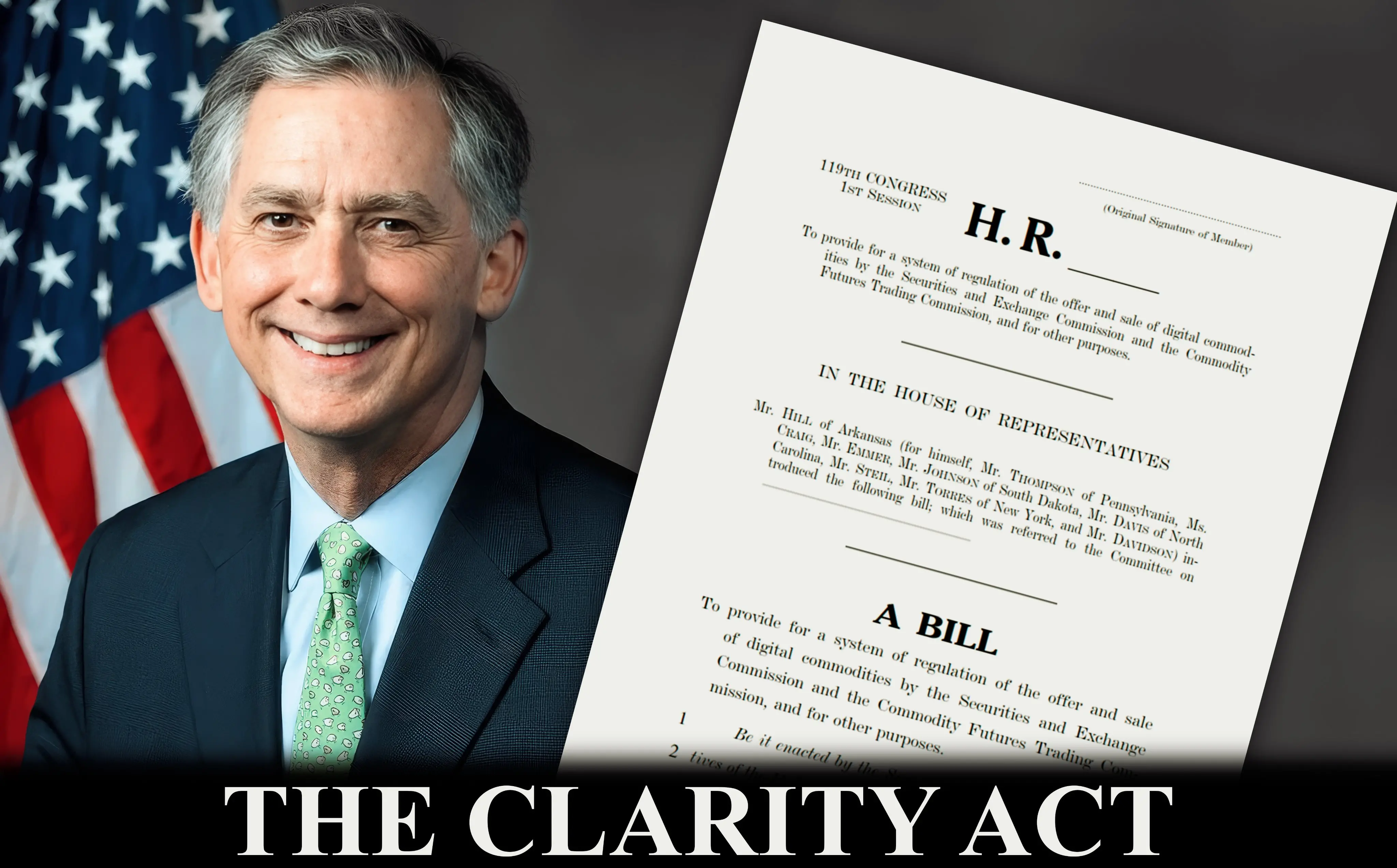
Progress of the "CLARITY Act"
On May 29, U.S. House Financial Services Committee Chairman French Hill officially introduced the "CLARITY Act," which spans 236 pages. However, its progress has not been smooth.
On June 3, the SEC faced strong criticism from House Democratic staff during a technical briefing on the "CLARITY Act," being labeled as "the worst technical assistance briefing." Staff accused SEC representatives of being unable to answer simple questions and even avoiding key information under the guise of "confidentiality," questioning their intent to obscure the truth and obstruct legislation.
At the same time, some Democrats expressed concerns over Trump's involvement in the crypto industry, questioning potential conflicts of interest that could interfere with the legislative process.
Despite the controversies, the CLARITY Act has continued to be refined with multiple stakeholders' efforts. On June 9, under a joint statement from eight major crypto policy organizations, the "Blockchain Regulatory Certainty Act" was successfully incorporated into the "CLARITY Act." This amendment is seen as a "firewall" for DeFi developers, aimed at protecting software developers and infrastructure providers who do not custody customer assets.
To further clarify regulatory responsibilities, the Financial Services Committee and the Agriculture Committee each revised and reviewed the bill, introducing their adjusted versions. Today, both committees successfully passed the bill. According to Republican members, the two versions will ultimately be merged into a comprehensive bill to be submitted for a full House vote.

Bill Interpretation: Laying a Clear Blueprint for Digital Asset Regulation
The "CLARITY Act" is not starting from scratch but is continuously refined based on relevant legislation from the past few years, particularly as a continuation and expansion of the "Financial Innovation and Technology Act of the 21st Century" (FIT21).
Here are the core points of the bill:
Regulatory Authority Division: Clarifying SEC and CFTC Responsibilities
The core of the "CLARITY Act" is to clearly delineate the regulatory scope of the SEC and CFTC based on the nature of digital assets. The SEC regulates "digital asset securities," while the CFTC oversees "digital commodities." For "hybrid" assets that may possess both securities and commodity characteristics, the bill requires coordination between the two agencies. The goal is to confirm the CFTC as the primary regulator of the digital commodity spot market while retaining the SEC's regulatory authority over securities-like digital assets.
According to community member @realMaxAvery's interpretation, the bill establishes a pathway: projects can initially operate as securities (highly centralized, strong investment attributes), and when they achieve a certain level of decentralization, they can "graduate" to be regulated as commodities.
A major highlight is the concept of a "mature blockchain system." If a blockchain network is sufficiently decentralized (no single controller, open-source code, automatic operation), it can be certified as a "mature system." Once certified, its tokens will face more lenient regulation, as they resemble commodities rather than securities.
DeFi and Blockchain Participants: New Exemptions and Boundaries
As long as they do not engage in intermediary activities, developers and operators of decentralized blockchain networks do not need to register with the SEC or CFTC. The bill also recognizes the distinction between DeFi and traditional finance, protecting developers from inappropriate financial regulatory constraints. Writing code, running nodes, or providing front-end interfaces typically will not be classified as financial service providers, allowing developers to build Web3 infrastructure with peace of mind.
However, the bill still retains enforcement powers against fraud and manipulation, ensuring a balance between innovation and user protection.
Exchanges and Intermediary Registration: Establishing a Regulatory Framework
Platforms operating digital commodity trading markets must register with the CFTC as "digital commodity exchanges," including over-the-counter brokers and market makers. These entities will comply with strict federal regulatory requirements, such as minimum capital, risk management, transaction records, regulatory reporting, and customer asset protection.
If a company is involved in both securities and digital commodity businesses, it must register separately with the SEC and CFTC. Although the compliance burden is heavier, the bill clearly delineates the regulatory boundaries for both parties.
Encouraging Traditional Financial Institutions to Enter the Crypto Market
The "CLARITY Act" opens the door for traditional financial institutions to enter the crypto space. Banks can legally provide crypto custody services, and traditional exchanges can operate alternative trading systems covering both stocks and crypto assets, promoting institutional adoption and helping Wall Street embrace digital assets.

"Clarity" is a Dual Proposition of Reconstruction and Breakthrough
Whether clarifying the responsibilities of the SEC and CFTC or providing protection for DeFi developers and blockchain innovators, the "CLARITY Act" lays a predictable foundation for industry development. However, alongside the support, there are also many concerns emerging.
Some crypto-native companies point out that the bill may be more beneficial to traditional financial institutions at the execution level. For instance, large Wall Street firms like Charles Schwab, which are already registered with the SEC, could quickly engage in digital commodity-related businesses once the bill is enacted; meanwhile, many crypto-native companies may face unclear and potentially more cumbersome registration processes with the Commodity Futures Trading Commission (CFTC). This institutional design may inadvertently create unequal "regulatory thresholds."
Nevertheless, the gradual clarity of the regulatory framework remains an indispensable part of promoting industry maturity. True "clarity" may signify new challenges, but it also heralds greater space for innovation.
 Risk warning
 Risk warning