Berlin Blockchain Week Insights

 This article will unveil the Berlin Blockchain Week from a mixed perspective of event participants and organizers, focusing on several events.
Author: Purple
Berlin is one of the important centers of hacker culture in Europe and even globally. This article will unveil the Berlin Blockchain Week (hereinafter referred to as BW) from a mixed perspective of event participants and organizers, focusing on several events. This BW features a total of 148 activities, including conferences, hackathons, meetups, parties, and more.
This article only represents personal feelings, and the views belong to the individual, without involving any stakeholders.
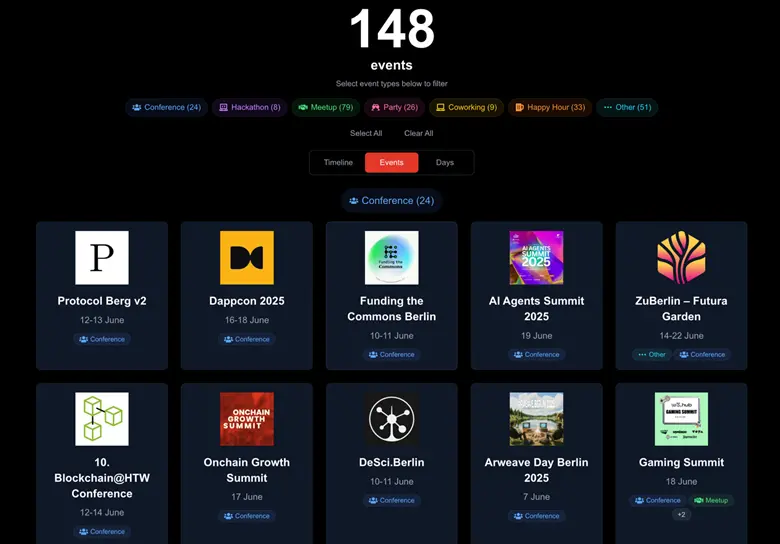
Source: BW Official Website
Why Attend This BW?
In my past work experience, I met several friends from Berlin who have a unique charm that attracts me. I can't quite explain it, but it definitely makes me want to explore, so I had to come and experience the vibe of the Berlin crypto scene. Additionally, as a long-term community contributor and event organizer, I wanted to gain deeper insights into some events here in Europe, and BW happened to be the perfect opportunity. To my surprise, I successfully obtained a Schengen visa using event tickets and on-chain salary DIY… and thus, I arrived through various coincidences.
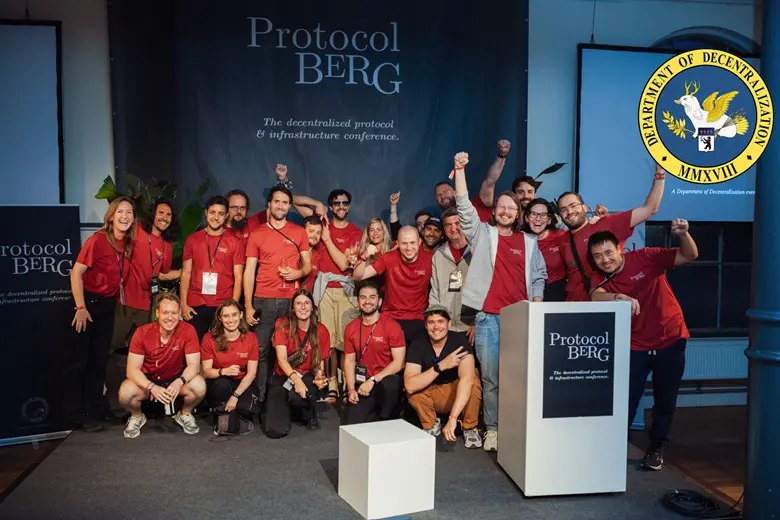
As expected, the crypto events I attended in Berlin had very few Chinese or even Asian faces. The hottest event during this Blockchain Week was undoubtedly Protocol Berg v2 (hereinafter referred to as PB), a completely free two-day conference with different talks each day, focusing on key technologies and industry concepts. I must say that PB was indeed well-organized, both in terms of organization and attendee experience, which I will elaborate on below.
By the way, let me introduce and recommend the organizer of PB, DoD, which stands for Department of Decentralization. They are a group based in Berlin composed of crypto, decentralized, and peer-to-peer communities, and it's worth mentioning that they contribute voluntarily. PB v2 is one of the events they organize, and they also have other regular and irregular meetups and activities, such as ETHBerlin. Some details, such as event announcements and schedule information, will be published on their official website (https://dod.ngo/blog/2025/protocol-berg-v2-cfp). If you want to experience the local tech community culture in Berlin or support what they are doing, you can contact them or provide donations.
Their official website introduction:
"The Department of Decentralization is a collective of Berliners. The group was formed in 2018 to organize ETHBerlin hackathons and has been active ever since.
Our goal is to be a neutral platform that promotes the adoption of decentralized technologies, educates newcomers, and raises awareness of the challenges and benefits of decentralization and open-source software.
All of our events are free to attend and aim to provide an unobtrusive experience, avoiding sponsors, paid talks, or other commercial elements. Our collective operates entirely on donations."
In addition to PB, there were many other events during BW, among which Dappcon and ZuBerlin were quite popular, but I personally felt they were not cost-effective, which I will mention later.
Conference Experience & Feelings
I will mainly focus on PB, ZuBerlin, and zk hack.
- The Valuable Protocol Berg V2
The main purpose of my trip was PB and zk hack. PB took place from June 12 to June 13, lasting two days, at the Colosseum in Berlin, which used to be a cinema and has since been renovated into an event venue.
The venue has two floors, with screening rooms distributed on both levels, but this event was concentrated in several screening rooms on the second floor. The setup of the screening rooms was quite impressive, and the organizers even provided popcorn, allowing attendees to enjoy talks while eating popcorn, creating an immersive experience reminiscent of a cinema. It's worth mentioning that the comfort of the chairs in the screening rooms was such that one could easily fall asleep while listening to technical talks.
I believe PB is one of the most unique and top three experiences I've had in the dozens of events I've attended since entering the crypto industry, but I've also heard some feedback that v1 was even better, which makes me very curious but unable to experience it.
Let me share why I think PB is worth recommending. Firstly, PB is completely free, with no sponsors or booths, which is rare and valuable. As long as you fill out the registration information and pass their review, you will receive a ticket. I even have a friend who didn't register but went to the venue on the day to listen to the talks, and the volunteers and staff allowed her in after a safety check. Additionally, since PB is not a particularly large event, although there were many people, it didn't feel overly crowded. You can also discover many thoughtful details, such as posters about PB and some industry jargon posted in the restrooms; an old typewriter set up on the first floor; and relevant booklets placed around, giving me a sense of a ceremonial and solemn technical depth, reflecting a corner of humanity and ideals.
Besides being completely free, the quality of the invited guests at PB was very high, with many speakers being founders, participants, or developers from well-known projects in the industry, such as Vitalik and Gavin Wood. There was no noise from the Twitter debates or competition between chains, only discussions about technology, topics, and the future of crypto; and the topics of the talks were diverse, covering networking, storage, consensus, infrastructure, cryptography, philosophy, and more.
Each presentation during PB had a scannable QR code for questions beside the PPT, which I thought was quite nice. Both offline and online audiences could participate in asking questions, and indeed some very good questions were raised. One that I still remember vividly was during a talk on zk/privacy, where someone asked the speaker whether they thought privacy was more important for women than for men. This question stumped the speaker, as he was male and candidly admitted he didn't know.
During PB, I also happened to encounter a live AMA with the Geth team, leading to a scene where a group of people sat in the cinema hall eating popcorn while the Geth team members answered questions live. It was reported that a few days earlier, the Ethereum Foundation (EF), including Ethereum-related Core Devs, had been holding meetings for several days to address a multitude of changes, and the situation of the Geth team was just one tangled mess among many. Although many of us criticize EF, one cannot deny that such open discussions are also a signal? A free market of ideas allows the truth to emerge.
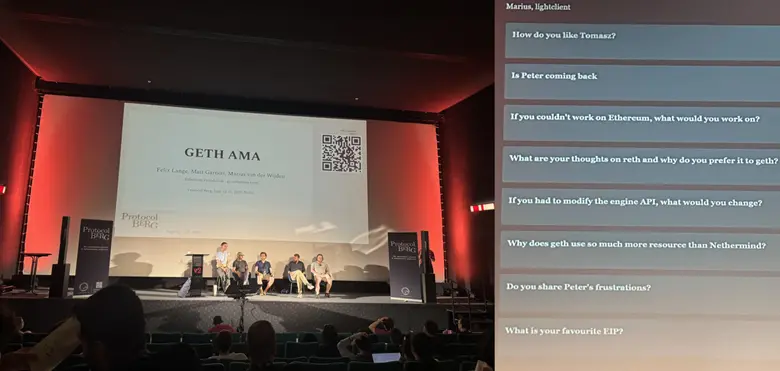
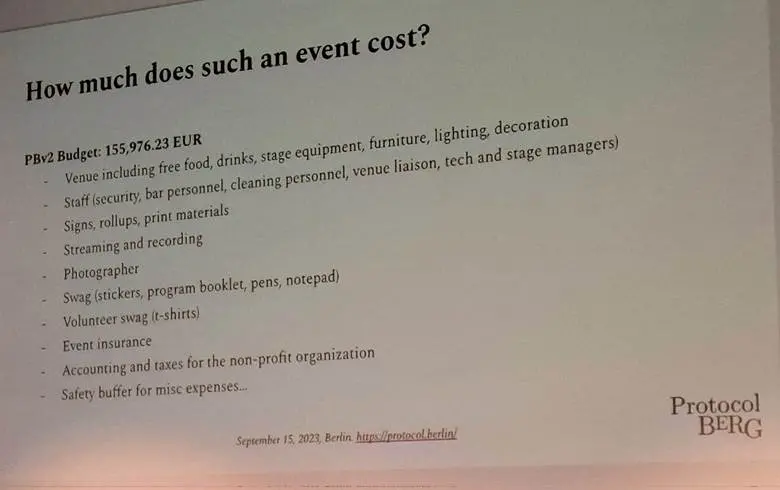
Image source: https://x.com/zkOrdinal/status/1933553363154587920
- The Overpriced ZuBerlin
If you ask which event had the most expensive tickets during this BW, it must be ZuBerlin, which took place from June 14 to June 22, lasting a week. Without accommodation provided, the early bird ticket price was 650 euros (originally 900 euros) for a week, which is not only expensive but truly exorbitant. It inexplicably reminds me of how merchants on Taobao raise prices to create a larger discount during the Double Eleven shopping festival. But does this really mask the fact that the product prices are excessively high? Consumers are not fools, yet there are still some people who, for one reason or another, pretend to agree like the "Emperor's New Clothes."
That said, whether it's PB or ZuBerlin, the contributions of volunteers are a very important and core part; basically, the vast majority of the work is done by volunteers. However, the volunteer rules for ZuBerlin are both chaotic and opaque. Take the deposit requirement, for example. ZuBerlin requires all volunteers to pay a deposit, with some needing to deposit 650 euros and others 100 euros, depending on the registration channel. Some of this money will be partially refunded after the volunteer work is completed, while others will receive a full refund.
In simple terms, if you volunteer at ZuBerlin, you can offset the ticket cost with your labor, but the value of your labor varies for each person. For instance, a friend of mine in the industry paid a 650 euro deposit shortly after they opened volunteer registration, and later they said she could get back 20% of that deposit, which is 130 euros, after her volunteer work ended. Let's do the math: even if you are in Berlin, where labor is relatively expensive, volunteering for two days (16 hours) at ZuBerlin means your labor is only worth 130 euros. However, as of 2023, the legal minimum wage in Germany (including Berlin) is 12 euros/hour, meaning that even based on the minimum wage standards from a year or two ago, the value of your labor would far exceed 130 euros.
Before the event started, ZuBerlin also announced a scholarship program, claiming to hope to give more people opportunities, but I genuinely wonder if anyone actually received it? It's unclear whether anyone got it, but the complexity of the application form is no different from submitting a resume. After all, a ticket is worth at least 650 euros!
In conversation, I found that the main attendees of ZuBerlin fall into several categories:
Workers from project teams, many of whom have their tickets and accommodations reimbursed by their companies or already have some activity allowances, so for them, it’s not a big deal, just an experience;
Builders on the front lines, who want to deeply connect with others through this co-living event, regardless of whether they have money or have made money;
People who participated in the previous ZuBerlin, as ZuBerlin's style is indeed quirky and wild, offering strong sensory stimulation to participants, such as last year's live demonstration of Japanese bondage;
People brought in by friends who came out of curiosity;
Others.
Now, some may ask, with such an expensive ticket price, is the event really exciting? The food must be great, right? The excitement of the event is subjective. In terms of content depth, there were indeed some decent topics, as there were many big names, making it easy to engage in conversations; the real issue arises when conversations don't happen. However, in terms of food, ZuBerlin really falls short; it’s said that only breakfast was decent, while the other two meals were hardly worth mentioning, consisting almost entirely of cauliflower, chicken breast, beans, and pasta. If one has no requirements for food and only seeks to be fed, then forget what I said, but compared to other free events, isn’t it more appealing?
The biggest feature of ZuBerlin, in my opinion, is its quirky stimulation and wildness, which aligns with the hidden aspects of human nature, truly reflecting German culture. Traditional German saunas are mixed-gender, and last year's ZuBerlin included a sauna segment; the closing ceremony involved a group of people being blindfolded and taken to an abandoned factory, which was indeed quite thrilling; it’s said that this year’s closing ceremony will feature super sexy dancers performing close dances… It seems to emphasize the release of one’s true nature.
Initially, I was also considering whether to register, but a friend who had volunteered at ZuBerlin quickly dissuaded me, saying that in previous years, volunteers were not fed well at all! It's hard to imagine having to pay to work for others while being hungry! A friend of mine worked there for a week last year and just bought a plane ticket to flee back home. By the way, if I remember correctly, last year the ticket price for volunteers working a week was 500U, and for two weeks it was 350U, haha.
So if the goal is purely to listen to ZuBerlin talks, we all concluded: don’t buy a ticket; watching the videos is the same, and you can rewatch them. If it doesn’t work out, just forget it. Indeed, organizing events undoubtedly requires effort, and it’s hard not to consider profitability, but 200-300 euros feels like a more reasonable price point. The original price of 900 euros or the 650 euros ticket? One can only say that it’s like Jiang Taigong fishing, willing to let those who are interested take the bait.
Lastly, I want to complain that for events that also rely heavily on volunteers for most of their operations, the volunteer management levels and experiences of PB and ZuBerlin are starkly different. This is a shout-out for my friend who worked 16 hours at ZuBerlin and was still pushed around.
- Berlin's Hackathons & Hacker Spaces & Hacker Culture
During the Berlin Blockchain Week, two well-known and relatively high-quality hackathons were Web3privacyNow and zk hack. I have quite a few friends who participated in Web3privacyNow, and many people I know also attended zk hack, with some participating in both. Speaking of zk hack, my first participation was in Istanbul, and as a seasoned foodie, I can only say that the food at zk hack was exceptionally good compared to other events. In March of this year, their event in Seoul was canceled due to venue issues, so I unhesitatingly joined the Berlin stop.
Regarding the venue, this is something most event organizers would consider. It’s said that venues in Seoul must be booked three months in advance and are difficult to communicate with. However, after chatting with the organizers of zk hack, they told me that finding a venue in Berlin is quite easy, perhaps due to the cultural atmosphere of Berlin, where there are many event spaces. A friend of mine who organizes events in Singapore also mentioned that venue prices in Berlin are at least friendlier than in Singapore.
This zk hack broke my stereotype—I found that hackathons in Berlin are not just for newcomers wanting to prove themselves or purely for the prize money; they are simply fun attempts. Many participants in zk hack are already founders or co-founders of certain projects, yet they still participated in zk hack and realized some ideas outside of their projects in a short time, embodying the hacker spirit and culture of trying new things and constantly breaking through, which is really cool! For example, Leo, the CEO of powdr, who won the "ZK Hack Grand Winner," worked with his colleagues on "ZeroHour," generating zero-knowledge proofs on a 64kb RAM smartwatch, although I later heard that his smartwatch was sacrificed, and I mourn for it.
During my time in Berlin, I visited c-base, one of the important symbols of European hacker culture and a pioneer of the global Hackerspace movement (official website: https://www.c-base.org/). c-base is a non-profit association dedicated to reconstructing a fictional, crashed space station. Their offline space is decorated in a cyberpunk and digital art style. A quote from Wikipedia states: "The association was originally founded on August 12, 1995, by three founders, Hardy Engwer (aka 'cynk'), Marten Suhr (aka 'mars'), and Carsten Ussat (aka 'nomax'), along with 17 founding members, with the intention of creating an 'extended living room.' Today, c-base is regarded as the core hub of Berlin's geek and hacker community." If you're lucky and someone can take you, experiencing a tour of c-base is highly worthwhile.
In addition to visiting c-base, during BW, I also went to the ChainSafe office, and after a deep conversation with them, I found that many of them are idealists actively engaged in open-source endeavors. At that time, by chance, I learned that the Lodestar (Ethereum consensus layer client: https://lodestar.chainsafe.io/) project team was preparing to rewrite the core parts of Lodestar using the Zig language, which is their new technological direction for the upcoming 2.0 version. I saw that they had already released this news in the past few days, and they are currently very welcoming developers familiar with Zig, Bun FFI, or those willing to participate in performance testing and fuzz testing to join.
Supplementary Summary
PB is really good, ZuBerlin is overpriced; the experience summary is that one should think twice about paid events;
There are many zkVMs, and the competition is too fierce;
The style has changed since Tomasz took over, and the entire EF is undergoing structural adjustments; life is definitely not as comfortable as before;
You can experience Berlin's hacker culture, such as the c-base tour, which is very cool;
Lodestar is looking for developers familiar with Zig, Bun FFI, or those willing to participate in performance testing and fuzz testing; if interested, you can contact them directly.
 Risk warning
 Risk warning