4E Labs|Robinhood has brought US stocks on-chain, what does this mean for Crypto?

 As a broker with a U.S. securities license and EU MiCA compliance qualifications, this initiative is not only a breakthrough on the technical level but also a critical point for the integration of traditional finance (TradFi) and decentralized finance (DeFi).
Author: X Mere
In recent years, the Crypto industry has been continuously trying to connect with Real World Assets (RWA), but mostly remains at the stage of tokenization attempts for "niche assets" such as bonds, real estate, and artworks. However, Robinhood's latest move may truly signify a "watershed moment for mainstream asset tokenization."
A New Era of Stock Tokenization: Robinhood's Crypto Breakthrough and Global Ambitions
On June 30, 2025, Robinhood launched a groundbreaking stock trading service in Cannes, France, allowing EU users to trade U.S. stocks via crypto for the first time. This marks a substantial step in the integration of stock securities with Web3. In this initiative, Robinhood will issue over 200 mainstream U.S. stocks and ETFs as 1:1 pegged on-chain tokens (Stock Tokens), covering companies like Apple, Nvidia, Tesla, and Google; it will also include indirect token exposure products for private companies like OpenAI and SpaceX.
As a broker with U.S. securities licenses and EU MiCA compliance qualifications, this move represents not only a technological breakthrough but also a critical point for the integration of traditional finance (TradFi) and decentralized finance (DeFi).
1. Analysis of Robinhood's Stock Tokenization Mechanism
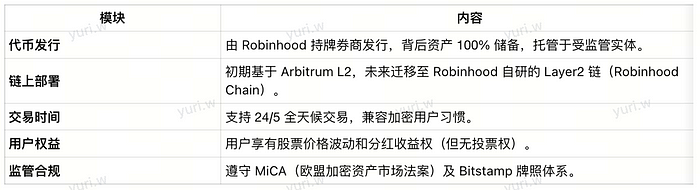 🚨 Note: Tokenized stocks ≠ traditional stocks. OpenAI and SpaceX have officially stated that they are not collaborating with Robinhood; these assets are merely indirect simulated holdings and do not imply any equity relationship.
2. Technical Path and Ecological Layout
Phase One: Deploying Stock Tokens on Arbitrum
- Utilizing Arbitrum as the infrastructure to quickly integrate EVM, Ethereum wallets, DEX, and other functionalities.
- All tokens will have verifiable on-chain records (e.g., etherscan).
- Liquidity pool plans will connect to protocols like Uniswap and SushiSwap.
Phase Two: Building Robinhood Chain (Layer2)
- Plans to launch Robinhood Chain by the end of the year, built on zk technology (or OP Stack).
- Achieve a closed-loop ecosystem for Robinhood assets (Stock Tokens, stablecoins, derivatives, RWA, staking services, etc.).
- Users can manage "on-chain wealth" on Robinhood Chain without switching wallet addresses.
3. Regulatory Path: Fine-tuning in a Gray Area
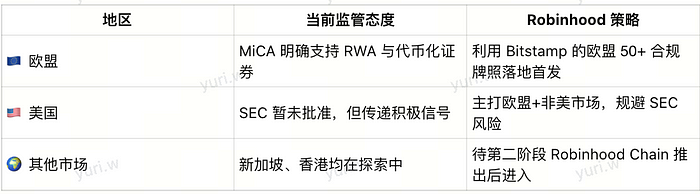
Former SEC Chairman Paul Atkins recently stated: "Tokenized securities are an inevitable trend, and we need clearer rules." This statement is seen by the market as a signal of regulatory easing.
4. Global Competitive Landscape: Platform Technology, Liquidity, and Regulatory Games
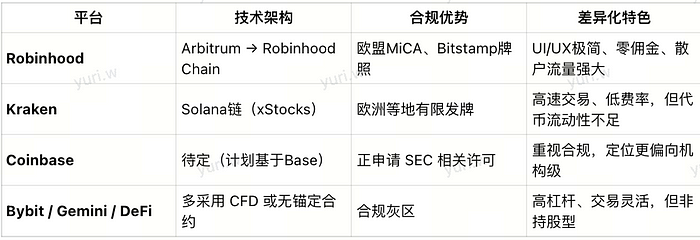
Robinhood's "licensed broker + token custody" model theoretically provides stronger legal backing and user trust barriers.
Why is this step significant?
We will analyze the profound impact of Robinhood's stock tokenization + Layer2 strategy on the Crypto industry from six perspectives.
1. RWA's First "Mainstreaming": Truly Connecting On-Chain Assets with Global Investors
Real World Assets (RWA) have always been a hot topic for the expansion of on-chain assets. However, previous projects mostly focused on real estate, private bonds, or artworks, which generally faced issues like high cognitive barriers, poor liquidity, and unclear pricing mechanisms.
Robinhood directly introduces the most liquid, recognized, and traded asset class globally --- U.S. stocks, mapping them as on-chain tokens.
👀 Compare the impact: If you say "I bought an art token," no one understands; but if you say "I bought Apple stock (AAPL) on-chain," almost everyone knows what that is.
This marks the entry of RWA into a more popular, higher frequency, and compliant new era.
2. Compliance Demonstration: The First Real Model for Institutional-Level On-Chain Asset Issuance
Robinhood is a licensed broker in the U.S. and one of the first compliant platforms under the EU MiCA framework. This means:
- Stock tokens are not "shadow assets," but rather "on-chain mapped items" backed by real stock custody and regulatory protection;
- Investors can trade and manage equity-type assets on-chain through legal pathways.
This could very well become the standard path for financial giants like BlackRock and Fidelity to enter the on-chain space, establishing a compliant model for institutional funds to "test the waters in DeFi."
3. Revolutionary User Onboarding Path: A Natural Transition from Stock Trading Apps to On-Chain Assets
Robinhood has been called "the enlightenment tool for U.S. retail investors," and now it is beginning to guide tens of millions of Web2 investors into Web3:
- Users can trade on-chain assets through Robinhood's account system without needing wallet plugins;
- Supports traditional payment methods for deposits, shielding users from complex processes like wallets, mnemonic phrases, and GAS fees;
- Provides on-chain financial services through a familiar UI/UX.
This is a truly "low-threshold, high-value" user entry channel, likely to become a new mainstay for acquiring Crypto users.
4. A New Paradigm for Layer2: Not Game, Not DeFi, but "On-Chain Wealth Management"
Unlike previous Layer2 expansions for NFTs or DeFi, Robinhood Chain has a clear and defined positioning: serving on-chain wealth management scenarios.
- Hold stock tokens, crypto assets, and stablecoins on-chain simultaneously;
- Enable diverse operations like wealth management, lending, dividends, and reinvestment;
- Provide a composite investment experience of "traditional wealth management + on-chain assets" for hundreds of millions of users.
This presents an unprecedented narrative perspective for Layer2, potentially redefining the application scenario paradigm for L2.
5. Global Trading Time Reconstruction: Can U.S. Stocks Be Traded 24/7?
Traditional U.S. stocks can only be traded during Eastern Time hours, and missing out means waiting a day. With the launch of stock tokens, users can achieve almost 24/5 trading liquidity on-chain, and in the future, it could even reach 7x24.
This is particularly friendly for investors in non-U.S. time zones like Asia, the Middle East, and Africa, truly realizing:
"Anyone, anywhere in the world, can participate in trading the world's best assets at any time without barriers."
This may gradually influence traditional market mechanisms --- allowing mainstream securities markets to start considering the optimization possibilities brought by "on-chainization."
6. Quality Leap of DeFi Underlying Assets: Enhanced Market Value, Liquidity, and Trust
Currently, the DeFi market has a large amount of collateral in ETH, stETH, LSD tokens, or platform tokens, which are highly volatile and cyclical.
Stock tokens will:
- Become a more stable basis for collateral;
- Provide stronger backing support for stablecoins;
- Offer more creation space for on-chain derivatives (like options, ETFs).
This fundamentally enhances the "anti-cyclical and credit risk resistance" capabilities of the entire on-chain financial system.
Final Thoughts
The stock tokenization and Robinhood Chain launched by Robinhood are not just a product iteration or chain construction; they sound a bell for the Crypto industry:
"The golden age of on-chain finance will no longer be limited to native assets but will fully embrace global mainstream financial assets."
Crypto is no longer the opposite of the financial system but is reconstructing the logic of global asset trading using blockchain technology. In the past, we expected BlackRock to do this, or Coinbase or Binance. But now, it is Robinhood that has taken the crucial first step, bridging the compliance, user, and asset triad. This will be the "front door" for Crypto to enter the mainstream financial ecosystem, rather than taking detours or sneaking in.
 Risk warning Risk warning