Ethereum's 1.9 Billion Unstaking Wave: Profit Taking or a New Starting Point for the Ecosystem?

 Unpledging does not necessarily mean that it will be sold.
Author: Deep Tide TechFlow
Whenever the market is good, FUD is inevitable.
Today, a piece of news has once again raised concerns about the price of ETH:
Ethereum network validators are queuing up to withdraw staked ETH.
As a representative of the PoS consensus mechanism, staking ETH is technically used to maintain the security of the entire Ethereum network, and economically it can generate additional income from staking, locking ETH's liquidity in the staking pool.
However, according to data from the Validator Queue, as of July 23, approximately 521,252 ETH are queued for withdrawal from staking, worth about $1.93 billion at current prices, with a waiting time of over 9 days and 1 hour.
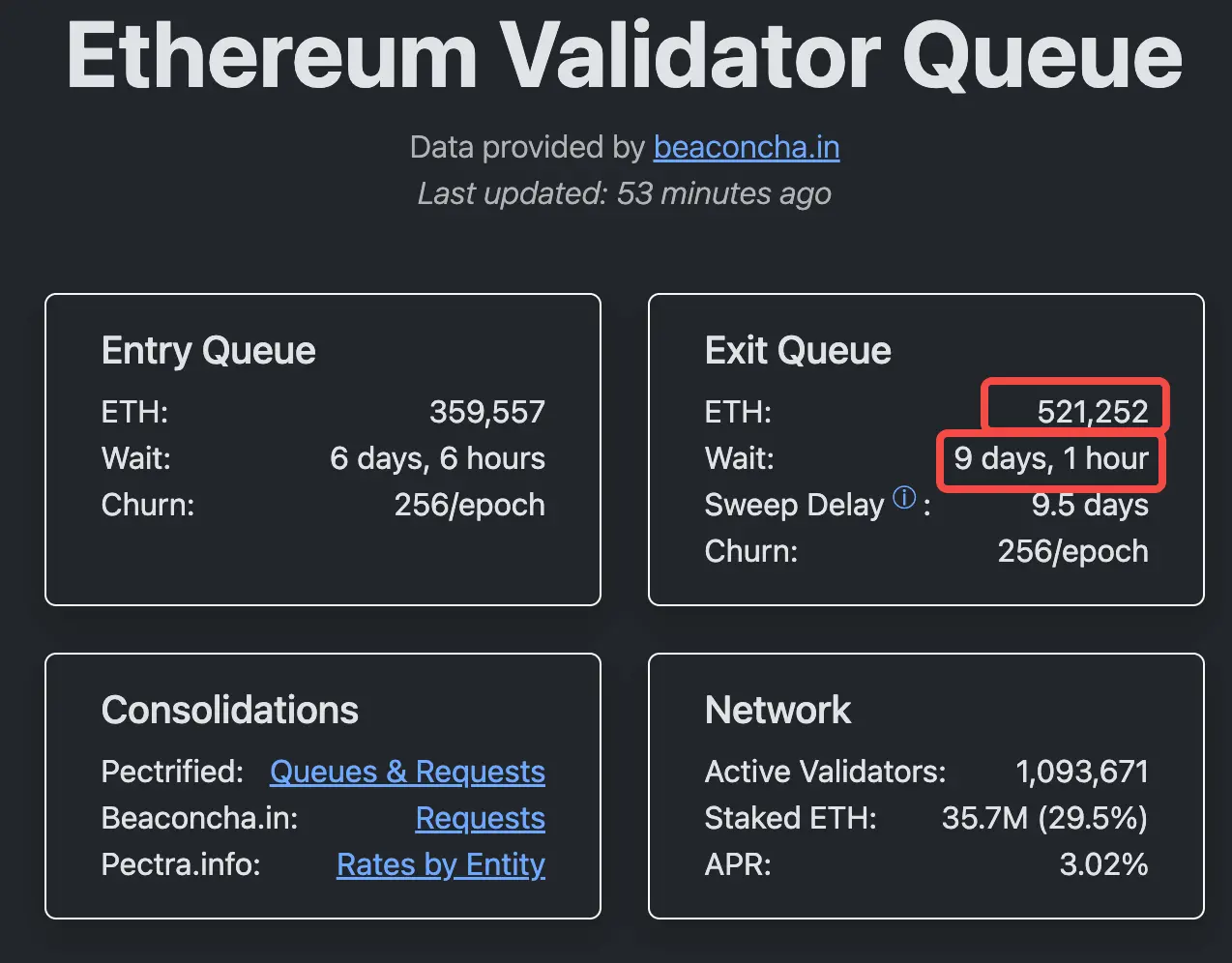
This is also the longest queue that validators have faced when choosing to exit in the past year.
Since each validator typically stakes 32 ETH, this theoretically means that over 16,000 validators are seeking to exit staking. The large-scale queue for withdrawal raises some warning signs.
Taking Profits?
Are the whales and institutions selling ETH to take profits?
The surge in Ethereum withdrawals may be partially related to the recent price increase.
Starting from the low point in early April 2025 (around the $1,500-$2,000 range), ETH has experienced a strong rebound, with a cumulative increase of 160% to date. Specifically, on July 21, ETH reached a high of $3,812, the peak in the past seven months.
Such rapid increases often prompt some investors to take profits, especially those who staked early, who may decide to lock in profits upon seeing gains rather than continue holding.
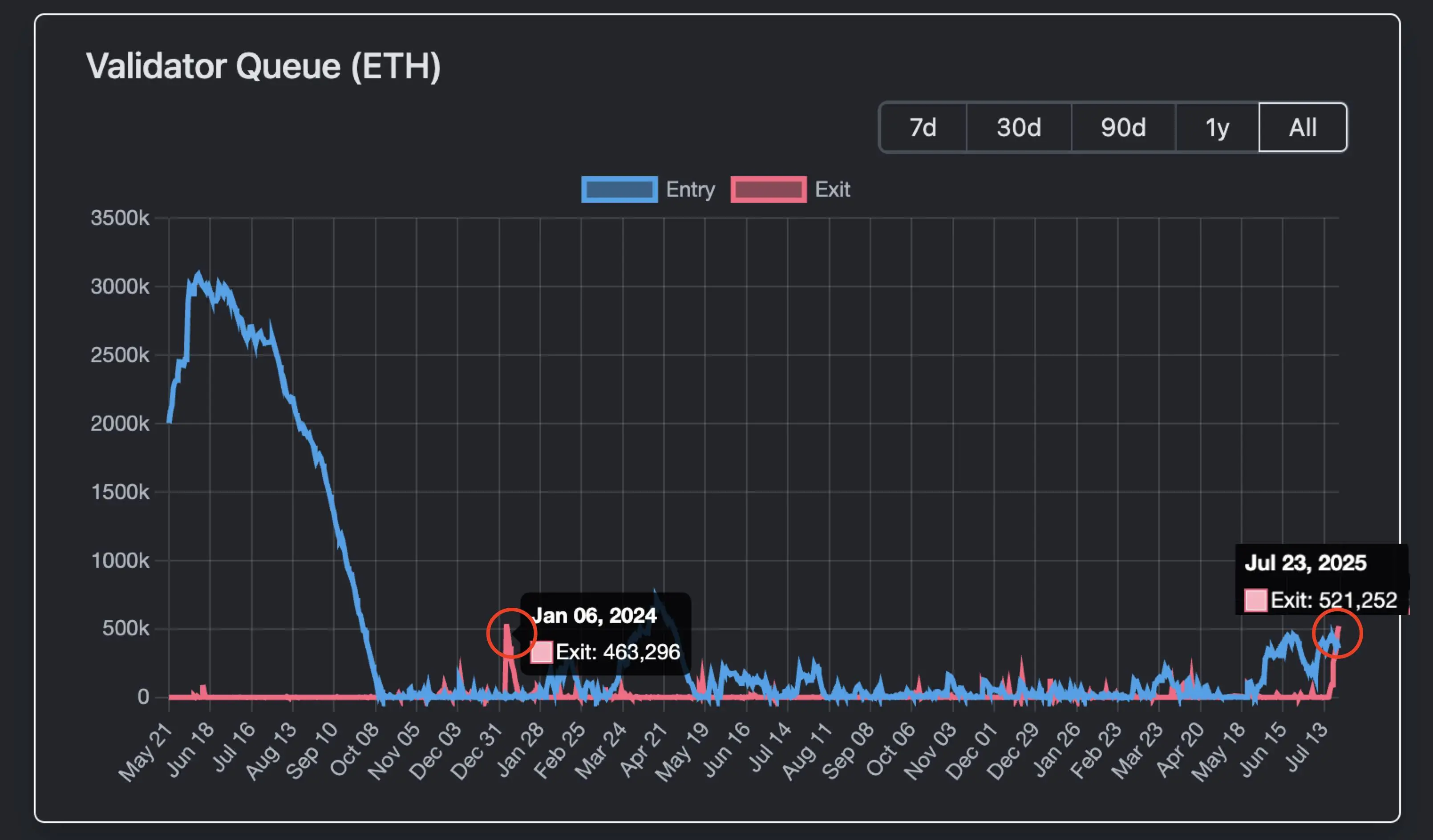
From a historical perspective, this pattern is not new.
From January to February 2024, after the ETH/BTC ratio rose by 25% in a week, a similar scale of withdrawal occurred, leading to a short-term price drop of 10%-15%. However, it was also around the same time that Celsius went bankrupt, with 460,000 ETH being concentratedly withdrawn in a short period, causing a queue congestion of about a week for validators exiting the entire ETH network.
Not a Sell Pressure
Unlike before, although the queue for ETH withdrawals is long this time and the amount is large, it does not necessarily mean direct sell pressure.
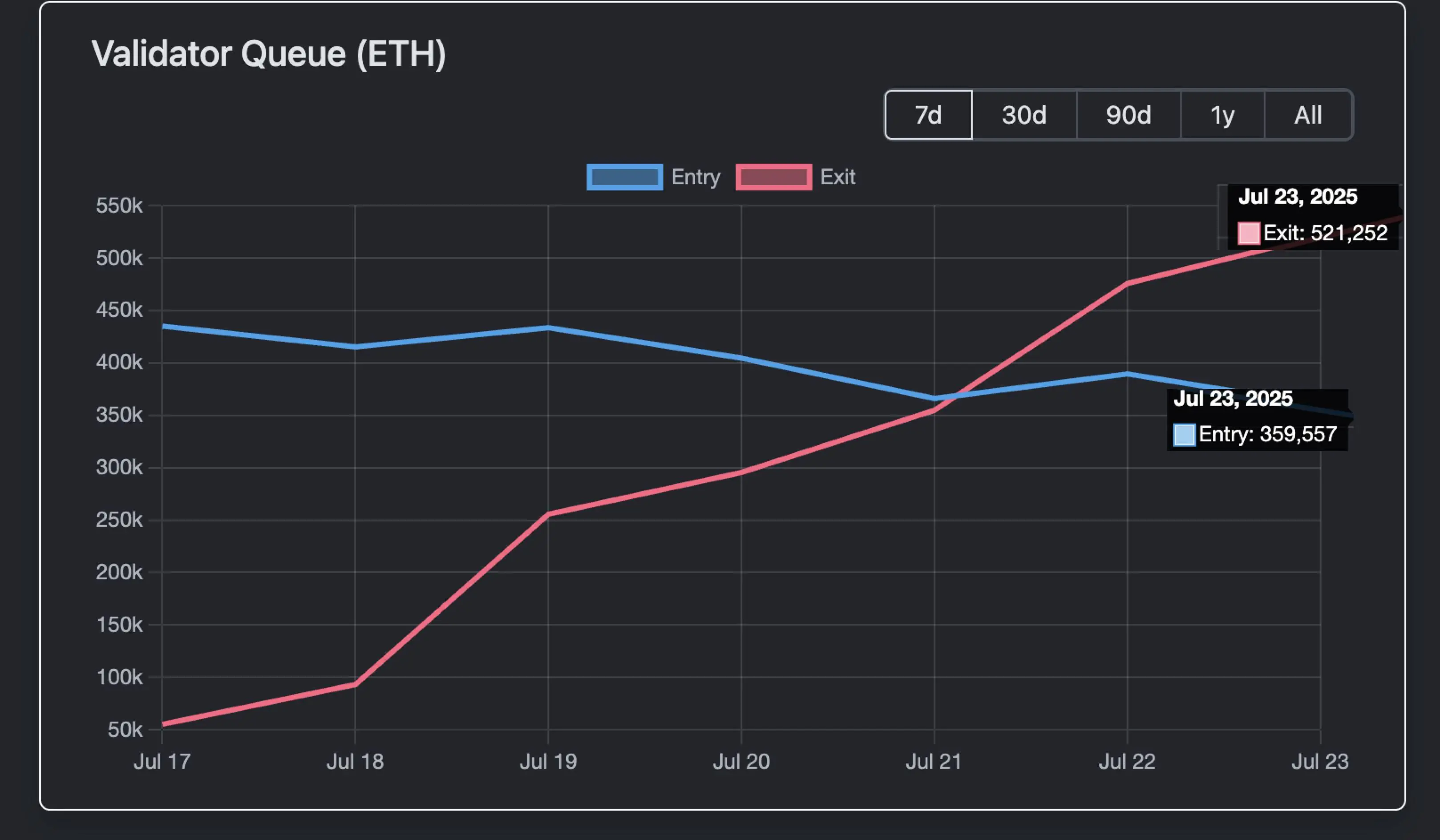
First, looking at the data from the Validator Queue, on July 23, there were 520,000 ETH queued for withdrawal, but at the same time, 360,000 ETH entered the staking queue.
This offset means that the net ETH exiting the Ethereum network will be significantly reduced.
Secondly, institutional behavior also plays a buffering role.
Data from July 22 shows that the total inflow of ETH spot ETFs from various institutions in the public market reached $3.1 billion, significantly greater than the 520,000 ETH (worth $1.9 billion) queued for withdrawal that day.
Moreover, this is just the net inflow amount for one day, not to mention that the validator exit queue has a waiting period of 9 days.

At the same time, withdrawing staked ETH does not necessarily mean it will be sold.
In the current bullish environment for ETH, concentrated withdrawals may also be due to institutions adjusting custody services or shifting to crypto treasury strategies, meaning they are looking to change custodians for ETH to seek more returns rather than selling it off.
On-chain, some of the withdrawn ETH is more likely to be used for DeFi and NFT-related activities. For example, as collateral to provide liquidity, or recently, a whale swept the floor of Crypto Punks;
Additionally, on-chain LST tokens often experience decoupling, which also provides arbitrage opportunities for ETH—recently, the ratio of stETH to ETH dropped to 0.996 (a discount of about 0.04%), and weETH also showed similar fluctuations. Arbitrageurs buy discounted LSTs and wait for the 1:1 peg to recover for profit, which increases the demand for ETH.
Overall, the withdrawal of staked ETH seems more like an internal adjustment within the Ethereum ecosystem rather than a direct selling signal.
However, there are various speculations on social media; while concentrated withdrawals do not imply sell pressure, they may indicate a phenomenon of "changing hands."
Some believe that BlackRock, which is committed to bringing crypto assets into mainstream finance, has effectively become a major player in ETH. As of July data, BlackRock has accumulated over 2 million ETH (worth about $6.9-$8.9 billion), accounting for about 1.5%-2% of the total ETH supply (approximately 120 million ETH).
This is not a secret but rather a public ETF asset management action, so it resembles an institutional-level "visible player"—promoting institutional adoption of ETH through public holding and accumulation via ETFs, rather than manipulating the market.
The logic of changing hands is that as Ethereum transitions from an internal value consensus to a broader consensus as a financial tool, it is becoming increasingly evident that Wall Street is preparing to make a big move.
This speculation is not without reason; staking and withdrawing may also represent a shift in the structure of holdings.
But regardless, Ethereum's growth potential will continue to support its leadership position in the crypto space, and this wave of withdrawals may just be the starting point of a new cycle.
Recommended Reading:
Coinbase Deep Dive: Ethereum vs Solana, Are Institutional Investors in a "Either-Or" Dilemma?
Surviving Twelve Years, Pantera Capital Makes Bold Moves in the Crypto Stock Frenzy
 Risk warning
 Risk warning



Popular articles