How to make the US stock market great again?

 The stock market no longer waits for the bell to ring, and investment no longer requires broker approval.
Author: 1912212.eth, Foresight News
Buying U.S. stocks is essentially betting on the fate of America. If you had invested $10,000 in the S&P 500 index in 2002, it would have grown to $85,900 today. If that $10,000 had been invested in the Nasdaq index, you might have received a return of $114,900.
As the largest securities market in the world, U.S. stocks rarely disappoint investors. However, there are still too many countries and regions where investors cannot access such assets, missing out on wealth opportunities.
What would happen if purchasing such assets no longer required an account and was not limited by region or trading hours? With just a smartphone and a balance in a crypto wallet, you could buy "stocks" of U.S. giants anytime and anywhere. This is no longer a fictional scenario; it is the reality brought about by "tokenization of U.S. stocks."
In the next era, the stock market will no longer wait for the bell to ring, and investing will no longer require brokers to place orders.
Tokenization is simply the process of converting real-world assets into programmable, tradable digital tokens. These tokens are based on blockchain technology and typically comply with ERC-20 or similar standards, ensuring transparency and security. Tokenized U.S. Stocks refer to mapping or anchoring the stocks of U.S. listed companies (such as Apple, Tesla, etc.) onto the blockchain in the form of tokens, allowing them to be traded, transferred, and held on-chain like cryptocurrencies.
In short, in the blockchain world, "replicating" a traditional stock turns it into "on-chain assets." For example, a stock worth tens of thousands of dollars can be fragmented into thousands of smaller units, allowing ordinary investors to participate with a low threshold. The advantages of tokenization include 24/7 trading, reduced intermediary costs, and enhanced liquidity, but it also faces regulatory uncertainties and technological risks.
For investors, the threshold for investing in U.S. stocks is lowered after tokenization. For companies, the motivation to explore tokenization stems from multiple factors. The liquidity bottleneck in traditional financial markets has become increasingly prominent, especially during non-trading hours. Additionally, institutional investors like BlackRock and JPMorgan are viewing tokenization as a tool to reduce financing costs. The improvement of the regulatory environment provides policy support for this wave.
So why is the wave of tokenization flooding into U.S. stocks?
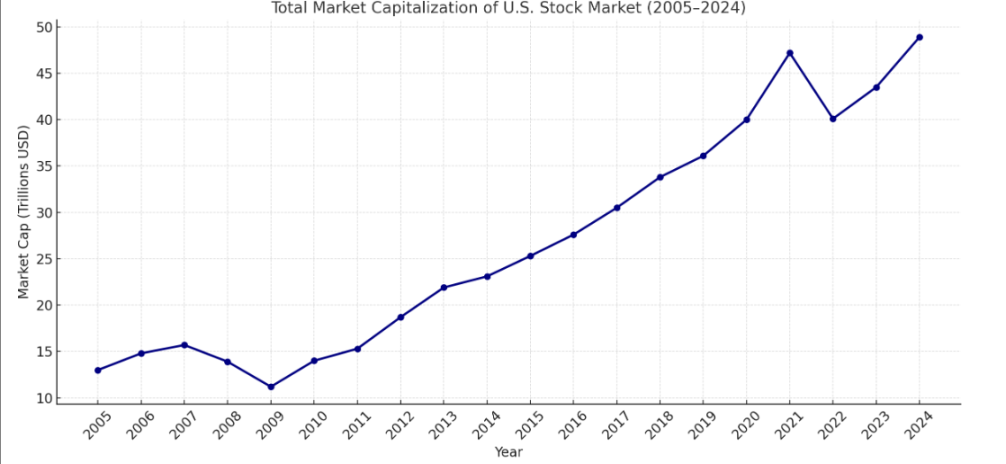
U.S. stocks have unique advantages that other assets do not possess. First, as the largest stock market in the world, the total market capitalization of U.S. stocks is expected to reach between $52 trillion and $59 trillion by 2025, far exceeding the stock markets of other countries or regions. The total market capitalization of global stock markets is around $124 trillion, with U.S. stocks accounting for over 40%.
High returns are another key factor; the S&P index recently reached a historic high of $6,336. The average annual return of the S&P 500 index since 1957 has been about 10.4% (approximately 6.5% after adjusting for inflation), while the average annual return over the past 20 years has been 10.364%, and 9% over the past 30 years. The threshold for trading U.S. stocks outside the U.S. is relatively high, as traditional investments require opening a brokerage account, meeting minimum investment amounts, adhering to trading hours (only weekdays from 9:30 AM to 4:00 PM Eastern Time), and dealing with cross-border regulatory and tax complexities. This process is especially cumbersome and costly for overseas investors.
The Wave of Tokenization
Retail investors are flocking to tokenized U.S. stocks to bypass barriers and wealth effects. But what about institutional actions? Crypto exchanges, on-chain protocols, and internet brokerages are all gearing up.
On May 22, cryptocurrency exchange Kraken, in collaboration with Backed Finance, launched a tokenized stock and ETF trading service called "xStocks," covering over 50 U.S. listed stocks and ETFs, including Apple, Tesla, and Nvidia.
Another cryptocurrency exchange, Bybit, has chosen to partner with Swarm to enter the U.S. stock market. Notably, Kraken and Bybit do not issue stock tokens themselves but opt to collaborate with other third parties. Companies like Backed Finance and Securitize are genuinely issuing stock tokens, with the former collaborating with protocols like Uniswap to provide freely transferable tokenized stocks that support on-chain trading under MiFID and Swiss DLT regulations. Securitize partners with well-known institutions like BlackRock and VanEck to offer end-to-end tokenization services.
However, the most talked-about and high-profile tokenization comes from the blockchain institutional platform Ondo Finance and the well-known U.S. brokerage Robinhood.
Ondo Finance is an institutional-level platform focused on tokenizing traditional financial assets and bringing them onto the blockchain. It is currently the most recognized and comprehensive project among RWA (Real World Assets) projects that have issued tokens. Ondo's flagship product, USDY, is a tokenized U.S. Treasury bond, with a total TVL reaching $1.39 billion. However, the market seems to be lukewarm, with its token price declining from $2 to around $0.7, oscillating for a long time.
With the wave of tokenization of U.S. stocks approaching, Ondo has become more aggressive. Since early July, it first partnered with Pantera Capital to plan a $250 million investment to promote RWA tokenization, and then on July 4, it acquired the U.S. SEC-regulated brokerage Oasis Pro to obtain a series of licenses for U.S. securities. Ondo also plans to launch tokenized stock trading in the coming months.
In just one month, Ondo has become particularly aggressive on the path of tokenizing U.S. stocks.
On July 10, Ondo acquired Strangelove to accelerate the development of a full-stack RWA platform and recently initiated a global market alliance, collaborating with public chains, DEXs, wallets, data service providers, cross-chain protocols, DeFi, and other products to unify industry standards.
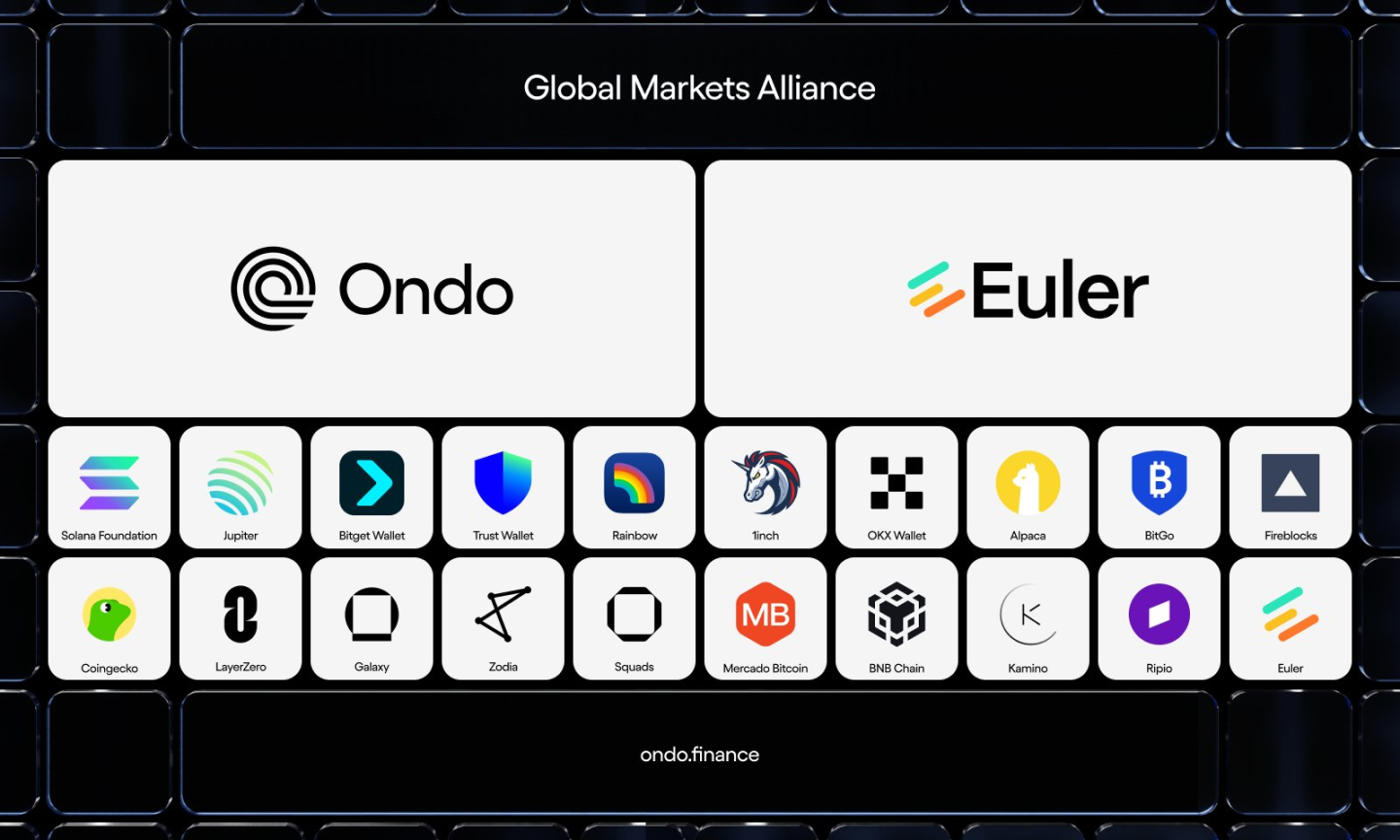
It is foreseeable that after launching tokenized U.S. stocks, Ondo will leverage its strong resource integration capabilities to push its reach into every corner of the crypto market, making it easy for crypto players to purchase tokenized U.S. stocks.
Robinhood is also personally entering the tokenization of U.S. stocks, becoming the first publicly listed brokerage to take this step.
This player, which has disrupted the traditional brokerage industry with a zero-commission trading model, has attracted a large number of young investors, especially millennials, with its low threshold and ease of use. Its average user age is 35, with 25.8 million funded accounts holding $221 billion in assets.
In June of this year, Robinhood launched over 200 on-chain stock tokens, even introducing tokenized equity for OpenAI and SpaceX, giving each qualified user €5 in OpenAI tokens.
Robinhood founder Tenev candidly stated the fundamental issue in the private equity market: the best companies have too many options and do not actively consider retail investors, leading to the "adverse selection problem." The key innovation of tokenization is that it "works without needing to be chosen by the tokenized company," which is precisely the breakthrough that Robinhood can promote.
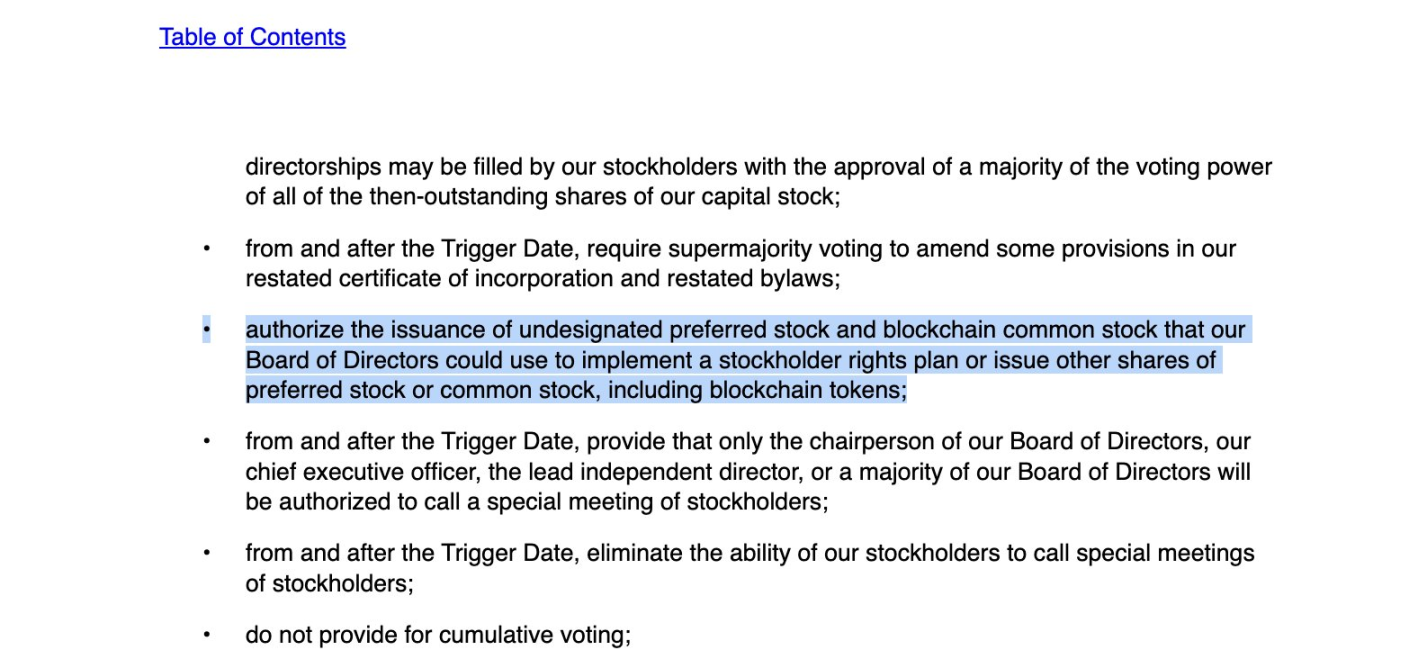
On July 21, design software giant Figma revised its IPO S-1 filing. In the new document, in addition to confirming the IPO price range, a significant difference from the S-1 submitted earlier in the month is the explicit statement that the company has formally authorized the establishment of a new class of "blockchain common stock." This grants the company's board the power to issue stocks in the form of blockchain tokens in the future. In a sense, institutions can reach potential investors from around the world through a borderless blockchain platform, gaining more potential buyers.
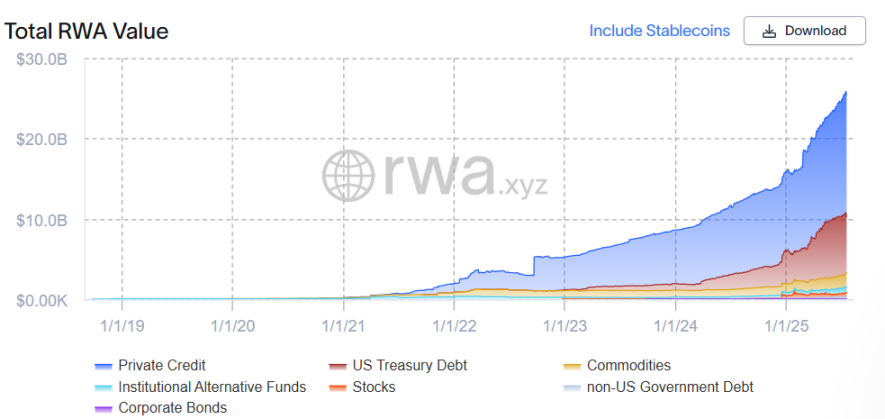
In the first half of 2025, the on-chain tokenization of U.S. stocks has shifted from concept to reality. According to data from rwa.xyz, its total TVL has risen to $530 million, with the number of monthly active addresses surging to 70,000.
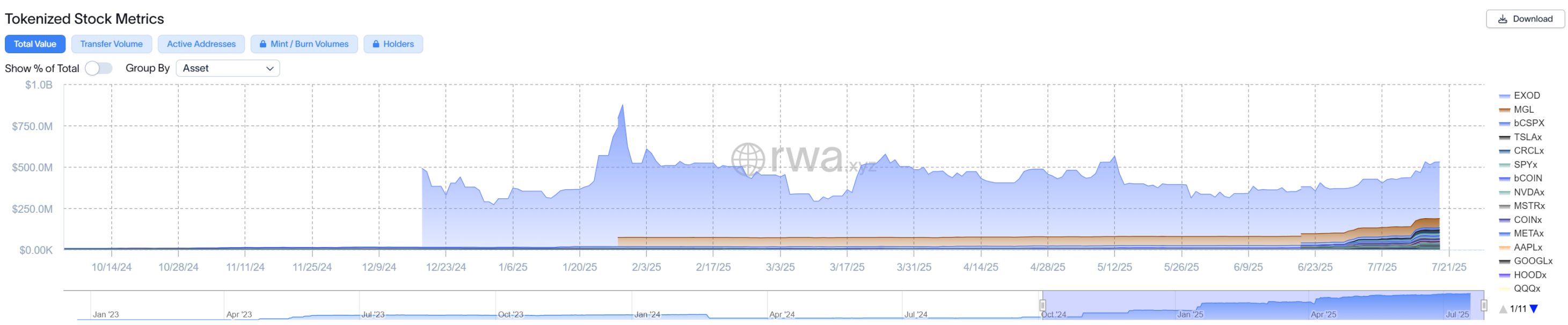
Tokenization is penetrating from pure crypto into traditional finance: it is no longer a speculative tool but a bridge to enhance efficiency.
The Wild Past
The current wave of tokenization of U.S. stocks, which seems to be thriving, is not a new phenomenon; its past is the price paid for innovation.
The early attempts at tokenizing U.S. stocks can be traced back to the experimental exploration of decentralized protocols in the last cycle. Synthetix was one of the earliest platforms to support synthetic asset trading of U.S. stocks, allowing users to hold tokens like sTSLA and sAAPL on-chain to simulate the price performance of U.S. stocks. However, these assets lacked real stock backing and relied solely on collateral mechanisms and oracle price feeds, leading to weak liquidity and the risk of decoupling. Statistics show that the cumulative trading volume of sTSLA on the Synthetix platform was less than 800 times, and most projects eventually transformed due to regulatory pressure and unsustainable business models.
Although there were no shareholder rights, it opened the door for mapping crypto assets to real assets. This model provided prices through oracles, bypassing traditional custody mechanisms and offering a reference paradigm for subsequent players.
At the same time, centralized exchanges became the main drivers of early tokenization of U.S. stocks. In 2020, FTX partnered with the German licensed brokerage CM-Equity to launch tokenized stocks for Tesla, Apple, and others, allowing non-U.S. users to trade 24 hours a day, with the tokens backed by real stocks. In 2021, Binance followed suit by launching "stock tokens," allowing users to trade Tesla and other assets with zero commission using USDT.
However, this model is essentially a derivative within CEX, lacking on-chain transparency and compliance backing, which quickly drew warnings from regulatory agencies in multiple countries. FTX's tokenized stock trading volume reached $94 million in the fourth quarter of 2021, but with the platform's bankruptcy in 2022, related services ceased; Binance also delisted its products after just three months due to regulatory pressure.
The ideal is beautiful, but the reality is harsh. The FTX collapse in 2022 became a watershed moment for the tokenization of U.S. stocks, shifting the market from "wild growth" to "compliance reconstruction."
These cases exposed the core contradictions of early tokenization of U.S. stocks: the imbalance among technological feasibility, compliance costs, and market demand. However, these practices laid the foundation for today's more compliant and structured tokenization attempts, pushing the market to recognize the potential of asset on-chain.
The true on-chain U.S. stock assets were brought back to the agenda after 2022, with the rise of the RWA concept. The representatives of this round include projects like Backed Finance, which generally adopt relatively friendly jurisdictions like Switzerland and Liechtenstein to map real U.S. stock securities into ERC-20 and other standard tokens with "1:1 custody + verifiable reserves + on-chain issuance," possessing stronger compliance and traceability.
In 2024, Exodus Movement became the first publicly listed company in the U.S. to tokenize common stock, issuing EXOD tokens through the Algorand blockchain, allowing users to convert on-chain tokens to real stocks on the NYSE at a 1:1 ratio. This marks a shift in the SEC's attitude towards on-chain stocks, but the tokens only support price tracking and do not include shareholder rights such as voting.
Challenges and Risks
In a field full of opportunities, risks always accompany. The liquidity of on-chain U.S. stocks is a real challenge.
On July 3, the price of the token tracking Apple, AAPLX, surged to $236.72, a 12% premium over the stock's trading price at the time. A similar token tracking Amazon soared to $891.58 on July 5, four times the previous day's closing price. An extreme case occurred on the peer-to-peer cryptocurrency trading platform Jupiter. Blockchain data showed that earlier on July 3, an unidentified user attempted to purchase about $500 worth of Amazon token AMZNX, briefly pushing its price up to $23,781.22, over 100 times the previous day's closing price.
The "xStocks" issued in collaboration with Backed Finance and Kraken mainly map various stock tracking tokens. However, due to low trading volume on multiple cryptocurrency exchanges, when users buy and sell beyond the market's capacity, they can experience severe price fluctuations. Such volatility may be exacerbated during nights and weekends when the stock market is closed.
The liquidity of the market itself, oracles, and potential manipulation concerns deter many on-chain U.S. stock players.
Moreover, user rights protection has also raised market concerns. After Robinhood announced the launch of OpenAI equity tokens, OpenAI quickly stated on X: "These 'OpenAI tokens' are not OpenAI equity. We have not collaborated with Robinhood, nor have we participated or recognized it. Any transfer of equity requires our approval— we have not approved it. Please be cautious."
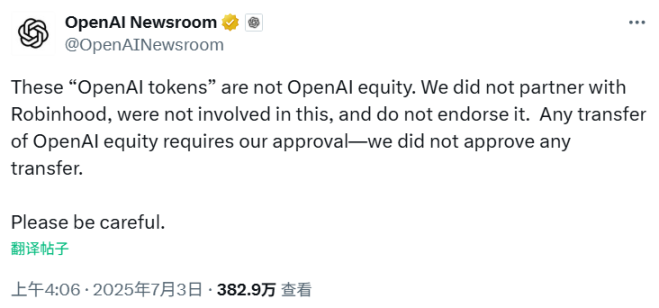
Elon Musk also mocked: "Your 'equity' is fake." EU regulators, such as the Bank of Lithuania, have intervened to investigate, and the SEC warned of potential violations, causing Robinhood's stock price to reverse and decline. Bernstein analysts pointed out that the company is betting on SEC policy support and the passage of the CLARITY Act to open the tokenized asset market.
Amidst the huge controversy, Robinhood founder and CEO Vlad Tenev recently stated in a program that the reactions from OpenAI and SpaceX are understandable but unfair. He used a vivid analogy: it is like "digital NIMBYism"—in principle, everyone supports tokenization, but when it really happens to them, the appeal is not as strong. What people really want is not complex financial tools but "capital as a service"—press a button, and funds can enter your account, he stated.
Whether potential market demand can support the on-chain stock race is worth questioning. A senior player told Foresight News, "Doing U.S. stocks on-chain is essentially finding U.S. stock investors among crypto players, who are used to global 24x7 trading and the large fluctuations of the crypto world. How many of these players are actually interested in U.S. stocks is worth questioning."
Additionally, he added, "For non-crypto players, learning about on-chain wallets to trade U.S. stocks is also a barrier."
Another challenge comes from regulation, as finance is typically a highly regulated field.
Recently, SEC Chairman Paul Atkins stated that he is considering introducing a cryptocurrency "innovation exemption" policy to encourage the market to advance the tokenization process.
However, this is not a panacea.
When Apple stocks are "copied" onto the chain, who will ensure that they truly represent shareholder rights? Who will be responsible for information disclosure, compliant trading, and anti-money laundering? Under U.S. securities law, the issuance and transfer of any securities must be registered or exempted, while the decentralized nature of on-chain assets is precisely at odds with traditional compliance logic.
In a recent statement on securities tokenization, the SEC stated, "Tokenization has the potential to facilitate capital formation and enhance investors' ability to use their assets as collateral. However, despite the immense potential of blockchain technology, it does not possess 'magic' to change the nature of the underlying assets. Tokenized securities are still securities. Therefore, market participants must carefully consider and comply with relevant federal securities laws when trading such instruments."
Once cross-border custody, KYC deficiencies, or liquidity directed towards non-registered platforms are involved, tokenized U.S. stocks are likely to be viewed by the SEC as illegal securities issuance. This is a test for innovators and a blind spot for regulators—neither can they turn a blind eye nor can they govern new paradigms with old rules.
Therefore, how subsequent tokenization companies and protocols "dance with shackles" in the gray regulatory area becomes an important issue that must be faced.
 Risk warning Risk warning

Popular articles