






Full text of the speech by the Chairman of the U.S. SEC on the "Crypto Plan"

 The United States aims to build a global cryptocurrency capital and reform the securities regulatory framework to fully migrate financial markets onto the blockchain.
Compiled by: Alex Liu, Foresight News
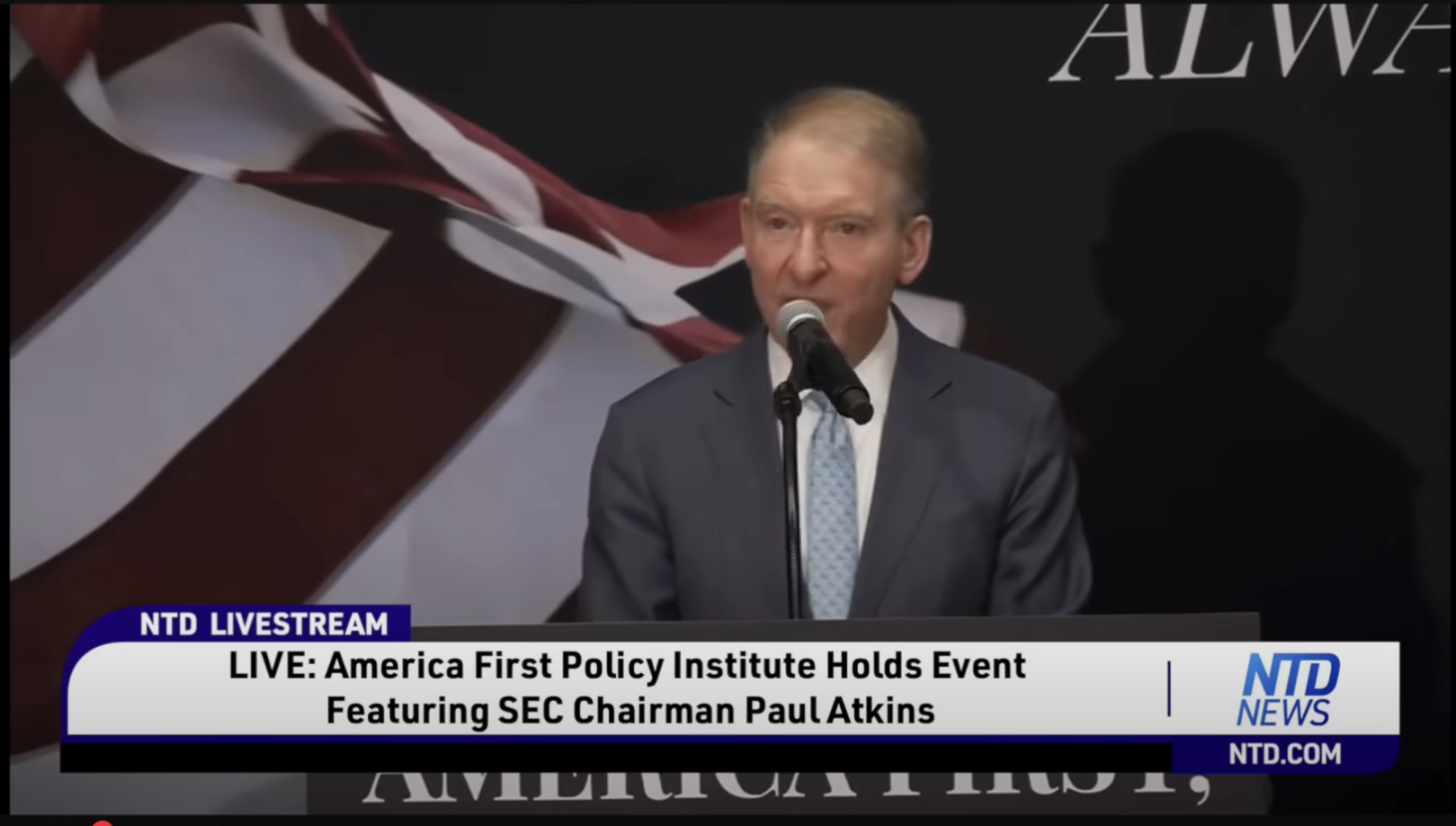
Speaker: Paul S. Atkins, Chairman of the SEC
America's Leadership in the Digital Financial Revolution
Good afternoon, everyone. Thank you, Norm, for the warm introduction, and thank you for inviting me to be here. I am very pleased to gather with all of you, especially at this critical moment when I believe the United States is demonstrating leadership in the cryptocurrency asset market. Before sharing some thoughts, I want to thank the America First Policy Institute for convening this timely discussion. Additionally, to reassure the compliance team, I must state that the views I express today are solely my own and do not necessarily represent the position of the SEC or other commissioners.
Today, I want to talk about what Commissioner Hester Peirce and I refer to as "Project Crypto," which will serve as the North Star for the SEC in assisting President Trump in his historic effort to make the United States the "global crypto capital." But before discussing our plans for dominance in the crypto market, I want to reflect on some pivotal moments in the history of capital markets, as they bear a striking resemblance to where we are now, and the future we shape should be worthy of the legacy we inherit.
From Sycamore Trees to Blockchains: The Evolution of Capital Markets
Innovation has always swept through our capital markets, sometimes like a hurricane. In 1792, it stirred the branches of a sycamore tree—under its shade, more than twenty stockbrokers gathered to sign an agreement that established the precursor to the New York Stock Exchange. That handwritten agreement on parchment, less than a hundred words, initiated an elegant system that has dominated the order of capital flow for generations.
For centuries, our markets have never stood still. They have expanded, evolved, and reshaped with contemporary ideas and technologies. The vibrancy of the market is due to human participation. Markets direct human creativity toward society's most challenging problems and reward those who develop the most valuable and sought-after solutions through incentive mechanisms. This is the mechanism of Adam Smith's "invisible hand": even as individuals pursue their self-interest, the market can guide them toward serving the public good.
The SEC's duty is to protect such a market: one where human creativity and skills can benefit society. Throughout its history, the SEC has both fostered innovation and, regrettably, stifled it. Fortunately, the forces of progress will ultimately prevail. When our regulatory posture can embrace innovation with prudence rather than fear, America's leadership always rises to new heights.
In the 1960s—when I was not yet involved—Wall Street was in a bull market, but the operations behind the scenes were often strained. Most clearing and settlement processes still relied on expensive and cumbersome procedures. Paper stock certificates piled up, needing to be transported by staff using carts, back and forth between Wall Street and financial centers across the United States.
This paper-based clearing and settlement system was designed for a more temperate era and clearly could not bear the rapidly growing volume of transactions. A delay by one company could hold up the entire chain; securities were frequently lost or stolen; transaction failures surged; some capital-weak brokerages even faced bankruptcy due to trading interruptions. In desperation, trading hours were shortened, and exchanges even closed on Wednesdays just to give companies time to process the mountain of paper certificates.
The then-chairman of the SEC described this systemic collapse as "the most severe and prolonged crisis in the securities industry in 40 years… bankruptcies, plummeting investor confidence." It is commendable that the SEC actively responded at the time, prompting market participants to establish what we now know as the Depository Trust & Clearing Corporation (DTCC), fundamentally changing the way securities are held and traded.
From then on, there was no longer a need for paper certificates to circulate between clients and brokers, or between brokers. Securities ownership began to be recorded electronically. The certificates themselves were "frozen," securely stored in vaults, while ownership was transferred through computer systems, laying the groundwork for today's clearing and settlement systems.
Like this ticker tape beside me, which was a breakthrough in the dissemination of market information, allowing Americans to receive transaction information line by line in real-time. But innovation should not just be about past glories.
By the late 1990s, electronic trading systems were all the rage, shaking many assumptions of traditional market structures. At that time, SEC Chairman Arthur Levitt also believed that the SEC had a responsibility to provide regulatory flexibility for innovations in electronic markets. Thus, the Alternative Trading System Regulation (Reg ATS) was introduced in 1999, allowing these systems to be regulated as brokers rather than traditional exchanges.
This brings us to today—a moment that requires American ambition, a project that can unleash that ambition.
Our regulatory framework should not be fixed in the analog era, refusing to explore new frontiers. After all, the future is accelerating toward us, and the world will not wait. America cannot merely keep pace with the digital asset revolution; we must lead it.
Shaping the Future: America's Leadership in the Financial Golden Age
Today, I want to declare to the world that under my leadership, the SEC will not stand by and watch innovation flourish overseas while our own capital markets stagnate. To realize President Trump's vision of making America the global crypto capital, the SEC must consider the potential benefits and risks of moving our markets from off-chain to on-chain.
We stand on the threshold of a new chapter in the history of capital markets. As I mentioned earlier, today I officially announce the launch of "Project Crypto," an initiative that spans the entire SEC, aimed at modernizing securities regulations to enable a comprehensive migration of America's financial markets to on-chain.
Just weeks ago, President Trump signed the GENIUS Act, establishing a gold regulatory standard for stablecoins in the global payments arena. After signing, he publicly supported Congress in passing legislation on crypto market structure within the year. I commend the bipartisan support demonstrated by the House in this process and look forward to the Senate further refining the relevant laws to establish a regulatory structure that protects against regulatory overreach and solidifies America's dominant position in the global crypto industry.
Yesterday, the President's Working Group on Financial Markets released the PWG Report, providing clear recommendations for the SEC and other federal agencies to establish a framework to maintain America's leadership in the crypto asset market. This report serves as a blueprint to ensure that the United States remains at the forefront of blockchain and crypto technology. As the President said last week, he hopes that "the whole world runs on the infrastructure of American technology." I am ready to help achieve this goal.
Therefore, I have launched Project Crypto and instructed the SEC's policy team to work closely with the crypto working group led by Commissioner Peirce to swiftly develop a plan to implement the recommendations of the PWG Report. Project Crypto will ensure that America continues to be the most conducive country for entrepreneurship, developing cutting-edge technology, and participating in capital markets. We will bring back the crypto companies that fled the U.S. due to the previous administration's "enforcement over regulation" policy and "Operation Chokepoint 2.0." Whether established firms or newcomers, the SEC welcomes market participants eager to innovate.
Bringing Crypto Assets Back to America: A New Era for the SEC
Project Crypto will encompass a series of initiatives within the SEC.
First, we will work to bring crypto asset issuance back to America. The complex offshore company structures, pseudo-decentralized performances, and confusion over whether crypto assets are securities will become a thing of the past. President Trump has indicated that America is in its "golden age"—and under our new agenda, the crypto asset economy will also enter its golden age.
According to the recommendations of the PWG Report, one of my top priorities is to establish a regulatory framework for crypto asset issuance in the U.S. as soon as possible. Capital formation is one of the core missions of the SEC, but for a long time, the SEC has overlooked the market's demand for choice and has suppressed crypto-based financing models. This has led the crypto market to gradually distance itself from asset issuance, depriving American investors of the opportunity to participate in productive economic activities through this technology. The SEC's long-standing avoidance of crypto assets, "shoot first and ask questions later," should become a thing of the past.
While the SEC's past position has been to view most crypto assets as securities, in reality, most crypto assets are not securities. However, due to the ambiguous applicability of the "Howey Test," some innovators have treated all crypto assets as securities out of caution. American entrepreneurs are leveraging blockchain technology to modernize various traditional systems and tools. For example, Bernie Moreno, a current U.S. Senator from Ohio and former entrepreneur, founded a company before his campaign that puts car titles on the blockchain. He recognized the efficiency issues in property transfer and proposed practical solutions using blockchain technology.
These entrepreneurs need and should have a clear set of criteria to help them determine whether their business is subject to securities laws. I have directed the commission staff to develop clear guidelines to assist market participants in determining whether a crypto asset is a security or constitutes an investment contract. Our goal is to help them classify crypto assets based on these clear standards, such as digital collectibles, digital goods, or stablecoins, and assess the economic substance of their transactions. Through these classifications, market participants can determine whether the issuer has ongoing commitments or obligations, thereby assessing whether the asset constitutes an investment contract.
Moreover, being classified as a security should not be the original sin of development. We need a regulatory framework that adapts to crypto securities, allowing these products to thrive in the U.S. market. Many issuers will prefer to utilize the product design flexibility offered by securities laws, and investors will benefit from attributes of securities such as dividends and voting rights. Project teams should not be forced to establish DAOs, create offshore foundations, or decentralize too early in non-ideal stages. I am excited about the new applications of crypto securities in business, such as participating in blockchain consensus mechanisms through tokenized stocks.
Therefore, for those crypto assets that indeed fall under the scope of securities laws, I have asked the staff to propose specific disclosure requirements, exemptions, and "safe harbor" provisions, including for so-called "Initial Coin Offerings (ICOs)," "airdrops," and network reward programs. Our goal is to ensure that issuers no longer exclude U.S. users due to legal risks but instead choose to include U.S. users in their issuance plans to enjoy legal certainty and a friendly regulatory environment. I believe that as long as we stick to this direction, we can usher in a Cambrian explosion of innovation.
Additionally, many companies wish to "tokenize" common stocks, bonds, partnership interests, and other securities or tokenize securities issued by others. Due to regulatory barriers in the U.S., such innovations mostly occur overseas. At the same time, our policy team has received many applications—from well-known companies on Wall Street to unicorns in Silicon Valley—seeking approval to distribute security tokens within the U.S. I have instructed the commission to work with these companies to provide regulatory exemptions where appropriate, ensuring that the U.S. does not fall behind in crypto innovation.
Enhancing Freedom: Providing Diverse Custody and Trading Venue Options
Second, to achieve the President's goals, the SEC must ensure that market participants have maximum freedom in choosing custody and trading platforms. As I have pointed out, the right to own and self-manage private property is one of America's core values. I firmly believe that individuals have the right to use self-custody wallets to hold their crypto assets and participate in on-chain activities, such as staking. However, some investors will still choose to entrust their assets to SEC-registered intermediaries, such as brokers or investment advisors, which must meet additional regulatory requirements when providing custody services.
During my tenure, implementing the PWG Report's recommendation on "modernizing SEC custody obligations for registered intermediaries" will be a priority. The previous administration's "special purpose broker framework," SAB 121 document, and "Operation Chokepoint 2.0" have resulted in a near absence of compliant crypto asset custody service providers in the market. Existing custody regulations do not consider the unique characteristics of crypto assets. I have instructed the staff to explore how to adapt the current system, including providing exemptions or modifying rules when necessary, to promote the development of crypto asset custody services.
The PWG Report also recommends that market participants be allowed to conduct multi-line business under the most effective licensing structure. We cannot force them into an outdated "Procrustean bed" regulatory system. I support allowing them to freely choose the regulatory path that best suits their business while safeguarding investor interests.
Promoting Super Apps: Achieving Horizontal Integration of Products and Services
Third, another important goal of my chairmanship is to allow market participants to innovate within the framework of "Super Apps." Many people ask me, "What is a Super App?" It's simple: securities intermediaries should be able to offer a diverse range of products and services on a single platform, under a single license. A broker with an Alternative Trading System (ATS) should be able to simultaneously provide trading in non-securities crypto assets, securities crypto assets, traditional securities services, as well as staking, lending, and other services, without needing to apply for over fifty state licenses or multiple federal licenses.
Currently, federal securities laws do not prohibit registered trading platforms from listing non-securities assets. I have instructed the commission staff to develop further guidance and plans to facilitate the implementation of such "Super Apps." Perhaps we will eventually name it "Reg Super-App."
According to the recommendations of the PWG Report, the SEC should collaborate with other regulatory agencies to establish the most streamlined and efficient licensing system for registered intermediaries, avoiding subjecting them to multiple layers of regulation. This model has been widely adopted in the banking sector, where banks generally do not need to register additionally as brokers or clearing agencies. Regulatory agencies should provide oversight with the minimum necessary dosage, protecting investors while encouraging business growth. We should not force companies overseas with excessive, paternalistic regulation, nor should we allow regulatory burdens to favor resource-rich large companies, stifling the competitiveness of small and medium-sized enterprises.
Based on the specific recommendations of the PWG Report, I have instructed the commission to develop a framework that allows non-securities crypto assets and securities crypto assets to trade in parallel on the same SEC-regulated platform. Additionally, I have requested an assessment of how to utilize the commission's authority to allow certain crypto assets to be listed on non-SEC registered trading platforms. This will not only enable state-licensed platforms to offer more assets but also provide margin functionality for CFTC-regulated platforms, even though Congress has not granted them additional authority, thereby releasing greater liquidity.
Unlocking the Potential of the U.S. Market: Beautiful and Powerful On-Chain Software Systems
Fourth, I have instructed the commission staff to update outdated regulatory rules to unlock the potential of on-chain software systems in the U.S. securities market. On-chain software takes various forms—some systems are truly decentralized and do not rely on any intermediaries for operation; others are maintained by specific operators. Regardless of the form, they should have a place in our financial markets.
Any regulatory framework for market structure concerning crypto assets must provide a clear path for on-chain software developers that do not rely on centralized intermediaries. Decentralized finance (DeFi) software systems—such as automated market makers (AMMs)—can facilitate automated, non-intermediated financial market activities. U.S. federal securities laws have traditionally assumed the presence of intermediaries that require regulation, but that does not mean we should forcibly introduce intermediaries merely to conform to outdated regulatory logic. If the market can operate without intermediaries, we should respect that.
We will leave room for both centralized and decentralized models to develop in the U.S. market. We will protect developers who simply publish software code, clearly delineating the line between intermediary participation and non-intermediary activities, and establish clear, workable regulatory rules for intermediaries wishing to operate on-chain software systems. DeFi and other on-chain software systems will become part of our securities market, rather than being stifled by redundant or excessive regulation.
To realize this vision, we need to amend existing rules. For instance, to support on-chain trading of securities, we may need to revise the National Market System Regulation (Reg NMS). In fact, twenty years ago, I co-authored a dissenting opinion against Reg NMS with then-Commissioner Cynthia Glassman, and today, the concerns we raised then are even more relevant. Over the past two decades, the excessive requirements imposed by Reg NMS have distorted market activities and hindered the natural evolution of the U.S. securities market. Congress envisioned that "competitive forces, not unnecessary regulation," would drive the development of the national market system. I will work to push us back toward that original intent, further promoting innovation and competition in the market.
Driving Innovation: Commercial Viability is Our North Star
Finally, innovation and entrepreneurship are the engines of the American economy. President Trump has called America a "nation of builders." Under my leadership, the SEC will encourage this spirit rather than suppress it with red tape and one-size-fits-all rules. The current commission is actively considering some reform proposals put forth by the industry to stimulate innovation; at the same time, we are exploring the introduction of an "innovation exemption mechanism"—allowing both registered and non-registered entities to quickly bring new business models and services to market, even if these models do not fully align with existing rules.
In my vision, this innovation exemption mechanism will allow tech pioneers and business innovators to immediately participate in the market without having to comply with cumbersome regulations that are outdated or hinder economic activity. Correspondingly, they will need to adhere to some principle-based conditions to achieve the core policy goals of federal securities laws. These conditions may include commitments to report to the SEC regularly, introducing whitelist or "certification pool" functions, and only allowing securities tokens that meet compliance functionality standards (such as ERC3643) to circulate. I encourage market participants to keep "commercial viability" as a core consideration when working with SEC staff in developing models.
Conclusion
As we advance these priorities, I look forward to collaborating with other government departments to work together to make America the global crypto capital. This is not only a transformation of regulatory models but also a cross-generational opportunity.
From the paper agreement under the sycamore tree to electronic ledgers on the blockchain, the winds of innovation continue to blow. Our mission is to ensure that this wind continues to propel America's leadership forward. After all, ladies and gentlemen, we have never been satisfied with following others. We will not stand on the sidelines. We will lead the way. We will build it ourselves. And we will ensure that the next chapter of financial innovation is written in America.
Thank you all for listening today. Please stay tuned for our upcoming announcements and proposals, and I welcome your continued valuable suggestions and feedback.
 Risk warning
 Risk warning



Popular articles