"RWA Industry Development Research Report" Released in Hong Kong: The Rise of RWA is Not Coincidental, Rejecting Blind Optimism

 The first RWA industry white paper in Hong Kong is released: Everything can be RWA is a false proposition.
Author: Friends of Planet Lord, Odaily
With the rapid development of the tokenization trend of Real-World Assets (RWA), the market has been rife with the rhetoric that "everything can be RWA." However, the "RWA Industry Development Research Report · Industry Chapter 2025" (hereinafter referred to as the "Report") was released in Hong Kong on August 7, breaking this blind optimism and systematically proposing standards and frameworks for asset selection.
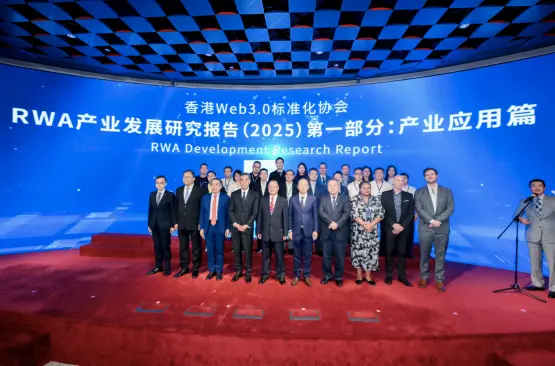
The report points out that not all assets are suitable for the three major thresholds of value stability, clear legal rights, and off-chain data verifiability. RWA tokenization, "everything can be RWA" is a false proposition. Assets that successfully achieve large-scale implementation need to meet these criteria.
Currently, the RWA industry is at a critical juncture transitioning from concept validation to practical application. According to Defillama data, as of June 2025, the total locked value (TVL) of RWA reached $12.5 billion, a 124% increase from 2024. RWA tokenization has become a key direction for global finance and blockchain industries, forming a collaborative pattern among traditional institutions, financial institutions, technology companies, and crypto projects.
Various entities are accelerating the transition of RWA from concept validation to large-scale application through cross-industry cooperation, compliance pilots, and underlying technology innovation. For example, leading global banks like Citibank and Standard Chartered are exploring RWA applications in payment settlement, asset management, and cross-border transactions; Ant Group has launched a blockchain platform called Jovay, designed specifically for institutional-level RWA transactions, significantly improving throughput and reducing user response time.
As different asset types gradually achieve on-chain tokenization, new energy, with its rigid demand and "trustworthy" digital genes, has become an ideal anchor asset for RWA. At the same time, although the application scenarios for real estate RWA continue to expand, several representative typical directions have already formed in practice. For instance, mainstream assets include financial assets such as gold, bonds, accounts receivable, and funds; new energy assets like charging piles and photovoltaics; real estate assets such as hotels and properties; intangible assets like carbon credits, data, and intellectual property; and computing power assets like GPU hardware. RWA represents "Chinese characteristics," showcasing the immense potential of green finance and financing scenarios for the real economy. The AI industry for computing power assets like GPU also explores RWA in fields such as commercial real estate, but faces challenges such as differences in property registration, inconsistent valuations, and local regulatory compliance.
The report also notes that the deep integration of RWA and stablecoins marks a paradigm shift in "on-chain finance," addressing issues of "transaction idling" and "token rootlessness" in the crypto ecosystem, and promoting a shift from mere "cryptocurrency speculation" to an "on-chain value internet."
In the face of new opportunities brought by RWA, regulatory bodies are gradually forming penetrating regulatory principles and sandbox testing mechanisms aimed at providing clear compliance paths for industry innovation. Regulatory agencies in various countries generally adopt penetrating regulatory principles and establish market barriers through licensing systems, while also creating regulatory sandbox mechanisms to provide a controllable testing environment for innovative applications.
The report emphasizes that the rise of RWA is not accidental, but the result of multiple factors working together, including the lack of liquidity in traditional assets, the maturity of blockchain technology, and changes in market demand. However, the development of RWA still faces significant risks, such as notable regulatory differences across countries, insufficient transparency of off-chain data, and poor liquidity of certain assets. Additionally, technical security vulnerabilities and contract complexity are also potential hazards. Therefore, while pursuing technological innovation, it is essential to emphasize the importance of risk management and compliance construction.
It is understood that the "RWA Industry Development Research Report · Industry Chapter 2025" was initiated by the Hong Kong Web 3.0 Standardization Association, Hong Kong Polytechnic University, the Digital Economy Research Center of the Guangdong-Hong Kong-Macao Greater Bay Area International Information Technology Association, and the IEEE Computer Society Blockchain and Distributed Ledger Standardization Committee.
Click to learn about job openings at ChainCatcher
Recommended Reading:
From Advertiser to Crypto "Price Hunter," the half-century trading legend of Peter Brandt
 Risk warning
 Risk warning