








Why are struggling companies rushing to buy Bitcoin?

 Companies are rushing to hoard Bitcoin to boost stock prices, but the risks of a bubble and regulatory concerns coexist, leading to market frenzy and skepticism over the collision between cryptocurrencies and traditional finance.
Author: Nikou Asgari
Compiled by: Block unicorn
Three months ago, George Calarco never considered that his semiconductor company would start buying Bitcoin.
His New York-listed company's stock had long been sluggish, and after reading about a healthcare company whose stock soared after purchasing digital currency, Calarco began to take an interest in Bitcoin. He said, "I was looking for ways to unlock the value of the company" after a failed deal scared off investors.
After discussing with the board and some investors, Calarco decided to launch a Bitcoin strategy. Sequans Communications raised $384 million from debt and equity markets to purchase the world's most popular cryptocurrency. Its stock soared 160% after the announcement.
Calarco said, "I wouldn't have said this last year, but today I am fully convinced… I am 100% sure that Bitcoin will always exist."
This cryptocurrency novice largely credits the transformation of Bitcoin evangelist Michael Saylor. Since 2020, this American cryptocurrency mogul has spent billions of dollars almost weekly buying Bitcoin and hosting conferences to encourage others to follow suit. Saylor's software company has transformed into a Bitcoin hoarder, with a current valuation of about $115 billion, nearly double the value of its Bitcoin holdings, as investors flock in. Last week, the company purchased $2.5 billion worth of Bitcoin, marking its third-largest purchase on record. Its stock has soared over 3000% in five years.
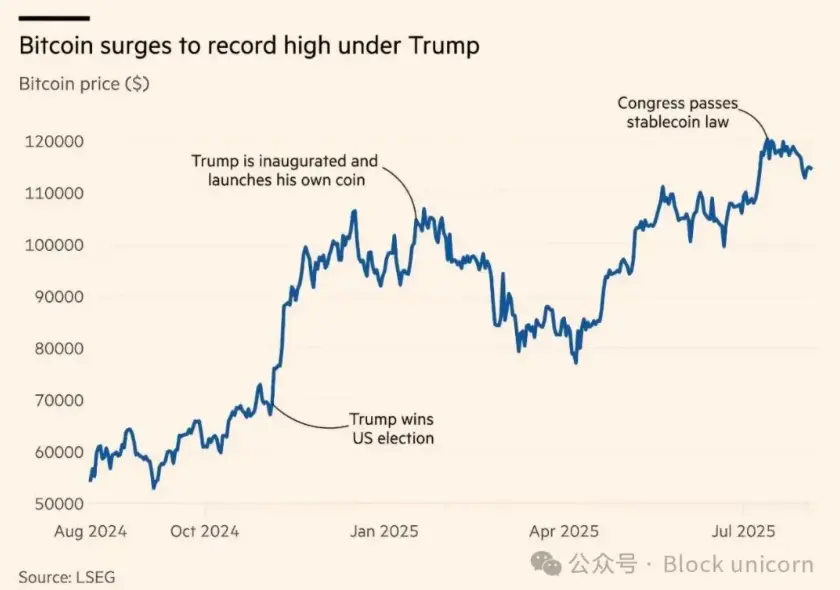
This success, coupled with U.S. President Donald Trump's full support for the digital asset industry, has spurred a global surge in so-called "cryptocurrency treasury companies."
Biotech firms, mining companies, hoteliers, electric vehicle manufacturers, and e-cigarette makers are all scrambling to buy cryptocurrencies, supported by investors looking to share in the cryptocurrency market's windfall without directly engaging with digital assets.
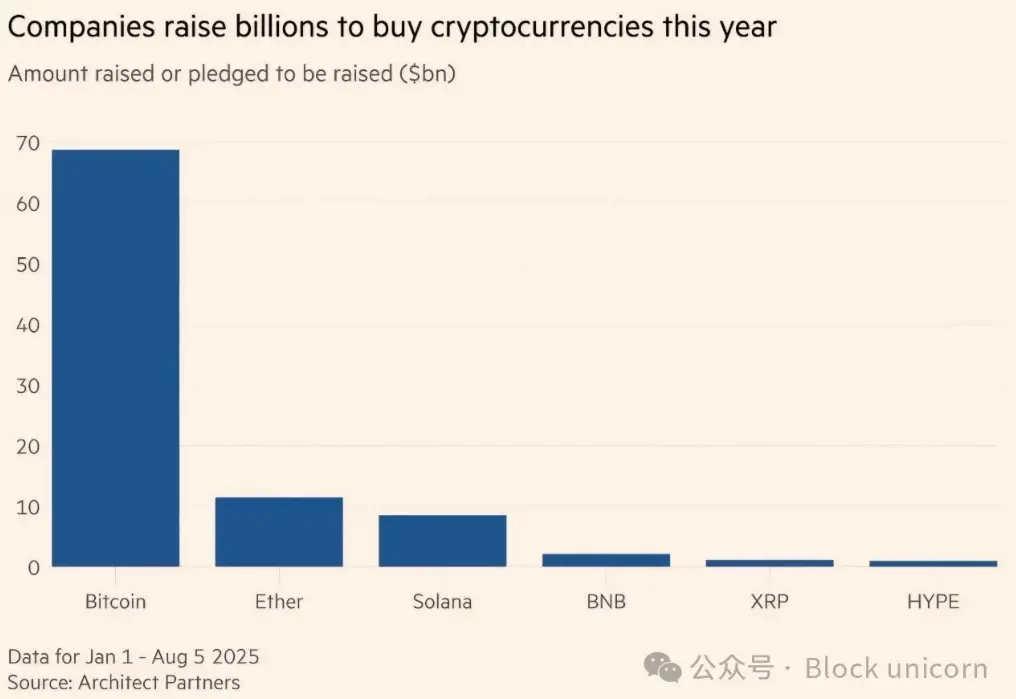
According to data from cryptocurrency consulting firm Architect Partners, about 154 publicly traded companies have raised or committed to raising a total of $98.4 billion for cryptocurrency purchases in the year ending August 5. Before this, only 10 companies had raised $33.6 billion.
Some companies have followed Saylor's lead, changing their website colors to Bitcoin's orange hue and providing data showing how much cryptocurrency they hold, its value, and other metrics important to investors.
Even Trump himself has joined the action—his family media company raised $2 billion in July to purchase Bitcoin and related assets.
In a year where Bitcoin and benchmark stock indices have repeatedly hit new highs, traditional investment institutions are struggling to find the best way to participate in the new world of digital assets, leading to a surge in cryptocurrency hoarding.
But many are skeptical about the sustainability of this trend. The rapid growth has left some investors worried about a market overheating. Brian Estes, CEO of Off The Chain Capital, who has invested in several Bitcoin treasury companies, stated, "This is reminiscent of the internet bubble in 1998," when companies rushed to reposition themselves as internet-first businesses to attract attention.
The surge in new companies has also raised concerns about a potential drop in cryptocurrency prices and its ripple effects. Companies that have borrowed billions of dollars to purchase cryptocurrencies may soon find themselves unable to repay creditors.
Eric Benoist, an investment banking technology and data expert at Natixis CIB, said, "The risk is a Bitcoin crash." In such a scenario, stock prices would also fall, and if companies cannot pay bondholders, investors will suffer losses, "which could have systemic implications for the Bitcoin ecosystem," he added. "Every time there is a small panic in the market, the entire market drops."
Kevin de Patoul, CEO of cryptocurrency market maker Keyrock, stated that investors should maintain a realistic attitude toward this. "You inject a lot of risk into a system that ultimately has almost no support, except for the continued appreciation of the assets."
For struggling companies, purchasing cryptocurrencies seems like a foolproof way to attract investor attention and boost stock prices—at least temporarily.
Aidan Bishop, founder of London-listed Bluebird Mining Ventures, said, "If we hadn't gone down this path, we would have struggled to raise future funds; we are like a company on life support." The company raised £2 million in June to purchase Bitcoin. Before that, "to raise funds, I had to go door to door begging," he added.

Cryptocurrency evangelist Michael Saylor has spent billions of dollars purchasing Bitcoin and hosting conferences to encourage others to follow suit since 2020. His company’s stock has soared over 3000% in five years. Source: Travis P Ball/Sipa/Reuters
Most newcomers are ordinary businesses with no prior cryptocurrency experience, yet the value of their digital assets far exceeds their actual revenue.
For example, U.S. energy company KULR Technology has a market capitalization of about $211 million, despite posting an operating loss of $9.4 million in the first three months of this year. However, it holds Bitcoin worth approximately $118 million.
In the UK, web design company The Smarter Web Company achieved a net profit of only £93,000 in the six months ending in April, but its market capitalization is about £560 million due to its Bitcoin holdings valued at £238 million.
The premium investors are willing to pay highlights their recognition of the value of these companies holding cryptocurrencies.
Companies that prove their commitment to continue raising funds to purchase cryptocurrencies will be rewarded by investors, with their stock valuations exceeding the value of the Bitcoin they hold. To actually purchase these tokens, companies typically raise funds through debt or equity issuance and then invest the proceeds in cryptocurrencies via exchanges like Coinbase.
Speed is crucial. Estes stated, "Ultimately, it’s a matter of speed. The goal is to increase the number of Bitcoins per share, and those who can do this the fastest will receive a high premium."
For investors, "Bitcoin per share"—the number of Bitcoins held per share of the company—is the measure of success. If a company quickly buys more tokens, the number of cryptocurrencies indirectly held per share by equity investors increases—this is also why investors are willing to pay a premium early on, as they hope to hold more Bitcoin per share in the future.
Most companies purchasing Bitcoin are also operating other businesses, but the new wave of transactions involves shell companies that are buying or committing to buy cryptocurrencies in large quantities. These companies operate as special purpose acquisition companies (SPACs), raising funds to purchase or merge with existing businesses.
Rob Hardwick, a general partner at venture capital firm Dragonfly Capital, stated that when a company with an actual business buys Bitcoin, the operational risks "are often actually higher": "You have an existing management team whose priorities may change over time and may conflict with the operational business."
Executives are now starting to purchase other tokens, as this trend has expanded beyond Bitcoin. These instruments also provide a way for those holding large amounts of cryptocurrencies to extract value without selling.
ReserveOne is a $1 billion deal funded by investors including exchanges Kraken and Blockchain.com, planning to purchase Bitcoin as well as other crypto tokens like Ethereum and Solana. Ether Machine raised $1.5 billion, intending to use it for purchasing Ethereum. Former Barclays CEO Bob Diamond raised $888 million through a SPAC deal with a biotech company to purchase HYPE tokens. Cryptocurrency billionaire Zhao Changpeng's venture capital firm led a $500 million deal to help a Canadian e-cigarette manufacturer purchase BNB, the token of the Binance exchange co-founded by Zhao.
Hardwick stated, "We are clearly witnessing a somewhat irrational gold rush. It feels unnecessary to set up investment vehicles for all these different tokens."
For retail and institutional investors, cryptocurrency treasury companies provide an alternative way to gain exposure to tokens without directly holding them.
Some investors choose to achieve this through U.S. exchange-traded funds (ETFs) launched by large asset management firms like BlackRock, Fidelity, and Invesco, which have accumulated over $100 billion in investments.
But other investors cannot do so. In countries like the UK and Japan, cryptocurrency ETFs have been banned as regulators try to protect investors from the volatility risks of digital assets. Thus, treasury companies serve as an agency tool, providing investors with a way to indirectly access cryptocurrencies through tradable instruments.
Taylor Evans, co-founder of UTXO Management, stated, "Many institutions (investors) cannot invest in ETFs at all or cannot directly hold (cryptocurrencies)." He added, "We believe Bitcoin treasury companies fill this gap, issuing securities that comply with investment mandates." His company has a size of $430 million, with 95% of its investments in Bitcoin fund management companies.
Investors are also taking advantage of tax arbitrage opportunities between holding crypto assets and stocks in some countries. In Japan, the tax rate on cryptocurrency gains can be as high as 55%, while the tax rate on stocks is 20%. In Brazil, the tax rate on cryptocurrency gains is 17.5%, while the tax rate on stocks traded on exchanges is 15%.
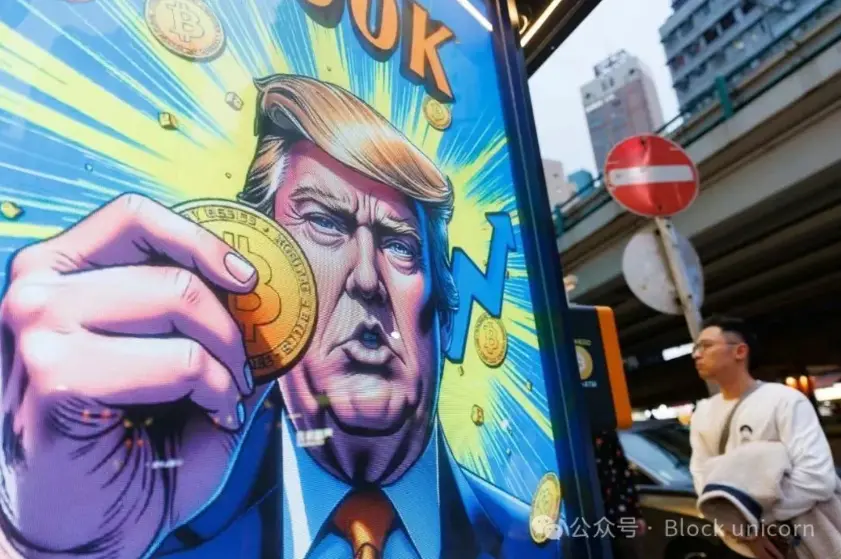
Source: The full support of U.S. President Donald Trump for the digital asset industry has spurred the flourishing of "cryptocurrency treasury companies" globally.
Thus, investing in companies holding large amounts of cryptocurrencies may be more tax-efficient than directly holding cryptocurrencies.
Eager investors are searching globally for new countries with similar tax structures to profit. Estes stated, "The U.S. market is now saturated… We are looking for opportunities outside the U.S."
The new alliance between cryptocurrencies and capital markets is somewhat ironic, as its original mission was to disrupt traditional financial markets, away from the prying eyes of large institutions.
Raising debt and equity from investors is at the core of the strategy and is a necessary condition for maintaining operations. Companies that are not fast enough in purchasing cryptocurrencies have begun to see their stock prices decline.
Although Sequans Communications' stock soared 160% after it began purchasing Bitcoin, its stock has now fallen back to pre-purchase levels, reflecting investor dissatisfaction with its pace of buying.
Estes said, "You combine Wall Street and cryptocurrencies, and you need the market to support this harvest."
To scale up, many such companies are planning to go beyond merely being pools of cryptocurrencies listed on global exchanges.
Diamond stated that his investment vehicle focused on HYPE tokens may acquire other cryptocurrency treasury companies. "If they get into trouble, we can acquire and rebuild them," he said. "This will create opportunities for the strongest, and frankly, it's about scooping up those poorly managed or underfunded companies."
Meanwhile, Japan's Metaplanet, the world's fifth-largest corporate Bitcoin buyer, plans to borrow against its large token reserves and transform into a cryptocurrency financial services company.
U.S. energy company KULR is also exploring "Bitcoin-backed financial services," such as lending, while mining company Panther Metals' CEO Darren Hazelwood stated plans to use its Bitcoin holdings to fund future exploration projects.
Benoist of Natixis CIB stated, "The natural evolution is financial services because you can use a large amount of Bitcoin to support your financial commitments."

Source: Attendees pose for a photo after U.S. Vice President JD Vance's keynote speech at the Bitcoin conference in Las Vegas. Companies that are not fast enough in purchasing cryptocurrencies have begun to see their stock prices decline.
But cryptocurrency lending is a high-risk business. In 2022, the lending market collapsed due to a series of defaults triggered by price declines, leading to the collapse of exchange FTX.
Benoist added, "My main concern with this strategy is that I don't quite understand how it will end. Companies get caught in a cycle where they must continually buy more to maintain this cycle and go back to the market to buy more—this cycle must continue to justify the premium."
The biggest risk is how deep the damage will be if— or when— cryptocurrency prices crash. Inevitably, a downturn in the cryptocurrency market means that companies linked to tokens will also decline.
Those companies that have borrowed face greater risks because they need to pay interest to investors and may be forced to raise more funds or sell their cryptocurrency holdings to meet debt obligations.
A head of a cryptocurrency hedge fund stated, "If you are using debt to pay off existing debt, this structure is very unhealthy and makes me very uneasy." He added, "You may face systemic risks because there are too many of these fragile structures that need to be fully or partially unwound, which will put pressure on the market."
He also stated, "I hope regulators will oversee this instead of everyone assuming the market will keep going up forever and establishing treasuries."
Investors say they are aware of the risks but are eager to make money during prosperous times. Evans of UTXO Management, who serves on the boards of several cryptocurrency treasury companies, stated he is pushing CEOs to "have a way to generate cash during market downturns through operational businesses and find ways to derive value from Bitcoin beyond just raising capital."
However, even stakeholders in the industry are becoming increasingly skeptical. Estes said, "This will end in a bubble burst. They can rise as fast as they can fall."
 Risk warning
 Risk warning




Popular articles





