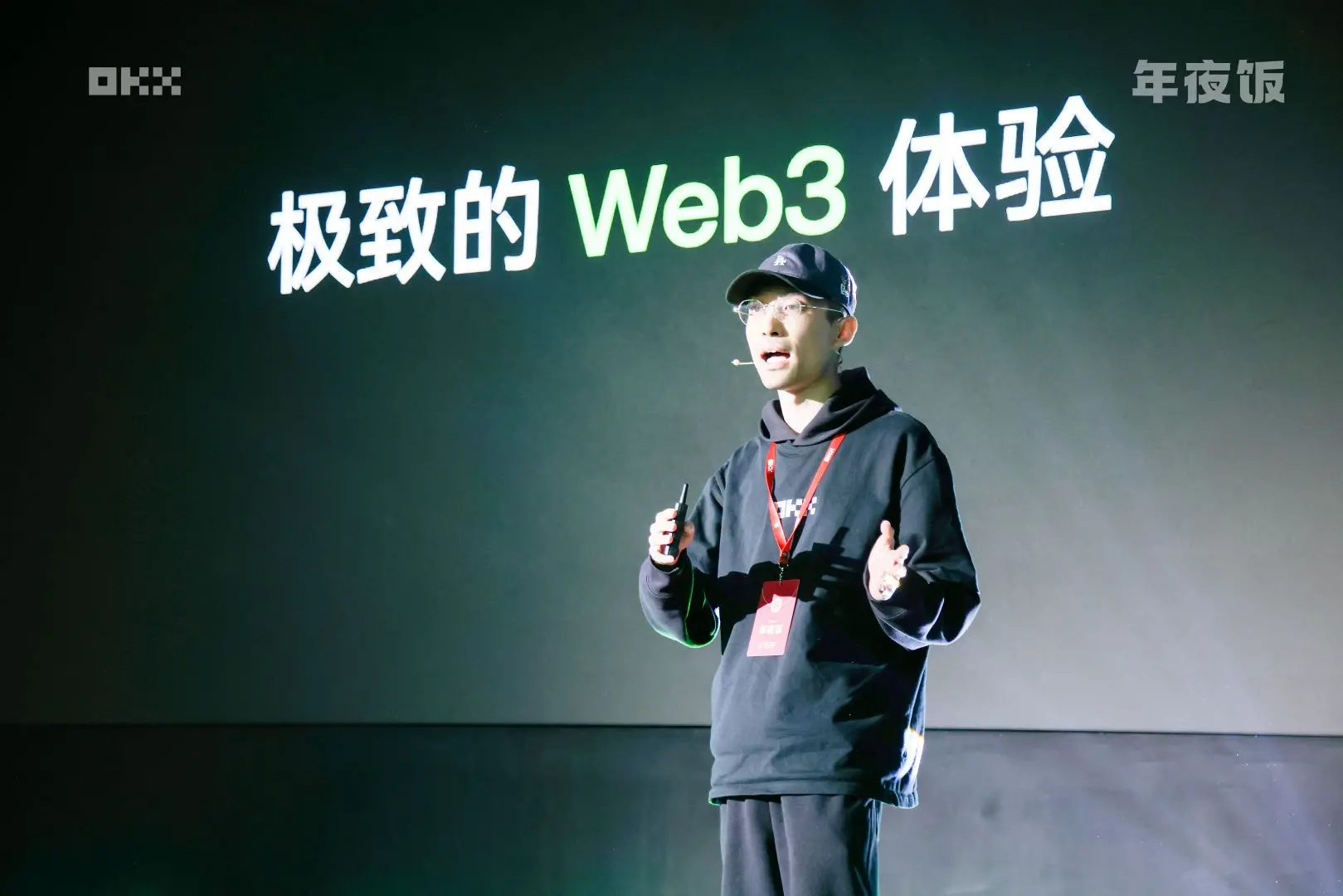
OKX Star Token2049 Speech: Everything on Chain, Self-Custody is the Future

 This article is the keynote speech by Star Xu, founder and CEO of OKX, at the Token2049 summit, where he elaborated on his vision that the future of finance will be "everything on-chain, self-custody first."
Have you ever wondered what the future of finance will look like?
On October 1st, Star Xu, the founder and CEO of OKX, was invited to speak at the Token2049 summit in Singapore, where he delivered a keynote speech titled "Everything Onchain, Self-Custody Is the Future." He believes that the next era of finance will not involve institutions holding assets for users, but rather users truly controlling their assets on-chain. Just like the development of the internet, finance is moving from closed systems to open protocols, and the infrastructure for on-chain finance is fully ready. He emphasized that as the era of "trust first, verify later" comes to an end, finance is shifting to "verify first, trust later." In this context, self-custody is the future—financial futures are not in vaults but in your crypto wallet.
He later reiterated his speech on the X platform: "The future of finance will not be determined behind closed doors—it will be built on-chain, transparently. At TOKEN2049, I shared our vision: everything on-chain, prioritize self-custody, verify before trusting. In the OKX ecosystem, we are gradually building this future with every block and every transaction on the blockchain. Now, everything is just beginning."
Let’s step into Star's perspective to glimpse the future of finance: Why will everything go on-chain? Why is self-custody the future? And how is OKX participating in the construction of future finance? Here is the full text of Star's speech at Token2049 (organized):
Why Will Everything Go Onchain?
Good afternoon, everyone. Twelve years ago, when I founded OKX, Bitcoin was like a magic bean from a fairy tale or a token from a game. We also held events like Token 2049, giving away hundreds of Bitcoins, which seems impossible now—today, the market cap of Bitcoin ETFs has surpassed that of gold ETFs, and public chains like Ethereum and Solana have become the infrastructure for decentralized applications.
The next era of finance will no longer involve institutions holding assets for users, but rather users holding and managing their own assets on-chain.
Looking back at history, if we review the development of mobile devices, we find that the mobile communications industry also had both open and closed systems. Traditional giants like Nokia and Motorola produced their own devices and developed operating systems and applications. However, when a new generation of open system companies emerged, such as Apple and Android, it ultimately led to the rapid decline of these traditional giants reliant on closed systems within a few years.
Now, if we turn our attention to traditional finance, we find that most of it is still a closed system, while decentralized finance (DeFi) is entirely different; it is an open system: transactions are transparent, rules are verifiable, and anyone can develop their own applications on it.
So, what is a true on-chain system? It has four core definitions: First, it must be open and transparent. Second, it must allow anyone to develop based on this system (promoting unlimited innovation). Third, it cannot rely on any single service provider; users should be allowed to migrate freely from one provider to another. Fourth, all of this must be global.
I believe that in the near future, we will see more and more assets going on-chain. Today, there are cryptocurrencies on-chain, as well as tokenized securities. In the future, various financial elements such as bonds, real-world assets (RWA), and payments will gradually migrate on-chain. In other words, everything will go on-chain.
How Far Are We from On-Chain Finance?
So, how far are we from on-chain finance? I believe the infrastructure is fully ready.
Twelve years ago, the Bitcoin network could only handle about 7 transactions per minute. But today, we see many L1 blockchains capable of processing thousands of transactions in one second, while Ethereum-based L2s can process tens of thousands of transactions per second.
At the same time, crypto assets themselves are also evolving. Bitcoin has become "digital gold," and stablecoins have proven to be one of the most successful cryptocurrency applications in the past twelve years.
More importantly, we see more and more crypto companies learning how to develop healthily within regulatory frameworks. Countries around the world are actively advancing crypto legislation; for example, the U.S. has proposed the GENIUS Act, the EU has launched MICA, and Singapore's MAS has also made significant legislative efforts.
Why Is Self-Custody the Future?
Throughout thousands of years of human history, we worked hard to earn money and then kept it at home, sometimes even under the bed. At that time, we did not rely on agents to hold our assets. However, in the modern financial system, we face a multitude of "agents" and need to consider which ones are trustworthy. The usual logic is that we first choose to trust an "agent" and then verify whether they are reliable. Once this "agent" goes bankrupt, users often can only recover a portion of their assets, if they are lucky.
But in the world of blockchain, self-custody changes everything. It allows users to "verify first, then trust."
Users can research these decentralized applications themselves: How much reserve do they have? How many transactions have they processed? If it’s a lending protocol, is its collateralization ratio healthy? In this process, users are "verifying first, then trusting" (rather than the previous "trusting first, then verifying").
At the same time, self-custody does not mean unsafe or non-compliant. Today, we have many advanced on-chain monitoring technologies that can help crypto companies perform anti-money laundering tasks, often even better than traditional financial institutions. Traditional financial companies can only see data on their own platforms, but in the crypto world, we can leverage AI and big data to capture all transaction information on-chain in real-time.
Additionally, we have technologies like multi-signature and account abstraction that make users' crypto wallets as secure as bank accounts. This year, OKX also developed a real-time monitoring system that can prevent hackers from using our wallet services.
How Is OKX Participating in Building Future Finance?
As a company that has been established for twelve years, OKX has also made significant contributions to the construction of on-chain financial infrastructure.
First, OKX CEX has become one of the most liquid exchanges globally and has obtained regulatory licenses in multiple major jurisdictions, including the U.S., EU, UAE, Singapore, and Australia.
Second, we always prioritize user asset self-custody in our development vision. OKX Pay is a compliant self-custody wallet that allows users to complete transfers as easily as sending a message.
Moreover, we have built the L2 network X Layer, which supports on-chain transactions for OKX Pay, helping global users achieve true peer-to-peer cross-border transfers, and more.
Not only that, but we have also partnered with numerous industry players to jointly promote the development of on-chain finance. In the sports sector, we sponsor the McLaren F1 team and Manchester City Football Club, sharing the crypto dream with millions of sports fans. In the finance and technology sectors, we have established partnerships with industry companies like Circle, Mastercard, Tether, and Paxos; at the same time, we closely collaborate with many crypto-native enterprises such as Aptos, Sui, Uniswap, and 1inch. Through OKX Pay and X Layer, these collaborations make our ecosystem more open and efficient.
Additionally, we work with influential individuals globally, sharing hundreds of millions of dollars in revenue with nodes each year. To support innovation, we established the OKX Vision Fund to help more startup projects deploy products on X Layer, accelerating the landing and development of on-chain finance.
Therefore, I believe that the "era of on-chain finance" does not belong solely to OKX; it belongs to everyone and should be built by each of us together.
The future of finance is not in vaults but in your crypto wallet. This is a beautiful future.
Thank you, everyone!
Disclaimer
This article is for reference only. It represents the author's views and does not reflect the position of OKX. This article is not intended to provide (i) investment advice or recommendations; (ii) offers or solicitations to buy, sell, or hold digital assets; (iii) financial, accounting, legal, or tax advice. We do not guarantee the accuracy, completeness, or usefulness of such information. Holding digital assets (including stablecoins and NFTs) involves high risks and may fluctuate significantly. Past performance does not guarantee future results, and historical returns do not represent future outcomes. You should carefully consider whether trading or holding digital assets is suitable for you based on your financial situation. Please consult your legal/tax/investment professionals regarding your specific circumstances. You are responsible for understanding and complying with applicable local laws and regulations.
 Risk warning
 Risk warning