RootData SG Summit Highlights
 Core Viewpoint

 The unexpectedly successful hosting of the RootData SG Summit not only provided attendees with in-depth industry insights but also clearly outlined the future development blueprint of the cryptocurrency industry.
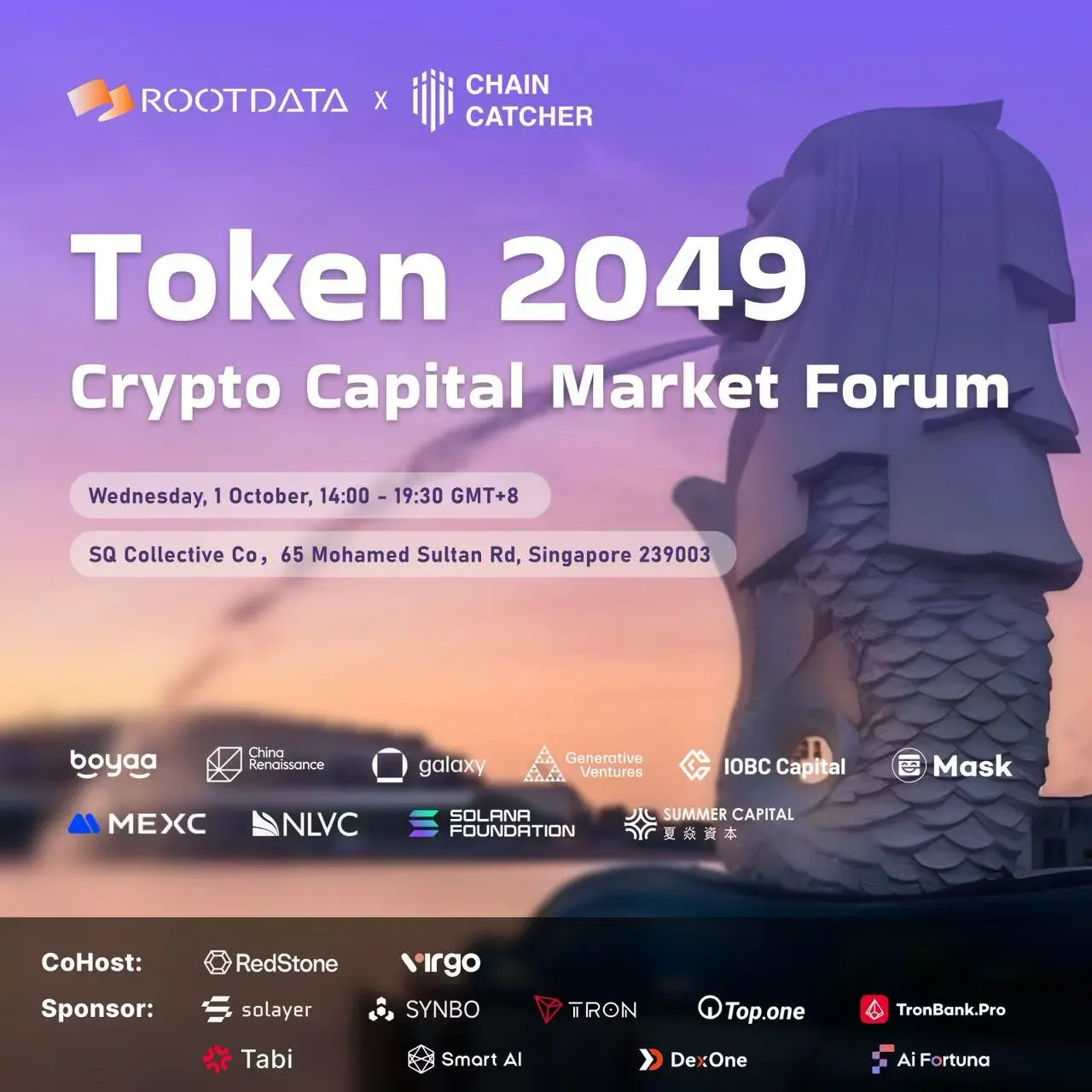
On October 1, the "RootData SG Summit" Crypto Capital Market Themed Forum was successfully held in Singapore. As one of the important peripheral activities of Token2049, this forum attracted participation from several listed companies, top projects, and investment institutions, including Boya Interactive (HK0434), Huaxing Capital (HK1911), Northern Light Venture Capital, Solana Foundation, IOBC Capital, MEXC, Mask, Solayer, TRON, Synbo Protocol, Top.one, Aifortuna, etc., to explore the immense opportunities and value within the Web3 ecosystem and capture the latest industry trends.
At the event, David, the founder of Boya Interactive (HK0434), Joseph Chee, Executive Chairman of Helius and Chairman of Summer Ventures, Mike Massari, Strategic Advisor of RedStone, Chang'an, Head of Asia at Solana Foundation, and Adam Cai, CEO of Virgo Group delivered wonderful keynote speeches.
Leo Zhao, Strategic Investment Director of MEXC, Suji, founder of Mask, John Cahill, COO of Galaxy Digital Asia, along with investors Abraham from WebX International Holdings, Joshua Sum, Product Director of Solayer, Will Wang, Partner at Generative Ventures, Stella Yang, Investment Manager at HashKey Capital, and Ethan, CSO of WEEX, participated in a roundtable discussion on topics such as traditional financial institution funding, crypto cycles, and digital asset ETFs.
Keynote Speeches
The event opened with a keynote speech by David, the founder of Boya Interactive (HK0434). David shared the development strategy of Hong Kong DAT. He pointed out that Hong Kong's regulations are not friendly towards listed companies solely financing to buy coins, so Boya Interactive adopts an "gaming + Bitcoin" innovative model to apply for purchasing Bitcoin under the guise of gaming chain staking. Currently, Boya Interactive holds approximately 4,000 Bitcoins. He believes that Bitcoin addresses the human monetary problem and ranks first among crypto assets.
Joseph Chee, Executive Chairman of Helius and Chairman of Summer Ventures, delivered a keynote speech titled "DAT Strategy: Institutional Evolution." He noted that for cryptocurrencies to grow from $4 trillion to $20 trillion, it must attract $500 trillion from Wall Street. Compared to Bitcoin and Ethereum, Solana has advantages such as the fastest speed, lowest cost, and a staking yield of 7-8%, and institutional adoption is just beginning. Joseph emphasized that currently, there are fewer than 200 institutions globally participating in DAT investments, and DAT will become the main channel for traditional finance to enter the cryptocurrency space, with enormous market potential.
Mike Massari, Strategic Advisor of RedStone, delivered a keynote speech on Oracle Extractable Value (OEV). He mentioned that RedStone is one of the fastest-growing oracles, currently serving hundreds of clients and supporting over 60 chains, securing $4 billion in assets.
In traditional clearing mechanisms, MEV bots compete for clearing opportunities, causing on-chain congestion and preventing protocols from capturing value. The OEV system developed by RedStone in collaboration with Fastlane integrates bidding results and price updates into a single atomic transaction through an off-chain auction mechanism, completing the entire process in just 300 milliseconds. As the RWA market grows from $5 billion in 2022 to $27 billion, OEV provides a safer and more predictable clearing mechanism for institutional-grade DeFi and has already launched on multiple chains, including BNB Chain and Unichain.
Chang'an, Head of Asia at Solana Foundation, elaborated on Solana's progress in performance, ecosystem, and institutional adoption over the past two years. Chang'an pointed out that Solana has become the preferred platform for startups and large companies in the blockchain field, consistently leading in several key metrics. He particularly recognized projects like Pump.fun for achieving commercial monetization through product capabilities, viewing this as a benchmark Solana hopes to establish. He finally predicted that more mature financial companies in Hong Kong would launch on-chain assets within six months, breaking traditional financial barriers.
Adam Cai, CEO of Virgo Group, delivered a keynote speech titled "Redefining Global Finance with Stablecoins and Web3 Wallet Solutions." Adam Cai revealed that Virgo Group's business is growing rapidly, with its wealth management platform Virgo Wealth's trading volume exceeding $2.6 billion by December 2024. Meanwhile, its Web3 wallet solution "Wallet V" achieved a trading volume of $100 million within 30 days. Adam believes that the crypto industry lacks truly killer applications, and the first should be a stablecoin cross-border remittance network that allows ordinary people to use it seamlessly. He pointed out that there are price differences for stablecoins in certain markets, and remitting with stablecoins is not only cheaper than traditional methods but can even earn a price difference, which will fundamentally change the global remittance market.
Roundtable Discussion
Leo Zhao, Strategic Investment Director of MEXC, Suji, founder of Mask, John Cahill, COO of Galaxy Digital Asia, and Abraham, an investor from WebX International Holdings, shared insights in the roundtable discussion titled "TGE, IPO, or M&A Exit?" delving into current exit strategies in the crypto industry.
The guests discussed that the crypto industry is undergoing a critical transformation in 2025. The U.S. regulatory environment has shifted 180 degrees, lifting restrictions on businesses like DeFi and paving the way for institutional capital to enter. A wave of mergers and acquisitions among exchanges is emerging, with small and medium-sized platforms facing consolidation pressure, while giants like Coinbase and Kraken are actively acquiring to expand their market presence.
Traditional brokerages like Robinhood are entering the crypto space, performing even better than native exchanges, indicating that the lines between Web2 and Web3 are rapidly blurring. Capital market tools are expanding, allowing projects to choose from diverse exit channels such as TGE and IPO, with the market gradually shifting from speculation to actual returns.
Joshua Sum, Product Director of Solayer, Will Wang, Partner at Generative Ventures, Stella Yang, Investment Manager at HashKey Capital, and Ethan, CSO of WEEX, shared insights in the roundtable discussion titled "Product, Business Value, and Capital Narrative."
The guests believe that the most significant structural change in the past year is the integration of traditional finance and cryptocurrencies. ETFs and DAT companies have brought over $200 billion in liquidity to the market, and mainstream adoption no longer relies on technological innovation but is achieved through traditional financial infrastructure.
Additionally, experts from various fields advised entrepreneurs to focus on product fundamentals rather than chasing short-term narratives, while warning that there is a bubble in crypto AI projects. Future opportunities lie in global native on-chain currency market funds, one-stop trading platforms, etc. Importantly, hardware acceleration is seen as a key technological direction to break through performance bottlenecks.
With the unexpectedly successful hosting of the RootData SG Summit, it not only provided attendees with in-depth industry insights but also clearly outlined the future development blueprint of the crypto industry. From the proactive layout of traditional financial institutions to the rapid implementation of applications like stablecoins and RWA, and the continuous breakthroughs in underlying technologies like hardware acceleration, the crypto market is undergoing a critical transformation from speculation to value creation.
As the global regulatory environment becomes increasingly clear, the large-scale entry of institutional capital has become an irreversible trend. Whether entrepreneurs seeking exit strategies or investment institutions laying out the future, it is essential to maintain clear judgment in this rapidly changing market. As emphasized by several guests, only product fundamentals and long-term value creation can seize the initiative in the next wave of industrial tides.
 Risk warning Risk warning