KOLs are all flaunting their income, while I want to share the hard-earned lessons from three years of investing as a VC
 Core Viewpoint

 Patience is an opportunity, luck is a profession, FOMO = suicide.
Source: BruceLLBlue
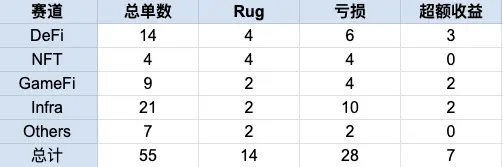
Recently, Twitter has been buzzing with a wave of Chinese KOLs posting about "how much they earned in the past year": millions, tens of millions, 102.4 billion (for those who get the joke)…… After reading, all I can say is, impressive! But as a former VC investment head (GP, General Partner), I just want to complain: after a few years as a Crypto VC, I lost tens of millions of dollars. This isn't just casual talk; it's a real story of blood and tears, with over 55 investments in 3 years, 27 of which lost money (including rugs), and 15 went to zero, while also investing in 9 relatively leading VCs.
Among them, all NFT-related projects failed, GameFi had a 33% rug rate, and Infra was a disaster area, with many projects left with only 10%-20% of their valuation. To the KOLs flaunting their income and esteemed Crypto traders, congratulations on catching the secondary wind; what about ordinary VCs focusing on primary investments? They are left licking the project parties; unlocking takes 3-4 years, and the result is often "invested early and correctly, but can't exit." Why show losses instead? Because this isn't about crying poor, but rather a wake-up call. Being a Crypto VC is inherently difficult; bear markets are brutal, and bull markets often lead to being "harvested" by project parties. However, I believe that in this new cycle, continuing to be a VC (or evolving it) may not be a super good time, even though institutional large funds are entering, regulations are clearer, and AI + on-chain tools are reshaping exit paths. I think there are better ways and paths to realize self-worth. Sharing my painful lessons, let's encourage each other.
1️⃣ Lesson One: The Naked Truth of Statistics, the "Win Rate" of 55 Deals
From joining Crypto VC in August 2022 to leaving in July 2025, I personally handled 55 direct investments + invested in 9 funds.
Rugs accounted for 14/55 (25.45%): The disaster area was NFT projects, all went to zero. One "star project" backed by a big IP was initially hot in early NFTs, but the team had shallow Web3 experience, the founder, a top celebrity, showed little interest in issuing tokens, and after core members left, it soft rug pulled; another "music + Web3" project, after a few years of work from a giant, achieved nothing and quietly faded away. There was also a Dex project with a "founder's entrepreneurial dream": the founder had the team do black work while pocketing the income, and core employees ran away; several "potential stocks" from a university lab basically all failed.
Losses accounted for 28/55 (50.1%): One GameFi project went from a 5x launch to a mess (remaining 20% of cost, down 99%); another "produced by a North American big factory background team" GameFi project peaked at 12x, now only 10% of cost; and another GameFi project was heavily dumped by a certain CEX's Launchpad, failing to gain traction and directly going under. The Infra field was even worse: no breakthroughs in ecology, no innovations in technology, after the hype, many were left with only 10% of their cost; if hedging wasn't done in time, it would be a complete disaster; additionally, a MOVE ecosystem socialfi project collapsed right before the 2024 bull market.
What about the fund investments (FoF, mother fund)? I invested in 9 leading European and American funds like @hackvc @Maven11Capital @FigmentCapital @IOSGVC @BanklessVC; these funds basically participated in the early investments of very well-known projects in this cycle, such as @eigenlayer @babylonlabsio @MorphoLabs @movementlabsxyz @ionet @altlayer @MYXFinance @solayerlabs @ethsign @0Glabs @berachain @initia @stable @monad @etherfi @breviszk @SentientAGI. On paper, it looks okay with 2-3x, seemingly respectable, but the actual DPI (distributed paid-in) is estimated to be only 1-1.5x. Why such expectations? The main reason is still due to slow project unlocks and poor market liquidity; if a bear market or something like the FTX collapse occurs, positions can instantly plummet.
2️⃣ Lesson Two: The Depth of Pits, the Depth of Human Nature ------ Several Heartbreaking Cases
The most painful is the "people investment" failures: a Dex project where the founder, despite having the aura of a CEX executive, actually outsourced black work, pocketing the income; GameFi's "North American big factory dream," after a 12x launch, continuously declined, never recovering. A certain @0xPolygon founder's Infra project has no ecological breakthroughs in sight, with only 15% of the investment valuation left; several hot Infra projects launched on the Korean giants (Upbit and Bithumb), then plummeted, never rising again. There was even a "music NFT" project, with a founder who was a Tencent Music executive, that soft rug pulled after a few years, achieving nothing.
VCs in the Chinese-speaking region suffer more: language/thinking patterns/resources are inherently disadvantages; the playbook of European and American funds is fundamentally different; they compete on scale to earn management fees, while we are shortsighted with Quick Flip and Paper hands. After well-known projects raise huge funds, they look for global outsourcing to implement their roadmap (I've interacted with a few; as long as the money is sufficient, it's fine), and the founders just need to handle the community and fundraising. What about VCs? The weakest group, some project parties offload tokens through airdrops, trading via USB drives and Korean exchanges (after pumping to the target price at launch, they split the profits, which is why Korean exchanges often see opening premiums), and investors have no way to verify. Every VC thinks they are impressive; checking the IRR and DPI of these funds shows it's better to just do fixed deposits in USDT/USDC.
3️⃣ Lesson Three: After Losing So Much, I Learned the Evolutionary Theory of "Exit is King"
Being a VC is genuinely hard; you have to survive bear markets, gamble on human hearts, see through human nature, and wait for unlocks without holding tokens, with a 3-4 year cycle repeating. If you don't hedge/manage liquidity in the secondary market, achieving excess returns is basically impossible. From my summary, most projects that achieved excess returns were invested in during the 2022-2023 period after the FTX collapse, mainly because: project valuations were low, founders had strong beliefs, and the timing of investment was right (projects had enough time to explore and could conduct TGE early when the bull market arrived). Why do other projects have poor returns or lose money? The main reasons are simply: either too expensive, too early, or misaligned unlocks.
Looking back, these are all valuable experiences! Moreover, now that $BTC is consistently hitting new highs, traditional giants and Wall Street are rushing in, the window for ordinary people to get rich is slowly narrowing, and institutional investment returns are aligning more with Web2 venture capital (it's hard to return to the wild growth era before 2021).
The new generation of investors: they may not necessarily be VCs; they are more likely to be individual angel investors or super KOLs who, through their influence and resources, can often secure better unlock terms and more favorable tokens than VCs. Moreover, it's not just about investing early and correctly; it requires capturing the entire chain: primary + secondary + options/convertible bonds + airdrop interactions + market-making hedging + DeFi arbitrage. In fact, there is a serious cognitive misalignment and difference between the East and West, which is also a gold mine for arbitrage.
🔵 Turning to the Keyboard, the Dignified Path of Content Output for Alpha
Losing tens of millions in my Crypto VC years made me realize one thing: constantly licking project parties, enduring token unlocks, and gambling on human hearts and nature leads to the humble label of "VC dog" and the grievances of backers, while project parties can secretly offload tokens, leaving investors helpless. Enough! Now, I choose to turn around and start writing articles: relying on daily keyboard tapping to output industry insights and alpha insights, no longer entangled in waiting for project unlocks, but instead directly laying out strategies and capturing project opportunities. Compared to the passive waiting of VCs, this path is more dignified, freely outputting value, and the compounding comes from the trust and shares of readers.
Ultimately, after these years of experience, I finally understand: patience > opportunity, luck > expertise, FOMO = suicide.
 Risk warning
 Risk warning

Popular articles