A comprehensive understanding of how "market makers" operate in the cryptocurrency space
 Core Viewpoint

 The role of market makers is both a liquidity provider and a price setter and risk controller, while retail investors generally feel that prices drop when they buy and rise when they sell, which is essentially the result of the game with market makers.
The original text is from Odaily Planet Daily's friend Planet Jun
This wave of spike-style decline has led many brothers to say that Binance's market makers have encountered problems, including the gold-pegged $PAXG also spiked.
Why do many retail investors say that whenever they buy, the price drops, and whenever they sell, the price rises?
So, what do market makers do? How do they operate?
Fee rebates
Bidirectional orders, with both sides executing, earning small spread profits, accumulating thin profits, essentially capturing liquidity through time and information delays
Price discovery, helping the market price efficiently, providing liquidity
Market manipulation, coordinating with news to sell liquidity to retail investors
The English term for "做市商" is Market Maker, which means that in places without a market, market makers create a market.
First, suppose you are a market maker for a project, and now there is an order book that looks like this: 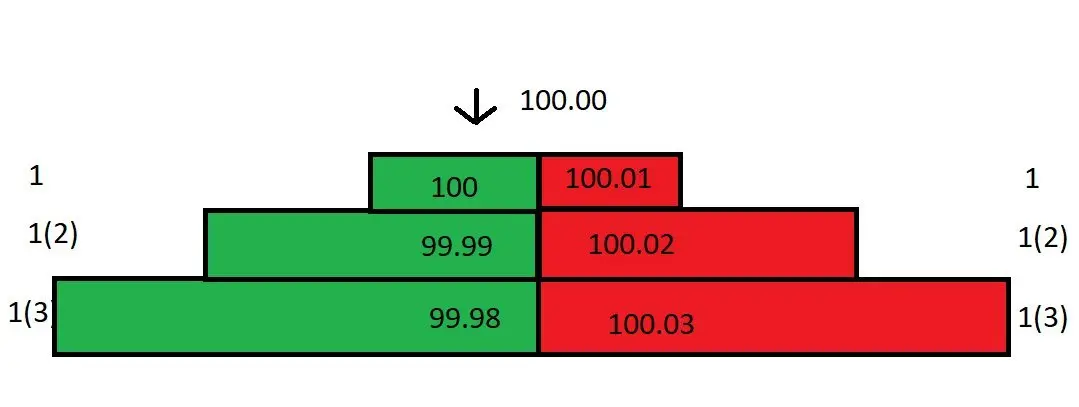
Let's make some assumptions: there are no other investors placing limit orders in this market, you are the only liquidity provider, meaning you are the only market maker; the minimum price movement unit is 0.01; all takers need to pay a 0.025% fee, and all makers receive a 0.01% rebate.
You are the market maker, on the side of the limit orders, and for all market orders that execute at your price, you can receive a 0.01% rebate.
The difference between the best bid and the best offer (best bid and best offer, abbreviated as bb/o) is called the spread, and the current order book's spread is 0.01.
Now, a market sell order comes in and will execute at your buy price of 100. You paid 100 for this transaction, but the other party actually only received 100 - 0.025 * 100 = 99.975, where 0.025 (100 * 0.025%) is the fee, and you can receive a 0.01% rebate from it, so you actually only paid 99.99.
Since the buy price has been taken, the structure of the order book has changed, and the current spread has become 0.02. However, the market price is still 100, because this is the last transaction price:
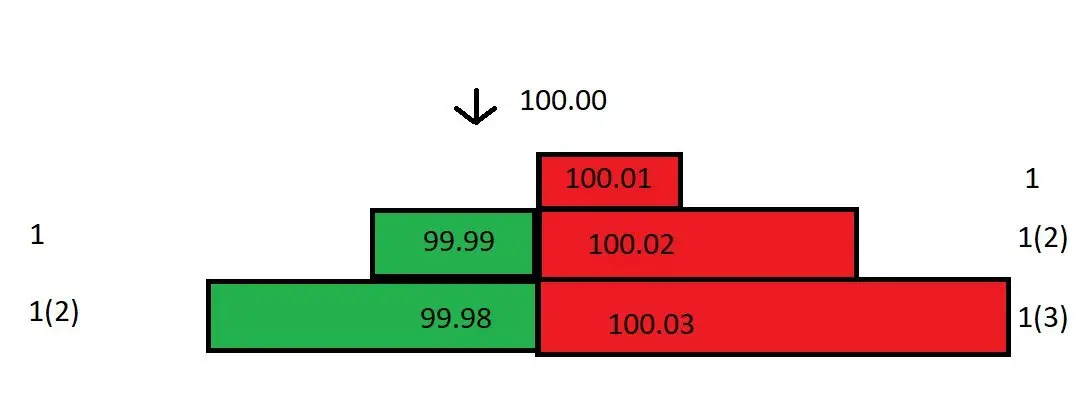
If a buy order comes in at this moment, it will execute at your sell price of 100.01. You bought the last order at 99.99 and are now selling at 100.01, earning 0.02, plus the rebate, the total profit from this buy and sell can reach about 0.03.
Although your buy (100) and sell (100.01) spread is only 0.01, the actual profit is as high as 0.03!
If a continuous stream of market orders comes in and executes with you, you can earn 0.03 on each buy and sell, and accumulating this way, getting rich is just around the corner!
But unfortunately, the market did not develop as smoothly as you expected. After you received the goods at 99.99, the spot market price immediately dropped from 100 to 99.80, and you immediately canceled the buy orders at 99.99 and 99.98 to avoid being arbitraged by others.
Since the current price has dropped to 99.80, your sell price is still 100.01, which is too high, and no one will transact with you at this price. Of course, you could lower your sell price to 99.81, but that would incur a loss of 0.17.
Don't forget, you are the only market maker in the market, and you can fully leverage this advantage to adjust the order book and minimize losses!
You calculated at what price to place a sell order to break even. You received the goods at 99.99 and want to sell at breakeven, so your sell order should be at 99.98 (because with the rebate, you actually receive 99.99, which is exactly break-even).
So you adjusted the order book, placing buy orders at 99.80 and 99.79, and a sell order at 99.98:
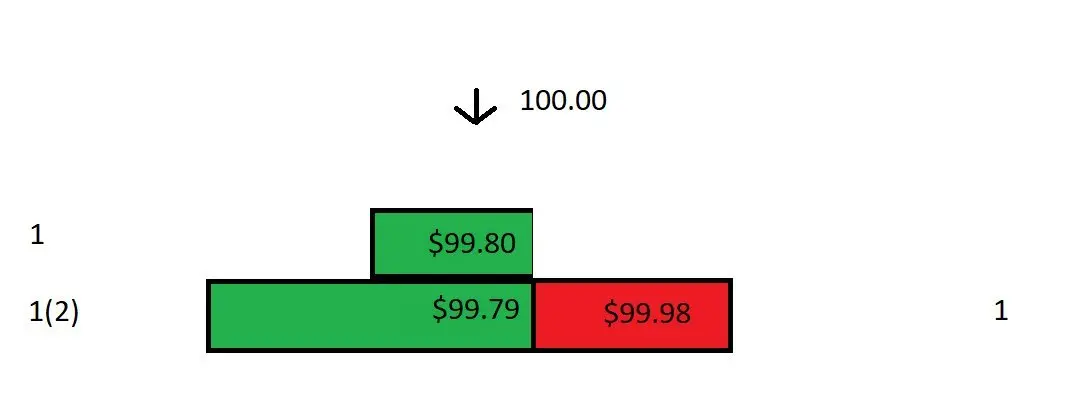
Although the spread is now large, you are the only market maker in the market, and you can decide not to lower the sell order price. If someone is willing to transact at the sell price of 99.98, that would be great. If not, that's okay, because your buy order price has already been lowered to 99.80, and there will be market orders coming in to execute with you.
At this point, a market buy order comes in and executes with your buy price. Now you have 2 contracts, and the average cost will be spread to: (99.79 + 99.99) / 2 = 99.89. (In the previous transaction, we executed at 99.99, and this one at 99.79, the lower price is because we have a 0.01% fee rebate.)
OK, now the average cost has been reduced to 99.89, and you lower your sell price from 99.98 to 99.89. Suddenly, the huge price difference has shrunk by half. Next, you can continuously operate this way to gradually reduce costs and narrow the spread.
In the above example, the price only fluctuated by 0.2%. What if the price suddenly fluctuates by 5%, 10%, or even more? Even using the above method could lead to losses because the spread is too large!
Therefore, market makers need to study two questions:
How volatile is the price over different time windows?
What is the market's trading volume?
Volatility, simply put, is the degree to which the price deviates from its mean, and the volatility of prices varies across different time windows. A particular asset may fluctuate wildly on a 1-minute candlestick chart while showing a calm trend on a daily chart. Trading volume tells us about liquidity, which affects the spread of limit orders and transaction frequency.
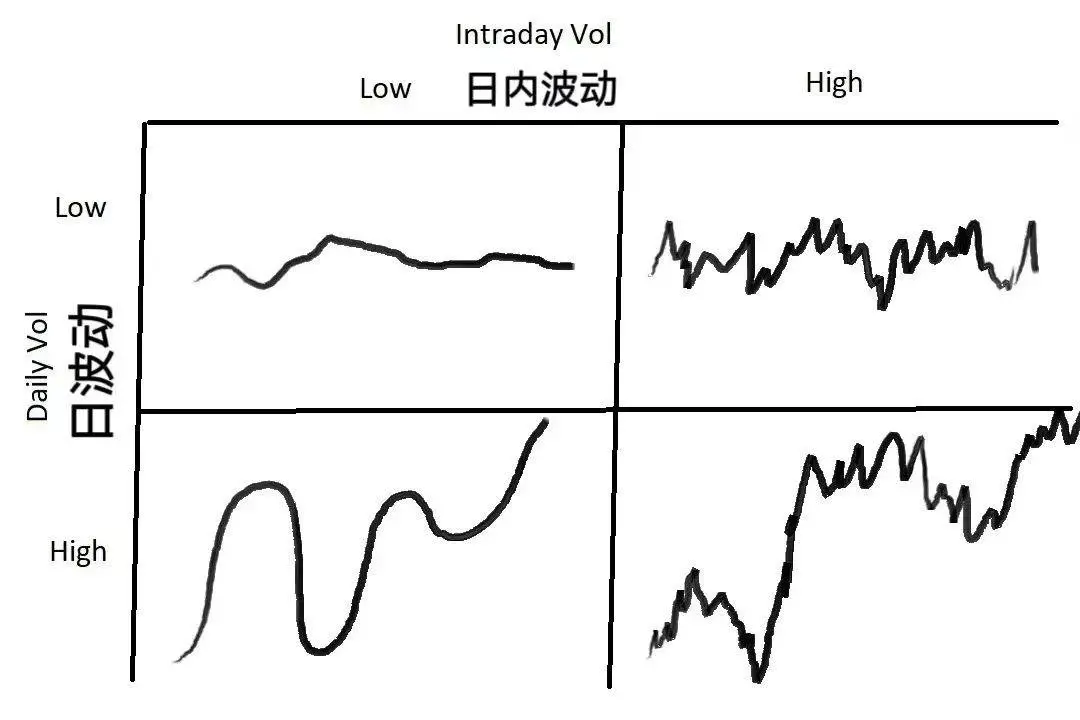
The above chart demonstrates four types of price volatility. For different volatility situations, market makers need to choose different responses:
If the overall market volatility is low, with both daily and intraday volatility being low, a smaller spread should be chosen to maximize trading volume.
If daily volatility is low but intraday volatility is high (meaning prices fluctuate significantly but without substantial change), you can widen the spread and use larger order sizes. If prices move unfavorably, you can use the aforementioned method to lower the average cost to reduce losses.
If daily volatility is high but intraday volatility is low (in other words, prices are trending steadily), you should use a smaller, tighter spread.
If both daily and intraday volatility are high, you should widen the spread and use smaller order sizes. This is the most dangerous market situation, often scaring away other market makers, but it also holds many opportunities. Most of the time, market makers earn stable profits, but when the market behaves erratically, it can breach one side of your order book, forcing you to exit at a loss.
Market making has two key steps: determining fair price and determining spread.
The first step is to determine fair price, which is about where to place your orders. Pricing is the first and very important step; if your understanding of fair price is too far off, your "inventory" may not sell, and you will ultimately have to close your position at a loss.
The first way to price is to reference the price of the asset in other markets. For example, if you are trading USD/JPY in the London market, you can refer to its pricing in the New York market. However, if there are abnormal fluctuations in prices in other markets, this pricing method can become very unreliable.
The second pricing method is to use the mid price, where mid price = (buy 1 price + sell 1 price) / 2. Pricing using mid price is a seemingly simple yet very effective method because the mid price is the result of market competition. Quote around mid, the market is probably right; pricing at mid price means the market is likely correct.
In addition to the two pricing methods mentioned above, there are many other pricing methods, such as algorithm-based pricing and market depth-based pricing, which will not be elaborated on here.
The second question market makers need to consider is the spread. To determine an appropriate spread, you need to consider a series of questions: What is the average trading volume in the market? How much does this trading volume vary (variance)? What is the average size and variation (variance) of taker orders? What is the situation of limit orders near the fair price? And so on. Additionally, you need to consider price fluctuations and variance over very short time windows, the fees that market makers pay/receive, and other secondary factors such as interface speed, order placement and cancellation speed, etc.
In very short time periods, the profit expectation for market makers is actually negative because every taker order wants to execute with you when they have a price advantage, unless it is a forced stop-loss order. Every other participant in the market wants to profit at your expense.
Imagine you are a market maker; where would you place your orders?
To maximize the spread while ensuring your orders can be executed, you need to place your orders at the front of the order book, which is at the buy/sell price. As soon as the price changes, your buy order will be executed quickly, but frequent price changes are a bad thing— for example, if you just received goods and the price changes, your original sell order can no longer be executed at the order price.
In a market with insufficient liquidity and small price changes, placing orders at the buy/sell price is much safer, but this raises another issue—other market makers will notice you and place orders with smaller spreads ahead of you (tighten the spread), and everyone will compete to keep narrowing the spread until there is no profit left.
Now let's explore how to determine the spread from a mathematical perspective, starting with volatility. We need to know the volatility of the asset's price/volume around its mean over a very short time period. The following mathematical calculations will assume that price movements follow a normal distribution, although this may deviate from actual conditions.
Assuming we take 1 second as the sampling period and the past 60 seconds as the sample, let's assume the current mid price's mean is the same as the mean from 60 seconds ago (remember, the mean is constant here), and this mean has a standard deviation of 0.04 from the current price. Since we assumed earlier that price movements follow a normal distribution, we can further conclude that, 68% of the time, the price will fluctuate within one standard deviation ($-0.04 to +$0.04) from the mean; and 99.7% of the time, the price will fluctuate within three standard deviations ($-0.12 to +$0.12) from the mean.
OK, we quote on both sides with a spread of 0.04, meaning the spread equals 0.08. Since the price will fluctuate around the mean within one standard deviation 68% of the time, for the orders on both sides to execute, the price movement must breach both prices, exceeding one standard deviation, which occurs 32% of the time (1 - 68% = 32%). Therefore, we can roughly estimate the profit per unit time: 32% * $0.04 = $0.0128.
We can continue to deduce: If we place orders with a spread of 0.06 (at positions 0.03 away from the mid price), this corresponds to 0.75 standard deviations (0.03/0.04 = 0.75), and the probability of price movement exceeding 0.75 standard deviations is 45%, estimating the profit per unit time as 45% * 0.03 = $0.0135. If we place orders with a spread of 0.04 (at positions 0.02 away from the mid price), this corresponds to 0.5 standard deviations (0.02/0.04 = 0.5), and the probability of price movement exceeding 0.5 standard deviations is 61%, estimating the profit per unit time as 61% * 0.02 = $0.0122.
We find that placing orders with a spread of 0.06, which is at the position of 0.75 standard deviations, yields the maximum profit of $0.0135! In this example, we compared the situations of 1/0.75/0.5 standard deviations, and found that 0.75 standard deviations yields the highest profit. To further confirm this intuition, I used Excel to derive expected returns under different standard deviations and found that expected returns form a convex function, which reaches its maximum near 0.75 standard deviations!
The above assumes that price fluctuations follow a normal distribution with a mean of 0, meaning the market's average return rate is 0, while in reality, the mean of prices can change. The shift in the mean can make it harder for one side's orders to be executed, and when we have inventory, it can not only lead to losses but also reduce the expected profit rate.
In summary, a market maker's expectation consists of two parts: the probability of orders being executed, such as placing orders at one standard deviation, which has a 32% chance of being executed; and the probability of orders not being executed, such as placing orders at one standard deviation, which has a 68% chance of the price moving within the spread, leading to orders not being executed.
When orders cannot be executed, the mean price is likely to change, so market makers need to manage "inventory costs," which can be viewed as a loan that incurs interest. Over time, volatility increases, and borrowing costs will rise accordingly. Market makers can formulate regression strategies based on average volatility over various periods to limit holding costs.
Finally, brothers, why do many retail investors say that whenever they buy, the price drops, and whenever they sell, the price rises? This is not unfounded; this article provides the answer!
 Risk warning Risk warning