Grayscale and TAOX launch a dual strike, Bittensor welcomes its institutional moment
 Core Viewpoint

 This article analyzes how the Bittensor ($TAO) token accelerates its path towards compliance and institutionalization under the dual benefits of Grayscale's submission of Form 10 registration statement and the completion of private financing by the U.S. listed company TAO Synergies Inc. ($TAOX), and is seen as a core asset connecting traditional finance with decentralized AI networks.
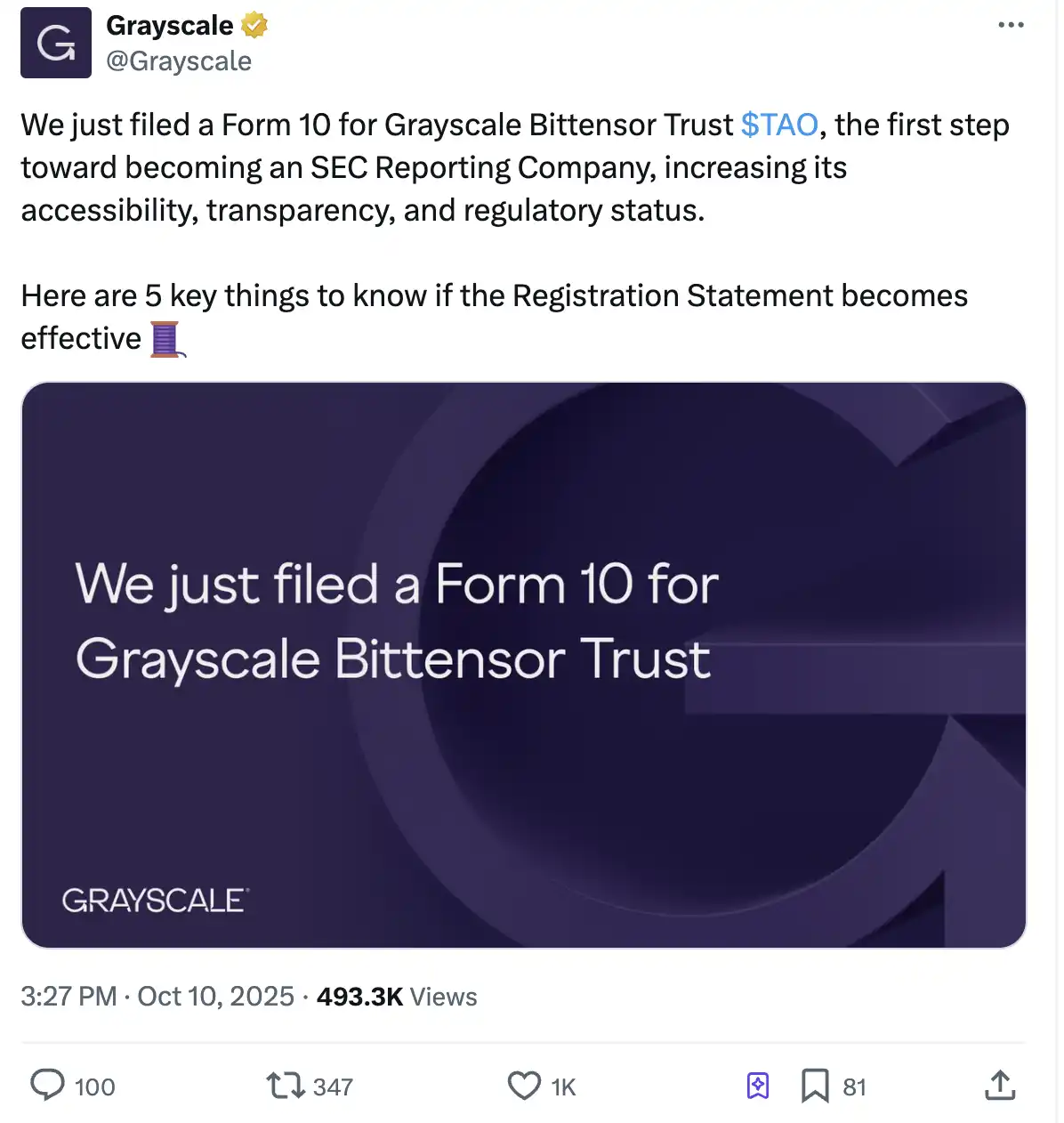
On October 10, Grayscale Investments submitted the Form 10 registration statement for Bittensor Trust (TAO) to the U.S. Securities and Exchange Commission (SEC), opening the door for this AI-centric cryptocurrency trust to move towards compliance and the public market. If approved, the private holding period for trust shares will be shortened from 12 months to 6 months, meaning early investors will gain liquidity more quickly and create conditions for institutional capital to enter.
A few days later, publicly listed company TAO Synergies Inc. (NASDAQ: TAOX) announced the completion of a $11 million private financing round, with investors including TAO strategy advisor James Altucher and Grayscale's parent company DCG. This news quickly ignited market confidence—over the past week, the price of TAO surged from $290 to $457, an increase of over 50%.

As AI becomes one of Wall Street's strongest narratives, TAO is gradually being seen as a bridge connecting regulated finance with decentralized AI networks. Market sentiment is high, trading activity is increasing, and TAO has not only become a new "AI target" in the eyes of institutions but is also expected to reach a historical high since April 2024.
What Form 10 Means
The so-called Form 10 is a registration document under Section 12(g) of the U.S. Securities Exchange Act of 1934, officially known as the General Form for Registration of Securities. When a trust or fund product submits Form 10 to the SEC and it is accepted, it means that it upgrades from a "private trust" to a "Reporting Company," which must fulfill the same information disclosure obligations as publicly listed companies—including regular submissions of 10-K (annual report), 10-Q (quarterly report), and 8-K (current report). In other words, once Form 10 becomes effective, the TAO trust will be formally included in the U.S. mainstream securities regulatory system.
Similar to Grayscale's Bitcoin Trust (GBTC) and Ethereum Trust (ETHE), the goal of the TAO trust is to land on the OTC Markets for over-the-counter trading, allowing traditional investors to directly allocate this asset through brokerage accounts. Looking back at Grayscale's path: GBTC submitted Form 10 in 2019, followed by ETHE in 2020, and both subsequently transformed into spot ETFs. TAO's current actions are following the same trajectory.
For TAO, this move has three significances:
- Shortening the liquidity cycle. The holding period is reduced from 12 months to 6 months, meaning previously locked private shares can circulate more quickly in the secondary market, releasing funds for early investors and activating trading depth.
- Opening the compliance gateway. Once the registration becomes effective, the trust can be quoted on the OTC Markets, allowing traditional brokers and family offices to invest in TAO in the form of securities without directly interacting with crypto wallets or custody services.
- Laying the foundation for ETF conversion. Grayscale has already validated the "Form 10 → ETF" path with its BTC and ETH trusts, and Form 10 is the starting point, paving the way for future applications for exchange-traded products (ETPs).
"TAO Micro Strategy" Takes Action Again
On October 14, publicly listed company TAO Synergies Inc. (NASDAQ: TAOX) announced the completion of a total of $11 million in private financing, with investors including TAO strategy advisor James Altucher and early supporter of Bittensor, Digital Currency Group (DCG).
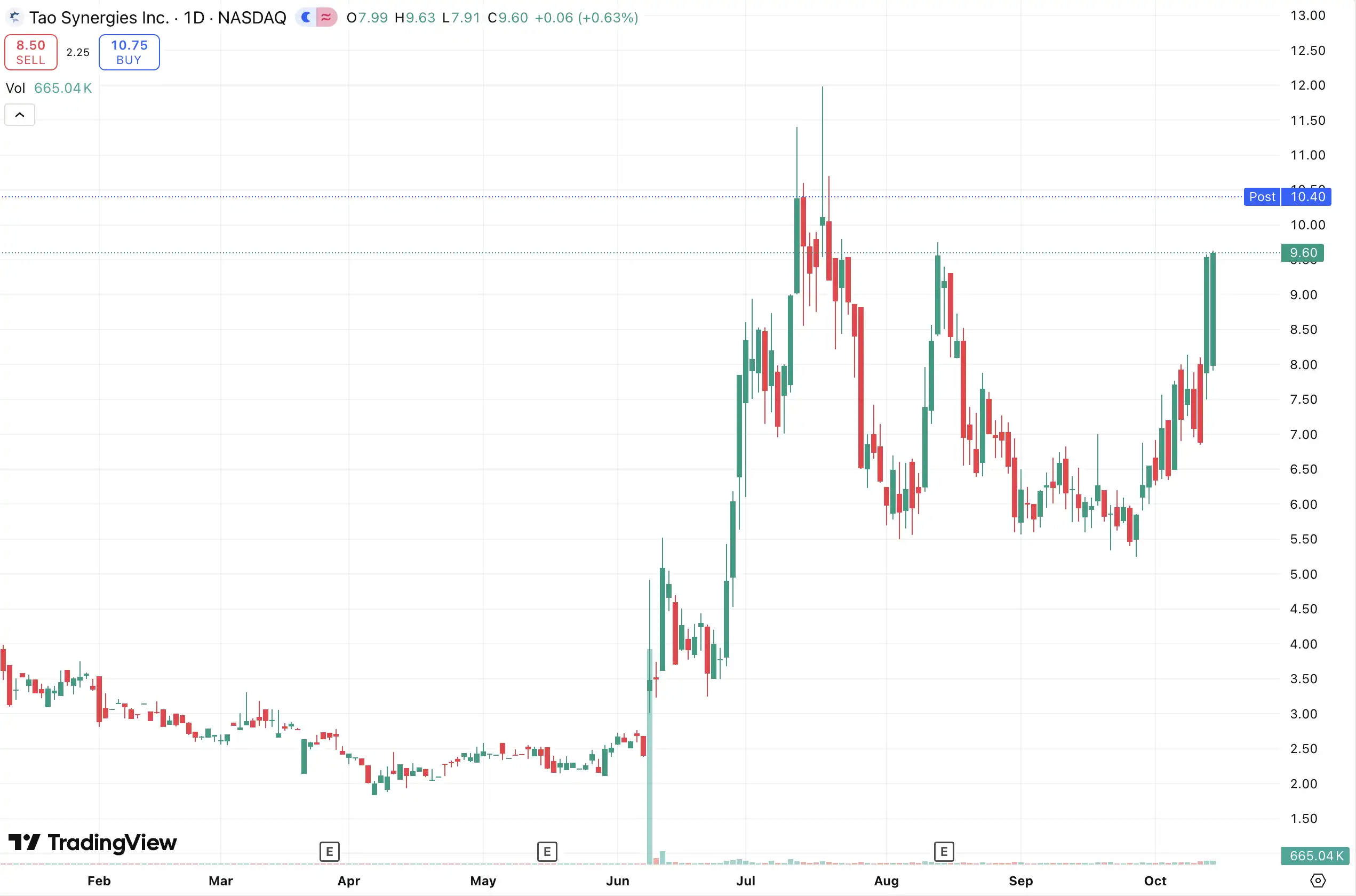
The company, formerly a biotech firm Synaptogenix, completed a strategic transformation in July this year and purchased 29,899 TAO tokens for a total value of approximately $10 million. As of now, TAOX has become the largest holder of TAO globally, with all holdings incorporated into the corporate treasury, and plans to stake the tokens on the Bittensor mainnet to participate in network computing and model training, generating long-term returns. Since the transformation in July, the company's stock price has increased more than threefold, maintaining strong performance despite a general pullback in DAT companies.
TAO strategy advisor James Altucher stated: "This financing further solidifies TAO Synergies' long-term strategy, which includes not only holding and managing TAO tokens but also creating revenue and accumulating influence within the Bittensor ecosystem. We welcome DCG's involvement—it is a leader in the crypto industry and one of the earliest supporters of Bittensor. We are confident in the future of decentralized intelligence and believe that Bittensor's network model will become a key driver of innovation and value creation in the coming years."
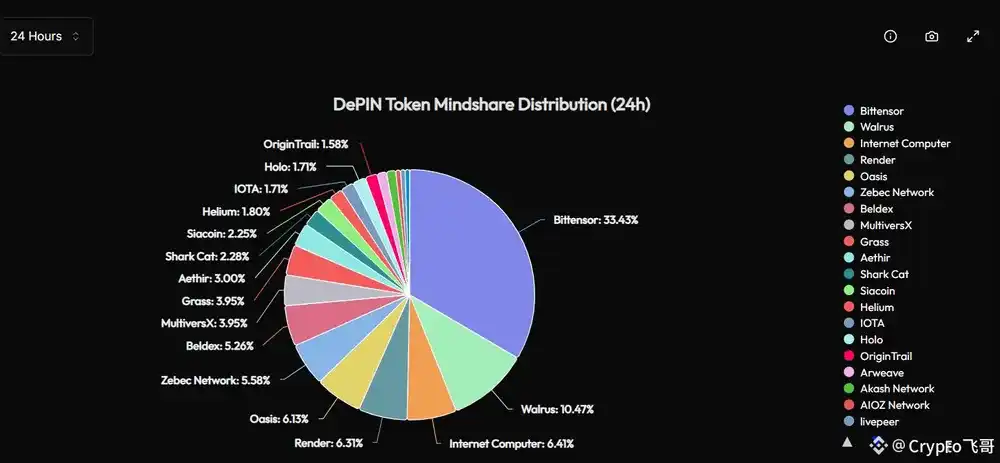
On-chain data shows that Bittensor's market share in the DePIN (Decentralized Physical Infrastructure) sector has exceeded 33%. With the accelerated layout of institutional capital, TAO is gradually transitioning from a mere "AI concept coin" to a foundational asset with real network value and cash flow models. The market generally believes that the dual actions of TAOX and Grayscale are becoming an important watershed for institutionalization in the AI sector.
Conclusion
As Wall Street's enthusiasm for the AI narrative continues to rise, from NVIDIA to OpenAI and then to Bittensor, this wave of AI is rapidly spreading to the crypto market, with TAO becoming a core beneficiary. With the restructuring of dTAO's incentive mechanism and the approaching first halving, TAO is expected to challenge the historical high of $1247 again. After a golden decade for Bitcoin, the AI narrative may become the next capital consensus, and TAO stands at the starting point of this new era.
 Risk warning Risk warning

Popular articles