Just now, the leading US stock registration company was offered $4.2 billion by a cryptocurrency exchange!
 Core Viewpoint

 A few years ago, we were still discussing whether "cryptocurrency can replace traditional finance," but these transactions in 2026 tell us that the real story is that whoever holds the license, whoever has the customers, can define the next capital market.
Author: Chloe, ChainCatcher
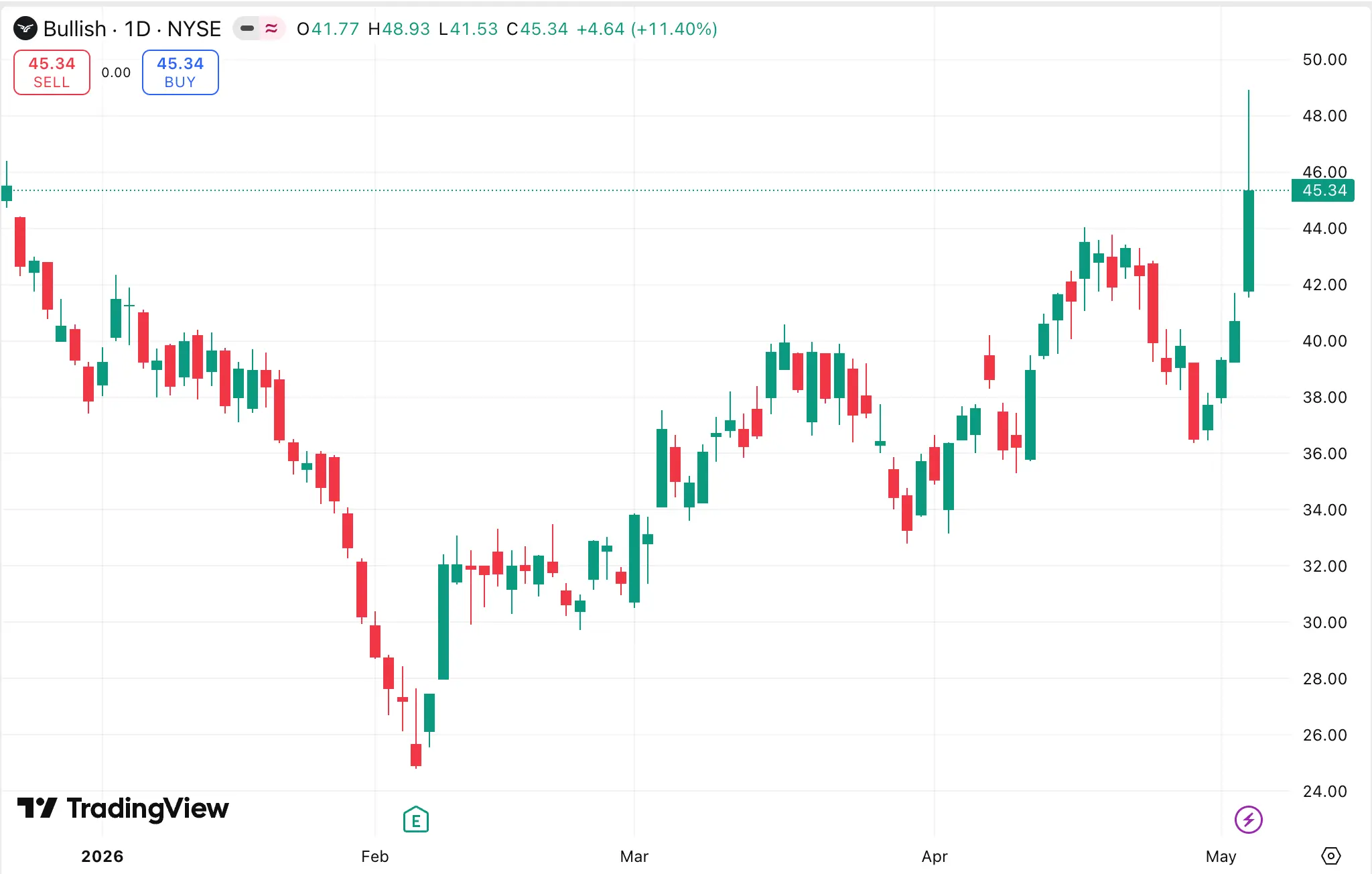
On May 5, 2026, the cryptocurrency trading platform Bullish (NYSE: BLSH) announced that it would acquire a company known on Wall Street as the "back-end nervous system" of the entire U.S. stock market, Equiniti, for $4.2 billion from private equity firm Siris Capital. Following the news, Bullish's stock price surged, rising by about 20% at one point.
Bullish's acquisition of Equiniti aims to leverage its role as a transfer agent to penetrate the competition between traditional exchanges and cryptocurrency platforms. Now, as the oldest infrastructure on Wall Street begins to be acquired by cryptocurrency exchanges, what exactly is this arms race competing for? Who will be the winner?
The Tokenization Race on Wall Street Enters a Heated Stage
Equiniti serves nearly 3,000 publicly traded companies globally, managing records for 20 million shareholders and handling $500 billion in dividends and payments each year, making it a well-known "transfer agent" on Wall Street. The shareholder registry for the renowned Berkshire Hathaway is maintained by it, and dividends for Rolls-Royce are paid by it; Equiniti is one of the choices for many traditional enterprises.
When a cryptocurrency exchange is willing to spend $4.2 billion (including $1.85 billion in debt and about $2.35 billion in Bullish stock) to acquire such a financial infrastructure company, it represents more than just a simple merger and acquisition story. This is a key signal that the tokenization race on Wall Street has entered a heated stage.
Why Acquire Equiniti? Is the Transfer Agent the "Last Piece of the Puzzle" for Tokenization?
To understand the strategic significance of this transaction, one must first grasp a concept: the real bottleneck of tokenized securities is not at the issuance end but at the registration end.
In traditional capital markets, when a company issues stock, it is not the exchange or the broker that truly records "who owns how many shares," but the transfer agent. It is responsible for:
Maintaining the shareholder registry (who the shareholders are and how many shares they hold)
Handling dividend and interest payments
Managing corporate actions such as stock splits, stock buybacks, and mergers
Completing the legal registration of ownership when stocks change hands
In other words, the transfer agent is the legal "system of record" for shareholders of a publicly traded company. In most major markets, this role is mandatory for publicly traded companies.
Why is This a Competitive Key in the Tokenization Space?
In recent years, there have been many attempts at "tokenized stocks" in the market. Carlos Domingo, CEO of Securitize, once pointed out the problem in a single sentence: most of the so-called tokenized stocks are actually just derivatives or price tracking tools, not genuinely issued native equity on the blockchain.
True "on-chain native securities" require a regulated transfer agent with legal standing that can update the shareholder registry in real-time on the blockchain, handle compliance restrictions, and execute dividend distributions.
Bullish CEO Tom Farley (former NYSE president) mentioned in the transaction statement that tokenization is the most important infrastructure transformation in capital markets over the next 25 years, and to implement it at an institutional scale, three conditions must be met, including end-to-end tokenization services, a unified ledger, and large-scale issuer relationships. Acquiring Equiniti gives Bullish a stronger foothold on Wall Street.
The merged company is expected to generate approximately $1.3 billion in adjusted revenue and over $500 million in adjusted EBITDA (excluding capital expenditures) in 2026. Notably, the company anticipates an overall revenue growth rate of 6% to 8% from 2027 to 2029, while the growth rate for tokenization and blockchain business itself could reach as high as 20%.
This means that Bullish is betting not on how much profit Equiniti's existing traditional business will generate, but rather viewing this infrastructure, which has accumulated 30 years of customer relationships and regulatory licenses, as a "springboard" to penetrate the $70 trillion U.S. stock market.
The timing of this transaction is extremely precise. Looking back at the first four months of 2026, the timeline for tokenization has advanced almost weekly:
January 19: NYSE parent company ICE announces the development of a tokenized trading platform.
The parent company of NYSE, Intercontinental Exchange (ICE), announced that it will develop a brand new tokenized securities trading and on-chain settlement platform:
24/7 trading: breaking the time constraints of U.S. stock trading from 9:30 AM to 4:00 PM
Real-time on-chain settlement: replacing the current T+1 settlement
Ordering in dollar amounts: supporting fractional share trading
Stablecoins as a funding source: allowing crypto funds to directly enter the stock market
This platform will combine NYSE's existing Pillar matching engine with a blockchain back-end settlement system and support multiple chains for settlement and custody.
March 18: SEC approves Nasdaq's tokenized stock pilot.
The U.S. Securities and Exchange Commission (SEC) approved Nasdaq's proposal submitted in September 2025 in Release No. 34-105047. After approval, eligible Nasdaq market participants can choose to settle Russell 1000 component stocks in tokenized form or traditional form, as well as ETFs tracking the S&P 500 and Nasdaq 100.
Notably, Nasdaq's strategy differs from that of NYSE. Nasdaq integrates tokenization into the existing exchange, allowing traders to choose between traditional equity or tokenized form on the back end; NYSE, on the other hand, is starting from scratch to establish an independent digital trading platform, even bypassing DTCC to settle directly on the blockchain.
March 24: NYSE signs MOU with Securitize to co-develop tokenization infrastructure.
Less than a week after the SEC approved Nasdaq's proposal, NYSE immediately announced it had signed a memorandum of understanding with Securitize, which is invested in by BlackRock and Ark Invest, to collaborate on developing the infrastructure for a digital trading platform.
Securitize is an SEC-registered transfer agent and will be one of the first companies eligible to mint tokenized stocks and ETFs on this platform. This collaboration also includes designing a "Digital Transfer Agent Program" to set standards for other transfer agents entering the tokenization market.
May 5: Bullish offers $4.2 billion to acquire Equiniti.
When looking at this timeline side by side, one can find something particularly interesting: Bullish is acquiring not just a transfer agent but is also positioning itself to seize a "cross-platform, neutral infrastructure" before the competition between NYSE and Nasdaq further unfolds.
Equiniti serves 3,000 issuers and has business dealings with NYSE, Nasdaq, the London Stock Exchange, and the Hong Kong Stock Exchange. Acquiring it means holding both NYSE and Nasdaq's client lists and regulatory compliance licenses.
This is Not "Crypto vs. Wall Street," but the Convergence of Both
A few years ago, we were still discussing whether "crypto can replace traditional finance," but the transactions in 2026 tell us that the real story is: the infrastructure of traditional finance is being renovated onto the blockchain track. In this process, those who hold licenses and customers will define the capital markets of the next 25 years.
Bullish's acquisition of Equiniti essentially ties together the "20th-century shareholder registry" with "21st-century smart contracts." Once this bridge is built, institutional investors can trade Apple stocks on weekends, retail investors can purchase fractional ETFs with USDC, publicly traded companies can see real-time changes in their shareholder structures, and cross-border equity trading can be shortened from T+2 to just a few seconds.
NYSE plans to launch in the second half of 2026, Nasdaq's pilot has been approved, and Bullish-Equiniti is expected to complete its delivery in early 2027. The next 18 months will be a critical window to judge whether this tokenization revolution is "real or hype." For investors, four things are worth closely tracking: first, the SEC's approval progress for the NYSE digital trading platform; second, the integration execution of Bullish-Equiniti, especially the acceptance of tokenization services by Equiniti's existing clients; third, the next steps of cryptocurrency exchanges like Coinbase and Kraken in "institutionalization" and "compliance"; and finally, whether Securitize and Equiniti will move towards cooperation or competition.
$4.2 billion is a significant bet for Bullish. But for Wall Street, this is just the prologue to the tokenization story.

 Risk warning