When the market is full of complaints about CZ, people begin to miss SBF
 Core Viewpoint

 FTX is not a scam, but a preventable tragedy exacerbated by systemic greed.
Written by: @amuse
Compiled by: AididiaoJP, Foresight News
The story of SBF did not end with his sentencing in court, but continues in spreadsheets, balance sheets, and forgotten ledgers.
The story told by these documents is starkly different from the version heard by the public.
Through the slow and monitored mail system of the prison, relayed by friends, I have maintained communication with SBF. In his letters, he appears calm, analytical, and reflective. He reads a lot of science fiction, immersing himself in fictional worlds, perhaps because in the real world, the company he built has been dismantled by lawyers who understand neither cryptocurrency nor the essence of business. He has lost weight and become quieter.
What he has to say now is worth listening to, as the official narrative surrounding the collapse of FTX may be one of the most serious distortions of financial truth in recent years.
According to data provided by SBF, FTX was never in a state of insolvency. This was true both when he relinquished control under pressure from lawyers and regulators in November 2022, and when the market hit rock bottom. According to his calculations, at the moment of filing for bankruptcy, FTX had $15 billion in assets and only $8.4 billion in liabilities. He believes this significant difference should have served as a cushion to protect customers and creditors.
However, bankruptcy lawyers declared the company "hopelessly bankrupt" and sold off assets at fire-sale prices. Now, every creditor has been fully repaid and even received additional benefits, but the billions that could have been recovered were wasted on high legal fees, legal disputes, and decisions made by those who "had no idea what they were doing."
The mainstream narrative paints FTX as a house of cards, a crazy enterprise run by a founder who behaved erratically, commingled funds, and defrauded investors. But the deeper truth is much more complex.
FTX's operating model was similar to many rapidly growing tech startups: iterating quickly and experimenting in a field where the law had not yet caught up. SBF now admits the irony that the company's real Achilles' heel was not fraud, but compliance. They spent too much energy trying to satisfy regulators who only knew how to punish and not guide.
"Our developers spent half their time dealing with the cumbersome requirements of regulators," he told me, "We didn't focus on building risk control systems and safety measures, but on creating reports that no one read and presentations that no one believed." He believes this diversion of energy was fatal. When market panic struck, FTX's internal systems were overwhelmed by bureaucratic burdens, the leadership was exhausted, and the founder was drowned in conflicting legal advice.
When the crisis hit, SBF did what most people would do under pressure: seek expert help. The problem was that these experts' interests did not align with his intention to protect customers. Their motivation was to push through the bankruptcy process, take control, and then bill by the hour. "They exerted tremendous pressure," he said, "the promises made were quickly denied." Looking back, he considers it his biggest mistake: choosing to yield rather than stand firm.
"FTX was clearly solvent, with ample funds," he told me, "but customers had the right to claim, and everyone told me that relinquishing control was in the best interest of the customers. What was the result? It only helped the lawyers."
This involves a moral distinction that is rarely discussed in public. SBF emphasizes that taking responsibility does not equate to admitting guilt. Responsibility means choosing to be the protagonist of the event rather than a passive participant, facing one's role in the unfolding of events. In this spirit, he does not deny his judgment errors. He deeply regrets: giving up control when leadership was most needed; failing to effectively monitor Alameda's risk exposure; focusing too much on regulatory games while neglecting operational management. But he also refuses to accept the label of "villain who stole billions." He believes his true failure lies in leadership, not theft.
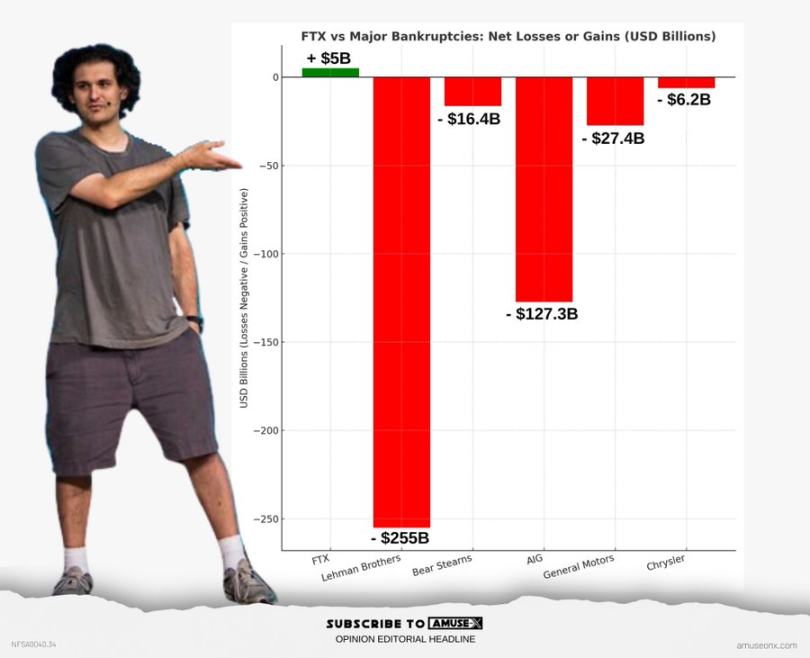
Lehman Brothers, Bear Stearns, AIG, General Motors, Chrysler—none of the executives from these companies went to prison.
If this sounds like a rewriting of history, consider the facts: thanks to asset appreciation, the bankrupt estate has paid creditors billions of dollars more than their original claims. This means every customer, every creditor has been able to recover all their funds, and no one has truly lost money. The victims of those large companies did not receive such treatment. Yet while the executives of those firms remain free despite their tarnished reputations, SBF faces years in prison, even though the data shows that the company he led merely encountered a liquidity crisis exacerbated by panic and poor advice.
The real winners are those who took over after his departure: lawyers, consultants, and experts, who collected over a billion dollars in fees for dismantling a company that could have survived.
The contrast could not be clearer: had FTX been allowed to recover naturally, it could have become one of the most remarkable comeback stories in financial history. Instead, it became a feast for professional service firms, which profited handsomely from handling a "failure." Lawyers hastily sold off assets at market lows, missing out on the subsequent strong rebound in the cryptocurrency market, which could have multiplied the recovery value of the assets. Sam estimates that if managed properly, the bankrupt estate could have generated an additional $125 billion in value. However, the actual outcome was that they sold at the bottom, boasting of the solvency that already existed, and paid their hefty bills with funds that should have been protected for stakeholders.
This absurd inversion of cause and effect is at the heart of the entire tragedy. The founder who created one of the most sophisticated exchanges in history is imprisoned, while those who dismantled it are reaping profits. Even now, Sam's reflections carry an attitude of trying to understand: why did a system established to maintain order ultimately consume such enormous value?
"When you are convicted in the court of public opinion," he wrote, "taking any responsibility is seen as an admission of all guilt." His frustration is palpable, but there is no self-pity in his letters, only the curiosity of a soul still trying to unravel the puzzle of his downfall.
In another parallel world, SBF might have become a reformer reshaping finance through a combination of transparency and technology. FTX's clearing engine, the system that automatically managed margins and risks, was revolutionary by industry standards. Traditional financial institutions are now adopting similar systems, but it was this powerful innovation that made FTX a target.
SBF points out that the regulatory agencies under the Biden administration "mostly did not protect customers; they assigned contradictory and cumbersome tasks to businesses and then prosecuted those they disliked." Under Gary Gensler's leadership, the SEC rejected every compliance framework proposed by FTX, often with the chairman personally vetoing them. This opposition created a perfect storm: political hostility, legal chaos, and media hysteria, all converging on a young founder.
It is easy to view this as a moral fable about arrogance. But it can also be a story about how systems devour innovation for their own benefit. Those who claim to uphold the public interest often behave like predators when opportunities arise.
The collapse of FTX has created an ecosystem of lawyers, bureaucrats, and consultants, while burying a company that could have survived under capable leadership. If there is a lesson to be learned, it is this: power abhors a vacuum, and when founders yield, the void is often filled not by virtue, but by vultures.
SBF is not seeking sympathy. He knows his name has become synonymous with "excess" and "recklessness." But the numbers do not lie: every creditor has been repaid; every investor has recovered their funds; the so-called "victims" are unscathed, while the so-called "villain" is behind bars. If justice is about compensation, then in this case, justice has been served, except for the one still locked behind iron bars.
His parting words to me were very restrained: "When almost no one advocates for you, you must stand up for yourself within the bounds of what you deserve." This statement reflects both his stubbornness and his humility. He does not deny his role in creating the chaos, but he refuses to let others distort the data. He believes that the fall of FTX was not an inevitable outcome of greed, but an avoidable consequence of giving up resistance.
In this sense, his story is not just about cryptocurrency or finance, but a larger American tragedy. Talent is destroyed by bureaucratic systems, and courage is misplaced in those who mistake control for capability.
If history is just enough, it will eventually record: FTX was not a scam, but a judgment error exacerbated by systemic arrogance. SBF's greatest crime may not be his actions, but his failure to persist in resistance.
The bankruptcy lawyers won.
Creditors received full repayment.
And the person who could have made them even wealthier is now reading science fiction, waiting for the day the world recognizes the truth.
 Risk warning Risk warning