a16z Annual Report: The Current State, Challenges, and Future of Cryptocurrency in 2025
 Core Viewpoint

 Cryptocurrency is "growing up" and entering a mature phase.
Authors: Daren Matsuoka, Robert Hackett, Jeremy Zhang, Stephanie Zinn, Eddy Lazzarin
Translators: zkBernard, ChainCatcher
This year, the world began to go on-chain.
When we published the first State of Crypto Report, the industry was still in its "teenage years." At that time, the total market capitalization of the cryptocurrency market was about half of what it is today, with slower blockchain speeds, higher costs, and lower reliability.
Over the past three years, cryptocurrency builders have experienced severe market downturns and political uncertainty—but they continue to make significant infrastructure improvements and other technological breakthroughs. These efforts have brought us to today, a moment when cryptocurrency is becoming an important part of the modern economy.
The story of cryptocurrency in 2025 is a story of industry maturation. In short, cryptocurrency has grown up:
- Traditional financial giants like Visa, BlackRock, Fidelity, and JPMorgan Chase—and tech-native challengers like PayPal, Stripe, and Robinhood—are offering or launching cryptocurrency products.
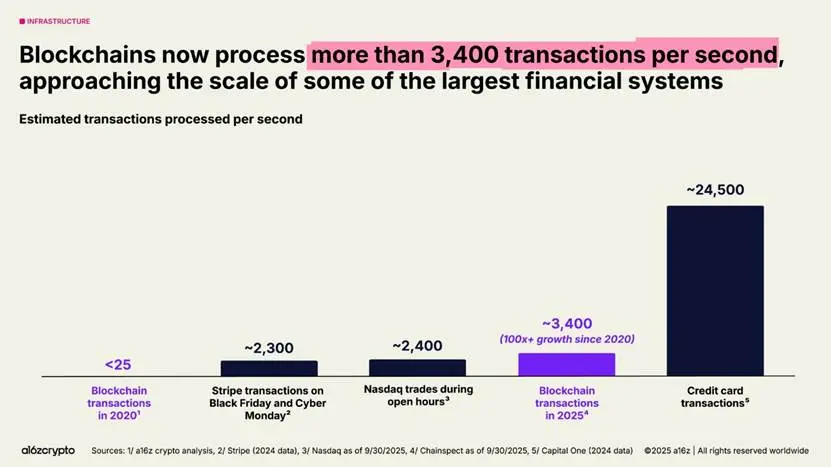
- Blockchains now process over 3,400 transactions per second (a more than 100-fold increase over the past five years).
- Stablecoins support an annual transaction volume of $46 trillion (adjusted to $9 trillion), comparable to Visa and PayPal.
- Over $175 billion has been invested in Bitcoin and Ethereum exchange-traded products.
Our latest State of Crypto Report delves into this transformation of the industry, from institutional adoption and the rise of stablecoins to the integration of cryptocurrency and AI. Additionally, we introduce a new way to explore data and track industry evolution for the first time—by measuring key metrics: the State of Crypto Dashboard.
Now, let’s look at the research findings…
Key Takeaways
- The cryptocurrency market is large, global, and continuously growing.
- Financial institutions are fully embracing cryptocurrency.
- Stablecoins are entering the mainstream.
- Cryptocurrency is stronger in the U.S. than ever before.
- The world is going on-chain.
- Blockchain infrastructure is (almost) ready for a golden age.
- Cryptocurrency and AI are merging.
The Cryptocurrency Market is Large, Global, and Continuously Growing
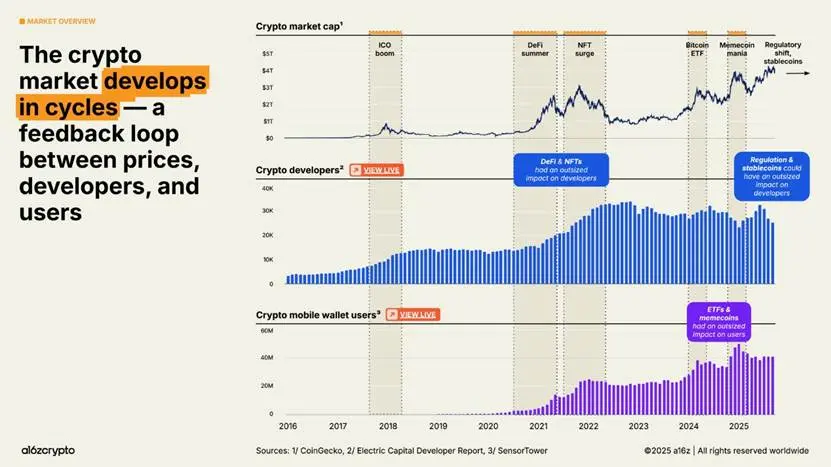
In 2025, the total market capitalization of cryptocurrency surpassed $4 trillion for the first time, marking significant progress for the entire industry. The number of cryptocurrency mobile wallet users also reached an all-time high, growing by 20% year-over-year.
The regulatory environment has shifted from hostile to more supportive, coupled with the accelerating adoption of these technologies—from stablecoins to the tokenization of traditional financial assets and other emerging use cases—that will define the next cycle.
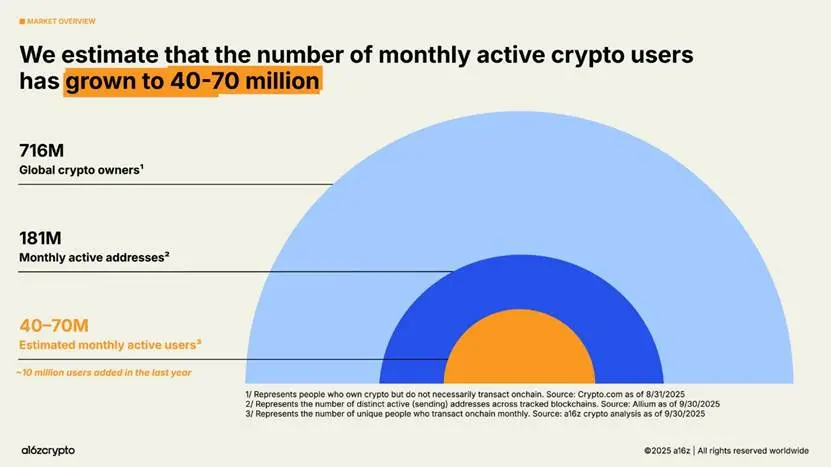
According to our updated methodology analysis, it is estimated that there are currently about 40 million to 70 million active cryptocurrency users, an increase of about 10 million from last year.
This is just a small portion of the 716 million people estimated to own cryptocurrency, a number that has grown by 16% year-over-year. It is also just a small fraction of the approximately 181 million monthly active addresses on-chain, which has decreased by 18% year-over-year.
The gap between passive cryptocurrency holders (those who own cryptocurrency but do not engage in on-chain transactions) and active users (those who regularly engage in on-chain transactions) presents an opportunity for cryptocurrency builders to reach more potential users who already own cryptocurrency.
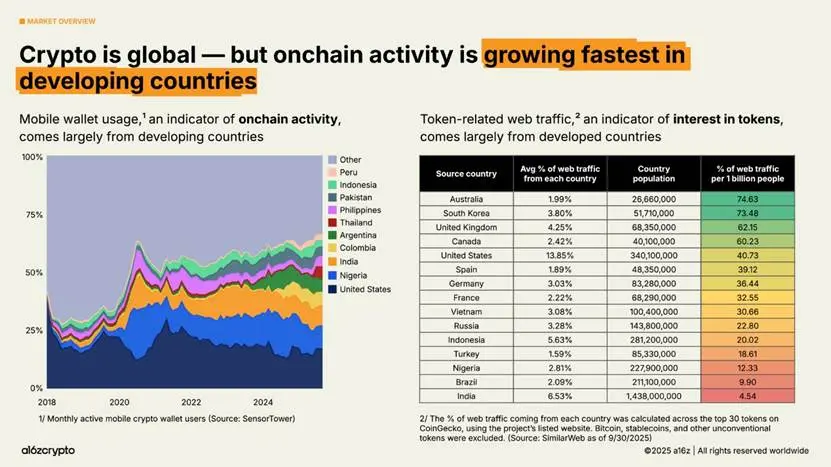
So where are these cryptocurrency users? What are they doing?
Cryptocurrency is global, but it seems to be used differently around the world. The usage of mobile wallets as an indicator of on-chain activity is growing fastest in emerging markets like Argentina, Colombia, India, and Nigeria. (Notably, in Argentina, the usage of cryptocurrency mobile wallets has increased 16-fold over the past three years amid a worsening currency crisis.)
Meanwhile, according to our analysis of the geographical sources of token-related network traffic, indicators of interest in tokens tend to lean towards developed countries. The activity in these countries—especially Australia and South Korea—may be more focused on trading and speculation, rather than the user behavior seen in developing countries.
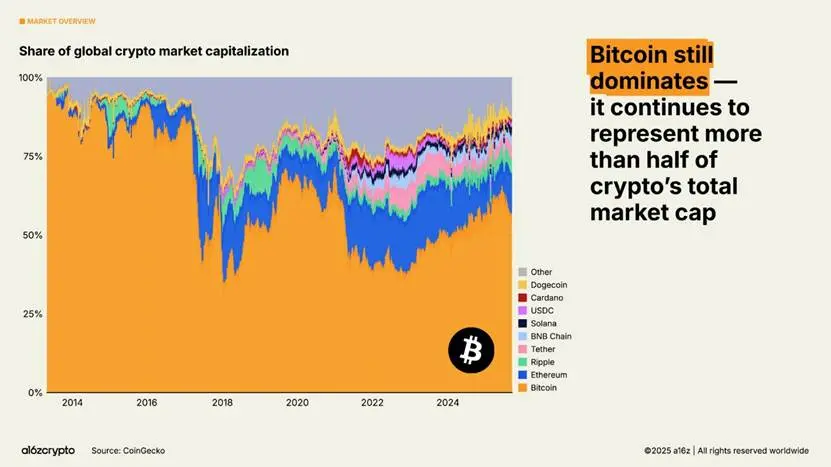
Bitcoin still accounts for more than half of the total market capitalization of cryptocurrency, with its price reaching an all-time high of over $126,000, as it becomes increasingly popular among investors as a store of value. Meanwhile, Ethereum and Solana have recovered much of their losses since the downturn in 2022.
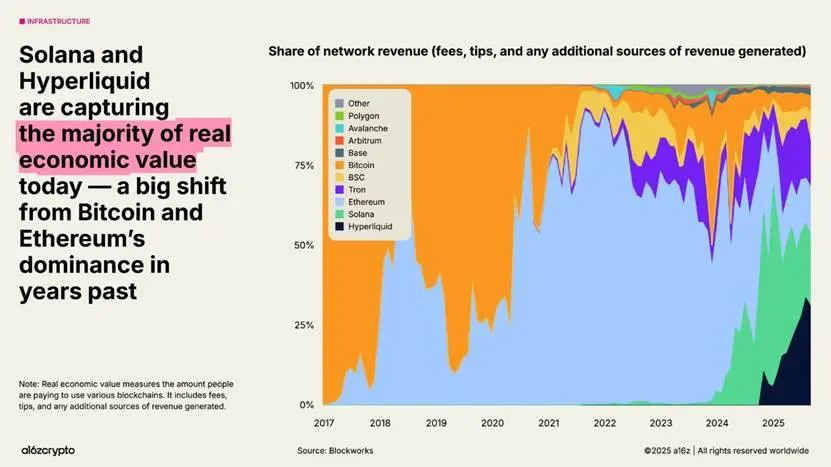
As blockchains continue to expand, the fee market matures, and new applications emerge, certain metrics become more important; one of them is "real economic value"—measuring how much people are actually paying to use the blockchain. Hyperliquid and Solana currently account for 53% of revenue-generating economic activity, which is a significant shift from the previous dominance of Bitcoin and Ethereum in prior years.
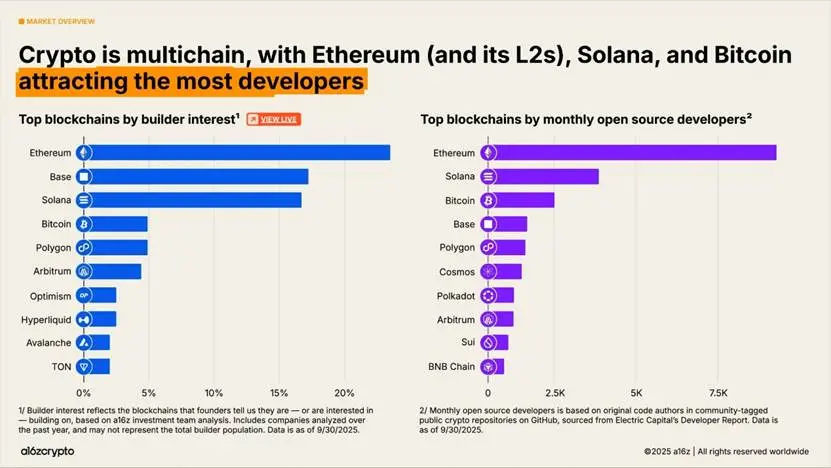
In terms of builders, cryptocurrency remains multichain, with Bitcoin, Ethereum (and its Layer 2s), and Solana attracting the most developers. Ethereum and its Layer 2s are the preferred destinations for new developers in 2025. Meanwhile, Solana is one of the fastest-growing ecosystems, with builder interest increasing by 78% over the past two years. The following chart reflects the number of ecosystems that founders have told us they are building or are interested in building—based on analysis from the a16z crypto investment team. (You can take a closer look at these and other trends in our State of Crypto Dashboard.)
Financial Institutions are Fully Embracing Cryptocurrency
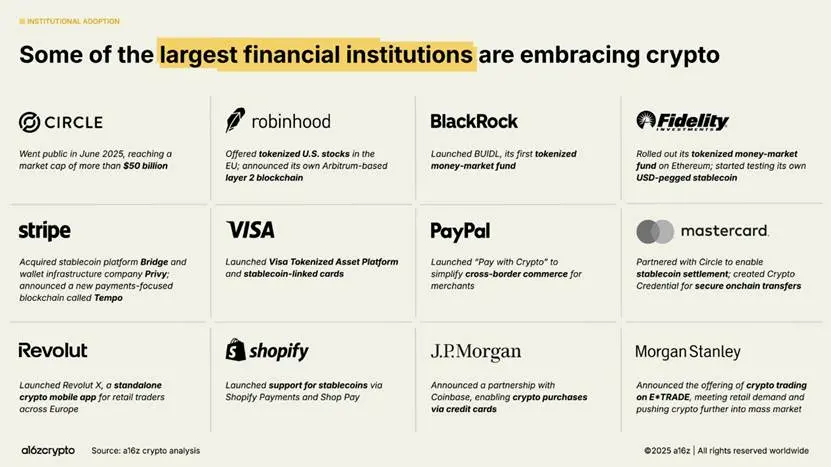
2025 is the year of institutional adoption. Just five days after last year's State of Crypto Report pointed out that stablecoins had found product-market fit, Stripe announced its intention to acquire the stablecoin infrastructure platform Bridge. The race has begun: traditional financial companies are also preparing to publicly enter the stablecoin space.
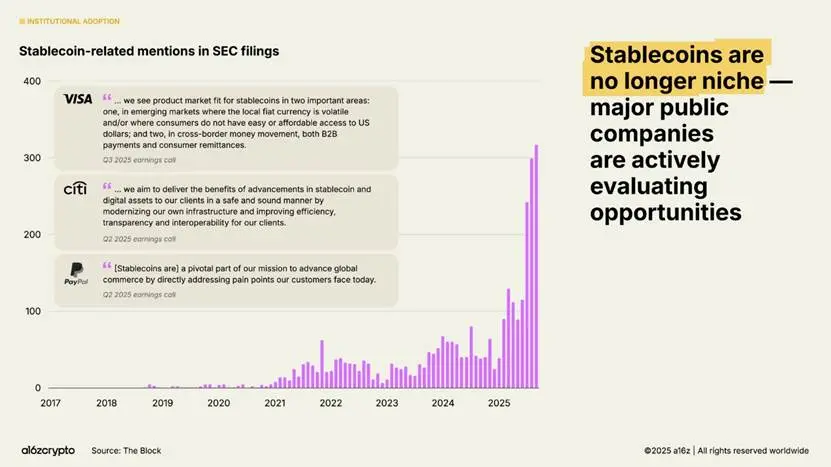
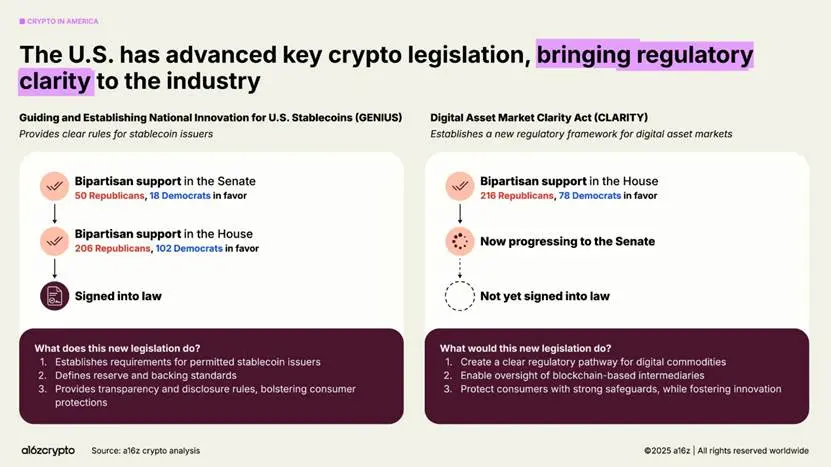
Months later, Circle's multi-billion dollar IPO marked the arrival of stablecoin issuers as mainstream financial institutions. In July, the bipartisan GENIUS Act was signed into law, providing the clarity that builders and institutions need to move forward. In the following months, mentions of stablecoins in SEC filings increased by 64%, as major financial institutions continued to release a series of announcements.
Institutional adoption is rapidly increasing. Traditional institutions—including Citigroup, Fidelity, JPMorgan, Mastercard, Morgan Stanley, and Visa—are now (or planning to) offer cryptocurrency products directly to consumers, allowing them to buy, sell, and hold digital assets, as well as stocks, exchange-traded products, and other traditional tools. Meanwhile, platforms like PayPal and Shopify are doubling down on payments and building infrastructure for everyday transactions between merchants and customers.
In addition to direct products, major fintech companies—including Circle, Robinhood, and Stripe—are actively developing or have announced plans to develop new blockchains focused on payments, real-world assets, and stablecoins. These initiatives could bring more payment flow on-chain, encourage enterprise adoption, and ultimately create a larger, faster, and more global financial system.
These companies have vast distribution networks. If development continues, cryptocurrency could become deeply integrated into the financial services we use daily.
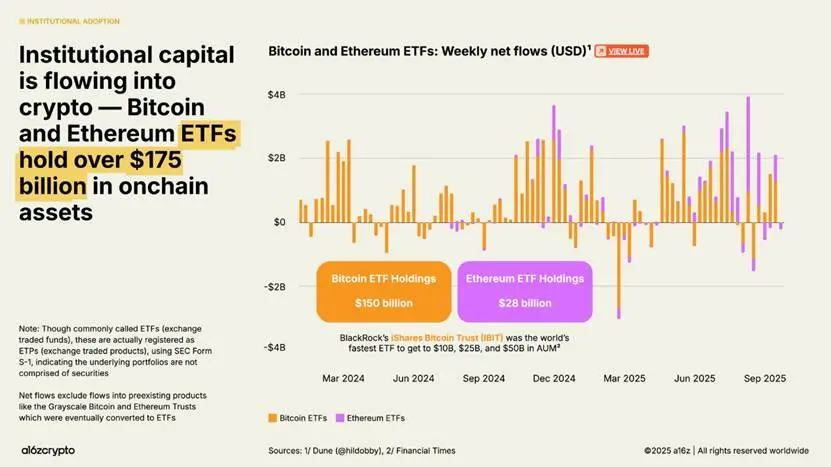
Exchange-traded products are another key driver of institutional investment, with on-chain cryptocurrency holdings now exceeding $175 billion, a 169% increase from $65 billion a year ago.
BlackRock's iShares Bitcoin Trust (IBIT) is considered the largest Bitcoin exchange-traded product issuance by trading volume in history, and subsequent Ethereum exchange-traded products have also seen significant inflows in recent months. (Note: While typically referred to as exchange-traded funds or ETFs, these are actually registered as ETPs or exchange-traded products, using the SEC's S-1 form, indicating that the underlying portfolio does not contain securities.)
These products make cryptocurrency more accessible, unleashing a significant amount of institutional capital that has historically been on the fringes of the industry.
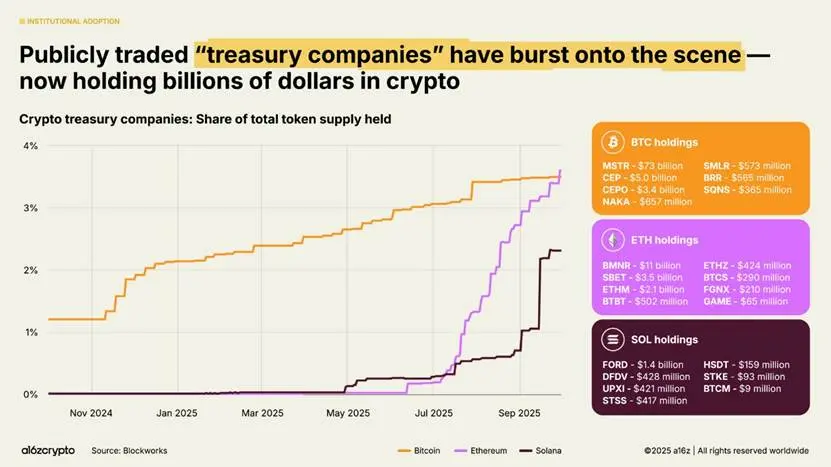
Publicly traded "Digital Asset Treasury" (DAT) companies—entities that hold cryptocurrency on their balance sheets, just as corporate treasuries hold cash—now collectively hold about 4% of the circulating supply of Bitcoin and Ethereum. These DATs, along with exchange-traded products, now hold about 10% of the supply of Bitcoin and Ethereum tokens.
Stablecoins are Entering the Mainstream
In 2025, nothing marks the maturation of cryptocurrency more than the rise of stablecoins. In recent years, stablecoins were primarily used for settling speculative cryptocurrency trades; however, they have now become the fastest, cheapest, and most global way to send dollars—reaching almost anywhere in the world in less than a second and costing less than a cent.
This year, they have become the backbone of the on-chain economy.
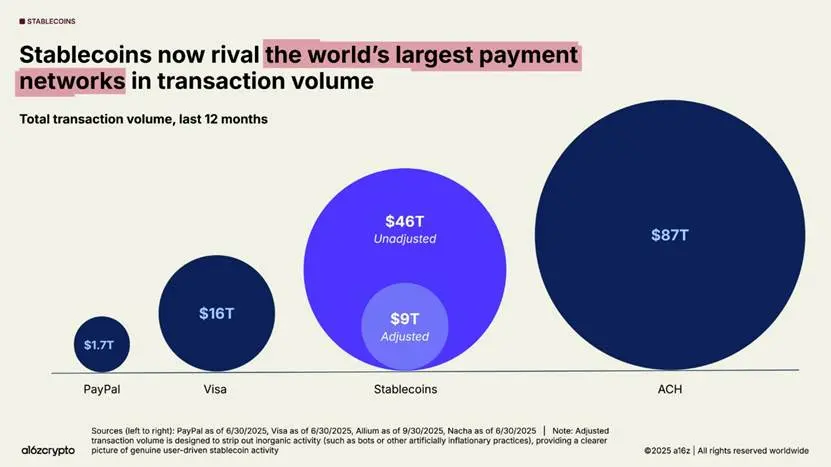
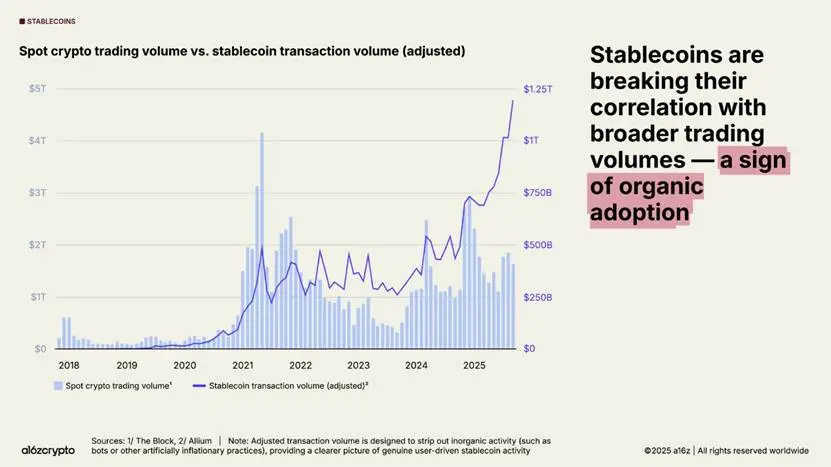
The total transaction volume of stablecoins reached $46 trillion over the past year, a year-over-year increase of 106%. While this is not a completely equivalent comparison, as this figure primarily represents financial flows (rather than retail payments on card networks), it is nearly three times that of Visa and approaches the level of the ACH network of the entire U.S. banking system.
On an adjusted basis— a better organic activity measure that attempts to filter out bot and other artificially inflated activity—stablecoins completed $9 trillion in transactions over the past 12 months, a year-over-year increase of 87%. This is more than five times PayPal's throughput and over half of Visa's.
Adoption is accelerating. Monthly adjusted stablecoin transaction volumes have surged to an all-time high, approaching $1.25 trillion in September 2025 alone.
Notably, this activity is largely uncorrelated with broader cryptocurrency transaction volumes—indicating the non-speculative use of stablecoins and, more importantly, their product-market fit.
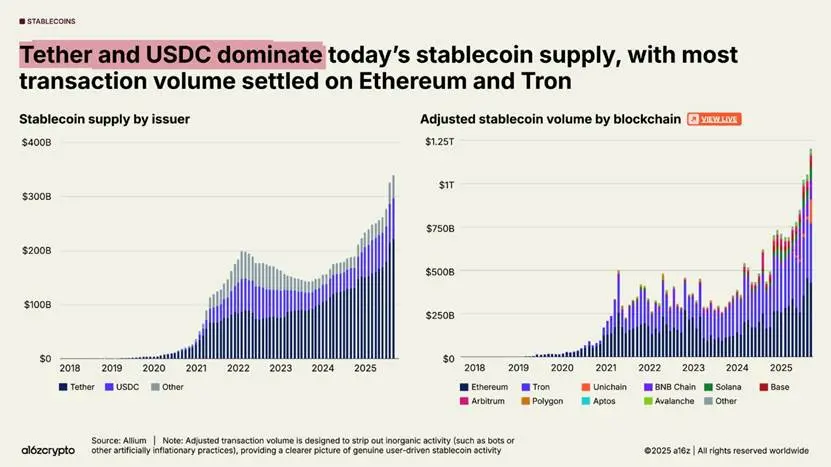
The total supply of stablecoins has also reached a record high, now exceeding $300 billion.
The largest stablecoins dominate the market: Tether and USDC account for 87% of the total supply. In September 2025, $772 billion in stablecoin transactions were settled on the Ethereum and Tron blockchains (adjusted), accounting for 64% of all transaction volume. While these two issuers and chains hold the majority of stablecoin activity, growth is also accelerating among new chains and issuers.
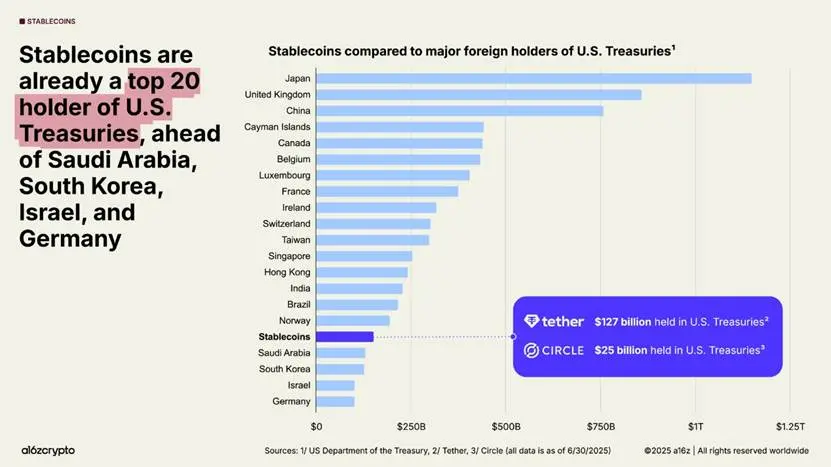
Stablecoins are now a global macroeconomic force: over 1% of dollars now exist in tokenized stablecoin form on public blockchains, and stablecoins are now the 17th largest holder of U.S. Treasury securities, up from 20th place last year. Overall, stablecoins hold over $150 billion in U.S. Treasuries—more than many sovereign nations.
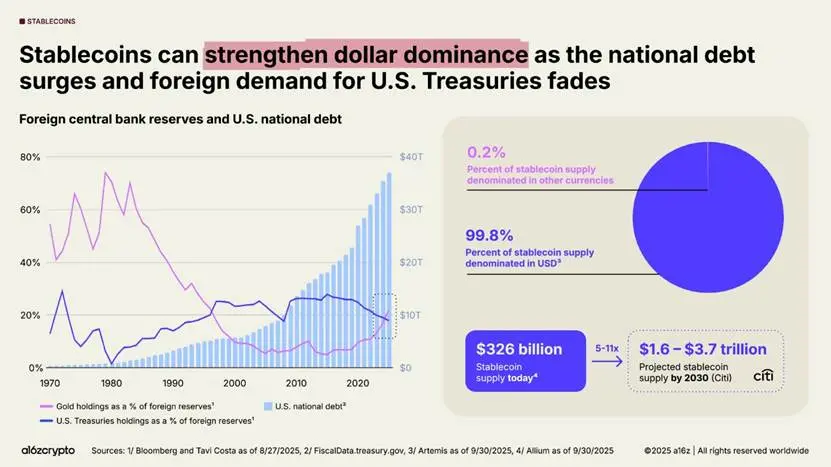
Meanwhile, U.S. Treasuries are surging, even as global demand for that debt is weakening. For the first time in 30 years, foreign central banks hold more gold reserves than U.S. Treasuries.
But stablecoins are going against the trend: over 99% of stablecoins are dollar-denominated, and they are expected to grow tenfold to over $3 trillion by 2030, providing a potential strong and sustainable source of demand for U.S. debt in the coming years.
Even as foreign central banks reduce their holdings of U.S. Treasuries, stablecoins are reinforcing the dollar's dominance.
Cryptocurrency is Stronger in the U.S. Than Ever Before
The U.S. has reversed its previous hostile stance toward cryptocurrency, restoring builders' confidence.
The GENIUS Act passed this year and the CLARITY Act approved by the House mark a bipartisan consensus that cryptocurrency will not only continue to exist but is poised to thrive in the U.S. These bills collectively establish a framework for stablecoins, market structure, and digital asset regulation, balancing innovation with investor protection. This legislation is complemented by Executive Order 14178, which overturned earlier anti-crypto directives and created a cross-agency working group to modernize federal digital asset policy.
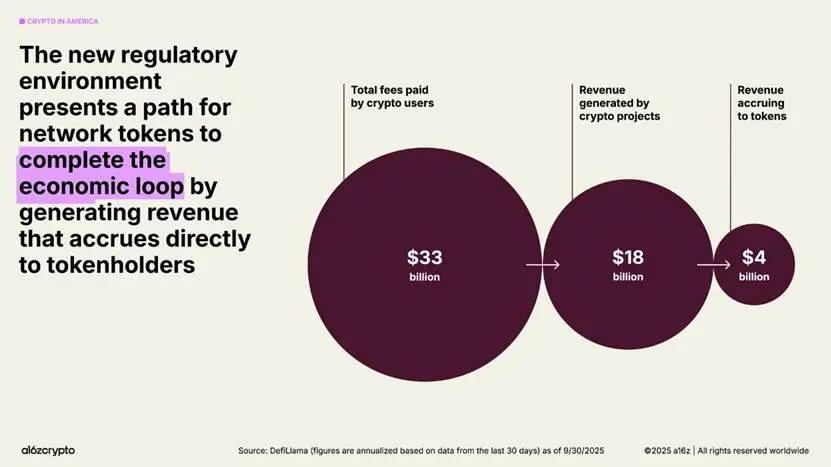
The regulatory environment is paving the way for builders to realize the potential of tokens as new digital primitives, similar to the role of websites in earlier generations of the internet. As regulatory clarity improves, more network tokens will be able to complete their economic cycles by generating revenue attributable to token holders—creating a new economic engine for the internet that is self-sustaining and empowers more users with rights in the system.
The World is Going On-Chain
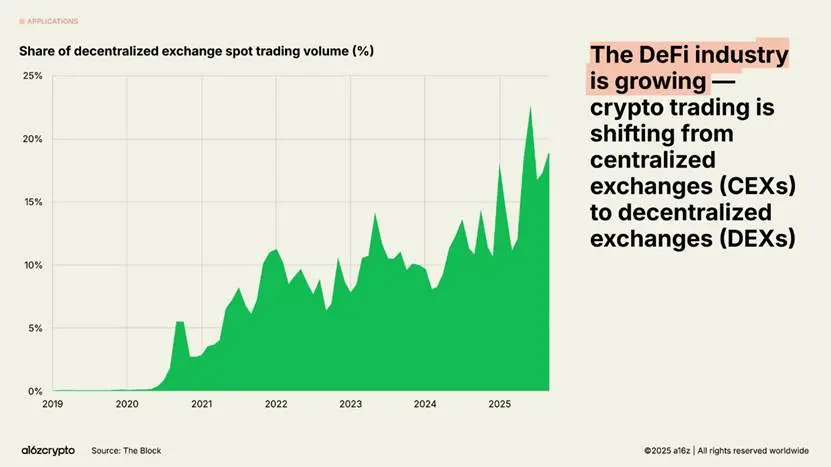
The on-chain economy—which was once a niche playground for early adopters—has evolved into a multi-sector market with tens of millions of monthly participants. Nearly one-fifth of spot trading volume now occurs on decentralized exchanges.
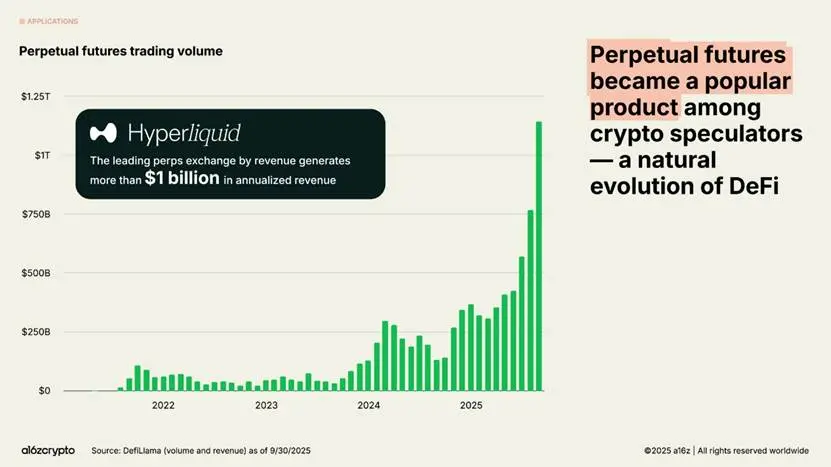
As trading volume has grown nearly eightfold over the past year, perpetual contracts have exploded in popularity among cryptocurrency speculators. Decentralized perpetual contract exchanges like Hyperliquid have processed trillions of dollars in transactions, generating over $1 billion in annualized revenue this year—numbers that can rival some centralized exchanges.
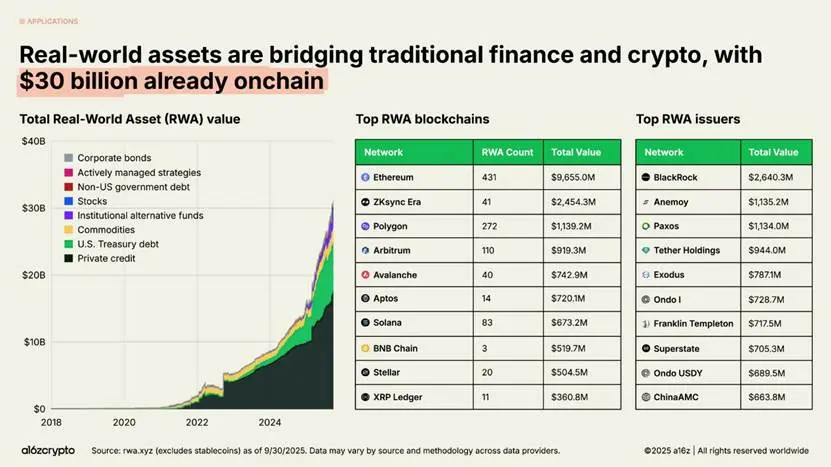
Real-world assets (RWAs)—traditional assets like U.S. Treasuries, money market funds, private credit, and real estate—are being represented ("tokenized") on-chain, connecting cryptocurrency and traditional finance. The total market size for tokenized RWAs is $30 billion, having grown nearly fourfold over the past two years.
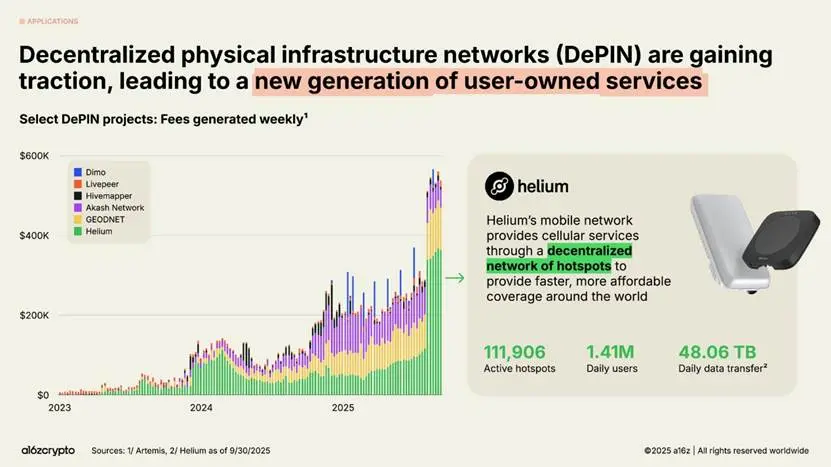
Beyond finance, one of the most ambitious frontiers for blockchain in 2025 is DePIN, or decentralized physical infrastructure networks.
DeFi has reimagined finance, and DePIN is reimagining physical infrastructure, including telecommunications and transportation networks, energy grids, and more. The opportunity is vast: the World Economic Forum predicts that the DePIN category will grow to $3.5 trillion by 2028.
The Helium network is the most notable example. This grassroots wireless network now provides 5G cellular coverage for 1.4 million daily active users through over 111,000 hotspots operated by users.
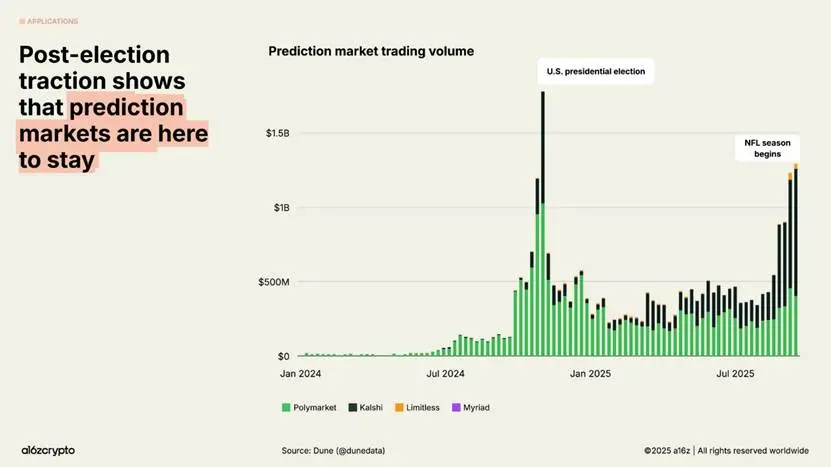
Prediction markets are entering the mainstream during the 2024 U.S. presidential election cycle, with the most popular platforms Polymarket and Kalshi seeing monthly trading volumes totaling billions of dollars. Despite doubts about their ability to maintain engagement in non-election years, these platforms' trading volumes have grown nearly fivefold since early 2025, approaching previous highs.
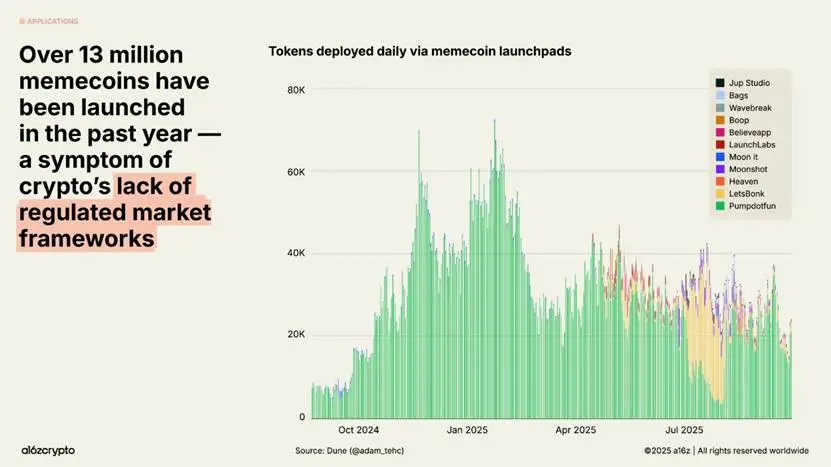
In the absence of regulatory clarity, meme coins have thrived. Over 13 million meme coins were launched last year. This trend seems to be cooling in recent months—September's issuance was down 56% from January—as sound policies and bipartisan legislation clear the way for more productive blockchain use cases.
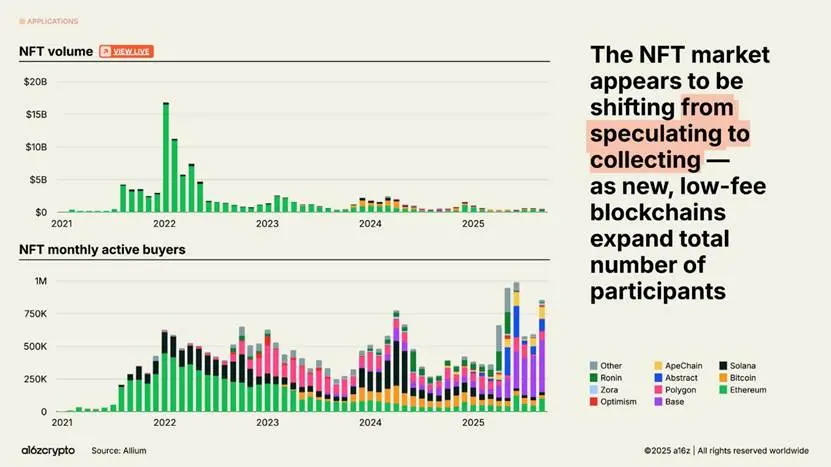
The NFT market's trading volume has yet to reach the peak levels of 2022, but the number of monthly active buyers has been increasing. These trends seem to indicate a shift in consumer behavior from speculation to collecting, aided by the emergence of cheaper on-chain block space like Solana and Base. (For more information on the intersection of cryptocurrency and the creator economy, see our Voices Onchain project.)
Blockchain Infrastructure is (Almost) Ready for a Golden Age
All of this activity would not be possible without significant advancements in blockchain infrastructure.
In just five years, the total transaction throughput of major blockchain networks has grown over 100-fold. Back then, blockchains processed fewer than 25 transactions per second. Now they handle 3,400 transactions per second, comparable to the completed trades of Nasdaq or the global throughput of Stripe on Black Friday—and at a cost that is just a fraction of historical costs.
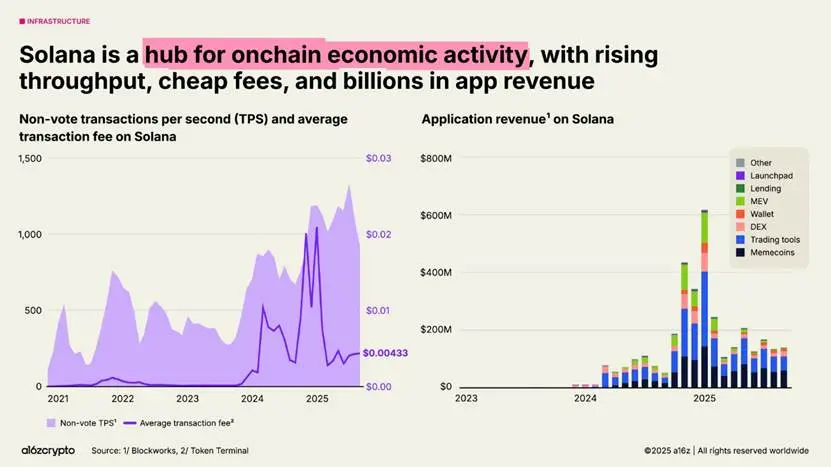
In the blockchain ecosystem, Solana has become one of the most prominent. Its high-performance, low-fee architecture now supports everything from DePIN projects to NFT marketplaces, with its native applications generating $3 billion in revenue over the past year. Planned upgrades are expected to double the network's capacity by the end of the year.
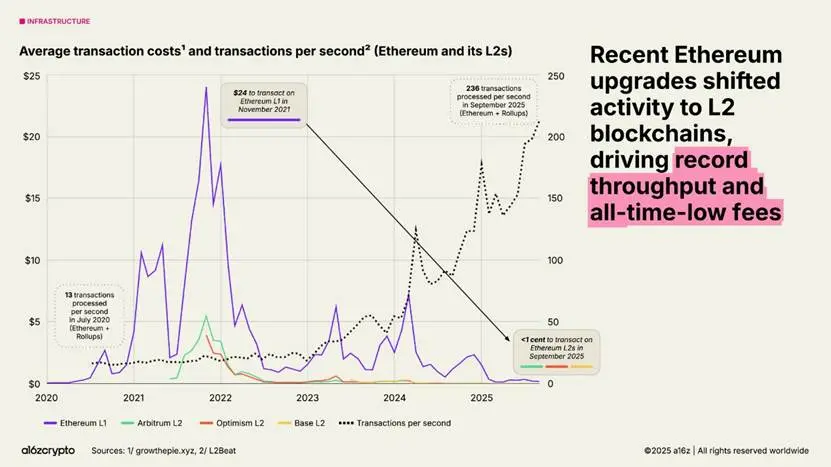
Ethereum continues to execute its scaling roadmap, with most economic activity migrating to Layer 2 (L2) solutions like Arbitrum, Base, and Optimism. The average transaction cost on L2 has dropped from about $24 in 2021 to less than a cent today, making Ethereum-related block space cheap and abundant.
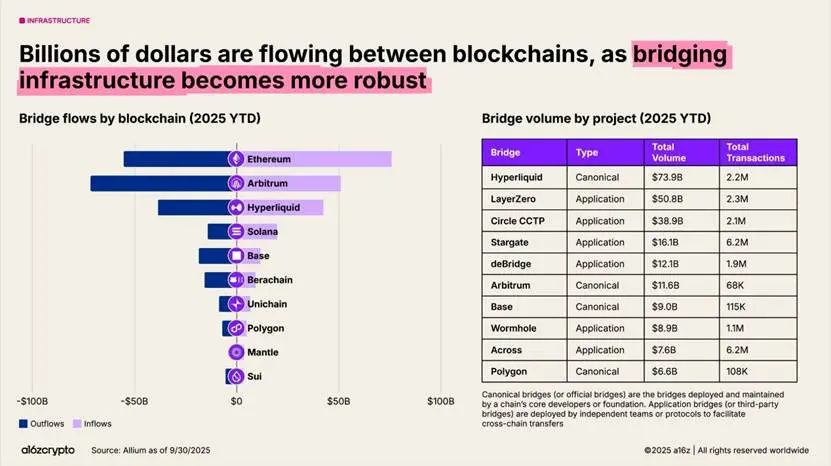
Cross-chain bridges are enabling interoperability among blockchains. Protocols like LayerZero and Circle's cross-chain transfer protocols allow users to move assets within multichain systems. Hyperliquid's standardized cross-chain bridge has also achieved a trading volume of $74 billion so far this year.
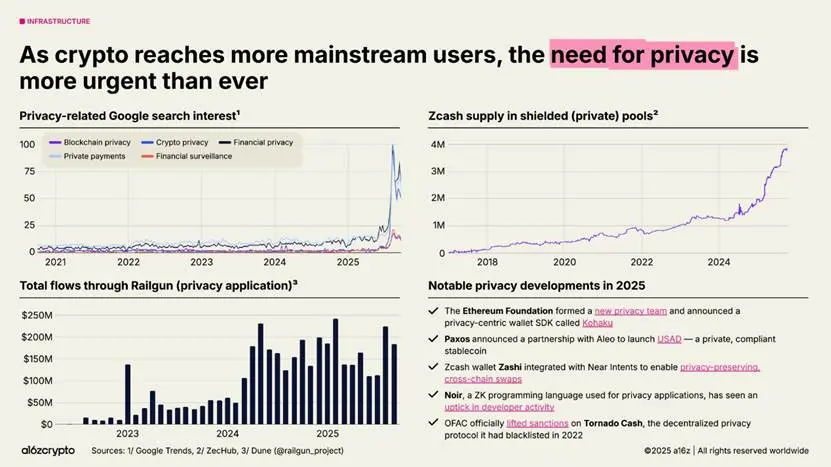
Privacy is coming back to the forefront and may become a prerequisite for broader adoption. Indicators of growing interest include: a surge in Google searches related to crypto privacy in 2025; Zcash's shielded pool supply growing to nearly 4 million ZEC; and Railgun's transaction volume exceeding $200 million per month.
More momentum: the Ethereum Foundation has established a new privacy team; Paxos has partnered with Aleo to launch a compliant private stablecoin (USAD); and the U.S. Office of Foreign Assets Control has lifted sanctions on the decentralized privacy protocol Tornado Cash. We expect this trend to gain greater momentum in the coming years as cryptocurrency continues to go mainstream.
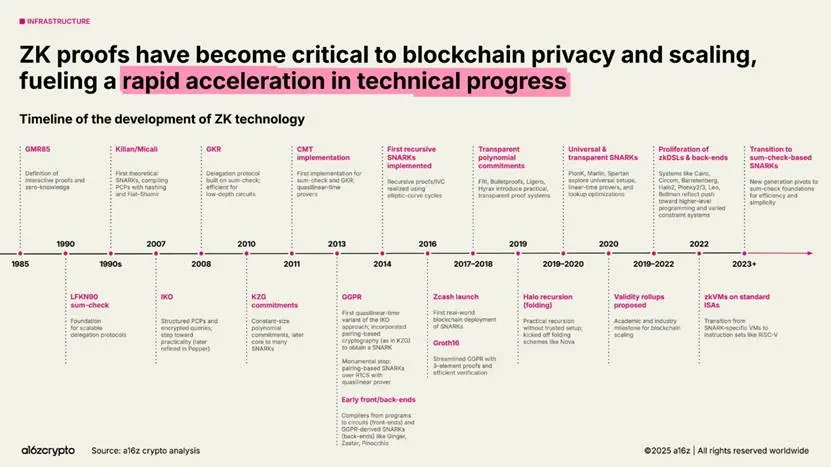
Similarly, zero-knowledge (ZK) proofs and succinct proof systems are rapidly evolving from academic research decades ago into critical infrastructure. Zero-knowledge systems are now integrated into Rollups, compliance tools, and even mainstream network services—Google's new ZK identity system is one example.
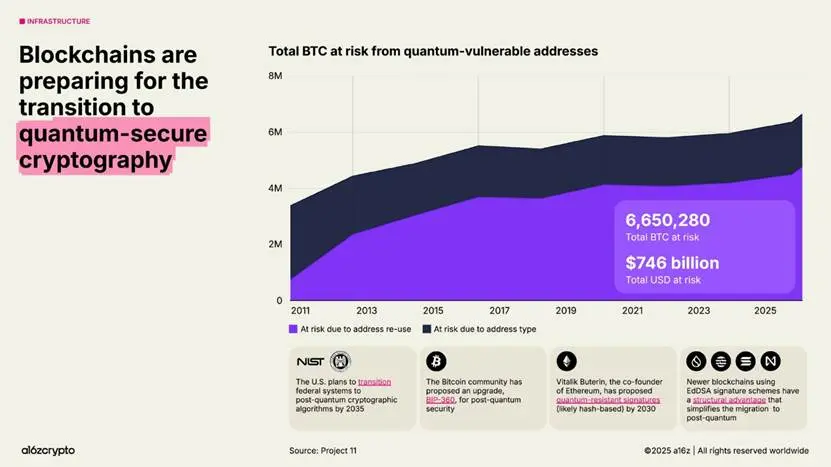
Meanwhile, blockchains are accelerating their post-quantum roadmaps. Approximately $750 billion in Bitcoin is stored in addresses vulnerable to future quantum attacks. The U.S. government plans to transition its federal systems to post-quantum cryptographic algorithms by 2035.
AI and Cryptocurrency are Merging
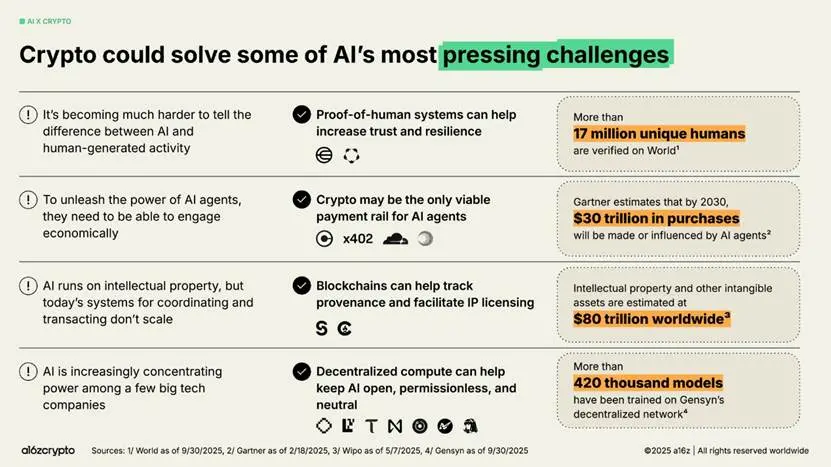
Among other advancements, the launch of ChatGPT in 2022 brought AI to the forefront of public attention—creating clear opportunities for cryptocurrency. From tracking provenance and IP licensing to providing payment rails for agents, cryptocurrency could be a solution to some of AI's most pressing challenges.
Decentralized identity systems like World have verified over 17 million people, providing "proof of humanity" and helping to distinguish between humans and bots.
Protocols like x402 are becoming potential financial pillars for autonomous AI agents, helping them conduct microtransactions, access APIs, and settle payments without intermediaries—Gartner estimates that this economic scale could reach $30 trillion by 2030.
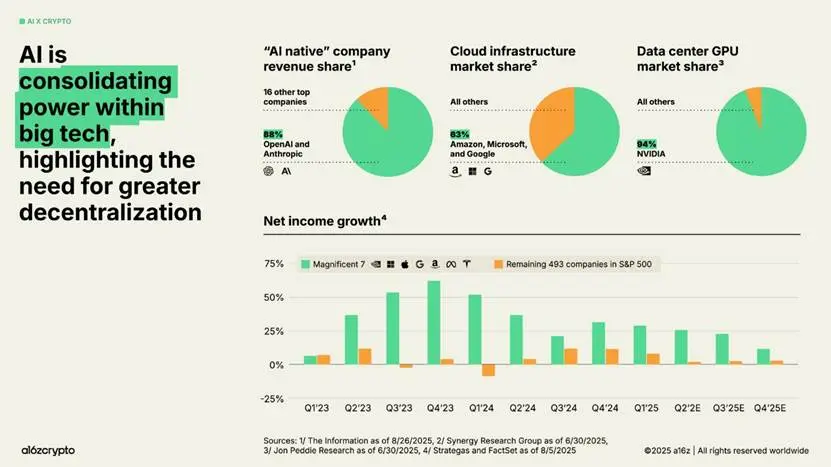
Meanwhile, the computational layer of AI is consolidating around a few tech giants, raising concerns about centralization and censorship. Just two companies, OpenAI and Anthropic, control 88% of the revenue of "AI-native" companies. Amazon, Microsoft, and Google control 63% of the cloud infrastructure market, while Nvidia holds 94% of the data center GPU market. These imbalances have driven double-digit quarterly net income growth for "the Big Seven" companies over the past few years, while the overall profit growth of the remaining companies in the S&P 493 has failed to keep pace with inflation.
Blockchain provides a counterbalance to the obvious centralizing forces in AI systems.
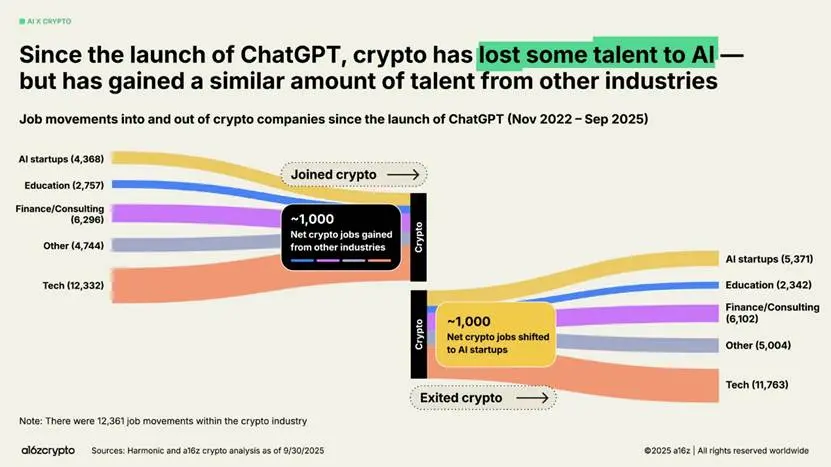
In the AI frenzy, some builders have shifted from cryptocurrency to other areas. Our analysis indicates that since the launch of ChatGPT, about 1,000 jobs have shifted from cryptocurrency to AI. However, this number has been offset by an equal number of builders from other fields (like traditional finance and tech) joining cryptocurrency.
Future Outlook
Where does this leave us? As greater regulatory clarity is on the horizon, a path for tokens to generate real revenue through fees is opening up. The adoption of cryptocurrency by traditional finance and fintech will continue to accelerate; stablecoins will upgrade traditional systems and democratize financial access globally; and new consumer products will bring the next wave of cryptocurrency users on-chain.
We have the infrastructure, distribution channels, and soon the regulatory clarity needed to push this technology into the mainstream. It is time to upgrade the financial system, rebuild global payment rails, and create the internet the world deserves.
Seventeen years have passed, and cryptocurrency is leaving its teenage years and entering adulthood.
 Risk warning
 Risk warning