HashWhale Crypto Weekly | Market Sentiment Cautious; Buying Pressure Gradually Accumulates (10.18-10.24)

 This week, Bitcoin's overall operating rhythm is characterized by "sideways consolidation → oscillating rise → short-term breakout → stabilization and rebound." The main price range is maintained between $106,000 and $114,000, with an overall fluctuation of about 7.5%, during which the forces of bulls and bears frequently alternate. The market has not yet completely escaped uncertainty and may still be affected by factors such as macro policies, exchange liquidity, and changes in capital flow in the short term.
Author & Editor: Monkey
1. Bitcoin Market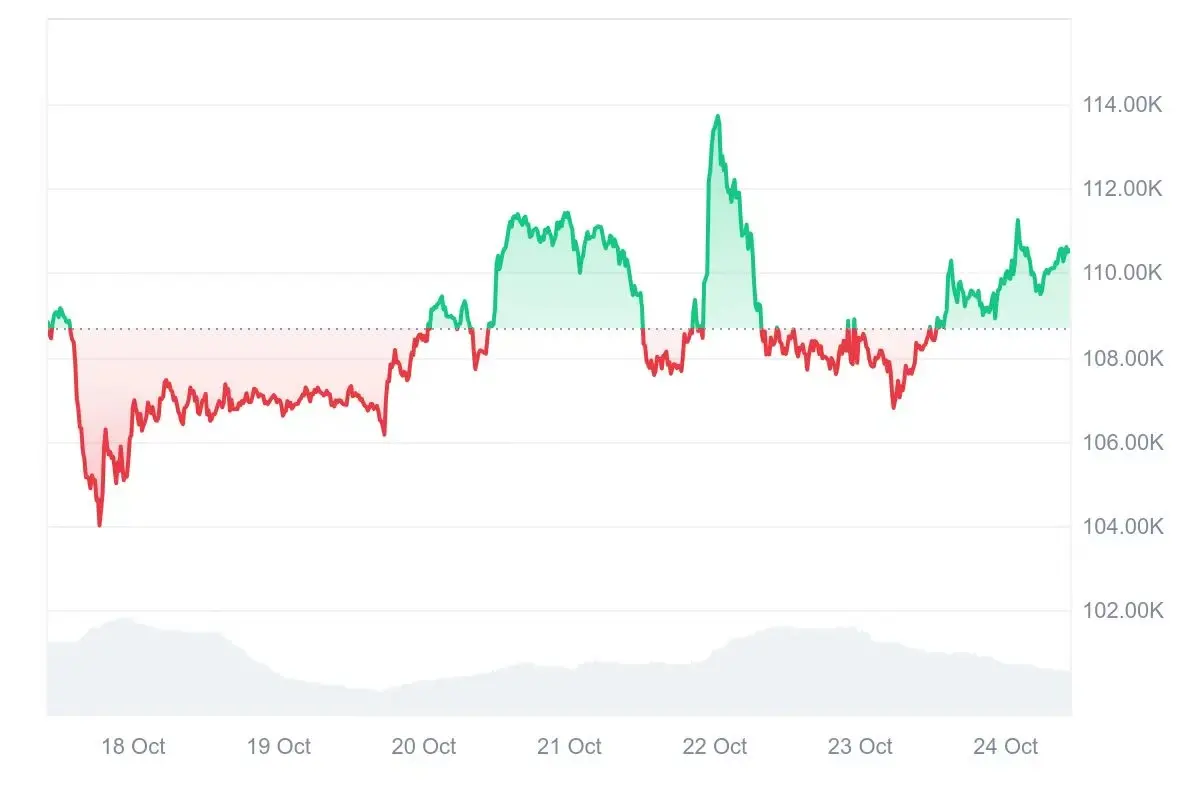
Bitcoin Price Trends (2025/10/18-2025/10/24)
In the past week (from October 18 to October 24, 2025), Bitcoin's overall movement was characterized by "sideways consolidation → oscillating rise → short-term breakout → stabilization and rebound." The main price range was maintained between $106,000 and $114,000, with an overall fluctuation of about 7.5%, during which bullish and bearish forces frequently alternated.
Sideways Consolidation Phase (October 18 to October 19)
From October 18 to 19, Bitcoin's volatility significantly narrowed, with prices hovering around the $107,000 mark. On the evening of October 19, after a slight dip, the price quickly rebounded, and the market gradually confirmed the recovery of short-term upward momentum.
Causes of Movement:
1. Improvement in On-chain and Technical Indicators
From on-chain data, the number of active addresses and transaction volume rebounded from low levels, and the short-term MVRV indicator for BTC rebounded from the oversold zone, indicating signs of "low-level accumulation" by some funds. Technically, the short-term RSI rose from below 30, and prices found support at the daily 20MA, forming a rebound signal.
2. Technical Recovery After Previous Corrections
After reaching a new high of approximately $126,000 at the beginning of the month, BTC quickly fell back, triggering a process of leveraged liquidation and risk deleveraging. This round of sideways movement is seen as a stabilization period after the market "washed out," accumulating momentum for the subsequent rebound.
Oscillating Rise Phase (October 19 to October 20)
In the afternoon of October 19, Bitcoin began to rise gently from the $107,000 mark, reaching a high of $111,611 on October 20, with an expanded daily amplitude and significantly improved market sentiment.
Causes of Movement:
1. Shift in Interest Rate Expectations Towards Easing
The market expects that the Federal Reserve may start a rate-cutting cycle in late October, driving funds back into risk assets. Bitcoin, as a "high β asset," reacted first, with prices strengthening alongside rising liquidity expectations.
2. Temporary Easing of Macroeconomic and Geopolitical Environment
The U.S. and China have released positive signals in the economic and trade fields, coupled with the Middle East situation not escalating further, which has reduced overall market risk aversion and favored a rebound in risk appetite.
3. Market Sentiment Recovery
BTC returning above $111,000 is seen as a re-establishment of a key technical threshold, boosting market confidence, with funds flowing into short-term long contracts and spot buying rising simultaneously.
Highs and Pullbacks with Consolidation Phase (October 22)
On October 21, Bitcoin experienced a pullback after continuous rises, gradually dipping to around $108,000. On October 22, Bitcoin briefly surged from around $108,000 to $113,790, but faced heavy selling pressure above, subsequently retreating back to around $108,000. From then until October 23, the market entered a sideways oscillation phase, with the fluctuation range gradually expanding and market trading sentiment becoming cautious.
Causes of Movement:
1. Profit-Taking at High Levels and Technical Resistance
Around $114,000 is a previous dense trading area and a resistance point, leading some short-term funds to take profits, resulting in weak upward momentum. The increase in trading volume followed by a pullback indicates that selling pressure dominated above.
2. Structural Adjustment and Unclear Trend
After a strong rebound, the market entered a consolidation range, with funds taking a short-term wait-and-see approach, awaiting new catalysts (such as macro policy signals or changes in ETF fund flows). Trading volume significantly shrank, and price fluctuations tended to be range-bound.
3. Ongoing Macroeconomic and Policy Interference
The temporary rise in the dollar index, the increase in U.S. Treasury yields, and some regulatory signals (such as the SEC slowing down the approval pace for crypto ETFs) all exert pressure on the market, limiting further upward space.
Opening Upward Channel After Consolidation (October 23 to October 24)
From October 23 to 24, Bitcoin gradually emerged from the consolidation range, forming a short-term upward channel, with prices slowly rising, reaching $110,519 at the time of writing, maintaining fluctuations between $110,000 and $112,000. If the upward structure continues, the market is expected to test higher resistance areas.
Causes of Movement:
1. Accumulation of Low-Level Buying and Confirmation of Support
After the previous pullback, prices found multiple supports in the $107,000 to $108,000 range, indicating gradually strengthening buying power. As low-level chips were absorbed, market confidence rebounded, laying the foundation for short-term upward movement.
2. Marginal Improvement in Macroeconomic and Geopolitical Environment
Investors are focusing on the upcoming U.S. inflation data (CPI) and developments in U.S.-China relations. The market generally expects that if inflation data shows a slowdown or if negotiations progress positively, it will help boost risk appetite and liquidity expectations. The temporary alleviation of risk aversion pressure has led to a corrective rebound in Bitcoin prices.
3. Technical Structure Repair and Trend Continuation
After the pullback and consolidation on October 22, the price structure was not damaged; instead, it formed solid support and regained strength, showing a typical pattern of "consolidation --- upward attack." Trading volume gradually increased, with support and moving average systems tilting upward, indicating that an upward channel has been preliminarily established.
Summary
Overall, in the past week, Bitcoin exhibited a structurally repairing trend within a volatile consolidation. After the previous rapid correction and risk deleveraging phase, market sentiment gradually recovered, with buying power re-entering the market, allowing prices to show certain resilience within the oscillation range. In terms of operations, investors can continue to adopt a strategy of buying low and selling high within the range, focusing on the Federal Reserve's interest rate decision rhythm, changes in ETF fund inflows, and dynamics of on-chain activity, as these factors will remain key variables influencing Bitcoin's short-term direction.
2. Market Dynamics and Macroeconomic Background
Capital Flow
1. ETF Fund Dynamics
This week’s Bitcoin ETF fund flows:
October 20: -$40.4 million
October 21: +$477.2 million
October 22: -$101.4 million
October 23: -$87.5 million
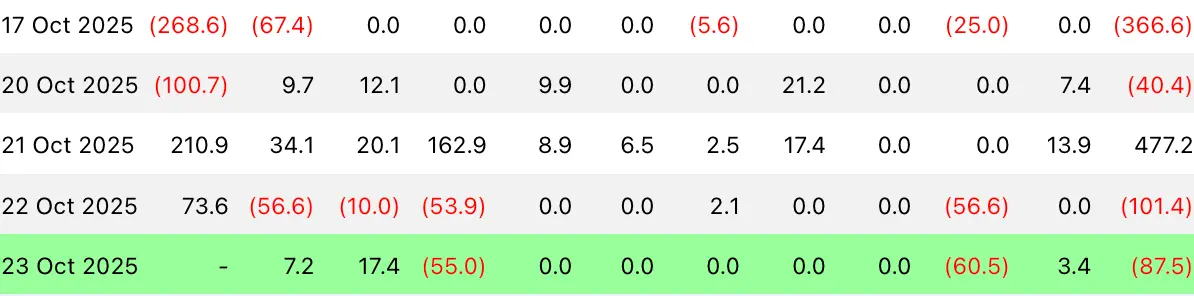
ETF Inflow/Outflow Data Image
This week, Bitcoin ETF funds showed a fluctuating flow, with a brief strong inflow followed by net outflows again. Data indicates that market funds are still in a wait-and-see and oscillation game phase.
2. Net Outflows from Exchanges Expand, Market Enters Accumulation Phase
Recently, Bitcoin's fund flows on exchanges have shown a clear "outflow" trend.
CryptoQuant data indicates that Binance's Bitcoin net flow indicator has recently remained significantly negative, with the 30-day moving average (SMA30) showing that Bitcoin is flowing out of exchanges in large quantities. This outflow of funds usually means that investors are withdrawing assets from exchanges to cold wallets for long-term holding rather than short-term trading or selling.
Analysts generally believe this aligns with the "accumulation phase" in the market cycle, indicating that investor confidence is recovering, laying the groundwork for subsequent short-term bullish trends.
3. Liquidity in the Futures Market Declines, Leverage Risks Significantly Alleviated
The capital flow in the derivatives market has shown signs of weakness in this cycle.
CryptoQuant analyst Axel Adler Jr pointed out that the Bitcoin futures liquidity index is below 45, indicating that the market is still in a weak zone of insufficient liquidity. Bullish forces have repeatedly failed in attempts to regain dominance, and current prices remain below the 30-day fair value, showing weakened buyer initiative. Meanwhile, Bitcoin's open interest has decreased by about 30%, indicating that excessive leverage in the market has been cleared.
The funding rate is trending towards neutrality, further reducing the risk of large-scale liquidation cascades, making the overall leverage environment healthier.
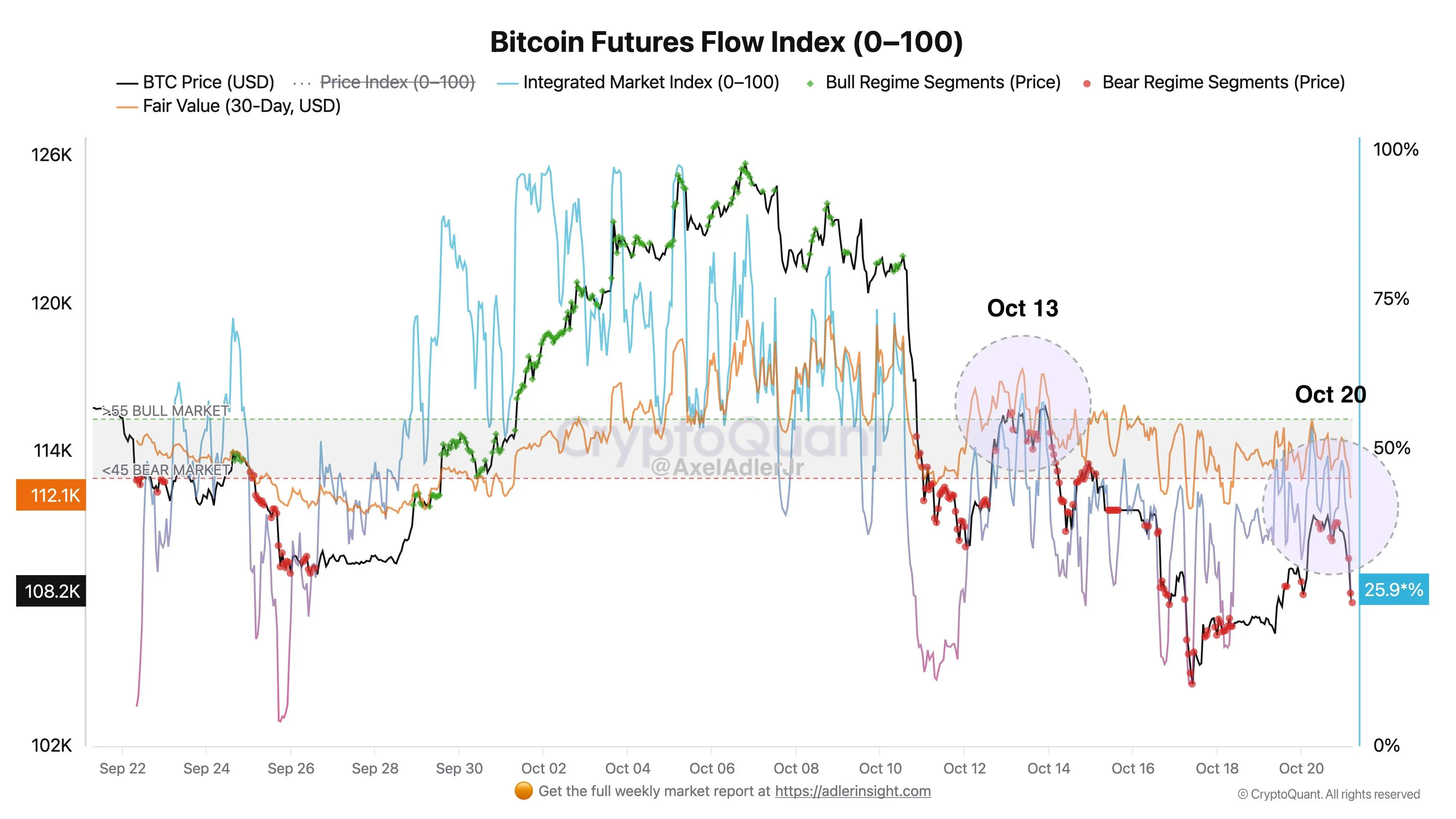
Related Image
4. Long-term Holders and Miners Reduce Holdings Simultaneously
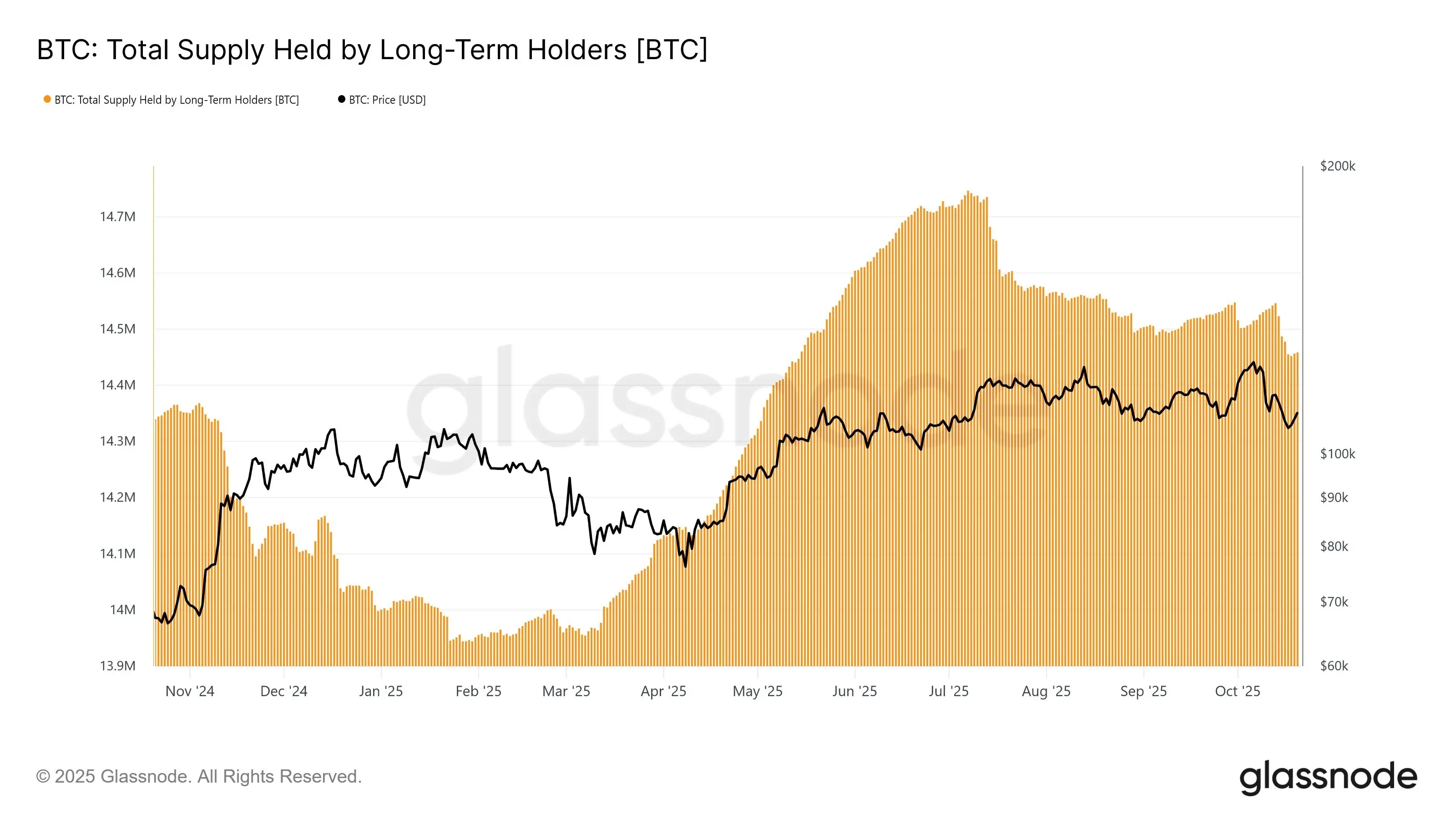
On-chain data shows that long-term Bitcoin holders (LTH) continued to distribute their holdings this week.
Since October 15, the total holdings of long-term holders have decreased by about 28,000 BTC, reflecting a phase of profit-taking. Meanwhile, miners' transfers of Bitcoin to exchanges have slightly increased, indicating that some miners are cashing out recent BTC production.
Although overall selling pressure is limited, the slight reduction in holdings by long-term holders and miners also reminds the market to remain cautious amidst optimism.
Related Image
Comprehensive Judgment: Market Capital Structure is Transitioning from High Leverage to Healthy Accumulation
Overall, the capital flow of Bitcoin from October 18 to October 24 shows structural characteristics of "outflows from exchanges, reduced leverage, institutional volatility, and stable holdings."
The continuous net outflow from exchanges and the reduction of leverage together indicate that speculative funds in the market are decreasing, while long-term and institutional funds are gradually flowing back amidst volatility.
This may signal that the Bitcoin market is transitioning from high leverage and short-term speculation to a more robust accumulation phase, providing a foundation for the next upward cycle.
Technical Indicator Analysis
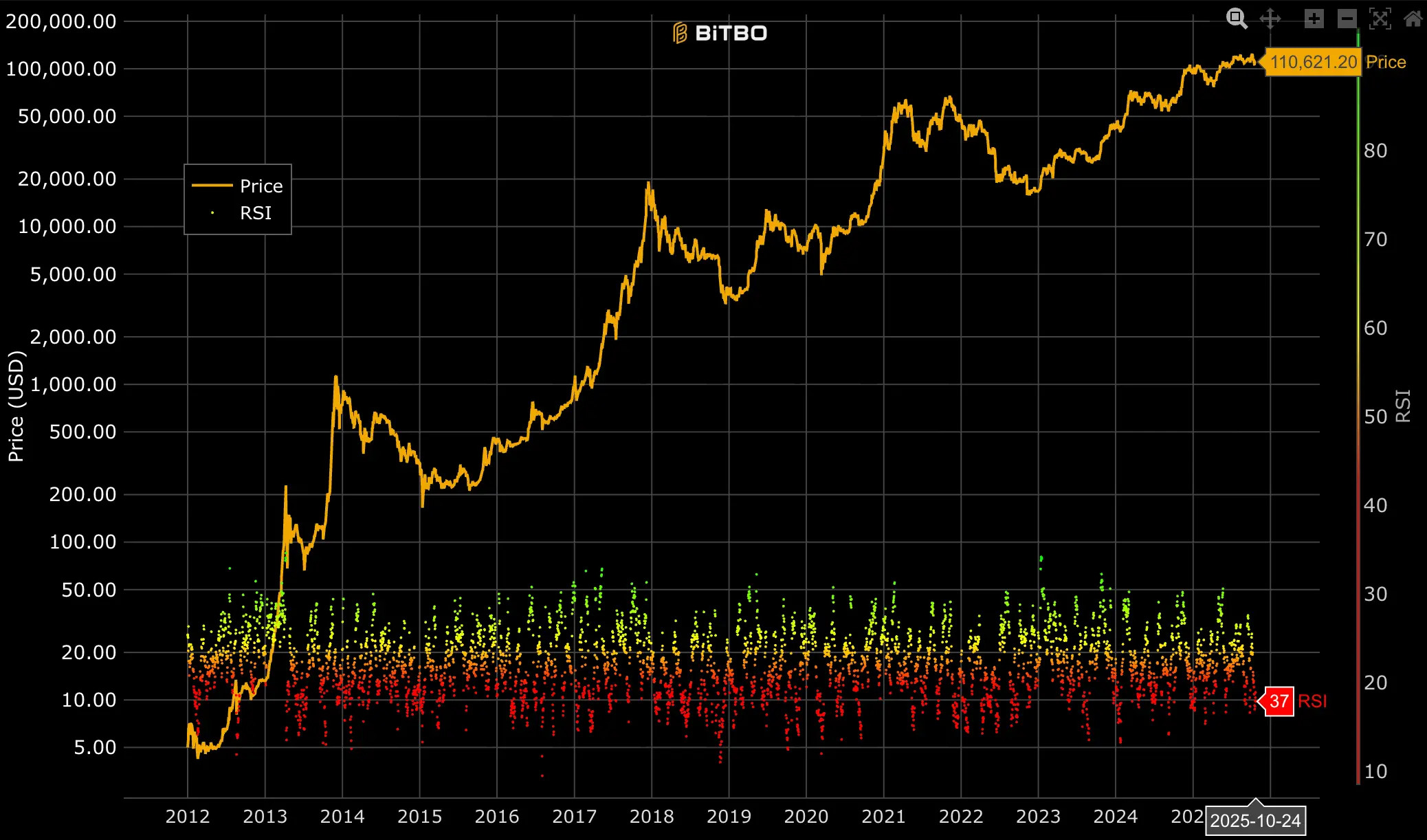
1. Relative Strength Index (RSI 14)
According to Bitbo data, as of October 24, 2025, Bitcoin's 14-day RSI is 37. This value is in the technical "oversold" critical zone (generally, RSI < 30 is oversold, RSI > 70 is overbought). The RSI hovering in the mid-low range indicates that the market has not yet regained strength, but the downside space is relatively limited. It may enter a "technical repair rebound" phase in the short term; if the RSI can further break above 45, it will likely confirm a short-term bottom structure.
Bitcoin 14-day RSI Data Image
2. Moving Average (MA) Analysis
MA5 (5-day moving average): $110,447
MA20 (20-day moving average): $115,698
MA50 (50-day moving average): $114,923
MA100 (100-day moving average): $114,937
Current Price: $110,800

MA5, MA20, MA50, MA100, M200 Data Image
Bitcoin's current price is running below MA5 and MA20, and the short-term moving averages continue to decline, indicating that the short-term is still in an adjustment cycle. MA50 and MA100 are nearly overlapping and tending to be flat, reflecting that the mid-term trend has entered a phase of oscillation and consolidation. The "death cross" structure between MA20 and MA50 has not yet been repaired, which is the main technical resistance limiting short-term rebounds.
If the price can regain and stabilize above MA20 (around $115,700), the short-term trend is expected to shift from weak to stable; conversely, if it loses MA5 and falls below $110,000, it may test the $107,000 or even $105,500 area again.
3. Key Support and Resistance Levels
Support Levels: In the short term, Bitcoin's key support areas are mainly located around $106,000 and $107,000.
On October 19, when the price fell to around $106,000, it received significant buying support, leading to a short-term rebound. On October 23, when the price again dipped to around $107,000, signs of stabilization appeared, indicating active buying in that area. Additionally, on October 18, 19, and 22, the price consolidated around $107,000 and $108,000, which are key consolidation zones in this round of oscillation.
Resistance Levels: Short-term resistance is mainly concentrated around $112,000 and $114,000.
On the evening of October 20, Bitcoin faced resistance and retreated after attempting to rise to around $112,000, indicating heavy selling pressure above. Although there was a quick surge close to $114,000 on October 22, it also failed to break through, followed by a pullback and consolidation. This area overlaps with previous dense trading zones and technical resistance, becoming the main pressure zone for short-term upward movements.
Market Sentiment Analysis
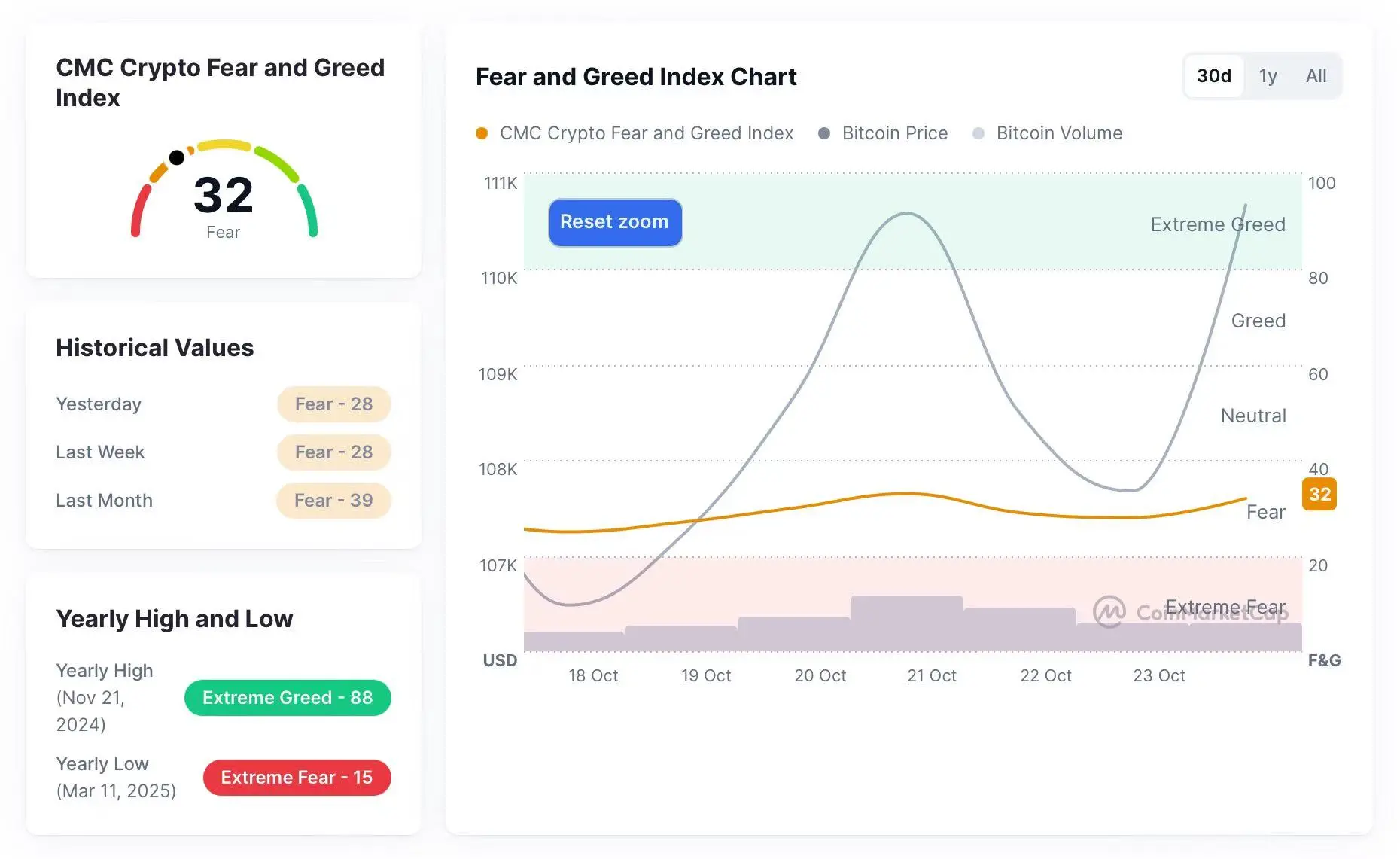
As of October 24, the Fear & Greed Index reported 32 points, falling within the "Fear" range, indicating that overall market sentiment remains cautious. Investors are still adopting a wait-and-see attitude towards Bitcoin's short-term trends, with the market lacking clear risk appetite and sentiment not showing significant warming.
Looking back at this week (October 18 to October 24), the daily values of the Fear & Greed Index were: 25 (Fear), 27 (Fear), 30 (Fear), 33 (Fear), 29 (Fear), 28 (Fear), 32 (Fear). The overall range operated between 25 and 33 points, remaining in the "Fear" zone, indicating limited short-term sentiment fluctuations, with overall investor sentiment being cautious but slightly recovering.
Overall, this week, Bitcoin's market sentiment showed a low-level oscillation and gradual warming trend. Although fear sentiment dominated, the index reaching a high of 33 points mid-week indicated that some investors began attempting to accumulate at lower levels, alleviating the market's wait-and-see atmosphere. However, the index fell back to between 28 and 32 points in the latter half of the week, indicating that the market has not fully escaped uncertainty and may still be influenced by macro policies, exchange liquidity, and changes in capital flow in the short term.
Fear & Greed Index Data Image
Macroeconomic Background
1. U.S. Strategic Bitcoin Reserves
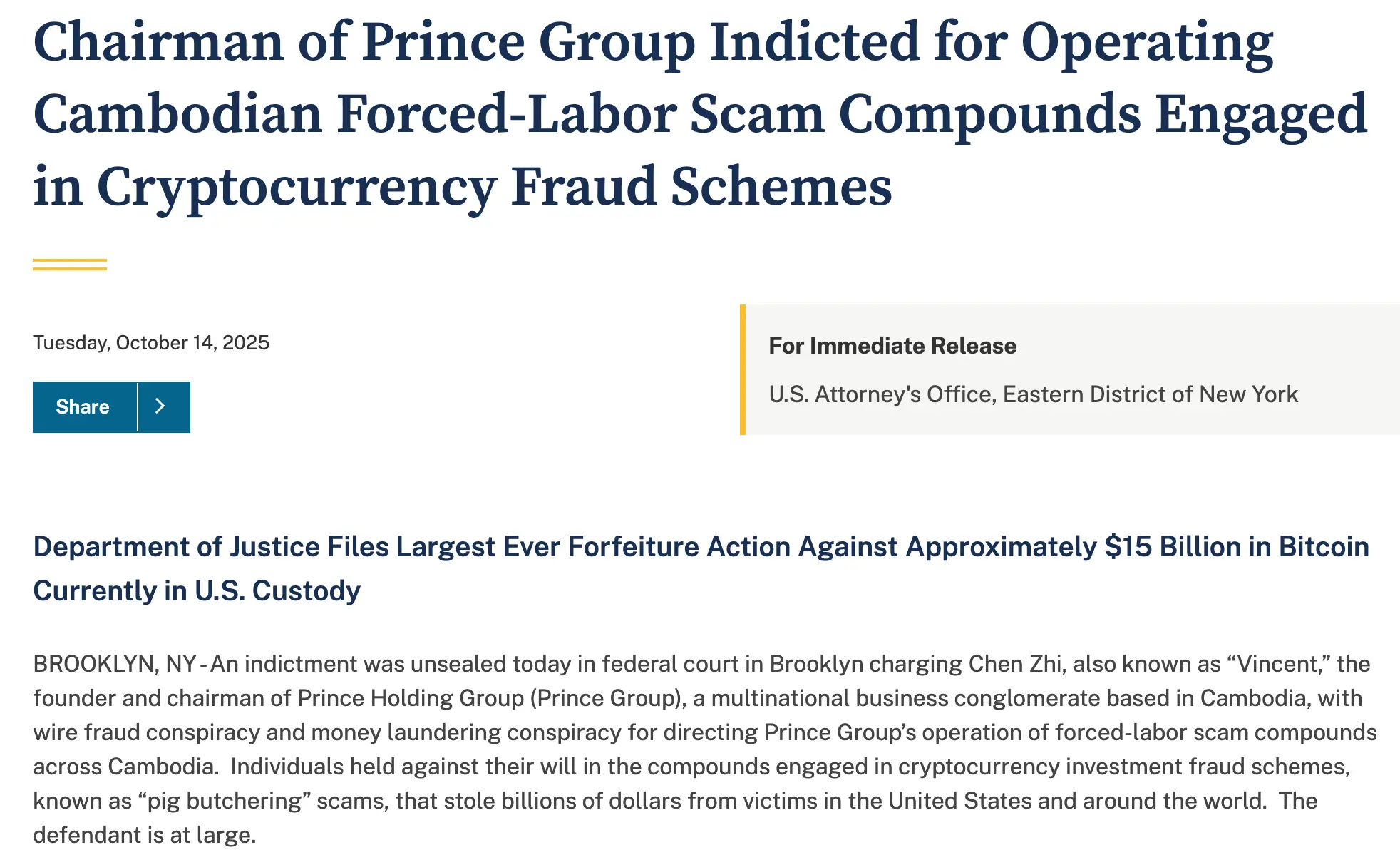
On October 19, according to Galaxy Research, the U.S. Treasury has been authorized to include seized digital assets into its strategic Bitcoin reserves since this year. Recently, with the Prince Group's seized assets added to the reserves, the scale of this strategic reserve grew by 64% overnight, amounting to approximately 3.5% of the U.S. gold reserves in dollar terms. This move indicates that the U.S. government is gradually incorporating Bitcoin into its official asset management system, which may constrain the supply of circulating Bitcoin in the market, thereby providing potential support.
Related Image
2. Key Macroeconomic Data and Monetary Policy Dynamics
The market generally expects that the Federal Reserve will hold a monetary policy meeting at the end of this month (October 28-29) to discuss whether to further lower the federal funds rate (estimated to drop by 25 basis points to around 3.75%--4.00%) in response to economic weakness. Current signs of a slowdown in the labor market and increased uncertainty in government budgets and data releases have also raised expectations for monetary policy adjustments.
The U.S. Department of Labor is set to release the September Consumer Price Index (CPI) data on October 24, which is seen as an important input for the next steps in monetary policy direction. If inflation continues to slow, it may enhance expectations for easing, thereby increasing demand for risk assets, including Bitcoin; conversely, if inflation exceeds expectations, it may suppress risk asset sentiment.
3. Tensions Escalate in U.S.-China Trade Relations Under Trump Administration
On October 22, 2025, U.S. President Trump announced that if U.S.-China trade negotiations do not make progress by November 1, the U.S. will impose a 155% tariff on all Chinese imports. He stated that while he hopes to maintain friendly relations with China, the U.S. has no choice but to take a tough stance due to the imbalanced economic relationship over the past few years.
Additionally, the Trump administration is considering restricting high-tech software exports to China, including products like laptops and jet engines, in response to China's recent expansion of rare earth export restrictions.
The implementation of these policies could have far-reaching impacts on global supply chains, the tech industry, and financial markets. Currently, the U.S. and China plan to hold trade negotiations in Malaysia on October 24 to seek to ease tensions.

Related Image
3. Mining Dynamics
Hash Rate Changes
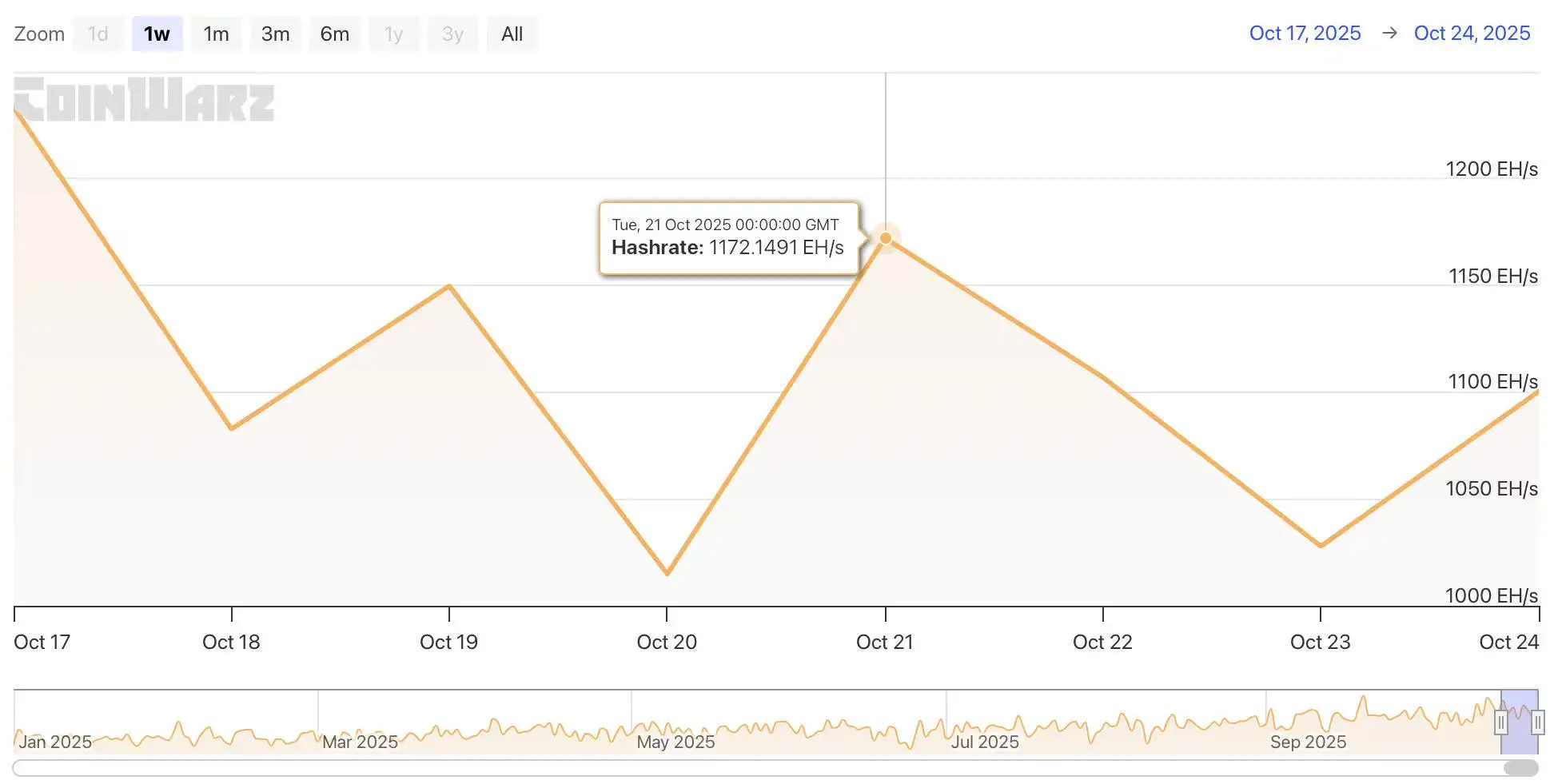
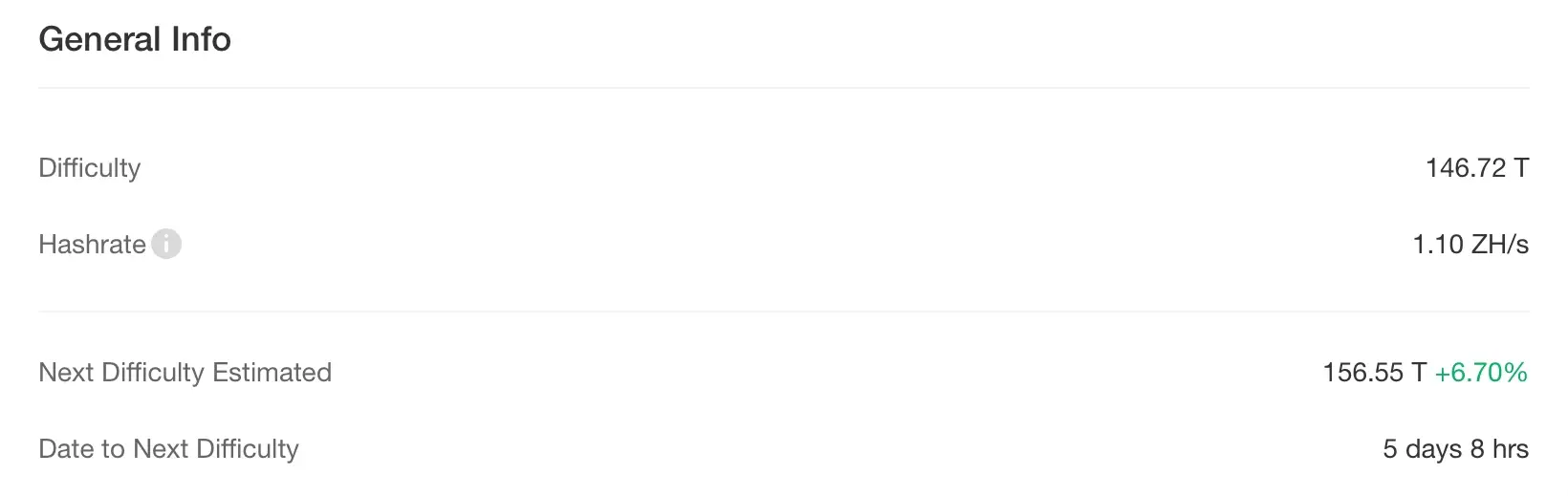
In the past seven days, Bitcoin's network hash rate has shown overall fluctuations, maintaining a range between 1014.88 EH/s and 1172.14 EH/s, remaining at relatively high levels. As of October 24, the total network hash rate reached 1.10 ZH/s, with mining difficulty at 146.72 T. The next difficulty adjustment is expected to occur on October 29, with an estimated increase of about 6.70%, bringing the difficulty to approximately 156.55 T. Overall, the network hash rate remains high, but volatility has increased, indicating that miners are still actively mining under price and cost pressures.
Weekly Bitcoin Network Hash Rate Data
Bitcoin Mining Difficulty Data
Miner Income
According to YCharts data, this week, Bitcoin miners' average daily total income (including block rewards and transaction fees) fluctuated between $47.14 million and $57.48 million, as follows:
October 18: $55.53 million
October 19: $47.14 million
October 20: $57.48 million
October 21: $53.88 million
October 22: $54.75 million
October 23: $48.85 million
Overall, miners' income this week has decreased compared to earlier periods, with a significant drop in income on October 19, mainly due to the sharp decline in Bitcoin prices that day.
Investment bank Jefferies reported on October 20 that Bitcoin mining profitability fell by over 7% in September 2025. With Bitcoin prices dropping by about 2% and network hash rates increasing by about 9%, mining profits faced dual pressures. North American publicly listed mining companies produced 3,401 BTC in September, down from 3,576 BTC in August, with their share of the global network declining from 26% to 25%. Among them, MARA Holdings had the highest output at 736 BTC (up from 705 BTC in August); CleanSpark followed closely with 629 BTC (down from 657 BTC in August). Theoretically, a mining rig with a hash rate of 1 EH/s generated about $52,000 in daily income in September, down from $56,000 in August, but still higher than about $43,000 a year ago.
4. Policy and Regulatory News
South Korea's Financial Services Commission Changes Regulation of Exchange Tokens to Direct Government Oversight
On October 20, the South Korean Financial Services Commission (FSC) decided to change the regulatory model for the listing of cryptocurrency exchange tokens from self-regulation to direct government oversight. This move aims to strengthen market compliance and investor protection, preventing exchanges from abusing their listing rights through internal decisions.
South Korean Financial Commission Plans to Ban Interest Payments on Stablecoin Holdings, Relevant Legislation to be Submitted This Year
On October 20, Financial Commission Chairman Lee Ik-hyun stated during a National Assembly audit that, in principle, interest payments on payment-type stablecoins due to holding or usage will not be allowed. Lee pointed out that South Korea will follow the relevant principles of the U.S. "Genius Act" and explore a bank-led alliance model, restricting fintech companies to act only as technical partners and prohibiting virtual asset exchanges from issuing stablecoins independently. Additionally, he confirmed that the second phase of legislation for virtual asset regulation will be submitted within the year and is currently in the final coordination stage. Lee also mentioned that stablecoins have high overseas demand potential in areas such as virtual asset trading, payment settlement, and cross-border remittances, and plans to lay out relevant applications in advance.

Related Image
Russian Finance Ministry and Central Bank Agree to Legalize Cryptocurrency in Foreign Trade
On October 22, it was reported by the Russian newspaper "Izvestia" that the Russian Finance Ministry and the Central Bank of Russia have reached an agreement to allow the use of cryptocurrency for payments in foreign trade. Finance Minister Anton Siluanov announced this news. After a strategic meeting on "Enhancing Economic Efficiency and Ensuring a Fair Business Environment," Siluanov stated, "We believe this area should be legalized, and its activities should be regulated by legislation. Therefore, we will work with the Federal Financial Monitoring Service and various regulatory bodies to ensure and restore order in this field." Siluanov emphasized that using cryptocurrency for settlements is an important task, as cryptocurrencies can not only be used for payments but also for transferring money abroad. Therefore, he stated that as this market is legalized, strengthening the control functions of regulatory agencies will be crucial.
5. Bitcoin News
Global Corporate and National Bitcoin Holdings (Weekly Statistics)
1. El Salvador Continues to Steadily Increase Bitcoin Holdings
On October 19, it was reported that El Salvador has increased its Bitcoin holdings by 8 BTC, bringing its total Bitcoin holdings to 6,354.18 BTC, valued at $678.7 million.
2. French Capital B Increases Bitcoin Holdings and Suspends Capital Increase Plan
On October 20, it was reported that the French listed company Capital B increased its Bitcoin holdings by 6 BTC, raising its total to 2,818 BTC. At the same time, it temporarily suspended its ATM-style capital increase plan with TOBAM.
3. Strategy Invests $18.8 Million to Increase Bitcoin Position
On October 20, it was reported that Strategy disclosed it had spent approximately $18.8 million to purchase 168 BTC at an average price of about $112,051 per BTC, and as of the beginning of 2025 (YTD 2025), its Bitcoin yield has reached 26%. As of October 19, 2025, it holds 640,418 BTC, which were purchased at an average price of about $74,010 per BTC, totaling approximately $47.4 billion.
4. Brazilian OranjeBTC Purchases 10 BTC, Holdings Exceed 3,700 BTC
On October 20, it was reported that the Brazilian Bitcoin financial company OranjeBTC announced it purchased 10 BTC at an average price of about $108,786 per BTC, with a total investment of about $1.09 million. As of now, OranjeBTC's total holdings have reached 3,701 BTC, with a cumulative purchase cost of about $390.16 million, and an average holding cost of $105,422 per BTC, yielding 1.7% year-to-date.
5. UK The Smarter Web Company Steadily Increases Bitcoin Holdings by 10 BTC
On October 21, it was reported that the UK listed company The Smarter Web Company announced it increased its Bitcoin holdings by 10 BTC, raising its total to 2,660 BTC. The company continues its steady asset allocation strategy, using Bitcoin as a long-term reserve asset.
6. Thailand's RSXYZ Invests $2.45 Million to Purchase 21.97 BTC
On October 21, it was reported that Thailand's listed company RSXYZ Public Company Limited (Ticker: XYZ) announced its latest purchase data, stating it bought 21.97 BTC at a price of $111,440 per BTC, with a total investment of about $2.45 million. Currently, RSXYZ's total holdings have risen to 74.97 BTC, with a cumulative investment of about $8.44 million and an average holding cost of $112,628 per BTC.
7. Hyperscale Data's Bitcoin Assets Account for Nearly 70% of Company Market Value
On October 21, it was reported by PRNewswire that the U.S. listed BTC treasury company Hyperscale Data (NYSE American: GPUS) announced that its Bitcoin asset pool is valued at approximately $60 million, accounting for about 66% of the company's current market value. The company also allocated $43.7 million in cash for its subsidiary Sentinum to purchase Bitcoin in the open market. Executive Chairman Milton "Todd" Ault III stated that the company will continue to hedge short-term volatility through a dollar-cost averaging strategy, aiming to expand its Bitcoin assets to a level equivalent to 100% of its market value, as a core part of its $100 million digital asset treasury strategy.
8. UK B HODL Continues to Accumulate Bitcoin
On October 21, it was reported that the UK listed company B HODL (Ticker: HODL) purchased an additional 6 BTC, raising its total holdings to 148 BTC. The company continues to implement a stable accumulation strategy, using Bitcoin as a core reserve asset.
9. Germany's aifinyo AG Launches Long-term Bitcoin Treasury Strategy
On October 21, it was reported that the German fintech company aifinyo AG announced it purchased Bitcoin worth €3 million and plans to accumulate over 10,000 BTC by 2027. The company received initial investment from strategic partner UTXO Management and adopts a "pure Bitcoin treasury model," continuously purchasing and holding Bitcoin from operating cash flow without engaging in short-term trading. Currently, aifinyo AG serves over 8,000 B2B clients, primarily in invoice management and corporate financing, providing a continuous funding source for Bitcoin purchases.
10. Spain's Vanadi Coffee Slightly Increases Holdings to 109 BTC
On October 22, it was reported that according to BitcoinTreasuries.NET data, the Spanish listed company Vanadi Coffee (Ticker: VANA.MC) recently increased its holdings by 2 BTC, bringing its total to 109 BTC. The company continues its cautious digital asset expansion strategy, optimizing its asset structure through small-scale increases.
11. Australia's Monochrome Spot Bitcoin ETF's BTC Holdings Exceed 1,100 BTC
On October 23, it was reported that the Australian Monochrome Spot Bitcoin ETF (IBTC) disclosed that its holdings had reached 1,101 BTC, with a market value exceeding AUD 183 million.
Jay Chou's friend who invested over 100 million in Bitcoin on his behalf has been missing for a year and has yet to return the assets.
On October 19, it was reported by Mirror Weekly that Jay Chou's friend Cai Weize helped him invest in Bitcoin through a holding account, amounting to over 100 million, but claimed a year ago that the account was locked for some reason and has yet to return the assets. Cai Weize himself has seemingly vanished.
Recently, Jay Chou posted on IG seeking information about "anyone who has seen this magician who made himself disappear, please let me know. Do you think I'm not a magician? If you don't show up soon, you're done." Subsequently, Jay Chou unfollowed Cai Weize on social media.
According to insiders, it was heard over a year ago that Cai Weize helped Jay Chou hold an investment account in Bitcoin, which was locked at that time. Cai Weize claimed he would find a way to unlock it and lamented that many people were looking for him for money, leading Jay Chou to ultimately agree to give him some time.
Cai Weize, as Jay Chou's magician friend, is not only a regular on travel shows but also one of his touring partners. He started his magic career at 19 and later gained recognition from Jay Chou, performing together. In response, Jay Chou's agency JVR has stated that there is currently no response.
Cai Weize later replied that he needed to "temporarily stop using social media," and Taiwanese media disclosed that the two are suspected of being involved in a financial dispute exceeding 100 million New Taiwan dollars, with Cai Weize helping to hold an investment account in Bitcoin, but he claimed a year ago that the account was locked and has yet to return the assets. Jay Chou's private messages to him have gone unanswered, forcing him to take this drastic measure.
However, community users found that Jay Chou's social media had deleted related posts but unfollowed Cai Weize.

Related Image
Jack Dorsey: BTC is not a cryptocurrency; it is currency
On October 19, it was reported that Twitter co-founder Jack Dorsey stated that Bitcoin is not a cryptocurrency; Bitcoin is currency.
An Independent Miner Successfully Packages Block 919923, Capturing 3.126 BTC in Rewards
On October 20, it was reported that according to mempool data, at 16:19:16, an independent Bitcoin miner successfully packaged block 919923, earning 3.126 BTC in block rewards, valued at approximately $347,700.
Zhao Changpeng Predicts Bitcoin's Market Value Will Eventually Exceed Gold
On October 21, it was reported that Zhao Changpeng posted on platform X, predicting that Bitcoin's market value will eventually exceed gold, though he does not know when exactly. It may take some time, but it will happen.
Walmart Plans to Accept Cryptocurrency Payments Through OnePay Cash
On October 21, it was reported by CNBC that the supermarket chain Walmart plans to accept cryptocurrency payments through OnePay Cash.
Previously, it was reported that Walmart's fintech company OnePay plans to launch cryptocurrency trading and custody services in its mobile app later this year. Users will be able to trade Bitcoin and Ethereum, with the service being developed in collaboration with the startup Zerohash.

Related Image
Trader Nachi: Extremely Bullish on Bitcoin, Expects BTC to Break $200,000 in the Next 6 to 12 Months
On October 22, it was reported that Binance trader Nachi stated in a recent post that he has closed all short positions and fully switched to long perpetual contract positions. He firmly believes that last Friday may have been a key bottom for Bitcoin, with market funds flowing from gold to Bitcoin.
Nachi remains extremely bullish on the market, predicting that Bitcoin will break $200,000 in the next 6 to 12 months, and Ethereum will break $10,000.
U.S. Department Store Chain Bealls Announces Acceptance of Cryptocurrency Payments
On October 22, it was reported that the 110-year-old U.S. department store chain Bealls announced it will accept cryptocurrency payments, supporting dozens of cryptocurrencies as payment methods through the digital payment platform Flexa, including Bitcoin, Ethereum, and major stablecoins.
Bealls operates over 650 physical stores across the U.S., primarily in the southern and western states, with annual sales exceeding $1.9 billion and approximately 10,000 employees.

Related Image
Eric Trump: Bitcoin Will See Amazing Performance in Q4, May Rise to a Million Dollars
On October 22, it was reported that Eric Trump, son of U.S. President Trump, stated in an interview that he "absolutely believes Bitcoin will rise to a million dollars," and expects Bitcoin prices to break $200,000 before the public becomes aware.
Eric Trump stated, "We are entering an amazing fourth quarter, which will be extraordinary for Bitcoin and the entire crypto market." He pointed out that the surge in global money supply and economic uncertainty is accelerating the arrival of the golden age of cryptocurrencies, "and we are just getting started."

Related Image
Russian Banking Giant Alfa Bank Now Offers Bitcoin Buying and Selling Services
On October 23, it was reported that Russian banking giant Alfa Bank has just announced that it now offers Bitcoin (BTC) buying and selling services.

Related Image
Standard Chartered: Bitcoin Price Could Reach $200,000 by Year-End
On October 23, it was reported by Bitcoin News that Standard Chartered predicts that Bitcoin prices could reach $200,000 by the end of this year.
Related Image
Wall Street Journal: Trump Pardons Binance Founder Zhao Changpeng
On October 23, it was reported by the Wall Street Journal that Trump pardoned Binance founder Zhao Changpeng's conviction. Zhao has been working for months to support the Trump family's crypto company.
Insiders stated that the president signed the pardon on Wednesday, and Trump recently expressed sympathy for the political persecution narrative related to Zhao and others.
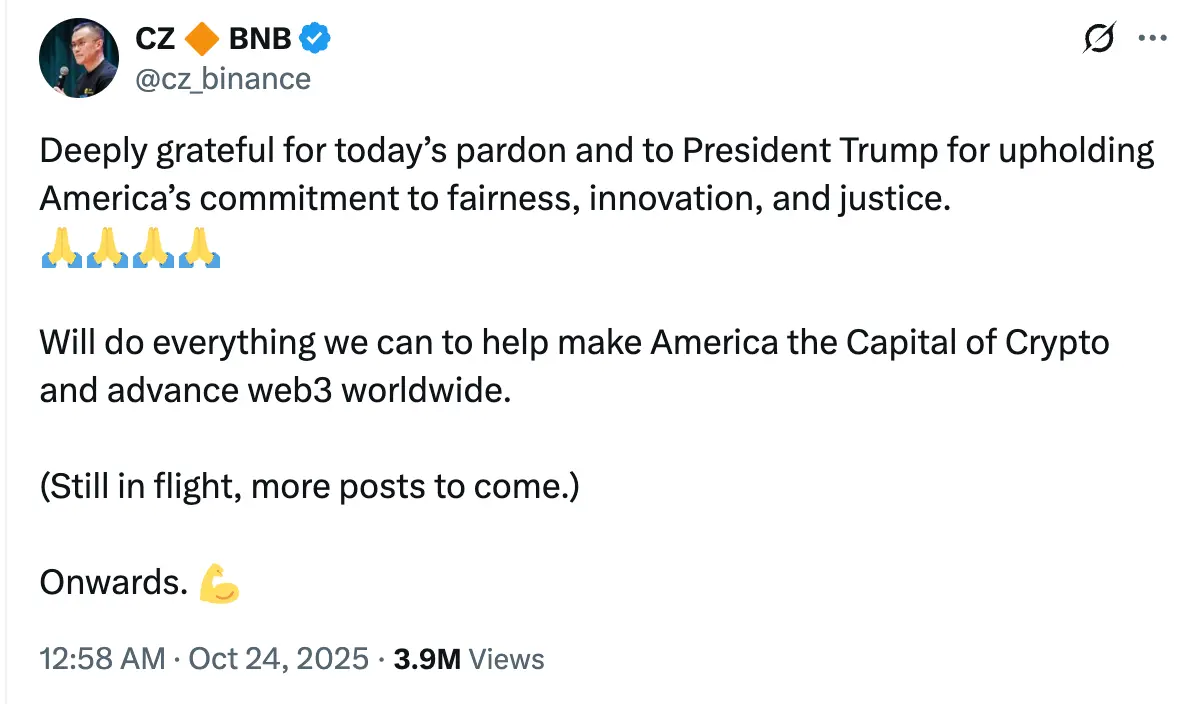
Subsequently, Binance founder CZ posted on social media expressing deep gratitude for the pardon received today and for President Trump's commitment to fairness, innovation, and justice in the U.S. He stated he would do everything possible to help the U.S. become the capital of cryptocurrency and promote the development of Web3 globally.

Related Image
 Risk warning Risk warning