Why can some coins surge without any income?
 Core Viewpoint

 The author proposes an insightful framework that divides the crypto world into two camps: "utility-based crypto" and "narrative-based crypto." The two mutually reinforce each other, together forming a dual driving force of the crypto ecosystem.
Original Title: narrative crypto vs usable crypto
Original Author: @yashhsm
Compiled by: Peggy, BlockBeats
Editor's Note: In the waves of the crypto world, we are often swept up by various narratives and technologies, making it difficult to clarify our direction. The author of this article presents an insightful framework: dividing the crypto world into two main camps: "Narrative Crypto" and "Usable Crypto." The former drives attention through stories, while the latter drives value through products. Both are opposing yet complementary, forming a dual engine for the crypto ecosystem. Whether you are a builder or a trader, this article will help you reassess your positioning and strategy, understand how attention translates into adoption, and how narratives feed back into products.
Here is the original text:
Usable Crypto vs Narrative Crypto
I used to view the crypto world as a whole, but recently my entire perspective has shifted. Now I always divide the crypto world into two main areas, especially from the builder's perspective: Narrative Crypto and Usable Crypto.
Next, I will explain how to understand these two and how to build products or make money based on them.
Usable Crypto
These are often "the best businesses": wallets (like @phantom, @MetaMask); stablecoins (like USDT, USDC); exchanges (like @HyperliquidX, @Raydium, @JupiterExchange); launch platforms (like @pumpdotfun); bots and trading terminals (like @AxiomExchange); DeFi protocols (like @aave, @kamino, @LidoFinance), etc.
These products are truly usable and can generate substantial revenue.
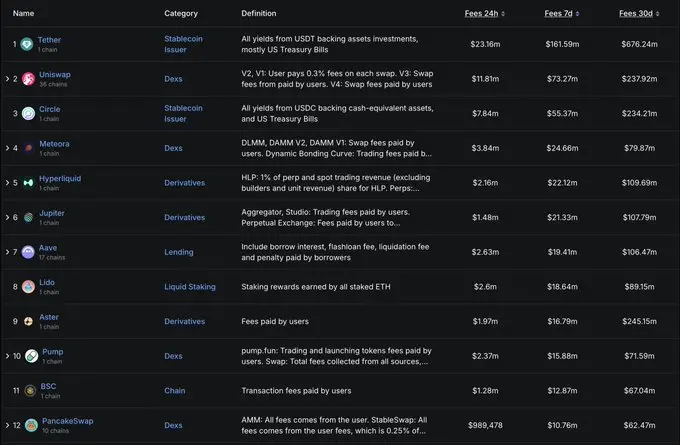
(Reference: Projects with the highest fee income in the crypto space)
Narrative Crypto
Typically has a grand story or vision (market cap of \$100 billion+), capable of changing the world: Bitcoin (the narrative of "better money" or "digital gold"); AI x Crypto (most GPU infrastructure and agent frameworks); decentralized science (DeSci) or intellectual property projects (like Story Protocol); new L1/L2 (such as stablecoin-driven L1 or perpetual contract L2); privacy coins (like @Zcash); re-staking and other infrastructure projects; x402.
These projects generate almost no revenue, but due to their strong narratives, they can attract both institutions and retail investors, driving up token prices.
The Two Are Not Mutually Exclusive, But Can Complement Each Other
For example:
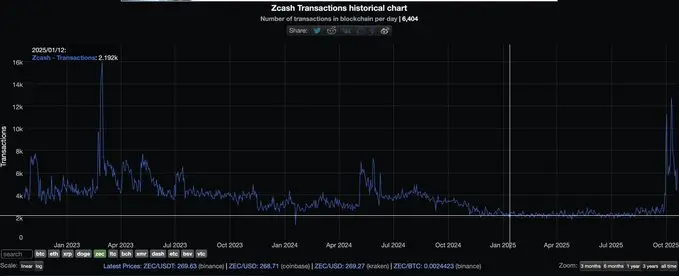
Zcash's daily trading volume is actually quite low (5-10k transactions per day), but its current "privacy" narrative is very strong, thus gaining a lot of attention. This attention may also drive its usability (refer to the recent surge in trading volume).
Another example: The x402 launched by @CoinbaseDev has almost no actual usage, but has recently become a hot topic, and speculative behavior can bring more attention and usage.
I always view this as a spectrum:
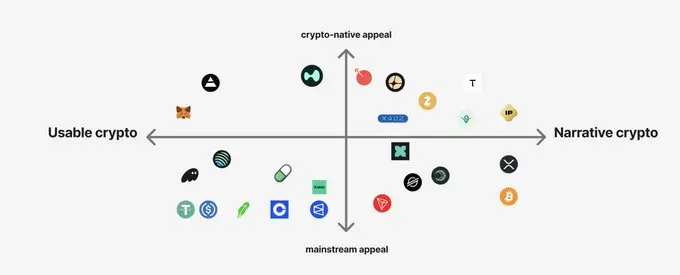
(If your logo is misplaced or missing, feel free to point it out!)
Both are equally important because they promote each other:
Narrative Crypto → Triggers speculation → Drives the adoption of Usable Crypto
In Usable Crypto, products (users) are king;
In Narrative Crypto, the community is king.
The Dilemma for Builders:
Every builder faces a question: Should I build a narrative project or a usable project?
A simple criterion:
If you are good at attracting attention and have enough charisma to initiate a movement (or you are "scammy enough"—which is actually a skill and a compliment!), then you should build a Narrative Crypto project.
For example: If you excel at tokenomics, getting listed on CEX, networking, etc., then you should focus on building a grand narrative and vision. Once the narrative is strong enough, it may also become useful—like Solana, where capital attracted talent, ultimately making the chain practical.
If you want to create a narrative with a market cap of \$1 billion+, you must start from first principles and think about what unique possibilities crypto technology can achieve.
Is this vision compelling enough? If realized, can it support a market of \$100 billion+? Is it attractive enough to retail investors? (For example, Plasma, which, although not yet in actual use, achieved a valuation of \$14 billion at TGE based on the narrative of a "\$1 trillion stablecoin market.")
If you are good at product development, then you should build a Usable Crypto project—solving a problem for a niche market (like Axiom serving memecoin traders, or a DeFi protocol).
The core of Usable Crypto is to build products that traders (or crypto natives) directly need (like terminals/exchanges) or indirectly need (like stablecoins). It does not necessarily serve only speculation; the same product can also have non-speculative uses (like stablecoins for payments).
Moreover, narratives are also important here (for example, the narrative of Polymarket is "prediction markets")—narratives are marketing.
Of course, you can also build both simultaneously, but it’s best to initially focus on one and establish a strong advantage within it. Finding your "competitive edge" is key.
For Traders:
You are always betting on narratives.
You are betting on what you believe to be the most promising narratives in the coming weeks, months, or even years.
Everyone trading tokens is actually playing a game of "attention arbitrage"—buying projects that are gaining attention and selling those that have become outdated. For example, rotating from perpetual contract coins to privacy coins, then to AI coins.
In a certain narrative, you want to bet on the teams you believe are most likely to gain attention, becoming alpha or beta projects within that narrative. If they succeed, your bets will take off.
TL;DR
Usable Crypto and Narrative Crypto are equally important aspects of the crypto world.
As a builder, you should initially choose a direction and excel in it. Once you have established a foothold in one direction, then expand into the other direction; this is the ultimate goal.
I learned all this through "trial and error" during my full-time entrepreneurial journey over the past year. I used to always have a "moderate mindset," resulting in nothing being accomplished.
But ultimately, this is a game—you must play by the market's rules.
 Risk warning Risk warning