Kill the Bluebird: Can X Chat Become Musk's "Western WeChat"?
 Core Viewpoint

 A super app that integrates communication, payment, social networking, and services. If X Chat can successfully operate independently and deeply integrate with the payment, AI, and content ecosystem of the X platform, it may become the prototype of a "Western WeChat."
Introduction: The Transformation from Twitter to X and the Birth of X Chat
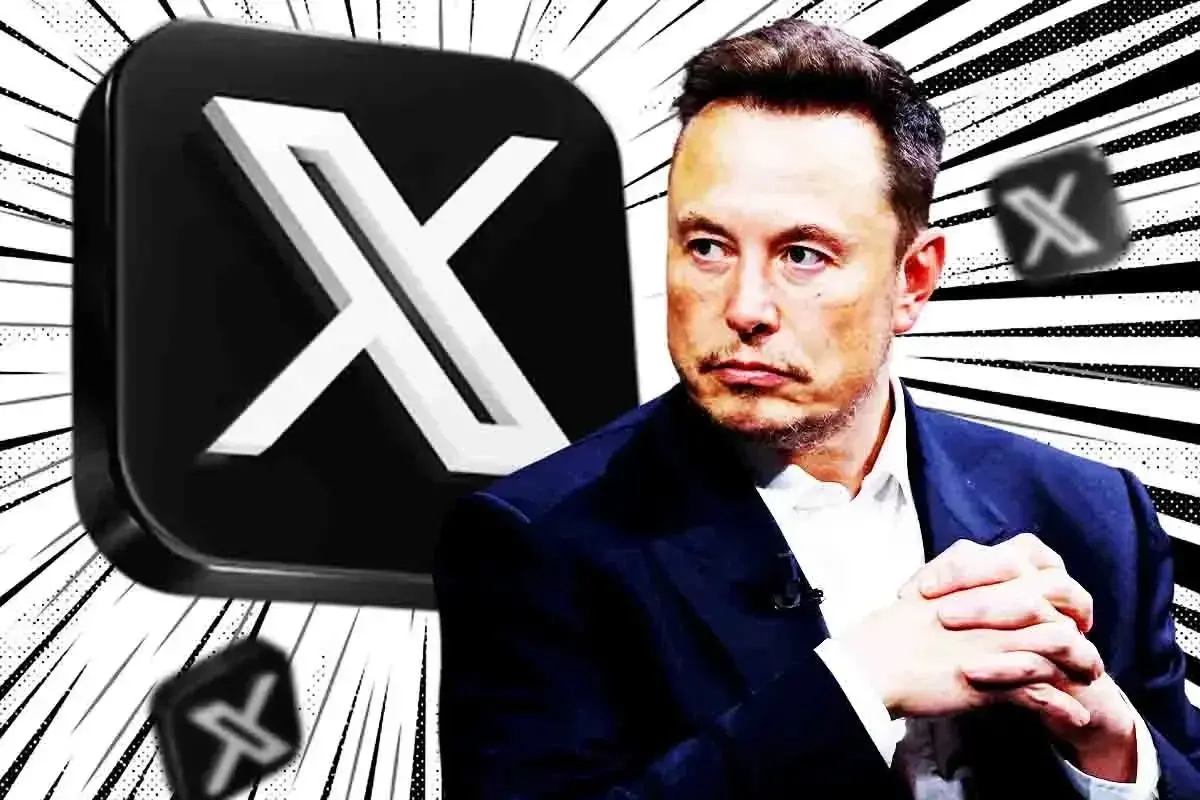
If Elon Musk were a character in a novel, his story would surely be filled with drama: a billionaire, a tech genius, an ambitious world-changer, navigating the stages of electric vehicles, rockets, and artificial intelligence.
In 2022, when he acquired Twitter for $44 billion, the latest chapter of this drama began. Twitter, once regarded as the "digital town square," became the center of global public discourse due to its 140-character limit. But under Musk's hand, within a year, this blue bird, symbolizing global public dialogue, was ruthlessly transformed into a cold black "X," a prototype of a "super app" that he claimed was "capable of anything."
Now, three years later, the birth of X Chat has become the latest footnote in this transformation—an end-to-end encrypted communication tool that embodies Musk's obsession with privacy, freedom, and technological integration, while also pushing him into direct confrontation with traditional communication giants.
But for observers on Wall Street and Silicon Valley, the real question is: Is this a communication revolution, or just another high-profile marketing ploy to cover up the X platform's struggles with advertising revenue?
I. Historical Background: Musk and Twitter/X's Love-Hate Relationship (2022-2024)
The seed of ambition was planted as early as 2017. At that time, the 46-year-old Musk, busy with his romance with "the Sea Queen," hair transplants, and saving the world, went through ups and downs to buy back the domain of his "first love company"— X.com, which grew into a towering tree that swallowed Twitter five years later.
In 2017, Musk spent a fortune to buy back the x.com domain—an asset that once belonged to his early startup X.com (which later merged with PayPal). At the time, few realized that this seemingly nostalgic move was actually a prelude to a grander plan. Five years later, when Musk began criticizing Twitter's content moderation policies, the value of this domain truly became apparent.
And the acquisition process in 2022 was itself a business thriller: Acquisition + Layoffs?
That year, Musk initially proposed to acquire Twitter at $54.20 per share, then attempted to back out, ultimately completing the $44 billion deal in October under legal pressure. So, what does this investment really mean?
If converted into aircraft carriers, this amount is enough to build 3 Ford-class carriers—considering that Ford-class carriers are among the most advanced and expensive warships in the world, with each costing as much as $13 billion. In other words, Musk spent an amount comparable to building three supercarriers when acquiring Twitter—this is the "ammunition" Musk invested in this acquisition.

After the acquisition was completed, he immediately launched what was called "the most radical corporate restructuring in Silicon Valley history": over 50% of the staff was laid off, including most of the content moderation team. The remaining employees were also required to work overtime under a "hardcore work mode." This radical management style dampened morale within Twitter but significantly reduced the company's labor costs.
At the same time, Musk introduced a "paid blue V" subscription model, hoping to achieve profitability through user payments rather than advertising revenue. However, this model sparked widespread controversy, leading to many advertisers pulling out, and Twitter's revenue plummeted.
Loose content moderation policies and algorithmic bias: Reality soon dealt Musk a heavy blow.
To attract more users, Musk relaxed content moderation policies, even restoring access to some far-right accounts. While this lenient policy brought a short-term surge in traffic, it also led to a spike in hate speech and misinformation, further driving away advertisers. By mid-2023, Twitter's brand image had taken a significant hit, and user trust had notably declined. Many well-known advertisers, including Apple and Disney, chose to "reduce or pause" their advertising on the platform, resulting in X's advertising revenue plummeting by over 50%.
From Twitter to X: Falling in love with WeChat, renaming the blue bird
In July 2023, Musk announced that Twitter would be renamed "X" and positioned as "everything app." This idea was clearly inspired by China's WeChat:
He had previously expressed admiration for WeChat in several public occasions (such as employee meetings and podcasts) and regarded it as a blueprint for X, calling WeChat an "excellent app" and a "good model" at the All-In Summit 2022.
WeChat is not only a chat tool but also a payment platform, an e-commerce entry point, and a content distribution channel. Musk hopes to create a similar super app with X, but he faces more complex challenges than WeChat. The sensitivity of Western users to privacy, strict scrutiny from regulatory agencies, and the strong power of competitors are all issues that X must confront.
Subsequently, the X platform launched video and audio calling features in the same year and began testing payment functions. More importantly, Musk integrated his AI company xAI into the X platform, laying the foundation for the later AI features of X Chat. By early 2024, X had evolved from a simple social media platform into an evolving digital ecosystem.
II. Development Context: The Evolution of X Chat from Concept to Launch (2024-2025)
Just as X platform's advertising revenue left Wall Street analysts scratching their heads, the often low-profile direct messaging feature in Musk's "digital harem" stood out. Once a supporting role, it was about to branch out and be named "X Chat."
In September 2024, Musk hinted for the first time on the X platform that the public posting and direct messaging functions would be separated, with direct messaging becoming a more secure and focused communication tool. Users could communicate privately using only X. This statement sparked endless speculation about X Chat.
On June 1, 2025, the beta version of X Chat officially launched, opening testing to a select group of users. This tool features end-to-end encryption, disappearing messages, file sharing, and audio/video calling, claiming to use a decentralized encryption architecture similar to Bitcoin. On October 20, the v0.1 version of X Chat entered public testing, attracting millions of users to try it. By the end of October, Musk officially announced plans to spin off X Chat into a standalone app, which would adopt a Bitcoin-like P2P encryption architecture and clearly stated that it would challenge traditional communication giants like WhatsApp and Signal.
Key timeline as follows:
- September 11, 2024: Musk hints at "decoupling public posting from direct messaging," allowing users to communicate privately using only X.
- June 1, 2025: X Chat beta integrated version rollout, Musk posts: "The new X Chat is launched, supporting encryption, disappearing messages, file sharing, and audio/video calls. Built on Rust, using Bitcoin-style encryption, completely new architecture."
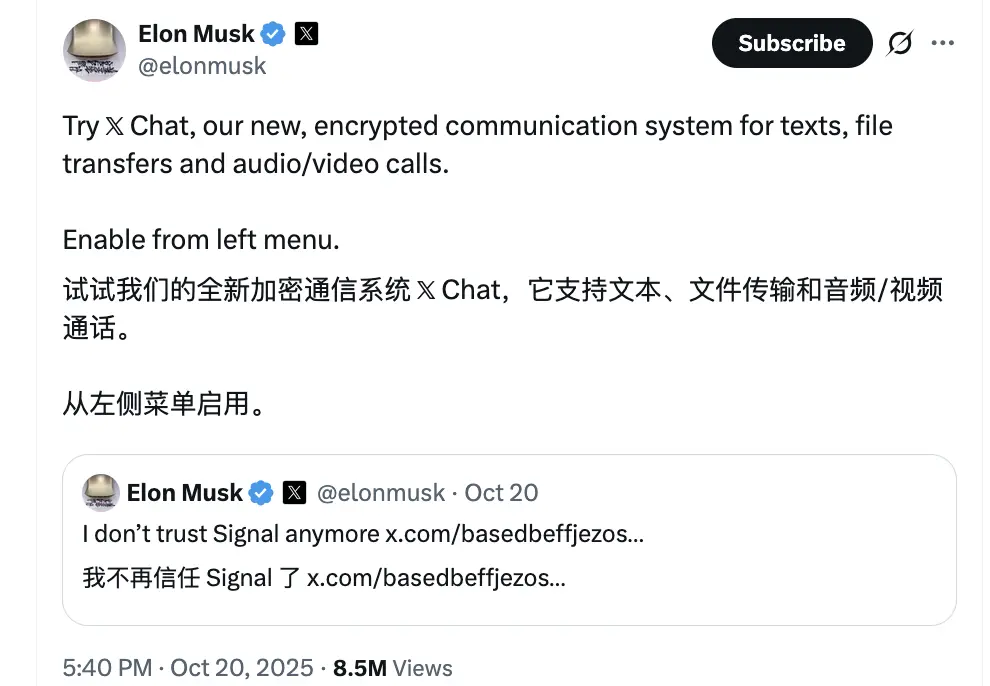
- October 20, 2025: v0.1 version public testing, Musk encourages trial: "Try 𝕏 Chat, our encrypted communication system, supporting text, file transfer, and calls. Enable from the left menu."
- October 31, 2025: Privacy feature updates, and reveals in Joe Rogan's podcast that the independent app will be launched "in the coming months," emphasizing P2P encryption and integration with Visa for payment.

Source: Youtube
III. Core Features and Technical Highlights: Privacy-First "Bitcoin-Style" Innovation
X Chat's first shield is a set of so-called "Bitcoin-like" encryption armor.
The core of X Chat lies in privacy protection, which is fully reflected in its encryption technology. It employs end-to-end encryption (E2EE), a decentralized encryption technology similar to Bitcoin, which is a 'peer-to-peer encryption (P2P)' architecture that ensures only the communicating parties can decrypt messages, and no third party can eavesdrop.

To further enhance security and operational efficiency, the development team chose the modern programming language Rust, known for its high performance and security, to reconstruct the entire communication module, thereby reducing potential security vulnerabilities. Even more surprisingly, X Chat claims not to collect user metadata—this stance is rare in the data-driven tech industry.
In terms of functionality, X Chat covers all the essentials of modern communication tools: disappearing messages allow users to set automatic destruction times for chat records; file sharing supports single file transfers of up to 2GB; audio/video calls integrate xAI's real-time voice optimization technology, ensuring low latency and high clarity. Additionally, X Chat also features seamless integration with the X platform, allowing users to share posts or media content directly in chats. This "platform + communication" model is considered a key part of Musk's "everything app" strategy.
From the perspective of observers in the encryption industry, the future release of X Chat will be more than just a product showcase; it is more like dropping a "new narrative bomb" on the entire industry. Its adoption of Bitcoin-like encryption design effectively introduces blockchain-level security standards into everyday communication tools—this move could drive more attention to privacy coins in privacy payment scenarios. More intriguingly, the built-in payment function of X Money has a subtle "chemical reaction" with the x402 payment protocol launched by Coinbase in May 2025: the former supports encrypted tipping, while the latter is designed for AI agent-driven instant micropayments.
If these two truly achieve integration, then AI-driven privacy payment scenarios will no longer be mere talk. Of course, the most direct beneficiary may still be Dogecoin—after all, in Musk's business landscape, this "Shiba Inu" has never lacked for drama.
IV. Challenges and Controversies: The Internal and External Dilemmas Facing X Chat
The path of a newcomer is never smooth: the winds and waves of reality are also significant.
Technically, although X Chat's end-to-end encryption technology has won applause from privacy advocates, its P2P architecture's stability under high concurrency scenarios remains to be tested. During the public testing in 2025, some users reported message delays and disconnection issues, raising doubts about whether it can withstand the pressure of a global user base.
In the market, X Chat faces fierce competition: WhatsApp has over 2 billion users, Signal has garnered countless fans with its privacy focus, and Telegram has established a foothold among high-freedom users with its channels, large groups, and anti-censorship features. How Musk will break through in this red ocean remains uncertain.
Perhaps the more challenging issue is trust. Since Musk took over the X platform, it has faced criticism multiple times for data privacy and content moderation issues.
Although X Chat promises not to collect metadata, user trust in Musk himself varies. Some critics sharply point out: "How can a platform that relies on advertising revenue truly prioritize privacy?" Additionally, regulatory pressure cannot be underestimated. The EU's MiCA Act and U.S. privacy legislation may pose challenges to X Chat's operational model, especially regarding data storage and cross-border transmission.
V. Future Outlook: Can X Chat Become the "Western WeChat"?
So, can this promising "newcomer" ultimately succeed in its crowning?
Musk has never concealed his envy for the WeChat model: a super app that integrates communication, payment, social, and services. If X Chat can successfully operate independently and deeply integrate with X platform's payment, AI, and content ecosystem, it may become a prototype of the "Western WeChat."
However, cultural and market differences may become roadblocks. WeChat's success relies on China's highly centralized mobile internet ecosystem and users' dependence on a single application, while Western users are more accustomed to decentralized functional applications.
Moreover, the contradiction between X Chat's privacy commitments and commercial needs has yet to be resolved: if advertising or paid features are introduced, will the platform deviate from its "privacy-first" intention? The birth of X Chat is not only a key step in the transformation of the X platform but also a bold challenge to the modern communication industry. Whether it can find a balance between privacy and functionality, and whether it can stand firm amid competition and regulation, remains uncertain.
But one thing is certain: even if Musk's blueprint cannot be fully realized, the existence of X Chat itself has already changed the rules of the game. The future communication industry may not be dominated by a single super app, but rather by fierce competition among various platforms in terms of privacy, functionality, and user experience.
Ultimately, the beneficiaries will be global users—and this may be the greatest value brought by X Chat.
 Risk warning Risk warning


Popular articles