Can the $2,000 "tariff bonus" announced by Trump really bring a liquidity feast?
 Core Viewpoint

 This bonus has no timetable, no eligibility criteria, and certainly no approval from Congress.
Original Title: A $2000 Christmas "Robbery": Trump and His Tariff Dividend
Original Author: Chain Revelation
Every Christmas, children receive gifts from a mysterious old man, and they never question the cost of the presents. Now, Donald Trump is trying to play Santa Claus in the adult world, promising to distribute a $2000 "tariff dividend" that falls from the sky, claiming the gift is paid for by distant "foreign factories." The crypto market is as excited as a group of eager children ready to unwrap their gifts. But there’s a neglected detail in this grand magic show: Before applauding that magically appearing rabbit, no one asks whose dinner it was exchanged for. And who will go hungry tonight?
I. When the President Announces Nationwide Cash Distribution: A Carnival for the Market
Source: Donald Trump
And the crypto market is precisely that diner who never cares who pays for dinner, only smelling the aroma.
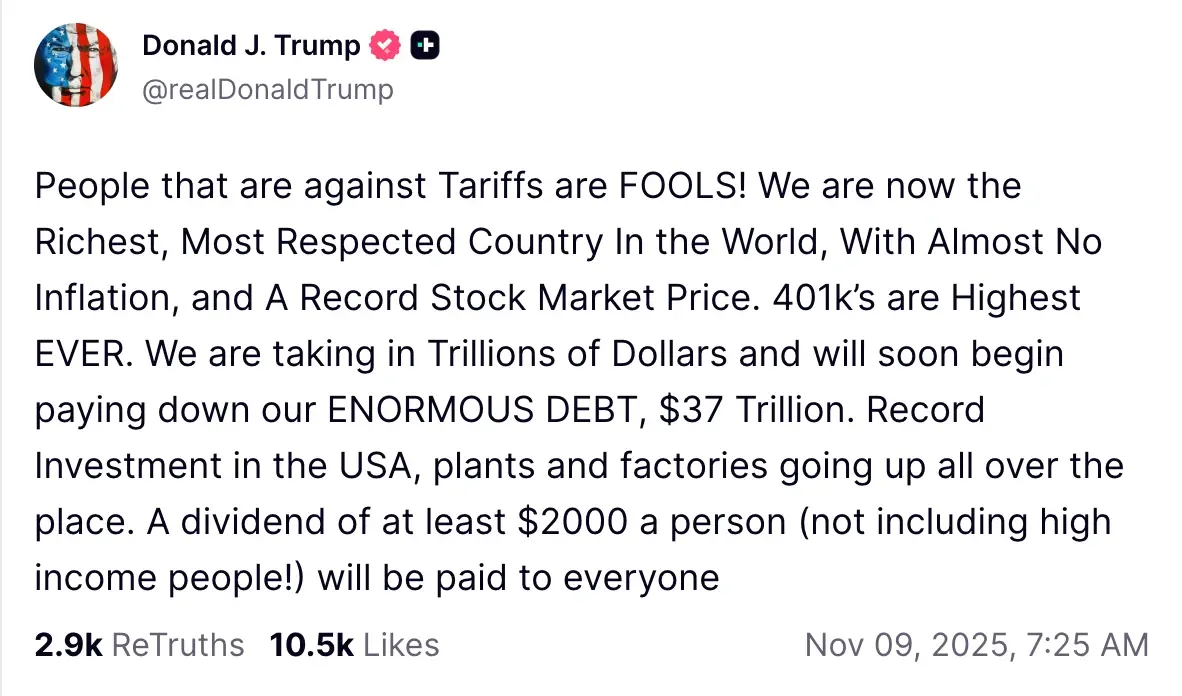
The last time they celebrated was during the pandemic stimulus checks; this time, the main course of the feast has been replaced by Donald Trump's new trick— the "tariff dividend." This 79-year-old "Santa Claus," who hurriedly "took office" more than a month early, officially announced on November 9 on his social platform Truth Social that he would distribute $2000 in cash to every low- and middle-income American. The "magic" that conjures this money is not the traditional printing press, but his beloved import tariffs.
The market's applause was thunderous and unwavering. Within minutes of the announcement, Bitcoin surged 1.75%, and Ethereum rose 3.32%. Privacy coins, such as Zcash and Monero, which are more sensitive to the "anonymous cash distribution" narrative, recorded double-digit gains. The trading volume on crypto exchanges skyrocketed, and cheers for a "new stimulus bull market" echoed on social media.
Clearly, for this excited group of "children," Santa Claus has already set off in his sleigh.
The Gift Box Opened Early: The Source of the Dividend
Trump's obsession with tariffs can be traced back to his 2016 campaign promise— "America First."
He firmly believes that high tariffs can protect American manufacturing and make foreigners pay for America's debts. After taking office, he quickly launched trade wars with economies like China and the EU, imposing high tariffs on imported steel, aluminum, and consumer goods.
This logic is simple yet dangerous: Tariffs are described as "protection fees" paid by foreigners, rather than hidden taxes borne by American consumers.
By the fiscal year 2025, U.S. tariff revenue is expected to reach $195 billion. Trump has repeatedly claimed that this revenue could be used to pay off America's $37 trillion national debt. However, economists point out that businesses simply pass the costs onto consumers, resulting in rising inflation and declining purchasing power.
But for Trump's supporters, this is a victory— "Foreigners pay, and America gets richer." This narrative has laid the political groundwork for his proposed "tariff dividend."
How is the Dividend Born?
The concept of the "tariff dividend" did not appear out of thin air; in a television interview last month, Trump hinted at plans to return a portion of tariff revenue to Americans—ranging from $1000 to $2000 per person. He claimed that this policy could generate over $1 trillion in revenue annually, enough to cover universal dividends.
On November 9, he officially announced the plan on Truth Social: "We are collecting trillions of dollars and will soon start paying off our massive debt. Everyone (excluding high-income individuals!) will receive at least $2000 in dividends."
Treasury Secretary Scott Bessent later hinted that the dividends might be distributed in the form of tax cuts. However, Trump did not provide specific details.
In other words, this glittering gift box, when opened, is empty. There is no timeline, no eligibility criteria, and certainly no nod from Congress.

According to calculations by investment analysts at the Kobeissi Letter, referencing the distribution model of past pandemic stimulus checks, approximately 220 million American adults currently qualify for this stimulus check. Formally, this sounds like a "fiscal innovation"; in essence, it is a replay of a political script. First shout the slogans, then stimulate market reactions.
The market has muscle memory. It clearly remembers that in 2020, the stimulus checks issued by the U.S. government sent Bitcoin soaring from $4000 to $69,000, creating the most frenzied bull market in crypto history. The market naturally expects "history to repeat itself," igniting the craziest party in crypto history. Now, the familiar music is playing again, and the market naturally anticipates "history to repeat itself."
But this time, the magician's trick has flaws: the party back then was fueled by the Federal Reserve printing wine out of thin air; today’s "dividend" is merely pouring some guests' wine into the glasses of others. It is not a new feast, but a mere rearrangement of taxes. Its scale and sustainability are full of questions.
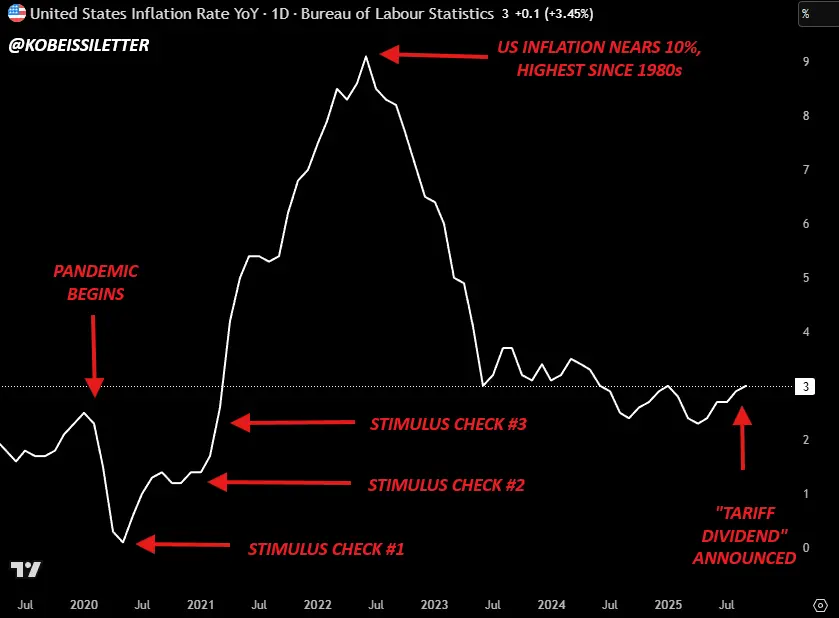
After the last round of stimulus measures, U.S. inflation approached 10%.
II. The Prepaid Carnival and Unpaid Bills: Emotion, Revelry, Illusion
The market's short-term revelry: Emotion leads, cash has yet to arrive
The crypto market always reacts quickly to stories.
Within 24 hours of the announcement, mainstream cryptocurrencies like Bitcoin, Ethereum, and Solana all surged.
"Stocks and Bitcoin will only respond to the stimulus—by rising," investor Anthony Pompliano wrote on his personal X platform after the announcement.
Bitcoin advocate Simon Dixon reminded: "If you don't invest this $2000 into assets, it will either be swallowed by inflation or used to pay off debts, ultimately flowing back to the banks."
This statement captures the core psychology of the market: Regardless of whether the stimulus is genuinely realized, liquidity expectations are the fuel for price increases.
However, this surge resembles a psychological speculative illusion.
First, the policy has not yet received any legislative authorization. If the Supreme Court rules the related tariffs illegal, the dividend plan may be stillborn.
Second, even if implemented, it means fiscal revenue is directly distributed rather than used to reduce debt. Trump's promise of "paying off American debt with foreign money" is likely to fall flat again.
More critically, large-scale cash distribution will increase inflationary pressures, forcing the Federal Reserve to adopt a more hawkish monetary policy. At that point, liquidity will tighten, and risk assets will bear the brunt.
Industry investment analysts warn that while some dividend funds will flow into the market, pushing asset prices higher, the long-term consequence will be fiat currency inflation and declining purchasing power.
Predicting Market Games: Kalshi vs. Polymarket
Behind the fervent emotions, a legal battle is underway. The U.S. Supreme Court is currently reviewing the legality of the tariffs. As of November 10, according to data from the decentralized prediction market Polymarket, traders give only a 23% probability that the Supreme Court will approve; on the prediction platform Kalshi, this number is even lower, at just 22%. In other words, the majority of the market is betting that the plan will ultimately be struck down by the judiciary.
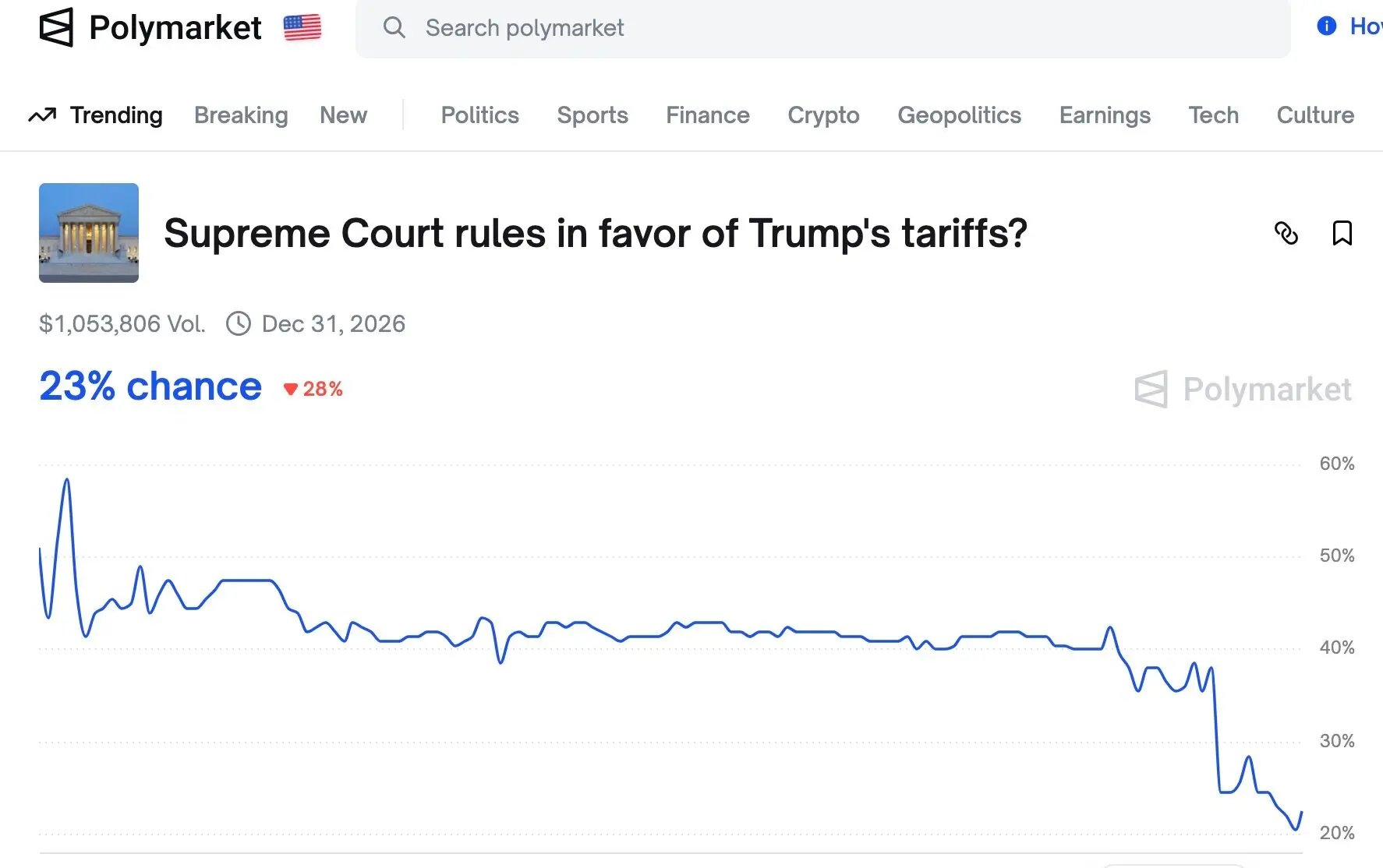
Source: Polymarket
But Trump himself is clearly a more skilled "theatrical director." He directly questioned on Truth Social:
"The President of the United States is authorized by Congress to stop all trade with foreign countries—far more severe than imposing tariffs—yet cannot levy taxes for national security purposes? What kind of logic is that?"
Look, with just one sentence, he cleverly reframed a dull controversy into a political drama about "sovereignty."
This dramatic strategy is second nature for someone who once made a cameo in the Christmas classic film "Home Alone 2," guiding the young protagonist on how to find the lobby.
III. Behind the Christmas Candy: A Cavity Called "Inflation."
In other words, behind the short-term revelry lies a familiar script, with the director unchanged, leaving the problems for the next actor.
The "tariff dividend" is carefully packaged as a Christmas gift, but it resembles a piece of Christmas candy that melts in your mouth; after the sweet taste (short-term stimulus), what remains is the difficult-to-treat cavity of "inflation."
The $195 billion in revenue from tariffs, compared to the $37 trillion national debt, is like using a coin to fill a swimming pool. Distributing that coin directly is akin to using future money to buy present applause.
The short-term political popularity gained comes at the cost of long-term fiscal risks. Economists warn that this policy could create "double inflation": tariffs raise costs, and dividends stimulate demand, like pressing the gas and brake pedals simultaneously on a car already speeding, ultimately leading to engine overheating and disaster.
Geopolitical aspects cannot be ignored either. This noisy family party may also attract complaints or even retaliation from neighbors (other countries). As the snowball of trade wars begins to roll again, the windows of the global supply chain will rattle, especially for the crypto mining industry that relies on global chips; this is akin to a snowstorm.
In other words, behind the short-term revelry lies a familiar script. Santa Claus has merely stuffed a bill marked "inflation," "deficit," and "trade war" into next year's Christmas stocking.
IV. The Last One to Leave the Table Pays the Bill

In this grand political drama, Santa Claus Trump has prepared a special gift not only for the ordinary people but also for the crypto world. When he announced that he would pull out $2000 for every American from that red pocket named "tariff," the entire crypto market seemed to hear the bells of Christmas Eve ringing early.
Now, history's sleigh seems to be following the old track. The children in the market (retail investors) are eagerly watching the chimney, convinced that some gifts will directly drop into their crypto wallets, ushering in another "altseason."
However, every child who believes in Santa Claus must ultimately face a reality question: What is the cost of the gift?
This time, Santa Claus's gift did not magically appear in a workshop in the Arctic; he merely extravagantly maxed out the nation's credit card. This feast, totaling over $400 billion, has a bill that reads "inflation." When the heat of the holiday makes the entire room (economy) too hot, the adults (the Federal Reserve) may have to open the windows to let in a cold breeze (interest rate hikes), ending the revelry prematurely.
Thus, what lies before every crypto investor is a beautifully wrapped gift box. In the short term, it shines with the alluring glow of history repeating itself; but in the long term, the back of the box may have fine print detailing an "inflation" bill.
Is this truly a gift that can warm the entire winter, or is it a piece of candy that melts in your mouth but brings cavities? For the believers in the crypto world, choosing which story to believe will determine whether they can walk away unscathed from this feast.
The last one to leave the party pays the bill.
Recommended Reading:
$1 Billion Stablecoin Vanishes: What’s the Truth Behind the DeFi Chain Reaction?
MMT Short Squeeze Event Review: A Carefully Designed Money-Making Game
 Risk warning
 Risk warning

Popular articles