What is happening in the crypto card market with trading volumes hitting new highs while platforms are continuously exiting?
 Core Viewpoint

 The Crypto Card may seem like just a bank card, but in reality, it is one of the heaviest infrastructures in Web3.
Author: Gu Yu, ChainCatcher
In the past few weeks, the Crypto Card industry has experienced two widely impactful events.
In mid-July, the Swiss payment platform Fiat24 announced the suspension of its Crypto Top-Up feature and simultaneously halted new user account openings. As Fiat24 has long provided bank accounts, fiat currency clearing, and card issuance capabilities to wallet products, the crypto card businesses of several wallets such as SafePal, [Bitget Wallet](https://www.rootdata.com/zh/Projects/detail/Bitget Wallet?k=MTQ2Mg== "multi-chain Web3 wallet and daily financial applications"), and imToken were immediately affected. Almost simultaneously, the crypto card infrastructure platform Kulipa also announced its cessation of operations, forcing wallets like Ready and Solflare to terminate their card projects.
Looking at these two companies individually, their business adjustments alone do not sufficiently indicate an industry trend. However, when two infrastructure platforms at different stages of the Crypto Card supply chain encounter issues in a short period, it is clear that this turmoil has extended beyond the operational scope of individual companies.
What is even more intriguing is that less than six months before Kulipa ceased operations, it had just completed a $6.2 million seed round financing led by Flourish Ventures and 1kx. For a startup that is still able to attract investment from top-tier institutions, announcing a halt to operations due to debt pressure just a few months later is clearly beyond the expectations of many industry insiders.
Meanwhile, Fiat24 did not announce a cessation of operations; instead, it first closed the high-risk crypto asset top-up feature. Although these two events manifest differently, they both reflect that the Crypto Card industry is entering a new adjustment cycle.
The Chinese Market is More Widely Affected
SafePal, Bitget Wallet, imToken, and some Asian products that previously used Kulipa's infrastructure all have a large user base from the Chinese mainland, Hong Kong, and Southeast Asia. This is not a coincidence, but rather a result of the market structure of the entire Crypto Card industry over the past few years.
Compared to the mature securities accounts, banking services, and electronic payment systems in Europe and the United States, the Chinese-speaking region has consistently been one of the markets with the highest demand for stablecoin payments. For many users, crypto cards not only serve daily consumption but also act as important tools for converting stablecoins to fiat currency, cross-border payments, and fund circulation. Therefore, Crypto Card users have long been concentrated in regions where fiat currency inflows and outflows are relatively inconvenient.
Although Fiat24 is headquartered in Switzerland, its capital and customer structure clearly leans towards the Asian market. Public information shows that its investors include Asia-Pacific investment institutions such as HashKey Capital, LIF, and Redpoint China Ventures, while its partner wallets mainly include Bitget Wallet, imToken, and other products with a strong Chinese background. This means that while Fiat24's business focus is built on the European financial system, the actual trading volume largely comes from Asian users.
Therefore, when Fiat24 suspended its crypto top-up service, the Chinese-speaking market was naturally the most impacted.
At the same time, several users recently reported on the X platform that some U cards can no longer be bound to or used with WeChat Pay. Although WeChat Pay has not publicly stated the reason, and it cannot be concluded that there is a unified policy adjustment, this change at least indicates that the pressure facing crypto cards is no longer limited to issuing institutions but is beginning to extend to payment channels. When issuing institutions, partner banks, and payment channels simultaneously raise risk control standards, the user experience of Crypto Cards in the Chinese-speaking market is inevitably affected.
Crypto Card is Not a Light Asset Business
In the past few years, the impression of Crypto Cards has often been "a wallet adds a bank card," but those who have actually operated related businesses know that this is one of the heaviest infrastructures in Web3.
A Crypto Card requires multiple steps from user application to final payment, including wallets, issuing platforms, BIN sponsors, partner banks, Visa or Mastercard networks, and acquiring institutions. For users, making a purchase is just a card swipe; but for the platform, each transaction is accompanied by a series of complex processes such as fiat currency conversion, bank clearing, anti-money laundering review, risk control monitoring, and payment authorization.
This means that the operational costs of Crypto Cards are much higher than those of ordinary internet products.
Platforms not only need to bear costs for bank cooperation, international card organization fees, KYC and AML review costs, but also must maintain ongoing investments in global customer service, risk control, and compliance teams. Meanwhile, their revenue sources are relatively limited, mainly relying on card swipe fee sharing, foreign exchange conversion profits, stablecoin exchange fees, and membership service income.
When the market is growing rapidly, this model can still rely on user scale and financing support; but as the industry enters a stage of stock competition, high fixed costs begin to rapidly erode profit margins. For startups with limited scale, even obtaining financing may not support long-term operations.
Kulipa's experience is a typical case. Financing addresses short-term cash flow but cannot change the fact that the card issuance business is one that requires heavy operations, compliance, and capital investment. When transaction volumes cannot continuously cover costs, the platform ultimately still needs to face the reality of its business model.
At the same time, the regulatory environment is also changing.
With the official implementation of the European MiCA, the ongoing advancement of the Travel Rule, and global banks continuously strengthening anti-money laundering and source of funds reviews, crypto asset top-ups have gradually become the highest risk link in the entire payment chain. Therefore, compared to directly stopping card services, suspending Crypto Top-Up often becomes the preferred choice for issuing platforms to control risks, which is also an important context for Fiat24's initial adjustment of its crypto top-up business.
Crypto Cards may seem like just a bank card, but in reality, they are one of the heaviest infrastructures in Web3.
The Industry is Not Cooling Down, but Concentrating Towards the Leaders
If we only look at events like those involving Fiat24 and Kulipa, it is easy to conclude that the Crypto Card industry is beginning to cool down. However, data from Paymentscan presents a different picture.
Data shows that since the end of 2023, the monthly consumption scale of Crypto Cards has almost maintained unilateral growth, increasing from less than $10 million to $725 million in July 2026, expanding hundreds of times in less than three years. This indicates that the demand for stablecoin payments has not disappeared due to infrastructure adjustments; rather, it continues to expand.
What has truly changed is the market structure.
Currently, RedotPay has reached a monthly transaction volume of $382 million, accounting for more than half of the entire market; EtherFi and KAST have reached $96.95 million and $88.21 million, respectively. The top three platforms collectively contribute nearly 80% of the transaction volume, while the market share of more small and medium-sized issuing platforms is rapidly declining.
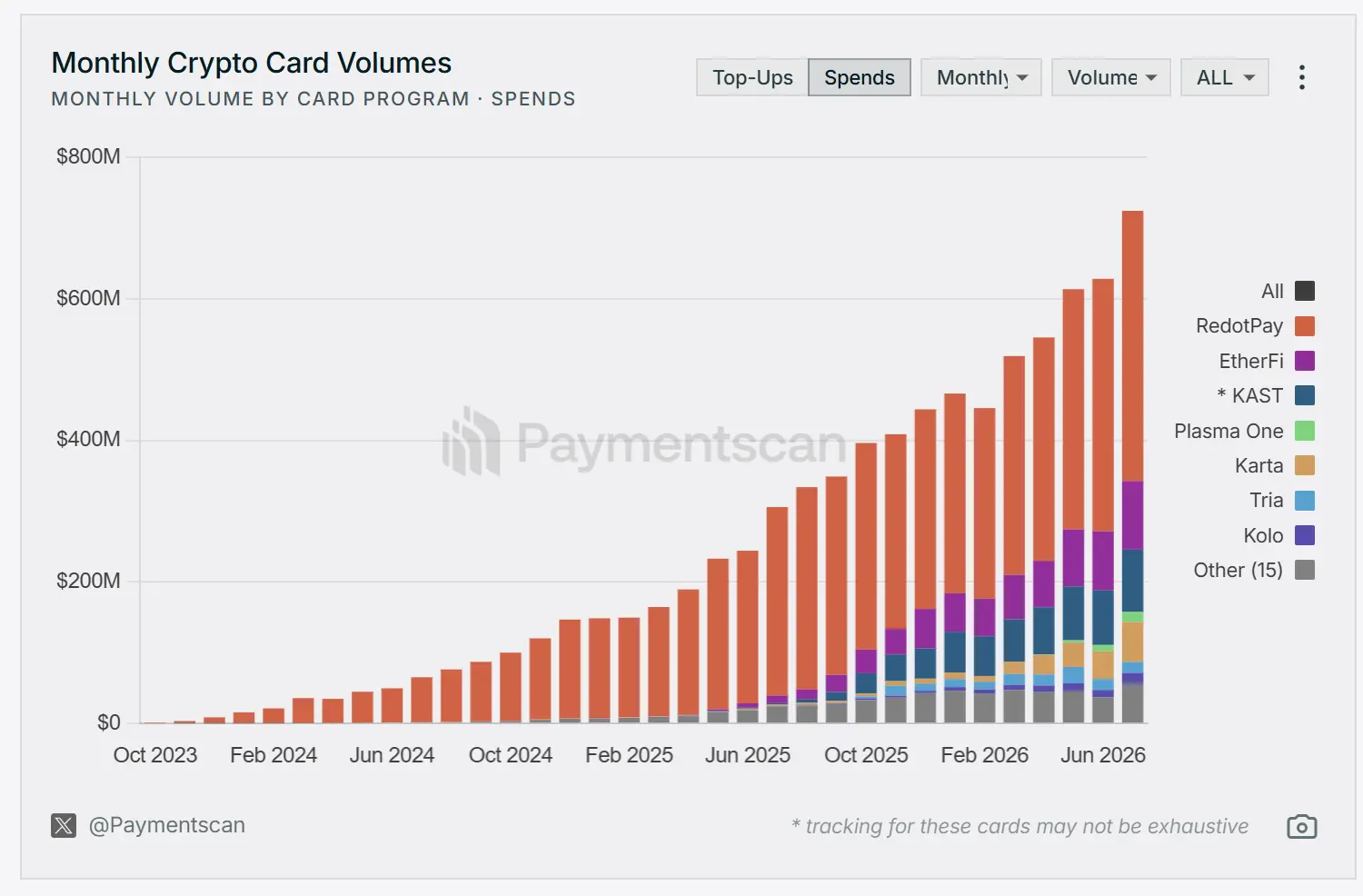
This trend is also reflected in recent data. According to Paymentscan statistics, platforms affected by these events, such as Ready, SafePal, Bitget Wallet, and Solflare, have all seen significant declines in transaction volumes over the past 30 days, with Ready experiencing a drop of nearly 70%; meanwhile, platforms like Wirex One, EtherFi, and Exa have maintained growth, with Wirex One's transaction volume increasing more than 11 times in the past 30 days.
In other words, Crypto Cards have not entered a recession; rather, they are undergoing a typical industry consolidation. Users have not left this product but are continuously migrating to platforms with more stable underlying capabilities and more mature services.
Looking at the longer term, what has exited or contracted over the past year is not the users or the demand for stablecoin payments, but rather a set of Crypto Card business models that were rapidly built over the past few years.
This model was established against the backdrop of rapid growth in stablecoins, the opening of global payment networks, and the continuous expansion of cross-border financial cooperation, allowing for quick connections between wallets, banks, and card networks in a short time. However, as regulations tighten, bank risk controls tighten, and operational costs continue to rise, this model that once supported the industry's rapid development is also beginning to face reality checks.
Therefore, Fiat24 and Kulipa may not necessarily be the last companies to exit; they are more like the earliest signals of this round of industry adjustment: the crypto card payment industry will ultimately return to the most traditional competitive logic of the financial industry: trust, compliance, and sustainable operational capability.
 Risk warning



Popular articles