Bloomberg: $1.3 Billion Paper Loss, Is Tom Lee's Ethereum Bet Facing Collapse?
 Core Viewpoint

 Tom Lee's Ethereum enterprise treasury experiment has encountered setbacks, and Bitmine has suffered a loss of 1.3 billion dollars.
Original Title: Tom Lee's Big Crypto Bet Buckles Under Mounting Market Strain
Original Author: Sidhartha Shukla, Bloomberg
Original Translation: Chopper, Foresight News
Ethereum's corporate treasury experiment is heading towards collapse in real time.
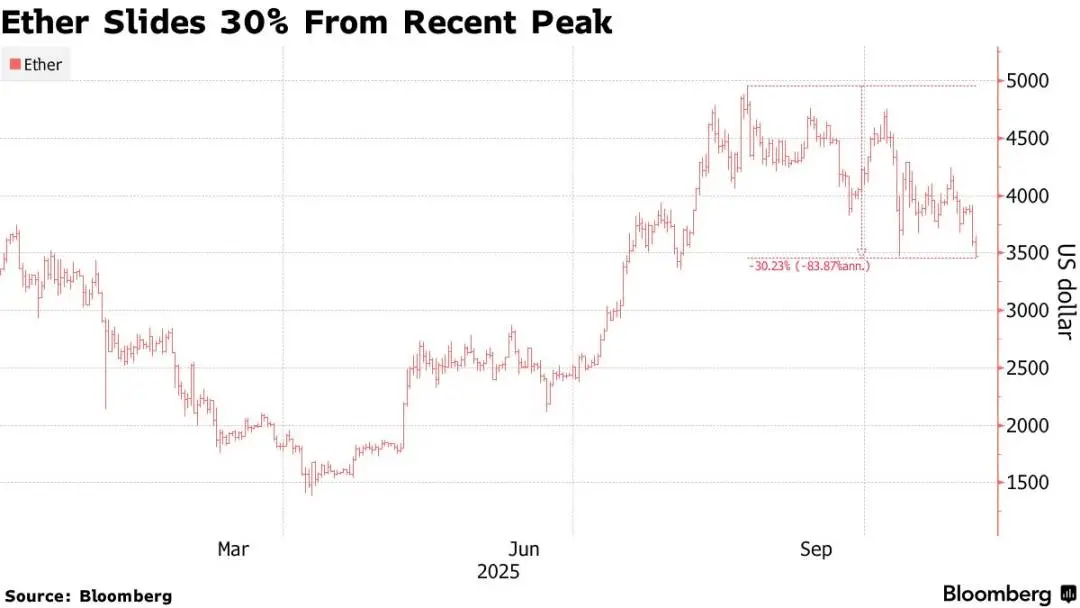
The world's second-largest cryptocurrency fell below $3,300 on Tuesday, declining in tandem with the market benchmark Bitcoin and tech stocks. This drop has brought Ethereum's price down 30% from its August peak, returning to levels prior to large-scale corporate buying, further solidifying its entry into a bear market.
According to data from research firm 10x Research, this reversal has left Ethereum's most aggressive corporate supporter—Bitmine Immersion Technologies Inc.—facing a paper loss of over $1.3 billion. The publicly traded company, backed by billionaire Peter Thiel and led by Wall Street forecaster Tom Lee, has adopted a strategy mimicking Michael Saylor's Bitcoin treasury model, purchasing 3.4 million Ethereum at an average price of $3,909. Now, Bitmine's capital reserves are fully deployed and facing increasing pressure.
10x wrote in its report: "For months, Bitmine has dominated the market narrative and capital flows. Now that its capital is fully deployed, it faces a paper loss of over $1.3 billion, with no excess funds available."
The report noted that retail investors who bought Bitmine shares at a premium to net asset value (NAV) have suffered even greater losses, and the market's willingness to "catch falling knives" is limited.
Lee did not immediately respond to a request for comment, nor did a representative from Bitmine.
Bitmine's bet is far from a simple balance sheet trade. Behind the company's accumulation is a grander vision: that digital assets can transition from speculative tools to corporate financial infrastructure, thereby solidifying Ethereum's position in mainstream finance. Supporters believe that by incorporating Ethereum into the asset portfolios of publicly traded companies, businesses will help build a new decentralized economy. In this economic system, code replaces contracts, and tokens serve as assets.
This logic fueled the summer rally. Ethereum's price once approached $5,000, and in July and August alone, Ethereum ETFs attracted over $9 billion in inflows. However, following the crypto market crash on October 10, the situation reversed: according to data compiled by Coinglass and Bloomberg, Ethereum ETFs saw outflows of $850 million, and open interest in Ethereum futures decreased by $16 billion.
Lee had predicted that Ethereum would reach $16,000 by the end of this year.
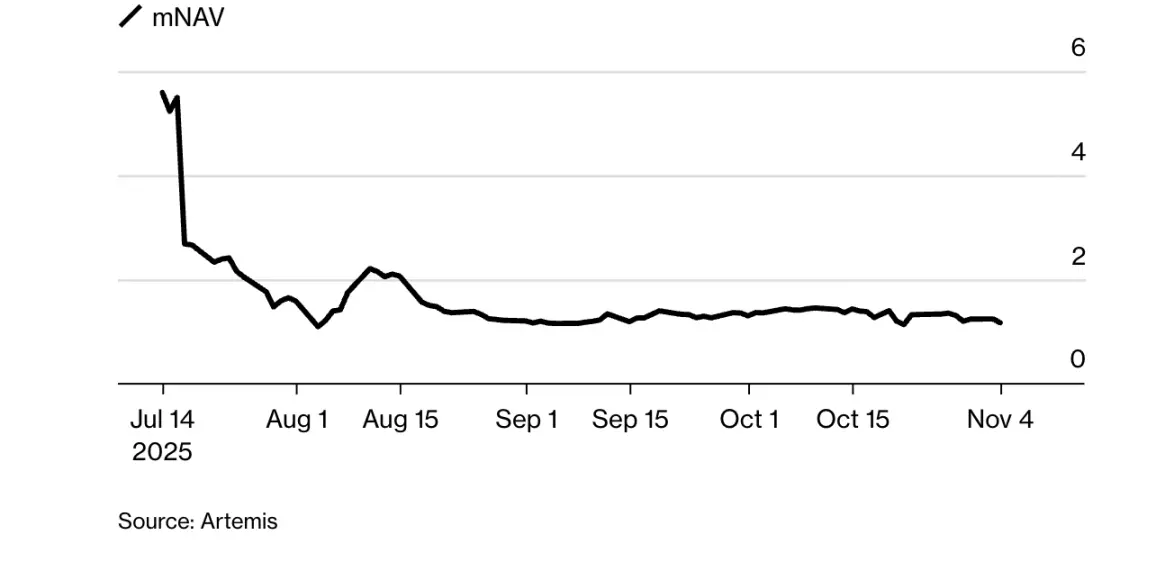
Bitmine's net asset value (mNAV) premium has fallen
According to Artemis data, Bitmine's market capitalization to net asset value multiple has plummeted from 5.6 in July to 1.2, with its stock price down 70% from its peak. Similar to previously Bitcoin-related companies, Bitmine's stock price is now closer to its underlying asset value, as the market reassesses the previously inflated valuations of crypto asset balance sheets.
Last week, another publicly traded Ethereum treasury company, ETHZilla, sold $40 million worth of Ethereum holdings to repurchase shares, aiming to bring its adjusted net asset value (mNAV) ratio back to normal levels. The company stated in a press release at the time: "ETHZilla plans to use the proceeds from the remaining Ethereum sales for further stock buybacks and intends to continue selling Ethereum to repurchase shares until the discount relative to net asset value normalizes."
Despite the price drop, Ethereum's long-term fundamentals appear to remain strong: its on-chain value processed still exceeds that of all competing smart contract networks, and its staking mechanism gives the token both yield and deflationary properties. However, as competitors like Solana gain momentum, ETF fund flows reverse, and retail interest wanes, the narrative that "corporates can stabilize cryptocurrency prices" is gradually losing its effectiveness.
 Risk warning Risk warning




Popular articles