1 billion dollars in stablecoins evaporated, what is the truth behind the DeFi chain explosion?
 Core Viewpoint

 In DeFi, any risk can spread downwards to five or six layers, and even cross-protocol and cross-chain transmission. If the collapse of Stream Finance is a lesson, then the outflow of one billion in stablecoin funds is definitely a warning to the market.
Author: Chloe, ChainCatcher
The market has yet to recover from the aftershocks of October 11, and another wave of the DeFi domino effect has begun.
According to stablewatch data, yield-bearing stablecoins experienced the most severe capital outflow since the collapse of Terra UST in 2022, totaling up to $1 billion in the past week. Among them, Stream Finance's xUSD alone saw an outflow of $411 million, becoming the trigger, and unexpectedly, this was not a singular event; this chain liquidation tore apart the fragile structure of the DeFi Lego stack.
Extreme Negative Returns Amidst Plummeting Collateral Values and Near 100% Utilization
The crisis was ignited on November 3, when Stream Finance suddenly announced that an external fund manager had incurred a loss of $93 million in trading, subsequently freezing all deposit and withdrawal functions. The price of xUSD plummeted from $1 to $0.43, with a market cap evaporating by over $500 million, currently struggling around $0.11. The chain reaction was instant, with Elixir's deUSD being the first to bear the brunt. As a lending partner of Stream, it held a large amount of xUSD as collateral, which saw its value evaporate by 65%, approximately $68 million USDC.
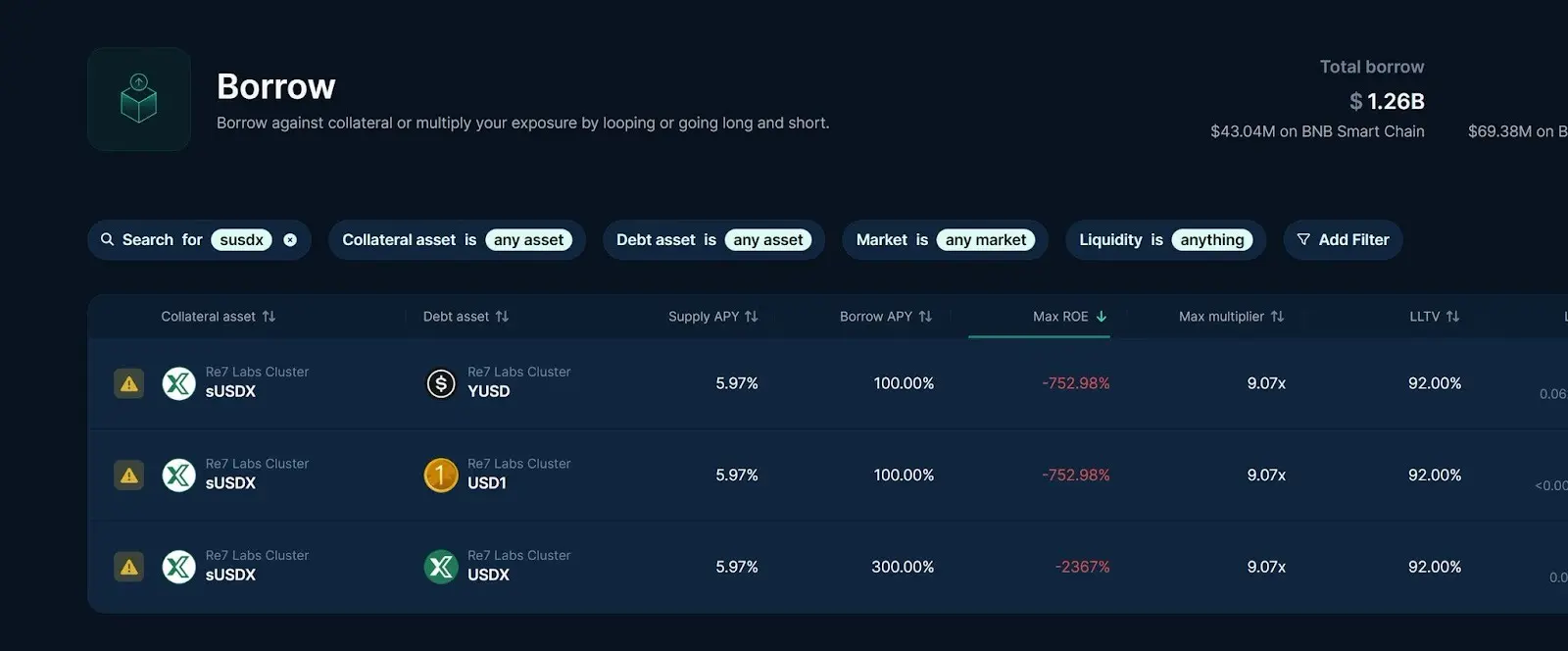
Meanwhile, the hidden market utilization rates of lending platforms Morpho and Euler soared to 95% to 100%, with borrowing rates once showing an anomalous value of negative 752%, indicating that the collateral had become a dead asset. Compound urgently closed some markets, and protocols like Silo and Treeve's scUSD also followed suit in decoupling.
Today, Elixir's official Twitter announced that the stablecoin deUSD has officially been retired and no longer holds any value. The platform will initiate a USDC compensation process for all holders of deUSD and its derivatives (such as sdeUSD). The affected range includes collateral providers on lending platforms, AMM LPs, Pendle LPs, and more. Elixir also warned users not to purchase or invest in deUSD through AMM or other channels.
This is the first time in DeFi history that a protocol has actively announced the "euthanasia" of a stablecoin. While it preserved the principal for holders, it completely ended the deUSD ecosystem. Elixir emphasized that the compensation funds come from the protocol's reserves and assets recovered from Stream, but did not disclose specific timelines or audit details. The market interprets this as a move by the protocol to "cut off the tail to survive" and avoid legal risks.
The Fundamental Cause of Stream xUSD Decoupling on October 11
To understand the root of this storm, one may need to trace back to the liquidation event on October 11. A deep dive by Trading Strategy on November 5 pointed out that the fundamental cause of Stream xUSD's decoupling was not the Balancer hack incident, but rather the failure of the Delta-neutral strategy during the historic liquidation on the 11th. Although Stream claimed to adopt a Delta-neutral hedging strategy (1:1 configuration of spot and short positions), during the extreme volatility on October 11, the exchange's automatic deleveraging (ADL) system forcibly liquidated its positions, breaking the original hedging balance. This led to a direct loss of principal for Stream, triggering the decoupling of xUSD.
Deeper issues include a severe lack of transparency (only $150 million of the $500 million TVL visible on-chain), high-risk off-chain trading strategies (including selling volatility strategies), and excessive leverage (recursive lending through Elixir). Analysis also pointed out that Stream was merely the first batch of victims to surface, and given that October 11 was an unprecedented extreme liquidation event, "it is expected that more DeFi projects will face similar explosions in the future." Little did anyone expect that just a few days later, various DeFi protocols would explode in a domino effect.
The Billion-Dollar Outflow of Stablecoins is a Major Warning for the Market
According to analysis by @cmdefi, DeFi can be divided into two models: protocol-governed and permissionless independent lending. The former, like AAVE and Spark, requires governance votes for asset listings, with the platform responsible for backing; the latter, like Morpho and Euler, has each market independently managed by Curators, often project parties or stakeholders.
The risk for Curators lies in self-established pools, allowing various assets to be listed without platform endorsement responsibility. "Problems like xUSD, or underlying issues in certain stablecoin projects, can lead to utilization rates soaring to 95%-100%, with borrowers refusing to repay at extremely high interest rates because their collateral has become worthless, making redemption impossible; no matter how high the interest, it's just a number."
Additionally, Block Mr. pointed out that this week's DeFi events remind users that although the term "isolated lending markets" suggests risks are confined to a specific pool/market, the reality is that risks can still be exposed to other asset risks due to cross-dependencies, chain infections, curators, borrowers, and structural issues.
If the Stream Finance explosion serves as a lesson, then the billion-dollar outflow of stablecoins is undoubtedly a warning to the market. In DeFi, any risk can potentially transmit downwards through five or six layers, even across protocols and chains.
Moreover, not all asset allocations of DeFi protocols are visible on-chain. The DeFi domino event may not yet be over, and for users, controlling risk should be the top priority.
 Risk warning
 Risk warning